Showing posts with label Palms. Show all posts

Saturday, 28 September 2024

Fossil pinnate Palm leaves from the Island Lagoon Flora, in the arid zone of South Australia.

Palms are an important part of the flora of the wet tropical and subtropical forests of eastern Australia, but are almost absent from the drier areas of the Australian interior, with only two species known from this area today, Livistona mariae from central Australia, and Livistona alfredii from the Pilbara region of Western Australia. Despite its large area, Australia is relatively species-poor in Palms compared with nearby landmasses, with only 54 species in 17 genera, compared to about 250 species on the island of New Guinea. 

The Palm flora of Australia contains a mixture of groups with different biogeographical regions, including Gondwanan groups, such as the Archontophoenicinae, Calamoideae, and Nypoideae, with fossil records in Australai which pre-date the Miocene, and Laurasian groups, such as Livistona spp., thought to have migrated from Southeast Asia since the Miocene, when monsoonal climates became prevalent across the region. Although of Gondwanan origin, the Archontophoenicinae are thought to have reached Australia from New Guinea in the Eocene, and subsequently dispersed from Australia to New Guinea in the Miocene. Beyond this, however, our understanding of the biogeographical origins of modern Australian Palms is severely limited by a paucity of fossils, particularly compared to the numerous fossil Palms of the Northern Hemisphere.

In a paper published in the journal Historical Biology on 25 September 2024, David Greenwood of the Department of Biology at Brandon University, and John Conran of rhe Environment Institute at the University of Adelaide, describe a new Palm species from fossil pinnate leaves from the Island Lagoon Flora for South Australia.

The Island Lagoon Flora is one of a number of ‘silcrete floras’ known the arid zone of South Australia, which produce a Plant fossils, which appear to have been species adapted to arid environments, with a smaller proportion of broad-leaved and Coniferous tree fossils. Age estimates for these floras have varied considerably since they were first recorded in the 1890s, with current estimates suggesting that different localities may reflect Eocene, Miocene, and Miocene-Pliocene assemblages. The Island Lagoon Flora is thought most likely to be of Miocene origin, probably contemporaneous with the Stuart Creek Silcrete Macroflora, though it is possible that it is older, possibly Eocene or Late Oligocene-Early Miocene.

The new Palm species is placed in the genus Phoenicites and given the specific name insula-lacuna, which is a Latin translation of 'Island Lagoon'. The species is described from two specimens, P14209 and P14467, both in the collection of the South Australian Museum. Both are incomplete portions of pinnate leaves, P14209 measuring 29.5 cm long and 27.7 cm wide, and P14467 measuring  23.9 cm long and 9.8 cm wide, with both showing at least 11 pinnae per side.

Phoenicites insula-lacuna. (A) Holotype P14209 showing whole specimen. (B) Paratype (P14467) with midvein at arrow. (C) Detail showing asymmetry of pinnae base (P14209). (D), (E) Detail of mid-pinnae showing midvein and secondary veins (P14209). (F) Rachis (P14209) showing patterned surface corresponding to ‘brown spots’ similar to those of extant Archontophoenix spp. (G) Detail of mid-pinnae with arrow showing midvein (P14467). John Conran in Greenwood & Conran (2024).

Greenwood and Conran note that there is little to differentiate the fossil genus Phoenicites from the living genus Archontophoenix, although they have chosen to use Phoenicites as the limited material available does not contain all of the diagnostic features for inclusion in the extant genus. This is a common situation in palaeontology, where all fossil species are morphospecies (species defined by their morphological appearance) rather than true biological species (which are defined by their ability to breed with other members of the species - something which fossils are incapable of doing).

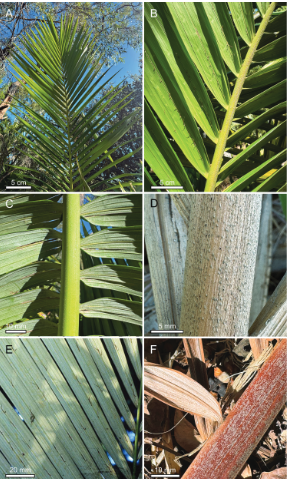
(A)–(F) Extant Archontophoenix in the Adelaide Botanical Gardens and Waite Arboretum, University of Adelaide, or in habitat ((E) only). (A), (C) Archontophoenix alexandrae, whole leaf (A) and partial view of abaxial side (B) showing pinnae with prominent veins and pinnae rachis attachment. (B), (D) Archontophoenix cunninghamiana, partial view of abaxial side showing pinnae venation and rachis attachment, and (D) rachis showing brown spots that dry as ‘tuberculae’. (E) Archontophoenix purpurea and (F) Archontophoenix tuckerii showing pinnae venation and rachis attachment. John Conran and John Dowe in Greenwood & Conran (2024).

Modern members of the genus Archontophoenix are found in wet environments, such as freshwater swamps, rainforests, under monsoonal to seasonally dry climates. This is different from the drier climate generally recorded in the silcrete floras of South Australia. However, Greenwood and Conran note that one of the environments in which these Palms are found is rainforest gullies within (dry) tall Eucalypt forests, possibly providing a setting for the other more moisture-loving Plants found in these floras.

Map of Australia showing the Island Lagoon fossil locality, other South Australian Silcrete Flora sites, the arid zone (where the annual rainfall is less than 250 mm), the extant distribution of Archontophoenix (green circles) and the two extant species of Palm endemic in the arid zone (orange squares; Livistona alfredii in Western Australia and Livistona mariae in the Northern Territory).Abbreviations: NSW, New South Wales; NT, Northern Territory; Qld, Queensland; SA, South Australia; Tas, Tasmania; Vic, Victoria; WA, Western Australia. Greenwood & Conran (2024).

See also...

Sunday, 22 March 2020

Phoenix dactylifera: Seeking the origin of the historic Judean Date Palm, using genetic analysis of germinated ancient seeds.

The Date Palm, Phoenix dactylifera, a dioecious species (in dioecious plants each individual produces either male or female flowers only) in the Arecaceae (formerly Palmae) family has a historical distribution stretching from Mauritania in the west to the Indus Valley in the east. A major fruit crop in hot and arid regions of North Africa and the Middle East and one of the earliest domesticated tree crops, archaeobotanical records suggest that the earliest exploitation and consumption of Dates is from the Arabian Neolithic some 7000 years before the present. Evidence of cultivation in Mesopotamia and Upper Arabian Gulf approximately 6700 to 6000  years before present support these centres as the ancient origin of Date Palm domestication in this region, with a later establishment of oasis agriculture in North Africa. 

The current date palm germplasm is constituted by two highly differentiated gene pools: an eastern population, consisting of cultivars extending from the Middle East and Arabian Peninsula to northwest India and Pakistan and a western population covering North Africa and sub-Saharan Africa. Introgressive hybridization by a wild relative in North African Date Palms has been proposed as a source of this differentiation.

Date palms in the southern Levant (modern-day Israel, Palestine, and Jordan), situated between eastern and western domestication areas, have historically played an important economic role in the region and were also of symbolic and religious significance. The Kingdom of Judah (Judea) that arose in the southern part of the historic Land of Israel in the 11th century BC was particularly renowned for the quality and quantity of its dates. These so-called 'Judean Dates' grown in plantations around Jericho and the Dead Sea were recognized by classical writers for their large size, sweet taste, extended storage, and medicinal properties. While evidence suggests that Judean Date culture continued during the Byzantine and Arab periods (4th to 11th century AD), further waves of conquest proved so destructive that by the 19th century, no traces of these historic plantations remained. 

In Jume 2008, Sarah Sallon of the Louis L. Borick Natural Medicine Research Center of the Hadassah Medical Organization, Elaine Solowey of the Arava Institute of the Environment at Kibbutz Ketura, Yuval Cohen and Raia Korchinsky of the Department of Fruit Tree Sciences at the Volcani Research Center, Markus Egli and Ivan Woodhatch of the Radio-Carbon Laboratory at the University of Zurich, and Orit Simchoni and Mordechai Kislev of the Mina and Everard Goodman Faculty of Life Sciences at Bar-Ilan University, published a paper in the journal Science in which they reported the germination of a 1900-year-old Date seed recovered from the historical site of Masada, a Herodian fortress overlooking the Dead Sea, built the second half of the first century BC, and destroyed in 70 AD.

(A) Ancient date seeds from Masada. (B) Germinated seedling age 3 months, showing normal development of simple juvenile leaves. Height is 15 cm. (C) Age 7.5 months, some leaves showing white patches. Height is  31 cm. (D) Age 26 months, normal seedling development with compound leaves. Height is 121 cm. Guy Eisner in Sallon et al. (2008).

In a second paper published in the journal Science Advances on 5 February 2020, Sarah Sallon, still of the Louis L. Borick Natural Medicine Research Center of the Hadassah Medical Organization, Emira Cherif and Nathalie Chabrillange of the Institut de Recherche pour le Développement at the Université de Montpellier, Elaine Solowey, still of the Arava Institute of the Environment at Kibbutz Ketura, Muriel Gros-Balthazard of the Center for Genomics and Systems Biology at New York University Abu Dhabi, and the Institut des Sciences de l’Evolution at the Université de Montpellier, Sarah Ivorra and Jean-Frédéric Terral, also of the Institut des Sciences de l’Evolution at the Université de Montpellier, Markus Egli, still of the Radio-Carbon Laboratory at the University of Zurich, and Frédérique Aberlenc, also of the Institut de Recherche pour le Développement at the Université de Montpellier, present the results of a follow-up study in which six additional ancient date seeds from archaeological sites in the Judean Desert were germinated, bringing to seven the number of ancient genotypes genetically analyzed using molecular markers. In addition, morphometric analysis (a tool used by palaeontologists, archaeologists, anthropologists and forensic pathologists to analyse and compare specimens, by taking numerous measurements of an object such as a bone or shell, and comparing both these measurements and ratios between measurements to those obtained from other specimens in order to establish relationships between them) was used to compare the size and shape of ungerminated ancient date seeds with modern varieties and wild Dates.

This study, which confirms the long-term survival of Date Palm seeds, provides a unique opportunity to rediscover the origins of a historic Date Palm population that existed in Judea 2000 years ago. The characteristics of the Judean Date Palm may shed light on aspects of ancient cultivation that contributed to the quality of its fruit and is thus of potential relevance to the agronomic improvement of modern Dates.

Of the hundreds of ancient date seeds and other botanical material recovered from excavations carried out in the Judean Desert between 1963 and 1991, 32 well-preserved Date seeds from the archaeological sites of Masada, Qumran, Wadi Makukh, and Wadi Kelt were planted in a quarantine site at Kibbutz Ketura. Of these, six ancient seeds germinated and were further identified by the following designations: Masada: 'Adam'; Qumran: 'Jonah', 'Uriel', 'Boaz', and 'Judith'; and Wadi Makukh: 'Hannah'.

Map of Judean desert sites where ancient seeds were discovered. Discovery sites are circled in red. Sallon et al. (2020).

On visual inspection, no specific observation linked the ability of these seeds to germinate compared with those that failed to germinate. Before planting, the ancient Date seeds had been weighted, and their length was measured, with the exception of those seeds from Masada, (including Adam, the germinated seed), which unfortunately were not measured. No statistically significant differences were found between germinated and ungerminated seeds in either weight or length.

Morphology of six germinated ancient Date seeds before planting. (A) Adam, (B) Jonah, (C) Uriel, (D) Boaz, (E) Judith, (F) Hannah, and (G) HU37A11, an unplanted ancient Date seed from Qumran (Cave FQ37) used as a control. Scale bars, 0.5 cm. (A) has no bar size as unmeasured before planting. Guy Eisner in Sallon et al. (2020).

Radiocarbon ages were determined for the ancient Date seeds germinated in the new study and also for the Date seed ('seed 3' or 'Methuselah') germinated in the original work. These ages were obtained from seed shell fragments found clinging to the rootlets of germinated seedlings during their transfer into larger pots (3 to 17 months of age). The values were recalculated to take into account contamination by modern carbon incorporated during seedling growth previously shown to reduce measured radiocarbon age by approximately 250 to 300 years, equivalent to 2 to 3% modern carbon. On the basis of these calculations, Methuselah, germinated in the previous study, and Hannah and Adam in the current study are the oldest samples (first to fourth centuries BC), Uriel and Jonah are the youngest (first to second centuries AD), and Judith and Boaz are intermediate (mid-second century BC to mid-first century AD).

Germinated ancient date seedlings. (A) Adam (110 months), (B) Jonah (63 months), (C) Uriel (54 months), (D) Boaz (54 months), (E) Judith (47 months), and (F) Hannah (88 months). Guy Eisner in Sallon et al. (2020).

Eighteen ancient Date seeds that failed to germinate were recovered from the potting soil and compared with modern seeds derived from 57 current date palms of which 48 are cultivated varieties and 9 are wild individuals. Ancient seeds were significantly larger in terms of both length and width (length 23.66-31.58 mm, width 9.67-11.09 mm) than both current cultivar (length 15.90-25.30, width 7.31-9.24) and wild Date Palm seeds (length 13.30-20.08, width 6.62-7.54). Ancient seeds were, on average, 27.69% wider and 38.37% longer than the combined current samples (wild and cultivated).

When only compared to the cultivars, the ancient Date seeds were still larger: 24.55% wider and 34.06% longer. However, the contrast in seed size is even more marked when comparing ancient seeds and current wild Date Palms: The Judean Date Palm seeds were, on average, 39.55% wider and 65.48% longer than current wild samples.

Analysis of seed shape diversity in current and ancient date seeds using principal components analysis performed on seed outlines confirmed visual observation that modern cultivated seeds were more diverse in size than ancient ones but similar in shape. Ancient seeds displayed an elongated shape similar to current cultivated samples.

The sex of the six germinated ancient Date seedlings in the new study were as follows: Judith and Hannah are female genotypes and Uriel, Jonah, Boaz, Adam, and Methuselah (seed 3) from the previous study are male genotypes. Through microsatellite genotyping, three levels of genetic inheritance were investigated to highlight geographic origins|: (i) inheritance transmitted by both parents to progeny, obtained by microsatellite markers showing western and eastern patterns of the ancient seed’s genomes; (ii) inheritance transmitted from mother to progeny through the chloroplast genome, reflecting maternal lineage origin by reporting chloroplastic minisatellite eastern or western alleles; and (iii) inheritance transmitted from father to son through the Y chromosome, reflecting paternal lineage origin by reporting male specific sex-linked eastern or western alleles.

Structure analysis revealed that distribution of the germinated ancient Date seeds was within previously described eastern and western Date Palm gene pools. Methuselah, Hannah, and Adam are the most eastern genotypes, although they also show ancient western contributions requiring numerous generations and highlighting ancient crosses. Boaz and Judith are the most admixed, with almost equal eastern and western contributions reflecting more recent crossings. Jonah and Uriel are the most western genotypes with the most western parental lineages.

To shed light on genetic diversity of the ancient dates, basic population genetic parameters were estimated and compared to modern reference collections. The ancient genotypes showed an allelic richness value with a relatively high diversity for such a small sample size (seven genotypes) compared to values of other countries sampled. Genetic relationships between the ancient Date and current varieties show Methuselah and Adam close to eastern modern varieties Fardh4 and Khalass, respectively, assigned to current Arabian Gulf varieties; Hannah and Judith related to modern Iraqi varieties Khastawi and Khyara, respectively; and Uriel, Boaz, and Jonah, the most western genotypes, related to modern Moroccan varieties, Mahalbit, Jihel, and Medjool, respectively.

In the new study, six ancient Date seeds, in addition to the seedling obtained in the previous study were germinated. All the seeds were approximately 2000 years old and had been previously recovered from archaeological sites in the Judean Desert, a rain shadow desert of about 1500 km² located between the maquis-covered Judean Hills and the Dead Sea.

Little is known about the mechanisms determining seed longevity; however, it has been related to the ability to remain in a dry quiescent state. Low precipitation and very low humidity around the Dead Sea could have contributed to the longevity of the ancient Date seeds, which may be an adaptation of Date Palms to extreme desert conditions fostering seed dispersion. Their remarkable durability, however, may also be connected to other extreme environmental conditions in this area; at 415 m below mean sea level, the Dead Sea and its surroundings have the thickest atmosphere on Earth, leading to a unique radiation regime and a complex haze layer associated with the chemical composition of the Dead Sea water. However, since no visible evidence in the study was linked to seed germination and, accordingly, to their long term survival, further investigations are needed to understand the basis of Date Palm seed longevity.

Among the world’s oldest cultivated fruit trees, Phoenix dactylifera is the emblematic of oasis agriculture and highly symbolic in Muslim, Christian, and Jewish religions. Closely connected to the history of Human migrations, the first cultivated varieties of Phoenix dactylifera are thought to have originated around Mesopotamia and the Upper Arabian Gulf some 6700 to 6000 before the present. In Judea, an ancient geopolitical region that arose during the 11th century BC in the southern part of the historic Land of Israel, and situated at the cross roads of Africa, Asia, and Europe, the origins of Date Palm cultivation are unknown. However, from historical records, a thriving Judean date culture was present around Jericho, the Dead Sea, and Jordan Valley from the fifth century BC onward, benefitting from an optimal oasis agriculture environment of freshwater sources and subtropical climate.

Described by classical writers including Theophrastus, Herodotus, Galen, Strabo, Pliny the Elder, and Josephus, these valuable plantations produced Dates attributed with various qualities including large size, nutritional and medicinal benefits, sweetness, and a long storage life, enabling them to be exported throughout the Roman Empire. Several types of Judean Dates are also described in antiquity including the exceptionally large 'Nicolai' variety measuring up to 11 cm.

In the new study, ancient seeds were significantly longer and wider than both modern Date varieties and wild Date Palms. Previous research has established that both fruits and seeds are larger in domesticated fruit crops compared with their wild ancestors, suggesting that the ancient seeds were of cultivated origin, most likely originating from the region’s date plantations. Furthermore, an increase in seed size has been linked allometrically to an increase in fruit size, corroborating the historical descriptions of the large fruits grown in this region.

Genotypes of the germinated ancient date seedlings cover a large part of present-day Date Palm distribution area, findings that reflect the variety, richness, and probable influences of the historic Judean Date groves. Microsatellite genotyping shows a relatively high diversity, with eastern and western gene pool contributions, allelic richness, and genetic proximity to current varieties cultivated in the Arabian Peninsula, Iraq, and North Africa. Although the sample size is small, a predominance of eastern female lineages (six of seven) indicates that eastern female varieties grown from local germplasm were probably clonally propagated from offshoots to maintain desirable fruit qualities. Male lineages, mainly western (four of five), suggest that genetically different or 'foreign' males were used for pollination. This assumption is supported by first century texts, indicating that substantial knowledge existed in ancient Judea 2000 years ago regarding the most suitable males for pollination of female Date Palms.

Sallon et al.'s results reinforce the historical narrative that a highly sophisticated domestication culture existed in ancient Judea. Local farmers with an interest in maintaining genetic diversity in their Date plantations and anthropogenic pressures leading to selection on fruit dimension and other desirable traits used cross-breeding with foreign (genetically different) males to develop a rich collection of varieties.

These findings suggest that Judean Date culture was influenced by a variety of migratory, economic, and cultural exchanges that took place in this area over several millennia.

In Israel, the oldest remains of Phoenix dactylifera are wood specimens 19 000 year old from the Ohalo II site on the Sea of Galilee. Recovery of carbonized Date seeds from Chalcolithic and Early Bronze Age sites (4500 to 2900 BC) in the Judean Desert, Jordan Valley, and Jericho, and early Iron Age sites in Israel (12th to 11th century BC) suggest that Human exploitation and consumption of Dates occurred at this time. However, it is unclear whether these samples, which are relatively few in number and of very small size, are derived from ancient wild populations, as suggested by morphometric studies of modern wild Date populations or represent an early stage of the domestication process.

In Sallon et al.'s new study, although the sample size is too small to claim a trend, on a gradient from east to west genetic contributions, the older the germinated seeds are on radiocarbon dating, the more eastern is the nuclear genome. In this respect, Methuselah, Adam, and Hannah (first to fourth centuries BC) have a predominantly eastern nuclear genome and eastern maternal lineage, their relationship to modern varieties from the Arabian Gulf and Iraq suggesting that they belong to the same eastern genetic background.

The Phoenix dactylifera cultivated by the inhabitants of Judea at that time therefore appears to be from the eastern gene pool, possibly growing locally and related to oasis populations, of which relict populations were recently found in Oman.

Elite female cultivars may also have been introduced to ancient Israel from these regions, consistent with a pattern of Human intervention and possibly active acquisition of Date palm varieties. Established trade links are documented with Arabia and the Persian Gulf from at least the 12th century BC. Babylonian Date Palm cultivation in southern Mesopotamia (most of modern Iraq), originating some 6000 before the present, used deportees from ancient Judea following its conquest in the sixth century BC. After the collapse of the Neo-Babylonian Empire, returning exiles may have brought this specialized knowledge and selected cultivars back to Judea; a Date variety 'Taali' cultivated in both Judea and Babylon is mentioned in the Talmud. 

Western genetic admixtures in the germinated seedlings and their proximity to current cultivated date varieties from Morocco also suggest that ancient Judean Date Palms were the result of germplasm exchanges with this area and of multiple crosses. Introgression of eastern genomes into western ones are common, detected in varieties from Algeria, Morocco, Mauritania, and particularly east-west junction areas like Egypt. In the latter, eastern contributions from the Persian Gulf, detected in ancient Egypt Date seeds from 1400 BC to 800 AD, reveal a chronological pattern of change in agrobiodiversity and the possible emergence of a western form in the Roman period.

Introgression of Date Palm western genomes into eastern ones, however, is far lower, their presence in the current study reflecting west to east exchanges.

The origins of these exchanges are unclear; however, archaeological evidence indicates that North Africa, Near East, and Mediterranean cultures were clearly linked during the Neolithic in the southern Levant (approximately 11 700 to 7300 years before the present) and were associated in Jericho with the earliest origins of food production and fundamental changes in human subsistence strategies.

Phoenicia, a maritime trading nation occupying the coastal areas of modern northern Israel, Lebanon, and Syria (1500 to 300 BC), was also historically associated with cultivation and trade of Date Palms. Sallon et al. speculate that later west to east germplasm exchanges to this region may have been associated with domesticated varieties originating in Phoenician City States in North African (e.g., Carthage in present-day Tunisia), where oasis agriculture appeared relatively late in the archaeological record.

The most western genotypes in Sallon et al.'s study (Uriel and Jonah) are also the youngest seeds (mid-first to mid-second AD), coinciding with established trade routes linking this region to North Africa and supporting evidence for date consumption in the latter 2000 years ago. This period coincides with Judea’s well-documented wars against Rome (66 to 73 AD and 132 to 136 AD) and deportation and displacement of its population. The ancient seeds in the current study were found in the Judean Desert, historically a place of refuge due to its steep cliffs and inaccessible caves. The loss of political autonomy and the final collapse of Judea have been postulated as causing major disruption to labor intensive practices associated with Date cultivation. Elite cultivars no longer conserved by vegetative propagation (offshoots) were gradually replaced by seedling Date Palms producing fruits displaying considerable variation within the progeny. Although Phoenix dactylifera can live for more than 100 years and date groves in this region are thought to have persisted for several more centuries, they were already rare by the 11th century and had been entirely replaced by seedling populations or feral, wild trees producing only low-quality fruit by the 19th century.

Sallon et al.'s new study study sheds light on the origins of the Judean Date Palm, suggesting that its cultivation, benefitting from genetically distinct eastern and western populations, arose from local or introduced eastern varieties, which only later were crossed with western varieties. These findings are consistent with Judea’s location between east-west Date Palm diversification areas, ancient centers of Date Palm cultivation, and the impact of Human dispersal routes a this crossroads of continents.

Given its exceptional storage potentialities, the Date Palm is a remarkable model for seed longevity research. Investigations on the molecular mechanisms involved in long-term protection in the dried state have important implications on plant adaptation to changing environments and for biodiversity conservation and seed banking. As new information on specific gene-associated traits (e.g., fruit colour and texture) is found, Sallon et al. hope to reconstruct the phenotypes of this historic Date Palm, identify genomic regions associated with selection pressures over recent evolutionary history, and study the properties of dates produced by using ancient male seedlings to pollinate ancient females. In doing so, Sallon et al. hope they will more fully understand the genetics and physiology of the ancient Judean Date Palm once cultivated in this region.

See also...

https://sciencythoughts.blogspot.com/2020/02/excavations-at-aksumite-town-of-beta.htmlhttps://sciencythoughts.blogspot.com/2019/11/eygyptologists-uncover-trove-of-new.html
https://sciencythoughts.blogspot.com/2019/10/mirabad-e-emam-qoli-sassanid-era-fire.htmlhttps://sciencythoughts.blogspot.com/2019/05/mapping-gerasa.html
https://sciencythoughts.blogspot.com/2019/02/animal-mummies-from-saqqara-necropolis.htmlhttps://sciencythoughts.blogspot.com/2019/02/sclerosperma-protomannii-sclerosperma.html
Follow Sciency Thoughts on Facebook.

Wednesday, 6 February 2019

Sclerosperma protomannii & Sclerosperma protoprofizianum: Two new fossil Palms from the Late Oligocene of northwestern Ethiopia.

Palms are an important part of the flora of most tropical environments, but are notoriously under-represented in Africa, where there are around 65 described species, compared to 437 in South America. Palms appeared during the Cretaceous, and their current diversity and biogeography is thought to be connected to a series of extinction and diversification events, though why this has left Africa with relatively few species of Palm is unclear. The genus Sclerosperma contains three living species, found in the understories of lowland tropical rainforests from Liberia to Rwanda. They typically form bushy Palms growing from a horizontal underground stem (rhizome), though one species can produce erect stems up to 9 m in height. The genus has a poor fossil record, with a few fossil leaves from the Miocene of South Kivu Province in the Democratic Republic of Congo and some pollen from the Miocene of Senegal.

In a paper published in the journal Grana on 25 October 2018, Friðgeir Grímsson of the Department of Palaeontology at the University of Vienna, Bonnie Jacobs of the Roy M. Huffington Department of Earth Sciences at Southern Methodist University, Johan Van Valkenburg and Jan Wieringa of the Naturalis Biodiversity Center, Alexandros Xafis, also of the the Department of Palaeontology at the University of Vienna, Neil Tabor, also of the Roy M. Huffington Department of Earth Sciences at Southern Methodist University, Aaron Pan of the Don Harrington Discovery Center, and Reinhard Zetter, again of the Department of Palaeontology at the University of Vienna, describe two new species of Sclerosperma, based upon pollen obtained from Late Oligocene Deposits exposed in the Guang River Valley at Chilga in the Amhara Region of northwest Ethiopia.

The Guang River exposure comprises a sedimentary sequence about 100 m thick, bounded at the bottom by a basalt layer dated to 32.4 million years ago using potassium-argon dating and at the top by an ash layer dated to 27.36 million years ago using argon-argon dating. The pollen grains described by Grímsson et al. come from a lignite (coal) layer about 30.5 m above the base of this sequence, which is estimated to be between 27 and 28 million years old on the basis of palaeomagnetic data.

Stratigraphic section, measured along the Guang River. Stars indicate stratum that produced the Sclerosperma fossil pollen, and the fossil leaf locality, CH41, is labelled and marked by a leaf icon. Radioisotopic dates are shown near the base and top of the section. Grímsson et al. (2018).

Potasium-Argon dating relies on determining the ratio of radioactive Potasium⁴⁰ to Argon⁴⁰ within minerals from igneous or metamorphic rock to determine how long ago the mineral cooled sufficiently to crystallise. Potasium⁴⁰ is often incorporated into cooling volcanic rocks, whereas any inert Argon present will escape as a gas. No further Potasium⁴⁰ or Argon⁴⁰ will enter the mineral from this point, but Argon⁴⁰ is produced by the decay of radioactive Potassium⁴⁰ at a steady rate, enabling scientists to establish a precise date for the crystallisation of the minerals containing the two elements.

Argon-Argon dating relies on determining the ratio of radioactive Argon⁴⁰ to non-radioactive Argon³⁹ within minerals from igneous or metamorphic rock (in this case volcanic ash) to determine how long ago the mineral cooled sufficiently to crystallise. The ratio of Argon⁴⁰ to Argon³⁹ is constant in the atmosphere, and this ratio will be preserved in a mineral at the time of crystallisation. No further Argon³⁹ will enter the mineral from this point, but Argon⁴⁰ is produced by the decay of radioactive Potassium⁴⁰, and increases in the mineral at a steady rate, providing a clock which can be used to date the mineral.

Palaeomagnetic dating relies on the fact that the Earth’s magnetic field undergoes periodic reversals to provide dates for strata. In deposits where iron rich minerals are able to settle slowly in liquids these will settle in alignment with the Earth’s magnetic field. Since this field reverses periodically, but irregularly, and these reversals have been mapped for many well dated deposits, these reversals can be used to date suitable deposits.

Grímsson et al. collected four samples from the lignite layer at closely spaced localities. These were treated with hydrochloric acid (HCl) and hydrofluoric acid (HF) in the laboratory, to remove any carbonates and silicates, then further treated with an oxidising agent to free any pollen.

Pollen is extremely useful to archaeologists and palaeontologists. It is resilient both and distinctive, and plants produce it in large amounts, and scatter it freely in the environment. Scientists who study pollen, called palynologists, are able to use pollen to date ancient sediments and to reconstruct the vegetation, and therefore climate, of ancient sites.

The pollen of modern species of Sclerosperma is roughly triangular, with a pattern of perforations on its surface and an aperture at the apex of one corner. The only previously described fossil material reliably assigned to the genus, from the Miocene of Senegal, conforms to this pattern but is to poorly preserved for further diagnosis.

The first new species is named Sclerosperma protomannii, meaning ‘before mannii’, in reference to the modern species Sclerosperma mannii, which it resembles. This species is described from roughly triangular pollen grains measured as 24–35 μm across with a scanning electron microscope, with up to 20 lumina (openings) per 100 μm², compared to 25 lumina per 100 μm² in the modern Sclerosperma mannii.

Light microscopy (A) and scanning electron microscopy (B)–(E) micrographs of Sclerosperma protomannii. (A) Pollen grain in polar view (upper, high focus) and equatorial view (lower). (B) Pollen grain in polar view, distal side. (C) Pollen grain in polar view, proximal side. (D) Close-up of apex with aperture, distal side. (E) Close-up of central polar area, distal side. Scale bars are 10 μm in (A)–(C), and 1 μm in (D) and (E). Grímsson et al. (2018).

The second new species is named Sclerosperma protoprofizianum, meaning ‘before profizianum’, in reference to the modern species Sclerosperma profizianum, which it resembles. The pollen of this species is triangular in polar view, but bean-shaped in profile, with a convex side and a concave side and measures 21–29 μm across with a scanning electron microscope. The grains have 50-65 lumina (openings) per 100 μm², compared to between 35 and 55 lumina per 100 μm² in the modern Sclerosperma profizianum.

Light microscopy (F) and scanning electron microscopy (G)–(J) micrographs of Sclerosperma protoprofizianum. (F) Pollen grain in polar view (high focus). (G) Pollen grain in polar view, distal side. (H) Pollen grain in polar view, proximal side. (I) Close-up of apex with aperture, distal side. (J) Close-up of central polar area, distal side. Grímsson et al. (2018).

In addition to the pollen grains Grímsson et al. describe a partial Palm leaf, collected from an ash layer 43 m above the lignite layer that produced the pollen samples (i.e. 73 m above the base of the section). This leaf comprises a leaflet (part of a divided leaf that itself resembles a leaf) attached to a rachis (leaf stem), with two other leaflets, presumed to have come from the same leaf in proximity.

Fossil leaf fragment collected at 74 m above the base of the measured Guang River section. Grímsson et al. (2018).

The leaf fragments are not preserved in sufficiently well preserved to be assigned to a species or even genus, but almost certainly come from one of two still extant families of Palms, the Arecoideae or the Ceroxyloideae. The Family Ceroxyloideae is absent from mainland Africa today, but is found in Madagascar, the Comoros Islands and Australia, so a presence in Africa in the past is not implausible. The Family Arecoideae, which includes the genus Sclerosperma, is present in Africa today, though it is not a major part of the African flora; of the four extant genera of Arecoideae on the African mainland and one on the island of Pemba (off the coast of Tanzania), the fossil leaf fragments most closely resemble those of Sclerosperma.

The ash layer that produced the leaf fragment, and the one at the top of the sequence that yielded the 27.36 million year argon-argon date, have produced a variety of Plant fossils including Ferns, Horsetails, Palms and other flora consistent with modern African forests found on seasonal floodplains, an environment consistent with that favoured by Sclerosperma today.

 An example of the modern Palm, Sclerosperma mannii, in the Forêt de la Mondah lowland rainforest of coastal Gabon. Thomas Couvreur/Palms of Africa.

See also...

https://sciencythoughts.blogspot.com/2018/11/raphia-gabonica-raphia-zamiana-two-new.htmlhttps://sciencythoughts.blogspot.com/2017/01/endothermy-in-ivory-palms.html
https://sciencythoughts.blogspot.com/2015/05/pathogenic-oomycete-chromists-from-new.htmlhttps://sciencythoughts.blogspot.com/2014/11/fossil-coryphoid-palm-leaves-from.html
https://sciencythoughts.blogspot.com/2014/11/the-impact-of-yellow-crazy-ant-on.htmlhttps://sciencythoughts.blogspot.com/2014/10/the-conservation-status-of-madagascan.html
Follow Sciency Thoughts on Facebook.

Tuesday, 13 November 2018

Raphia gabonica & Raphia zamiana: Two new species of Palms from Gabon and Cameroon.

Palms are an important component of modern tropical ecosystems, with the majority of species (~90%) restricted to tropical rainforests, where they are important understory plants. Palms reach their maximum diversity today in Asia (over 1200 species) and the Americas (about 730 species), but are much less diverse in Africa (about 65 species, less than Madagascar, which has about 200), with only one species native to Europe. Despite Palm Tree being the most familiar form of Palms, there are also climbing, shrubby, and stemless forms. The genus Raphia contains about 20 species of economically significant Palms, noted for their fibrous leaves (the largest leaves of any known Plant) used in making thatch, furniture and matting, and edible fruit. Almost all species of Raffia are found in Africa, with one species found in Central and South America, and one in Madagascar. Despite their economic significance, Raphia Palms have been little studied by botanists, largely due to their preference for swampy tropical environments.

In a paper published in the journal PhytoKeys on 6 November 2018, Suzanne Mogue Kamga of the Plant Systematic and Ecology Laboratory at the University of Yaoundé, Raoul Niangadouma of the National Herbarium of Gabon, Fred Stauffer of the Conservatoire et Jardin botaniques de la Ville de Genève and the Laboratoire de systématique végétale et biodiversité at the Université de Genève, Bonaventure Sonké, also of the Plant Systematic and Ecology Laboratory at the University of Yaoundé, and Thomas Couvreur of the Université de Montpellier and the Naturalis Biodiversity Centre, describe two new species of Raphia from Gabon and Cameroon.

The first new species described is named Raphia  gabonica, in reference to the country Gabon where it was discovered. The Palm forms a tree with a trunk 3-7 m in height and 20-30 cm in diameter, surmounted by 7-8 leaves, 8-13 m in length. Old leaf sheaths persist and hang down around the trunk, protecting and largely obscuring it. Flowers and fruit are born on pendulous rachillae up to 1.8 m in length. This Palm was found at only two locations, on hill slopes near streams in lowland rainforest in northern Ngounié Province, in Gabon, with a total known area occupied of less than 8 km². For this reason the species is considered to be Endangered under the terms of the International Union for the Conservation of Nature's Red List of Threatened Species

 Raphia gabonica in natural habitat (Alèmbé, Gabon). Notice dry land habitat, not growing in colonies, single stem with curly fibres and long pendulous inflorescences. Thomas Couvreur in Mogue Kamga et al. (2018).

The second new species described is named Raphia zamiana, where 'zamiana' derives from 'Zam' the name for these Palms in Beti, a language spoken in southern Cameroon and northern Gabon. This Palm forms trees with trunks 3-8 m high and 30-40 cm in diameter, surmounted by 10-12 leaves, 12-21 m in length. Again old leaf sheaths persist and hang down around the trunk, protecting and largely obscuring it. Flowers and fruit are born on pendulous rachillae up to 2.8 m in length. This Palm is found in the Atlantic rainforests of central and southern Cameroon, Gabon and probably Equatorial Guinea. The species is extremely abundant and widely used by local populations for its leaves which are used as a construction material, as thatch, and to make furniture, baskets and mats. Its fruit are also harvested and sold as a treatment for hypertension and diabetes. The sap of this species is collected for Palm wine, and edible Grubs are collected from it.

Raphia zamiana. Habitat along the road, with Raoul Niangadouma for scale (Oyem, Gabon). Thomas Couvreur in Mogue Kamga et al. (2018).

See also...

https://sciencythoughts.blogspot.com/2017/01/endothermy-in-ivory-palms.htmlhttp://sciencythoughts.blogspot.co.uk/2015/05/pathogenic-oomycete-chromists-from-new.html
http://sciencythoughts.blogspot.co.uk/2014/11/fossil-coryphoid-palm-leaves-from.htmlhttp://sciencythoughts.blogspot.co.uk/2014/11/the-impact-of-yellow-crazy-ant-on.html
http://sciencythoughts.blogspot.co.uk/2014/10/the-conservation-status-of-madagascan.htmlhttp://sciencythoughts.blogspot.co.uk/2013/06/three-new-species-of-palm-weevil-from.html
Follow Sciency Thoughts on Facebook.

Monday, 9 January 2017

Endothermy in Ivory Palms.

Endothermy, the biological production of heat, is familiar in Mammals and Birds, but is also found in a variety of other Animals, such as Bumblebees, some Fish and even some Snakes. It is also known in Plants, where it is usually used to warm flowers rather than the whole Plant, enhancing the emission of scent molecules used to attract pollinators. One recently discovered example of this is the Ivory Palm, Phytelephas aequatorialis, an economically important Palm species found on the western side of the Andes in Ecuador, in which the male flowers have been shown to generate heat; this is unusual as most Flowering Plants in which this behaviour has been observed have flowers with both sets of sex organs, rather than flowers with different sexes, and it is unclear if endothermy is restricted to the male flowers in the Ivory Palm, or whether it occurs in the female flowers as well.

In a paper published in the journal Frontiers in Ecology and the Environment on 1 December 2016, Sylvain Pincebourde of the Institut de Recherche sur la Biologie de l’Insecte at the Université François–Rabelais de Tours, Rommel Montúfar and Erika Páez of the Facultad de Ciencias Exactas y Naturales at the Pontifica Universidad Católica del Ecuador, and Olivier Dangles, also of the Facultad de Ciencias Exactas y Naturales at the Pontifica Universidad Católica del Ecuador, and of the Institut de Recherche pour le Développement, describe the results of an investigation into the female flowers of the Ivory Palm.

Pincebourde et al. visited the Otonga Reserve in Ecuador in February and June 2015 to look for female flowers of the Ivory Palm. The male flowers of the Ivory Palm are large and obvious, forming inflorescences over a meter in length, but the female flowers are much smaller, reaching at most 30 cm. In addition the female flowers are found in the crown of the Palms, typically more than 10 m above the ground. The Palms flower several times per year, but the male flowers are typically open for about 24 hours and the female flowers for only a few days, so that at any one time flowering trees will be widely scattered in the landscape.

The male inflorescence of endemic ivory palm (Phytelephas aequatorialis). The orange material at the top of the image is the remnants of the bud integument. Pincebourde et al. (2016).

However, the Palms are important to local communities, who use its leaves as a roofing material and its seeds to make buttons and other handicrafts, and Pincebourde et al. were able gain the help of local people in finding female flowers of the Ivory Palm.

Initial examinations of these female flowers with infrared cameras proved disappointing; the did not appear to be emitting any heat. However further examination revealed that while the mature flowers produced no heat, the female buds were as much as 10–20°C above ambient air temperature. This led Pincebourde et al. to investigate the buds of the Ivory Palm more closely, revealing that buds of both sexes maintained a constant temperature of about 37°C (comparable to the body temperature of a Mammal or Bird), in an environment where the ambient air temperature ranged between 17°C and 28°C.

Photographs (left) and thermographic images (right) of a male flower bud (top) and female flowers with the bud integument remaining at the base of the flower (bottom) taken on 9 Feb 2015 (at 18:30) and 11 Feb 2015 (at 12:10), respectively. Air temperature was 23.4°C for the male bud and 22.5°C for the female inflorescence. Three female inflorescences at different phenological stages are shown: (a) late stage, (b) senescent, and (c) recently opened. Pincebourde et al. (2016).

The production of heat by the buds of a flower is unexpected; heat in flowers is typically used to help release scent molecules to attract pollinators, but a bud, which is an unopened flower, has no need to do this, requiring a different explanation. Rapid growth can lead to the generation of heat, but this seems unlikely in the case of the Ivory Palm, where a constant temperature is maintained (unlikely if the heat is simply the product of a metabolic process) and this temperature is roughly the same in buds of both sexes, despite the fact that the male buds grow faster and larger than the females.

Local people reported that the open flowers were visited by a wide range of Insects, including a variety of Beetles and Flies. However when Pincebourde et al. monitored  Buds of the Ivory Palm of both sexes they found that they were regularly visited by a type of Stingless Bee, Trigona sp. These Bees regularly flew around the bulbs, and often settled on the buds and walked along the groves at their tops. Pincebourde et al. suggest that this species may be involved in the pollination of the flowers, possibly using the heat identify the short lived male flowers before they open, in order to enter and gain pollen, then visit the slightly longer lived female flowers to get nectar.

See also...

http://sciencythoughts.blogspot.co.uk/2015/05/pathogenic-oomycete-chromists-from-new.htmlhttp://sciencythoughts.blogspot.co.uk/2014/11/fossil-coryphoid-palm-leaves-from.html
http://sciencythoughts.blogspot.co.uk/2014/11/the-impact-of-yellow-crazy-ant-on.htmlhttp://sciencythoughts.blogspot.co.uk/2014/10/the-conservation-status-of-madagascan.html
http://sciencythoughts.blogspot.co.uk/2013/06/three-new-species-of-palm-weevil-from.html
Follow Sciency Thoughts on Facebook.

Thursday, 21 May 2015

Pathogenic Oomycete Chromists from New Zealand, Hawaii and Côte d’Ivoire.


Oomycete Chromists are Fungus-like micro-organisms which cause a wide variety of infections in plants, such as Potato Blight and occasionally animals, such as White Rots in aquarium Fish. It is also likely that many live non-pathogenic lives in soil and water ecosystems, though the ecology of the group is not well understood outside species that cause problems for agriculture. The group were formerly thought to be related to Fungi, but genetic studies have shown them to be more closely related to Brown Algae and Diatoms, and in addition has revealed a great deal of diversity within the group, with species formerly classified together on the basis that they cause similar infections now known to be only distantly related.

In a paper published in the journal Phytotaxa on 10 April 2015, BevanWeir, Elsa Paderes and Nitesh Anand of Landcare Research in Auckland, New Zealand, Janice Uchida of the University of Hawaii at Manoa and ShaunPennycook, Stanley Bellgard and Ross Beever, also of Landcare Research, describe two new species of Oomycete Chromists from New Zealand and Hawaii and Côte d’Ivoire.

Both the new species are considered to be members of ‘Phytophthora Clade 5’, which is to say the fifth group assigned to the genus Phytophthora with a common ancestry closer to one-another than to other members of the genus. This clade has until now contained only two species, Phytophthora castaneae, which infects Chestnuts in Japan and East Asia, causing a form of Trunk Rot, and Phytophthora heveae, which has been shown to cause a variety of infections in a wide range of plants.

The first new species described is named Phytophthora agathidicida, meaning ‘killer of Agathis’ after the tree it infects, Agathis australis, the Kauri Tree of New Zealand. Kauris are Araucarian Conifers which formerly dominated many lowland areas in New Zealand. They are large, slow growing trees that were heavily harvested by European settlers in the nineteenth and early twentieth centuries and now have a very limited range, with old growth trees being found only in a few protected reserves and considerable effort being put into re-introducing the species across much of its former range. In 1971 it was noticed that Kauri Trees on Great Barrier Island in the Hauraki Gulf were suffering from a form of Collar Rot which caused bleeding lesions on the trunk and roots, yellowing of the foliage and thinning of the canopy, and occasionally tree death.

Phytophthora agathidicida. (A) Kauri stand on steep ridge displaying canopy thinning—“little-leaf” syndrome. Thereis a progressive dieback of the crown in response to parasitism of the cork cambium. (B) Bleeding resin (“kauri gum”) associatedwith collar-rot of lower trunk. The advancing lesion will spread laterally, eventually girdling the tree. (C) Diffuse non-patterned, colonymorphology after 10-days incubation at 20°C in the dark. (Left to Right) Clarified V8 juice agar, MEA, CMA, and PDA.(D) Scanning electron micrograph of oogonia. (E) Oogonia with amphigynous, tapering bases. (F) Oogonia with amphigynous, sub-globose antheridia (image courtesy of M.A. Dick, Scion). (G) Differentiation of the cytoplasm within papillate sporangia into acid fuchsin stained zoospores. (H, I) Papillate, globose sporangia. Scale bars are 10 μm. Weir et al. (2015).

Colonies of Phytophthora agathidicida produce globoseoogonia 3-4 days after becoming established. These oogonia are 22.2-45.0 μm in diameter and have slightly stipuled walls. These contain oospores 19.8-35.0 μm in diameter, and can develop into new colonies (check).

The control of Kauri Dieback is currently being managed by the Ministry for Primary Industries along with the Department of Conservation, Auckland, Bayof Plenty, Northland and Waikato Regional Councils and the Tangata Whenua Roopu, with measures being taken to prevent the spread of the disease by foot traffic and infected trees being treated with phosphite.

The second new species described is named Phytophthora cocois, which derives from Cocos, the formal generic name for Coconuts. This was first detected as a disease of Coconut Palms on KauaiIsland, Hawaii, in the 1970s and has subsequently spread to the islands of islands of Oahu, Hawaii and Maui, then in the 1980s was discovered in Côte d’Ivoire in West Africa. The infection leads to rotting and early drop of the fruits and eventually death of the Palms.


Phytophthora cocois. (A) Death of young Coconut fronds is the first common symptom of this disease. The young leaves wilt, dry, and are often bent or drooping into the tree canopy. (B) Premature loss of fruits is an early sign of disease. In later stages, fruit rots become more common. Infected green fruits have characteristic “green island” black to brown rots that expand irregularly and frequently form green areas surrounded by darkened diseased tissue. (C) Internal fruit rot. (D) Colony morphology of after 10-days incubation at 20°C in the dark. (Left to Right) Clarified V8 juice agar, MEA, CMA, and PDA.(E) Scanning electron micrograph of oogonia showing reflexed antheridium. (F–G) Oogonia showing some reflexed antheridia and mildly bullate oogonium ornamentation. (H) Differentiation of the cytoplasm within papillate sporangia into zoospores. (I, J) Sporangia shape variation. Scale bars are 10 μm. Weir et al. (2015).
  
Oogonia of Phytophthora cocois are globose and measure 22.3-35.0 μm in diameter, bearing spores measuring 19.8-29.7 μm. All measures to treat Coconut Palms once they become infected have failed, with the only means of controlling infection being to remove infected trees and fallen material from these trees as quickly as possible. In parts of Hawaii this has led to the effective clearance of large areas formerly inhabited by Coconut Palms. Phytophthora cocois appears to be host specific, and does not infect any other known host.

See also…

http://sciencythoughts.blogspot.co.uk/2015/04/three-new-species-of-diatoms-from-skin.htmlThree new species of Diatoms from the skin of a West Indian Manatee.                                      Most Marine Mammals are thought to host communities of Epizoic Algae living on their skins, though these have only been extensively studied in Cetaceans (Whales and Dolphins). Two closely related genera of...
Pucciniomycote Fungi (Rusts etc.) typically produce microscopic fruiting bodies, though a few do produce larger sporocarps, typically with a basal spore producing area, with spores being expelled through some sort of structure above this. However the production of such bodies seems to be...
Toxoplasma gondii is a protozoan parasite that affects humans, and many other animals, across the globe. While it causes disease in many organisms, it reproduces only in Felids, particularly in Domestic Cats, with oocysts (egg-like cysts) being shed in Cat...
Follow Sciency Thoughts on Facebook.