Showing posts with label Shell. Show all posts

Friday, 13 May 2016

Massive oil spill off the Lousiana Coast.

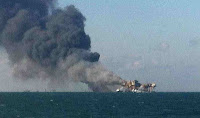
The U.S. Bureau of Safety and Environmental Enforcement has reported that 2100 barrels (333 900 litres) of crude oil has been released from a the Shell-operated Brutus Platform, located 156 km off the coast of Louisiana in the Gulf of Mexico. The oil has reportedly formed a slick 21 km in length and 3 km in width, and was first spotted by a Shell helicopter pilot, leading to operations on the platform to be halted while the cause of the leak is identified and repaired.

Oil slick off the coast of Louisiana. Rick Wilkin/Reuters.

The Brutus Platform is a processing rig receiving oil from other platforms on the Glider Oil Field and piping it to onshore facilities. This means that it is easily shut down following an incident of this kind, unlike a drilling rig which can release oil after a complete shutdown if pressure from buried oil deposits continues to force it up pipelines. However this does mean that production of oil from the Glider Field is likely to have to be severely curtailed while the problem is dealt with.

See also...

http://sciencythoughts.blogspot.co.uk/2015/04/four-confirmed-fatalities-following.htmlFour confirmed fatalities following fire on Mexican oil platform.                                      Four people are confirmed to have died following a fire on the Abkatun Permanente Oil Platform in the Gulf of Mexico on Wednesday 1 April 2015. Between 16 and 45 further people are reported to have sustained injuries (accounts from different sources vary), with two...
http://sciencythoughts.blogspot.co.uk/2013/07/burning-gas-rig-off-coast-of-louisiana.htmlBurning gas rig off the coast of Louisiana.  An oil and gas rig 95 km off the coast off Louisiana which has been burning for a day has begun to collapse into the Gulf of Mexico. The Walter Oil & Gas owned Hercules 265 jack-up rig (an oil rig that can be...
http://sciencythoughts.blogspot.co.uk/2012/11/two-feared-dead-after-explosion-on-oil.htmlTwo feared dead after explosion on oil rig in Gulf of Mexico.                                               Two workers are feared dead after an explosion on an oil rig in the Gulf of Mexico on Friday 16 November 2012. The men, described as Philippine nationals...
Follow Sciency Thoughts on Facebook.
 

Tuesday, 17 March 2015

Crude oil spill in Bayelsa State, Nigeria, blamed on poor maintenance by Shell Petroleum.

An oil spill in Bayelsa State, Nigeria, has been blamed on a poorly maintained pipeline servicing the Shell Petroleum Development Company operated Seibou Oil Well. The leak occurred in January this year, and resulted in the discharge of 549 barrels (87 285 liters) of crude oil onto the Ogboinbiri River in the Southern Ijaw Local Government Area, covering about 300 000 square meters of water and severely affecting local communities. Shell Petroleum responded by closing off the well 15 hours after the leak was reported and cordoning off part of the waterway with booms to contain the spill while the oil was recovered. However the company did not register the spill on its own oil spills registration website, which would have triggered compensation payments for local communities.

The approximate location of the January 2015 Bayelsa oil Spill. Google Maps.

A report by a Joint Investigative Visit, which included representatives of Shell Petroleum as well as representatives of the Bayelsa State Government, the Nigerian National Oil Spills Detection and Response Agency and the environmental group Environmental Rights Action/Friends of Earth Nigeria published on 13 March 2015 has concluded that the spill was caused by a dilapidated and poorly maintained pipeline.

Shell Petroleum and other oil companies operating in the Niger Delta, have in the past come under considerable criticism from Nigerian and international human rights and environmental groups for failure to report leakages and/or attributing leakages caused by poor maintenance to sabotage or criminal activity, for which it is not obliged to compensate local communities. The Nigerian government has also come under criticism, for being over reliant on expert advice from oil companies as to the cause of leakages. In the past Joint Investigative Visits have involved representatives only of the oil companies, the government and local communities, who were often poorly equipped to counter technical arguments given by the companies. The inclusion of representatives of environmental groups in such visits may indicate a tougher line being taken by the Nigerian authorities.

See also...

Exxon Mobile facility in Akwa Ibom State, Nigeria, occupied by protestors.
An ExxonMobil terminal on the Quo Iboe River in Akwa Ibom State has been occupied by protestors complaining at the oil company's failure to carry...

Gas and oil leak at Taylor Creek in Bayelsa State, Nigeria.
Members of the Ikarama community in the northeast of Bayelsa State, Nigeria, have reported that a mixture of natural gas and crude oil is leaking from an...


Exploration company claims to have struck oil off Lagos State, Nigeria. 
Nigeria is the world's fifth largest oil producer, earning over 98% of its export earnings from the sale of hydrocarbons. However the presence of oil has widely been seen as a curse as much as a blessing, with the oil producing areas of the Niger Delta having suffered numerous pollution events in the industry's...


Follow Sciency Thoughts on Facebook.


Saturday, 13 July 2013

Six Greenpeace activists climb London's Shard to protest oil drilling in the Arctic.

Six protestors from the environmental group Greenpeace have climbed The Shard building in central London in order to protest drilling in the Arctic by oil company Shell. Greenpeace are protesting a deal between Shell and Russian giant Gazprom to cary out joint exploration of the Russian Arctic for oil and natural gas. This comes after plans by Shell to begin drilling in the Alaskan Arctic were put on hold by US authorities following the grounding of an exploration rig on Sitkalidak Island. The Shard is 306 m high, making it the tallest building in London, and indeed western Europe.

Protestors from Greenpeace ascending The Shard in London on 11 July 2013. Oli Scarff/Getty Images.

The six protesters were Ali Garrigan, 27, from Nottinghamshire, Sabine Huyghe, 33, from Ghen in Belgium, Sandra Lamborn, 29, from Stockholm in Sweden, Liesbeth Deddens, 31, from Groningen in the Netherlands, Victoria Henry, 32, from London, and Wiola Smul, 23, from Poland. They approached The Shard in a specially modified van which enabled them to secure themselves inside while they extended a ladder onto the London Bridge Station's ticket hall, from where they began their ascent. The climb was split into a number of stages, each of which required a lead climber to free-climb a section of the building before attaching a rope to the building's structure, allowing the remaining climbers to follow her path. The climbers remained roped-together throughout the expedition, so there was never a risk of a fall of more than a few meters.

Once the group had reached a position 18 m bellow the peak of the building, a final ascent was made by Polish climber Wiola Smul, the youngest member of the group, who unfurled a 'Save the Arctic' banner slightly before 7.00 pm. All six protestors were arrested n suspicion of aggravated trespass when they returned to the ground, though they were later bailed.

Polish climber Wiola Smul unfurls a Greenpeace banner from the top of The Shard building. BBC.


Follow Sciency Thoughts on Facebook.

Wednesday, 3 July 2013

Magnitude 3.0 Earthquake in The Netherlands.

The Royal Netherlands Meteorological Institute recorded a Magnitude 3.0 Earthquake at a depth of 3 km beneath Groningen Province, close to the town of Loppersum, slightly after 1 am local time on Wednesday 3 July 2013 (slightly after 11.00 pm on Tuesday 2 July 2013, GMT). The quake was felt across much of the province, and is reported to have caused minor damage to buildings, though no injuries have been reported.

The location of the 3 July 2013 Groningen Earthquake. Google Maps.

The Netherlands suffers occasional Earthquakes due to the Lower Rhine Graben, an area of rifting associated with the uplift of the Alps and the collision of Africa with Europe. Essentially (and this is rather simplified) Europe to the east of the the Graben is being pushed northeastward by the northward movement of Africa. This stretches the crust and lithosphere on the Graben, causing it to thin and creating a long rift valley, which the River Rhine follows.

However this quake, and a series of smaller quakes in the Groningen area running up to it, is being widely attributed not to the Lower Rhine Graben, but to the activities of gas extraction company Nederlandse Aardolie Maatschappij (a joint venture owned 50% by Shell and 50% by Exxon Mobile), which has been extracting natural gas from beneath Groningen Province since the 1960s. The company has not sought to deny these allegations,  and has promised to take steps to protect vulnerable buildings in the area, and to find ways to extract gas without such effects. A government investigation into the industry is currently underway.

Witness accounts of Earthquakes can help geologists to understand these events, and the structures that cause them. If you felt this quake, or were in the area but did not (which is also useful information) then you can report it to the Royal Netherlands Meteorological Institute here.

See also Earthquake off the coast of HollandAn Earthquake off the coast of Margate, 8 April 2012 and Earthquake in the Netherlands. 8 September 2011.

Follow Sciency Thoughts on Facebook.

Monday, 15 April 2013

Oil spill in Bayelsa State, Nigeria.

A major spill has been reported in the Nembe Kingdom area of Bayelsa State, Nigeria, with oil covering mangrove swamps, rivers and commercial waterways. The spillage appears to have originated near to the Shell-owned Well 62, early on the morning of Friday 12 April 2013, and has affected members of the Ewelesuo Community, who report they are having difficultly in gaining access to fresh water and that local fisheries have been severely impacted.

Shell Oil facility on Nembe Creek, Nigeria. Pius Utomi Ekpei/AFP/Getty Images.

Shell has stopped production on the Nembe Creek this month, while security forces carry out a clamp-down on illegal 'bunkering operations' which siphon oil from pipelines for sale on the black market. Shell claims to lose a considerable proportion of its total production in this way in the Niger Delta , and the activity clearly has an impact on the local environment (though Shell has been accused of using the existence of the oil bunkerers as a way of covering for its own environmental misdemeanors). The oil is siphoned off by cutting into the pipelines, which criss-cross the countryside, then crudely distilling the crude in oil drums to produce a low-quality diesel sold across much of Nigeria.

Security forces have shut down a number of such operations in the area this week, and claim the spill came from a new operation, which had apparently gone wrong, saying they found a small camp with cutting equipment as well as cooking utensils, sleeping mats etc.

An illegal refinery on Nembe Creek that was raided by authorities on 22 March. Pius Utomi Ekpei/AFP/Getty Images.

Oil bunkering is a highly risky activity, the oil is highly toxic and both cutting into pipelines and the distillation process frequently result in deadly explosions. In addition the authorities are prone to (often draconian) clampdowns on the activities of oil bunkerers, and are threatening to re-introduce the death penalty for those involved in the activity.

However the sale of black-market fuel provides a means of gaining hard cash in an area that has seen little benefit from the presence of the oil companies, and where the oil is often seen as a resource that should belong to the local people, not foreign oil companies or the (fairly remote) government of Nigeria. The environmental problems caused by both legal and illegal oil operations in the Delta strongly impact upon the local economy, which is based upon small scale farming and fishing, leaving many people with no legitimate source of income, which combined with a rapidly growing population and therefore increased demand for food, makes the black market oil industry more attractive than it might otherwise seem.

A charred body near to a damaged pipeline that exploded near Ilado Village in Lagos State in May 2006, killing an estimated 200 people. Sunday Alambe/AP.

The clampdown comes following a decision by a court in Holland in January that Shell is responsible for the security of its pipelines in the Niger Delta, and that it can be held responsible for damage to the property of third parties.

The clampdown has not gone unopposed in the area. On Friday 5 April a launch carrying 15 police officers was attacked by unknown gunmen, killing 13. Responsibility for the attack has been claimed by the Movement for the Emancipation of the Niger Delta (MEND), a militant group that has carried out a number of attacks on oil companies and security forces in the Delta region since 2006, though authorities have denied this, blaming the incident on criminals instead.

Relatives of the police officers attacked in Bayelsa State waiting for news. Naij.

MEND has also issued a statement to the effect that it has blown up an oil well on Nembe Creek, though both the Nigerian authorities and Shell deny this, as do some former members of the group that have taken part in an amnesty and ceasefire. The statement claims the attacks were in retaliation for the imprisonment of Henry Okah in South Africa, for a bombing in Abuja in 2010. The group has also threatened to attack Muslim targets in Nigeria in retaliation to the activities of the militant Islamic group Boko Haram in the north of the country.

It is unclear to what extent these threats are likely to be followed up. The group has a history of violence, but has in theory been taking part in a ceasefire since 2009, with members receiving government funds as part of the amnesty deal, though there are internal divisions within the organization, and there have apparently been disputes over the distribution of amnesty money. An upsurge in activity combined with an attempt to widen the cause to include religious as well as territorial and economic issues may represent an attempt by one faction within the group to gain control.

See also Nigeria threatens Shell with US$11.5 billion in fines and compensation payments over the Bonga Oil SpillDutch court fines Shell over pollution in ther Niger DeltaPipeline explosion in Ogun State, southwest NigeriaOil barge explosion in Port of Lagos and Amnesty International reports on the 2012 Bodo Oil Spill.

Follow Sciency Thoughts on Facebook.

Wednesday, 27 March 2013

Nigeria threatens Shell with US$11.5 billion in fines and compensation payments over the Bonga Oil Spill.

The Nigerian National Oil Spill Detection and Response Agency and Nigerian Maritime Administration and Safety Agency have recommended that oil giant Shell be ordered to pay a total of US$11.5 billion over the Bonga Oil Spill, which resulted in around 40 000 barrels of oil being lost into the sea off the Nigerian coast in December 2011. This is an unprecedentedly large sum from the Nigerian agencies, which have often been accused of being to close to oil producers. Shell Nigeria has contested the amount and claims much of the oil damage was caused by a second leak from an unnamed third party vessel.

Satellite image showing the extent of the Bonga Oil Spill.  Skytruth.

The spill occurred in December 2011, when an offshore storage facility developed problems while transferring oil to a tanker. Shell estimated the loss to be slightly under 40 000 barrels, though independent agencies suggested the spill might have been three times as large. The spill was treated with dispersants, which the oil company claim prevented the oil from reaching the shore. 

However around a hundred communities in the Niger Delta region were affected by oil washing onshore during the incident, something for which Shell denies responsibility, citing a second spill from an unnamed vessel. Given the disparity between the amount of oil Shell admit to having lost and the amount independent agencies estimate was in the water, this would suggest the unnamed vessel lost around twice as much as the Shell facility, which given Shell admits to having lost the equivalent of 20% of one day's production for the entire oil-field, seems slightly improbable. 

As a result of this the Nigerian National Oil Spill Detection and Response Agency has recommended to a hearing of the Nigerian Parliament that Shell be fined US$5 billion for environmental damages and The Nigerian Maritime Administration and Safety Agency has suggested that the company pay a further $6.5 billion in compensation to communities in the affected area. It is unclear if Nigeria has the legal framework to enforce these charges, though potentially they could be pursued through the courts in other nations, particularly The Netherlands where Shell Nigeria's parent company, Shell Oil, is based.


Follow Sciency Thoughts on Facebook.

Wednesday, 30 January 2013

Dutch court fines Shell over pollution in ther Niger Delta.

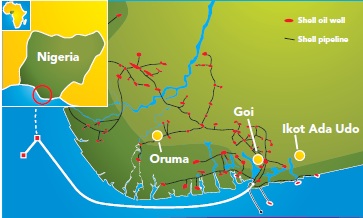
A court in the Hague ruled that the Shell Petroleum Development Company of Nigeria Ltd., a subsidiary of oil company Shell must pay compensation to a Nigerian farmer for an oil leak that damaged fish ponds in his village. The damage was caused by a leak from a disused wellhead, dubbed the 'Christmas Tree' by locals because of its shape, which sprayed oil into fishponds in Icot Ada Udo village in the Niger Delta, belonging to farmer Friday Alfred Akpan, killing his fish and rendering the ponds unusable.

 The location of Ikot Ada Udo, and other villages involved in the case. Milieudefensie/Friends of the Earth Netherlands.

The wellhead was installed in the 1960s as part of an exploratory drilling program, then capped off and effectivelly abandonded when it was decided it would not be profitable to extract oil from the site. It began to leak in the 1990s; workers from Shell coming out when called upon by villigers to cary out ad-hoc repairs. This persisted until August 2007 when the Christmas Tree began to spray oil across the village. This (unsurprisingly) lead to disagreement between the villagers and Shell Nigeria, resulting in no work being carried out until government mediators became involved, with the leak finally sealed in November 2007.

The 'Christmas Tree' in Ikot Ada Udo village. Kadir van Lohuizen/NOOR/Milieudefensie/Friends of the Earth Netherlands.

Shell did not attempt a clean-up in the village until September 2008, by which time the rainy season had come, spreading the oil into fields and fishponds and contaminating the local water suply. Shell Nigeria provided the village with a water tank and pipes, but did not compensate them for the damage to crops and fish ponds.

This prompted Milieudefensie (Friends of the Earth Netherlands), working with NGO partners in Nigeria, to file a case on behalf of Mr Akpan in the Hague against both Shell Nigeria and its Anglo-Dutch parent company, along with four other cases on behalf of villagers in the Delta which the court rejected. Shell had argued that the spill was the result of sabotage, but the court rejected this on the grounds that Shell had an obligation to make the wellhead safe agianst such actions. Milieudefensie now plan to bring actions on behalf of other villagers in Ikot Ada Udo village, and ar considering appealing the other cases. Shell is also currently facing a law suit in London on behalf of 11 000 members of the Bodo community, who were affected by a major spill in 2008.

See also Pipeline explosion in Ogun State, southwest Nigeria, Oil barge explosion in Port of LagosAmnesty International reports on the 2012 Bodo Oil SpillExplosion aboard oil vessel in Port Harcourt, Nigeria, and Oil spill in Bayelsa State, Nigeria.
Follow Sciency Thoughts on Facebook.
 

Saturday, 5 January 2013

Oil rig runs aground on Sitkalidak Island on New Years Day.

On 21 December 2012 the Shell Oil Exploration Rig Kulluk left the port of Dutch Harbor on Unalaska Island, Alaska, with the intention of reaching the port of Seattle, in Washington State. It did this despite extremely poor weather conditions, apparently to avoid paying a tax bill that would be incurred if the rig remained in Alaska on 1 January, attempting to make the voyage in winds described as 'near-hurricane force'. On 28 December the rig ran into trouble, when one of the vessels towing it, the Edison Chouest Offshore operated Anchor Handling Tug Supply Vessel Aiviq, suffered an engine failure. This lead to a loss of control of the Kulluk, which dragged the two attached vessels, the Aiviq and the Alert 16 km towards the rocks of Kodiak Island over the following four days, before a cable connecting the Aiviq to the Kulluk snapped and the struggle was abandoned to avoid the loss of the towing vessels. The vessel eventually ran aground on 500 m deep rocks of Sitkalidak Island.

The Kulluk on rocks of Kodiak Island. AP.

The United States Coast Guard has formed a unified incident command with companies involved in the salvage operation, including experts brought in from Dutch company Smit Salvage. A total of 630 people and twenty-one vessels, are said to be involved.

The Kulluk is in the Arctic as part of a Shell plan to drill for oil in the Beaufort and Chukchi Seas, a project which has provoked considerable controversy with environmental groups concerned that the rigs will not be able to operate safely in Arctic waters, and which has bee dogged by problems from the outset. In February 2012 protestors from Greenpeace occupied the Nobel Drilling vessel Nobel Discoverer, which will be forming the other part of the two-drilling rig operation. In December 2012 the Nobel Discoverer was again detained, this time by the US Coast Guard for safety reasons. A third vessel, the Arctic Challenger failed to meet seaworthiness requirements for some months. 

This new disaster has renewed calls for the US Department of the Interior to rescind Shells permits to drill in the Arctic. The event will also cost the company severely in financial terms, as it will be forced to reimburse all costs incurred by the recovery operation, as well as the original tax bill, estimated at US$6-7 million, since the vessel never made it out of Alaskan waters. 

Shell has issued no statement other than to confirm that there was no loss of life in the incident, that the rig was not leaking any oil, and that it will cooperate fully with the US Coast Guard.


Follow Sciency Thoughts on Facebook.

Sunday, 12 August 2012

Amnesty International reports on the 2012 Bodo Oil Spill.

On 21 June 2012 a leak was discovered on a Shell-owned oil pipeline in the Bodo Creek area of the Niger Delta; this was subsequently stopped on 30 June 2012. It is unclear how long the leek had been undetected. In August 2012 human rights organization Amnesty International published a report highlighting concerns about how this (and previous) leeks on Shell pipelines in the Niger Delta were investigated.

Oil leaking into Bodo Creek on 26 June 2012. Amnesty International/Centre for Environment, Human Rights and Development.

Oil spill investigations in Nigeria are (in theory) carried out by a joint team comprising representatives of the regulatory agencies, the oil company involved, the local community and the security forces. If the investigation finds that the spill was the result of sabotage, then the local community is entitled to no compensation. This provides the oil companies with a powerful incentive to establish sabotage as the result of any spills in the country, and there have been numerous allegations from both local and international agencies that oil companies, particularly Shell (the largest operator in Nigeria's oil industry), have sought to use their role as part of the investigatory body (invariably the oil company will be the best funded agency involved) to influence the outcome of investigations in favor of sabotage as an explanation.

A preliminary investigation into the oil spill on 30 June concluded that the most likely explanation is sabotage, on the basis that the leak was in the 'twelve o clock position' (i.e. at the top of the pipeline), which Shell claims is associated with sabotage. This is despite the fact that the leaking pipeline had to be excavated mechanically, and there being no sign of any previous excavations at the site, and claims by the local population that the pipeline showed clear signs of corrosion. A second investigation took place on 3 July, where Osita Kenneth, an independent engineer with more than 10 years in the pipeline industry, who was appointed by the local community to represent them in the investigation, also concluded that the leak was due to corrosion. Amnesty International has subsequently shared photographs of the pipeline with AccuFacts, a US company with over 40 years experience of inspecting oil infrastructure, who also concluded that the leak was most probably caused by erosion to the pipeline. They also noted that it was not unusual for pipes to develop leaks in the 'twelve o clock position' due to corrosion.

The joint investigation team at the site of the 2012 Bodo Oil Spill. The pipeline has been excavated using a mechanical digger. Centre for Environment, Human Rights and Development.

The pipeline after the leak had been stopped (by hammering a stick into the hole), showing apparent corrosion around the leak site. Centre for Environment, Human Rights and Development.

Amnesty International also observed that an investigation into a leak at Bodo Creek in August 2008 concluded that only 1640 barrels of oil were spilled, despite independent estimates that 1440 to 4320 barrels of oil were leaking per day, and the leak having lasted for 72 days, for a total of between 103,000 and 311,000 barrels of oil.. Amnesty has asked Shell for an explanation of this discrepancy, but to date has received no answer.

Amnesty also report on a leak at a Shell site in Batan in Delta State in 2002. On this occasion Shell initially claimed the leak was due to sabotage two days prior to the initial investigation of the site, despite the leak being under 4 m of water. An investigation of the site representatives of the company, the Nigerian military and the regulatory bodies, which included a trained diver, then concluded that the leak was the result of equipment failure, however the explanation for the leak was subsequently changed back to sabotage without explanation.

Amnesty International maintain that it is the responsibility of Shell both to maintain their pipelines and to protect them against sabotage. The network of pipelines used by the company is extremely old, with almost all of the pipelines in use past their normal expected lifetimes, often by several decades. These pipelines often run close to homes, farms and fisheries, and many people in the Niger Delta have had both their lives and their economic prospects severely blighted by leaks.

Fishermen on the Bodo Creek in 2011. The fishery has been severely depleted by repeated oil spills. Amnesty International.


Follow Sciency Thoughts on Facebook.

Friday, 24 February 2012

Greenpeace activists occupy drilling ship in New Zealand.

Early on the morning of Friday 24 February 2012 seven activists from the environmental group Greenpeace, including actress Lucy Lawless (better known as Xena the Warrior Princess) boarded the Liberian registered drilling exploration ship Noble Discoverer in the Port of Taranaki 0n North Island, New Zealand, as a protest against plans to search for oil in the Alaskan Arctic on behalf of the oil giant Shell. The ship had been chartered from its owners, Noble Drilling, after Shell was granted a license to prospect for oil in the Chukchi Sea, of the coast of Alaska, by the US Interior Department in August 2011.

Greenpeace activists atop the drilling derek on board the Noble Discoverer. Image from Greenpeace.

Greenpeace objects strongly to oil exploration in the Arctic, where ecosystems are thought to be especially vulnerable to oil spills, and where any major oil spill would be next to impossible to clean up. They point out that the cleanup operation after the blowout on the BP chartered oil rig Deepwater Horizon in the Gulf of Mexico involved over 6000 ships and managed to recover only 17% of the oil spilled. The US Coast Guard has stated that such a cleanup in Arctic waters could not be attempted.

They also point out that Arctic environments are particularly vulnerable to the threat of global warming, and that the best means to protect them would be to cease exploration for new hydrocarbons and switch to alternative forms of energy generation as quickly as possible.

The New Plymouth Police, within whose jurisdiction Taranaki falls, have described the action as illegal, but have agreed to leave the protestors, who reportedly have several days worth of supplies, in place for the time being, stating that safety is their paramount concern. Shell have expressed 'disappointment' at the Greenpeace action, which they say endangers the lives of both the protestors and the crew, and have said they have offered to discuss their plans for drilling in the Arctic with Greenpeace.

This is the second Greenpeace action against Shell this week, on Monday (21 February 2012) protestors scaled the National Gallery in London, where Shell were hosting a reception, and unscaled a 40 m² banner reading "It's No Oil Painting", also in protest against the planned Arctic Drilling.

The location of the Chukchi Sea, where Shell hope to drill for oil. AP.

Saturday, 24 December 2011

Oil spill off the coast of Nigeria.

On 20 December 2011 a routine transfer between a floating oil production, storage and off-loading vessel and a waiting oil tanker in the Bonga Field, off the coast of Nigeria, developed a problem resulting in the discharge of a large amount of oil into the sea. The operators, The Shell Exploration and Production Company (SNEPCo), a local subsidiary of the Shell global oil group, estimated the loss at under 40 000 barrels, roughly one-fifth of the Bonga Field's daily output, and the worst offshore oil spill in the Bight of Benin since 1998. SNEPCo has responded by closing down production at the Bonga Field, and deploying five ships and two aircraft to spray the spill with dispersants, chemicals which break down oil in seawater.

Satellite image of the oil spill released by the environmental group SkyTruth.

Oil spreads very thinly over the surface of the water very thinly, so a spill of 40 000 barrels ought to cover about 600 km² of ocean. However satellite images taken by the European Space Agency Envisat Satellite and released by the SkyTruth environmental group on 21 December appear to show a slick covering about 923 km², suggesting that Shell may have lost slightly more oil than they thought, and Peter Ibador of Nigeria's National National Oil Spill Detection and Response Agency (NOSDRA)has suggested that the spill could be three times as large as Shell has admitted, presenting a severe threat to wildlife and the local population. Senator Bukola Saraki, chairman of the Nigerian Senate Committee on Environment and Ecology expressed concern that NOSDRA lacks the equipment and manpower to monitor the situation, let alone combat a spill on this scale, making Nigeria dependent on the 'grace and benevolence' of the oil companies to deal with incidents of this nature.

Nevertheless by the 24th Shell appeared to be confident that they had dispersed about 50% of the oil, without calling on assistance from waiting Nigerian Navy vessels, and have been inviting senior Nigerian government officials to visit the area.

Shell has been the biggest player in the Nigerian oil industry since the 1950s, but has long suffered from a poor reputation in the area, both for weak environmental management and links to several military regimes with bad records on human rights. In August this year the United Nations Environment Program produced a detailed report into oil pollution in the Ogoniland area of the Niger Delta, as a result of which traditional leaders of the Ogoni People have lodged a court action against Shell in the US, seeking a billion dollars in compensation for past environmental damage.

Monday, 11 July 2011

Drilling for oil on the Ningaloo Reef

On the 24th of June 2011 the Ningaloo Reef, off the western coast of Australia, was granted World Heritage Site status by UNESCO, 30 years after the same status was granted to the more famous Great Barrier Reef off the eastern Australian coast. This recognizes that the reef is of universally significant interest to the international community, and binds Australia to conserve the site for the benefit of all mankind. UNESCO has a budget of US$4 million a year to help countries protect sites, though with a large number of sites in developing countries, it is hard to see any circumstance under which Australia would qualify for any financial assistance. The site was, of course, nominated by the Australian government; UNESCO does not impose heritage status upon countries. However on the 8th of July 2011 the Australian government granted permission for oil giant Shell to drill for natural gas on the reef.

The Ningaloo Reef runs for 260 km along the northwest coast of Australia. It is noted for its megafauna, such as whale sharks, dolphins, humpback whales, dugongs, manta rays and turtles. It is also home to hundreds of species of fish, mollusks, corals, sponges and other marine invertebrates.


The Ningaloo Reef

As of 2009 there were known reserves of 190 163 119 460 000 m³ natural gas worldwide. Each year the world uses 3 198 000 000 000 m³ of gas; if we continue to use gas at the current rate then these reserves should last us 60 years. It is likely that consumption of gas will rise sharply in the next few decades as oil reserves start to run low.

This potential shortage has lead countries and extraction companies to extreme measures in the hunt for new gas resources, most notable 'Fracking', more properly Hydraulic Fracturing, a process by which pressurized fluid is forced into a gas bearing shale (mudstone) bed, causing a shock wave which (hopefully) releases a quantity of gas. This process has been linked to contamination of the water table in the eastern US and a small earthquake in England; the process has become controversial and deeply unpopular, and proposals for new fracking operations regularly attract large demonstrations. South Africa has recently placed a moratorium on fracking (which is being challenged in the courts by Shell), and other countries may follow suit. In this environment it is unsurprising that companies may be interested in reserves which can be worked by more conventional means.

Shell's environmental record has not always been good; the company is generally loathed by environmental groups. In particular the companies operations in the Niger Delta, where it has become implicated in a toxic mix of environmental destruction and political corruption, have been highly damaging to the companies reputation, if not its coffers. This means that when the company's name comes up in connection with a controversial project, the feathers are bound to fly.


A Nigerian protestor at an anti-Shell rally in San Francisco, California. In the modern world problems can travel.

In a world where resources are running low, then governments may sometimes have to make difficult choices about natural resources. The Australian government has been keen to emphasize its green credentials of late, forcing through unpopular carbon taxes. Logically if a government wishes to reduce carbon emissions, then it should be trying to find alternatives to fossil fuels, something that previous Australian governments have not always been good at. However it is quite conceivable that a government trying to switch to alternative methods of energy production may find that it cannot do this rapidly enough to avoid the need for new gas sources, and be reluctant to turn to sources overseas to fill this gap, in which case it might well turn to resources in places otherwise considered off limits. However if a government does feel the need to do this then it needs to be sure that it is seen to be acting in the best interest of its people, not that of multinational corporations.

A Hawksbill Turtle on the Ningaloo Reef.

See also Rethinking Energy and Walking with Giant Wombats.