Showing posts with label ρ Ophiuchi Star Forming Region. Show all posts

Sunday, 10 December 2017

Observing the Elias 2-24 Protoplanetary Disk with the Atacama Large Millimeter/Submillimeter Array.

The Ophiuchus Molecular Cloud is a dense molecular cloud roughly 125 parsecs (408 light years) from Earth in the constellation of Ophiuchus, that forms one of the closest areas of star-formation to the Earth. This region contains over 200 known T Tauri stars (very young stars which have not yet begun to generate heat by hydrogen fusion, but which produce considerable energy through gravitational heating) and at least 16 protostars (stars which are still gaining mass by accretion from a surrounding disk, the accretion disk, and are emitting ionised material in jets from their poles). Elias 2-24 is a T Tauri star within the Ophiuchus Molecular Cloud with an estimated age of 400 000 years and mass roughly equal to that of the Sun. This star is surrounded by a protoplanetary disk (a dense structure from which planets are thought to form) from which matter is still actively accreting onto the star, and which is roughly edge on when seen from Earth, making it a good candidate for observation by astronomers trying to understand these structures.

In a paper published on the arXiv database at Cornell University Library on 18 November 2017, and accepted for publication in the Astrophysical Journal Letters, a team of scientists led by Lucas Cieza of the Facultad de Ingenier a y Ciencias, N ucleo de Astronom a at the Universidad Diego Portales, and the Millennium Nucleus Center of Protoplanetary Disks in ALMA Early Science, describe the results of a study of the Elias 2-24 Protoplanetary Disk made with the Atacama Large Millimeter/Submillimeter Array (ALMA) on 13 and 14 July 2017.

Cieza et al. immaged the Elias 2-24 Protoplanetary Disk at a range of wavelengths, intended to detect the densities of different molecules. Molecules will absorb light as energy across a broad part of the spectrum, but can only absorb a finite amount of light before being forced to re-emit some of this energy. However this energy is not released in random bursts, but radiated at specific frequencies determined by the atoms present in the molecule, which atoms are bound to which other atoms, and even which isotopes of each element are present. This gives each molecule its own unique spectrographic signature, which can be used by astronomers to detect different molecules in distant objects such as protoplanetary disks.

Using this method Cieza et al. were able to detect three distinct gaps in the protoplanetary disk around Elias 2-24, at distances of 20, 52, and 87 AU from the star (i.e. 20, 52 and 87 times as far from the star as Earth is from the Sun), and have widths of 6, 28 and 11 AU, respectively. Such gaps in protoplanetaty disks are thought to be caused by the formation of planets, as matter from the disk accretes onto the forming protoplanetary body. Calculating the amount of matter that would be missing from the disks in this gap, Cieza et al. suggest that enough material has been used to form planets with masses of 4, 20 and 10 times that of Jupiter, though they do not believe that all of the missing material would have been used up by planetary formation; much of it is likely to have been ejected from these gaps by tidal forces generated by the forming protoplanets.

 Composite ALMA image of the Elias 2-24 Protoplanetary Disk, assembled from averaged images at different wavelengths. Cieza et al. (2017).

Cieza et al. further note that the temperatures at the inner two gaps, 23 and 15 K corresponds closely to those predicted for the snow-lines of Carbon Monoxide (23-28 K) and Nitrogen (12-15 K), i.e. the temperatures at which these molecules with cease to be disassociated gases and start to accrete into snow, suggesting that such snow-formation plays a role in the early stages of planetary formation.

See also...

http://sciencythoughts.blogspot.co.uk/2016/09/imaging-inner-disk-of-lkca-15.htmlhttp://sciencythoughts.blogspot.co.uk/2016/01/transition-disks-around-lkca-15.html
http://sciencythoughts.blogspot.co.uk/2015/11/j1604217-213028-young-star-in-upper.htmlhttp://sciencythoughts.blogspot.co.uk/2015/04/imaging-potential-protoplanet-in-gomezs.html
http://sciencythoughts.blogspot.co.uk/2015/03/the-outer-disk-of-t-chamaeleontis.htmlhttp://sciencythoughts.blogspot.co.uk/2014/07/protoplanetary-disks-around-class-i.html
Follow Sciency Thoughts on Facebook.

Wednesday, 2 July 2014

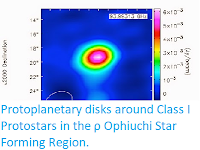
Protoplanetary disks around Class I Protostars in the ρ Ophiuchi Star Forming Region.

Stars are thought to form from the aggregation of material from vast clouds of molecules known as Stellar Nurseries or Star Forming Regions. The initial protostars (Class 0 Protostars) are embedded in envelopes of gas and dust up to 0.1 parsecs (0.3 light years) across. Over time this dust envelope begins to rotate and collapse under the influence of the protostars gravity, a stage referred to as a Class I Protostar. Eventually most of this material is accreted into rotating protoplanetary disk about a Class II Protostar through the conservation of angular momentum (put in simple terms, material is able to remain in a disk on a single plain around the equator of a fast rotating object, but on any other plain is thrown away from the object). Within these disks dust size particles accrete over time into larger bodies, eventually forming asteroids even planets thousands of kilometres across. Finally the majority of the material in the protoplanetary disk is either accreted into larger bodies or blown away by stellar radiation from the new star, leaving a Class III Protostar, surrounded by a system of planets and debris disks.

In a paper published on the online arXiv database at Cornell University Library on 5 May 2014, and accepted for publication in the journal Astronomy & Astrophysics a team of scientists led by Anna Miotello of the European Southern Observatory and the Dipartimento di Fisica at the Universita’ degli Studi di Milano describe the results of a study of two Class I Protostars in the ρ Ophiuchi Star Forming Region with the Australian Telescope Compact Array at wavelengths of 3 mm, 3 cm and 6 cm, and the results obtained from attempts to build models that fit these observations.

The protostars of the ρ Ophiuchi Star Forming Region are about 815 light years from Earth in the constellation of Ophiuchus. The two bodies studied were Elias29 and WL12. Elias29 is calculated to have a mass 3 times that of the Sun, an effective radius 5.9 times that of the Sun and a surface temperature of 4786 k (compared to 5778 K for the Sun), while WL12 is thought to have a mass 0.6 times that of the Sun, an effective radius 3.5 times that of the Sun and a surface temperature of 3980 K.

Elias29 map: detection of the source at 3 mm. The total flux of the source at 3 mm is 10.36 mJy, with a 3σ rms of 0.18 mJy. Miotello et al. (2014).

Miotello et al. calculate that Elias29 either has a dense protoplanetary disk reaching to about 15 AU (15 times the distance at which the Earth orbit’s the Sun) from the central star or a thinner disk reaching 50-200 AU from the star. The properties of the smaller, thicker disk were impossible to model, but the larger, thinner disk would almost certainly contain pebbles with sizes that could be measured in centimetres. WL12 appears to have an optically thick disk with a mass at least 30% of that of our Sun, reaching to about 30 AU from the star.

WL12 map: detection of the source at 3 mm. The total flux of the source at 3 mm is 17.48 mJy, with a 3σ rms of 0.22 mJy. Miotello et al. (2014).

Both stars appear to have mineral grains in the millimetre range already forming within their disks. The disks appear to be relatively compact, but also rather thicker than models would predict; Miotello et al. suggest that this may be due to magnetic fields generated by the protostars countering the angular momentum of the spinning disk. They further suggest that this mechanism is only likely to be efficient during the early part of the Class I Protostar stage, while the disk is relatively massive.

See also…


HD 163296 is a young Herbig Ae star (a star producing heat by gravitational collapse, which is expected will fuse Hydrogen in the future, but which has not reached this stage yet) slightly under 400 light years from Earth. It is surrounded by a fairly well documented circumstellar disk, which reaches slightly over 900 AU from the star...


Protostars are areas within molecular clouds where stars are forming, areas of increased density surrounded by dusty envelopes of gas hundreds of AU across (AU stands for Astronomical Unit, 1 AU being...


T Chamaeleontis is a young star (about 7 million years old) roughly 326 light years from Earth in the constellation of Chamaeleon. It has a mass of about 1.5 × that of our sun, and is surrounded by an...


Follow Sciency Thoughts on Facebook.