Showing posts with label Atlantic Coastal Forests. Show all posts

Saturday, 19 October 2019

Inbiomyia azevedoi: A new species of Inbiomyiid Fly from the Atlantic Forest in southeastern Brazil.

Inbiomyiid Flies are a curious group of True Flies, Dipters, first discovered in 2006. They are small in size, with the largest recorded specimens being about 1.6 mm in length, and generally very dark in colour. Inbiomyiid Flies are restricted to the tropical forests of the Americas but little is known about their biology. Large, flattened eggs have been found within the bodies of females, but what they are laid upon is unclear. To date only twelve species have been discovered, all of which have been placed within a single genus, Inbiomyia.

In a paper published in the American Museum Novitates on 12 Auguat 2019, Paula Raile Riccardi of the Departamento de Entomologia at the Museu Nacional do Rio de Janeiro, and Dalton de Souza Amorim of the Departamento de Biologia at the Universidade de São Paulo, describe a new species of Inbiomyiid Fly from the Atlantic Forest in southeastern Brazil.

The new species is named Inbiomyia azevedoi, in honour of Leonardo Henrique Gil Azevedo of the Museu Nacional do Rio de Janeiro, who collected most of the specimens from which the species is described. These specimens comprise eight males and seventeen males caught in the Parque Nacional de Itatiaia in Rio de Janeiro State, and one female caught in the Parque Nacional do Caparaó in Espírito Santo State, all caught with Malaise (fine net) traps. They are between 1.75 and 1.8 mm in length with wings that are 2.1 to 2.2 mm long.

Inbiomyia azevedoi, female. Riccardi & Amorim (2019).

See also...

https://sciencythoughts.blogspot.com/2019/02/choerades-analogos-new-species-of.htmlhttps://sciencythoughts.blogspot.com/2018/12/nemotelus-nartshukae-new-species-of.html
https://sciencythoughts.blogspot.com/2018/09/oligopipiza-quadriguttata-new-species.htmlhttps://sciencythoughts.blogspot.com/2018/04/acartophthalmites-willii-new-species-of.html
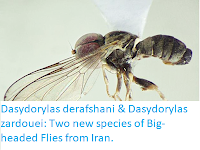
https://sciencythoughts.blogspot.com/2018/03/homoneura-yanqingensis-new-species-of.htmlhttps://sciencythoughts.blogspot.com/2018/01/dasydorylas-derafshani-dasydorylas.html
Follow Sciency Thoughts on Facebook.

Tuesday, 11 September 2012

A new species of Nectar-Feeding Bat from Brazil.

New World Nectar-Feeding Bats (Phyllostomidae) evolved separately from the Nectar-Feeding Bats of the Old World (which may themselves represent more than one evolutionary lineage). They can be split into two distinct groups, the Lonchophyllinae which extract nectar by the means of two deep groves on either side of their tongue, and the Glossophaginae, which feed by means of a brush-like apparatus on their tongues. 

In a paper published in the American Museum Novitates on 25 June 2012, Marcelo Nogueira, Isaac Lima and Adriano Peracchi of the Laboratório de Mastozoologia at the Universidade Federal Rural do Rio de Janeiro and Nancy Simmons of the Department of Mammalogy at the Division of Vertebrate Zoology at the American Museum of Natural History describe a new species of Glossophagin Bat from the Coastal Forests of Brazil.

The new species is described from two Bats captured in tableland Atlantic forest at the Reserva Natural Vale in the north of the state of Espírito Santo, in southeastern Brazil, and a third specimen from  semideciduous seasonal tableland Atlantic forest at the Floresta Nacional de Goytacazes reserve about 30 km south on the right bank of the Rio Doce. These tableland forests are considered to be the most botanically species rich parts of the Atlantic Forests.

Map showing the location of the Reserva Natural Vale and Floresta Nacional de Goytacazes reserves. Nogueira et al. (2012).

The new species is named Dryadonycteris capixaba, where Dryadonycteris means 'bat from Dryades' (a reference to the name 'Dryades' which was used by the 19th-century German naturalist Karl Friedrich Philipp von Martius to describe the Atlantic Forrest Floral Province) and capixaba is a Tulpi word meaning from Espírito Santo.

Dryadonycteris capixaba is a small Glossophagin Bat, slightly over 55 mm in length, with an elongate snout, lacking lower incisors, having a triangular noseleaf and having tricoloured banding of its fur (i.e., each hair has a pale middle band and darker basal and distal bands). The Bats were captured in ground-level mist nets in both dry and wet seasons. The areas where they were captured have been sampled for Bats extensively, implying these are quite rare animals. The forests if Floresta Nacional de Goytacazes are quite badly fragmented, suggesting that Dryadonycteris capixaba may be able to cope with such conditions.

Dryadonycteris capixabaNogueira et al. (2012).

See also New species of Bat discovered in Vietnam and Mammals on Sciency Thoughts YouTube.

Follow Sciency Thoughts on Facebook.