Between the fifteenth to nineteenth centuries, at least 12.5 million people were abducted from sub-Saharan Africa and taken as slaves to the Americas, and to a lesser extent Europe, the largest forced migration in Human history. This has had a profound impact on the demographics, economics, and politics of both Africa and the Americas, and while is some ways the process was well-documented (we have, for example, documented records of the voyages of at least 30 079 vessels which were involved in the slave trade, including records of ports they visited and the number of captives they transported), we know very little about the identities of the individuals involved and their actual points of origin.
Recent studies have used genetic information from archaeological remains from the Caribbean, Brazil, North America, St Helena, and South Africa, have had some success in determining the populations from which individuals descended, this cannot tell us where they a person was born or brought up.
Strontium isotopes (specifically the ratio between the isotopes strontium⁸⁷ and strontium⁸⁶) in water are largely determined by bedrock, as well as rainfall and geomorphology, and is taken up and incorporated into biomineralized tissues, such as tooth and bone. Importantly, these ratios remain stable over archaeological timescales, enabling archaeologists to use them to determine the origin of Human and Animal remains, as long as a geological reference map, with the isotope ratios present in appropriate locations, is available.
In sub-Saharan Africa, strontium isotope ratios have been used to trace the migration routes of large Mammals, and to determine the origin of ivory seized from smugglers, as well as to analyse landscape use by early Hominins, but has been under-used in other spheres, such as historical archaeology, largely because data on strontium isotope ratios are not available for large areas of the continent, and in particular much of West and West-Central Africa, the areas from which the overwhelming majority of slaves were taken to the New World. This is in part due to the high cost associated with carrying out strontium isotope testing over large areas, with the added complication that some parts of the continent are plagued by ongoing conflicts and political instability, making the necessary fieldwork difficult and dangerous.
In a paper published in the journal Nature Communications on 30 December 2024, a team of scientists led by Xueye Wang of the Center for Archaeological Science at Sichuan University and the Anthropology Department at the University of California Santa Cruz, present strontium isotope ratios from 778 new environmental studies from 24 African countries, mostly in West and West-Central Africa, which they combine with 1488 previously published strontium isotope ratios from other studies, to build a more detailed map of strontium isotope ratios across sub-Saharan Africa. These are then compared to ratios obtained from Human remains at two cemeteries in the Americas associated with African slaves, the Anson Street African Burial Ground in Charleston, South Carolina, and the Pretos Novos Cemetery in Rio de Janeiro, Brazil.
Strontium⁸⁷/strontium⁸⁶ ratios in Africa range from 0.70381 to 0.87810, a far higher range than is known from any other continent studied. Some areas have a high proportion of radiogenic strontium⁸⁷, notably those areas with an underlying Archaean bedrock, such as Angola, Zimbabwe, Zambia, western Tanzania, northern South Africa, Côte d'Ivoire, Liberia, Sierra Leone, and southwestern Mali. Other areas have a very low level of strontium⁸⁷, particularly areas of East Africa covered by Mesozoic-Cainozoic volcanic rocks, and areas of South Africa covered by flood basalts, as these tend to generate soils with a high cation exchange capacity and clay content. Strontium ratios are also affected by precipitation levels and elevation, both of which impact the weathering rate of silicate rocks.
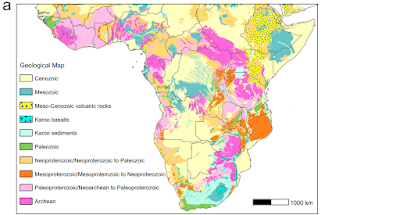
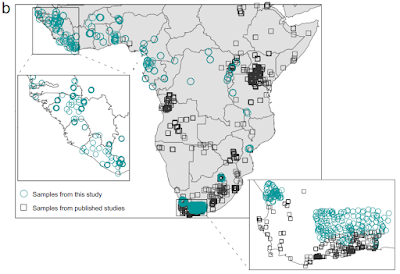
Geological map and sampling locations. (a) Simplified geological map. (b) Map showing the environmental sampling locations from this study and previously published work. The sampling locations focused on filling gaps in West Africa, West-Central Africa, and parts of South Africa, covering all major geological units across the African continent south of the Sahara. Wang et al. (2024).
Strontium isotope ratios were analysed for five individuals from the Anson Street African Burial Ground for which genetic analysis had been used to determine a population-of-origin, and five individuals from the Pretos Novos Cemetery, for which this data was not available, but oxygen isotope ratios, which can be used to determine diet, were.
Two of the Anson Street African Burial Ground individuals had previously been determined to be of West-Central African origin, both of which produced strontium isotope ratios consistent with an origin in eastern-central Angola. The remaining three individuals were all determined to be from West Africa by genetic analysis. The first of these produced a strontium isotope ratio which indicates that they could have originated from a wide area, including large regions of Liberia, Côte d’Ivoire, Guinea, Sierra Leone, and Mali. The remaining two individuals showed much higher levels of radiogenic strontium, consistent with having come from either a 100 km stretch of the coast of southern Côte d’Ivoire and Ghana, or from the eastern part of Guinea.
Four of the five individuals from the Pretos Novos Cemetery produced strontium isotope ratios consistent with having come from different regions of Angola or South-East Africa, while the fifth produced a result consistent with having come from parts of Guinea, Nigeria, Cameroon, or South Africa.
Oxygen isotope ratios suggest that this individual grew up in a region where the main crops were C₄ Plants. This would exclude the 'Rice Coast' of West Africa, which runs from Guinea Bissau through Guinea into western Côte d’Ivoire, or the vegecultural zone of southern West Africa, where the predominant crops are Manioc, Yams, and other C₃ root vegetables, but would include parts of central Nigeria where the main crops are Sorghum and Millet, and parts of northern Cameroon where different areas would have grown Sorghum and Millet or Maize (itself introduced from the Americas by European traders). Potentially, a South African could have also had a diet dominated by C₄ Plants, which are easily grown in many places there, but Wang et al. consider this less likely, given the much larger number of slaves taken from West Africa to Brazil.
The four other individuals from Pretos Novos Cemetery are hypothesized to have come from different parts of Angola based upon strontium isotope ratios. This was supported by the oxygen isotope analysis, which suggests they did not share common dietary habits in early life. This is consistent with the known agricultural practices in Angola at the time, with different regions emphasizing the cultivation of manioc and other root crops, or maize and millet.
Wang et al. are confident that improved groundwater sampling from a wider area of Africa would have the potential to greatly improve our ability to determine the origin of African remains from the New World. With the limited sampling available, they were able to provide approximate locations of origin for ten individuals from two well-studied burial grounds, one in the United States and the other in Brazil, and while their answers cannot be taken as 100% reliable at this stage, none of them contradict data from previous studies, nor do they suggest improbable points of origin for the individuals examined.
There are still some notable gaps in the strontium ratio maps used by Wang et al. most notably Namibia and the Sahel Region. Wang et al. identify these regions as being sparsely populated, and therefore unlikely to have been heavily targeted by slavers. This is probably true for Namibia, where the most habitable areas are separated from the coat be large areas of desert, but certainly isn't true for the Sahel Region, which was home to powerful states such as the Mali Empire, and where travellers such as Mungo Park recorded extensive activity by slavers. Sampling is also limited for Mozambique, from where historical records show that at least half a million people were taken as slaves in the first half of the nineteenth century. The method is further limited in that it can only trace the origins of people born and raised in Africa, anyone raised in the Americas will have a strontium isotope signal from there, no matter where their parents came from.
Wang et al. also note that an improved isotope map for Africa, particularly if it includes other elements, such as oxygen, hydrogen, sulphur, and carbon, has the potential to improve not just our ability to identify the origins of Human remains from archaeological contexts, but also items such as smuggled wildlife and timber. It also has the ability to improve our understanding of wildlife migrations, or historic dispersals, including those of species extinct today. Moreover, it also has the ability to help identify the thousands of African migrants who perish in the Mediterranean Sea during their passage to southern Europe, something which has been described as potentially the greatest humanitarian disaster in Europe since the Second World War.
See also...


