Showing posts with label Barberton Group. Show all posts

Sunday, 7 February 2016

Three still missing following collapse at South African gold mine.

Three people are still missing following a collapse at the Vantage Goldfields operated Makonjwaan Lily Gold Mine near Low's Creek in Mpumalanga at about 8.40 am local time on Friday 5 February 2015. The incident was reportedly caused by the failure of an underground pillar, which in turn led to a roof collapse, trapping 87 miners below ground. All of these workers have now been rescued successfully with only miner injuries, however the collapse also led to the formation of a sinkhole (surface hole created by the formation of a void bellow ground)which swallowed a mobile office building in which two women and a man were working, It is these three mine employees, understood to have been involved in issuing miners with safety equipment, that are still missing and are still being actively sought by rescue teams. All production at the mine has ceased until further notice, and workers are being offered trauma counseling.

Friends and relatives of the missing mineworkers waiting for news at the Makonjwaan Lily Gold Mine. AP.

The Makonjawaan Lily Gold Mine is a shallow pit mine with an estimated reserve of about 0.35 million ounces of gold and an annual production of about 35 000 ounces per year. It accesses an ore body within the Barberton Greenstone Belt, an ancient (more than 3 billion years old) section of basement rocks underlying parts of South Africa and Swaziland, which forms the eastern part of the Kaapvaal Craton, one of the ancient blocks from which the continent of Africa was assembled. 

The approximate location of the Makonjwaan Lily Gold Mine.  Google Maps.

See also...

http://sciencythoughts.blogspot.co.uk/2015/02/486-miners-rescued-safely-after-fire-at.html486 miners rescued safely after fire at South African gold mine.                                            All the workers who were bellow ground at the Harmony Gold operated Kusasalethu Mine, at Carletonville near Johannesburg in South Africa, when an underground fire broke out on Sunday 22 February 2015 have...
http://sciencythoughts.blogspot.co.uk/2014/08/at-least-one-fatality-following.htmlAt least one fatality following Magnitude 5.5 Earthquake in northern Free State, South Africa.                                                          The South African Council for Geoscience recorded...
http://sciencythoughts.blogspot.co.uk/2014/05/the-potential-for-geothermal-energy-in.htmlThe potential for geothermal energy in Limpopo Province, South Africa.                    South Africa is the largest producer of carbon dioxide on the African continent, and as such has committed itself to ambitious emission reduction plans, aiming to cut production of the gas by 40% by 2050. At the same...
Follow Sciency Thoughts on Facebook.
 

Monday, 29 June 2015

Microbial sediments from the Early-to-Middle Archean of Mpulanga Province, South Africa.


The quest for evidence of the earliest life is made difficult by both the presumed simplicity of such life (almost certainly Bacteria-like cells with no capacity for biomineralization, let alone large distinctive skeletons) and the limited amount of surviving, unaltered sediments from the earliest eras of the Earth. The best hopes for finding evidence of such life are biomarkers, chemicals or isotopic ratios known to be produced by living things, but which are difficult to explain in the absence of life.

In a paper published in the journal Geology on 26 May 2015, a team of scientists led by Frances Westall of the Centre de Biophysique Moléculaire at the Centre National de la Recherche Scientifique in Orléans, France, describe evidence for the presence of a microbial community in the 3.33 billion-year-old (Early-to-Middle Archean) Josefsdal Chert of Mpulanga Province, South Africa.

The Josefsdal Chert forms part of the Barberton Greenstone Belt, and represents a series of inshore sediments 6-30 m thick and several kilometres in extent along the border with Swaziland, sandwiched between layers of volcanic basalt. These sediments have been preserved intact, without compression, by the action of a number of hydrothermal systems, which produced silica-saturated waters, leading to mineralization of the sediments in a chert matrix.

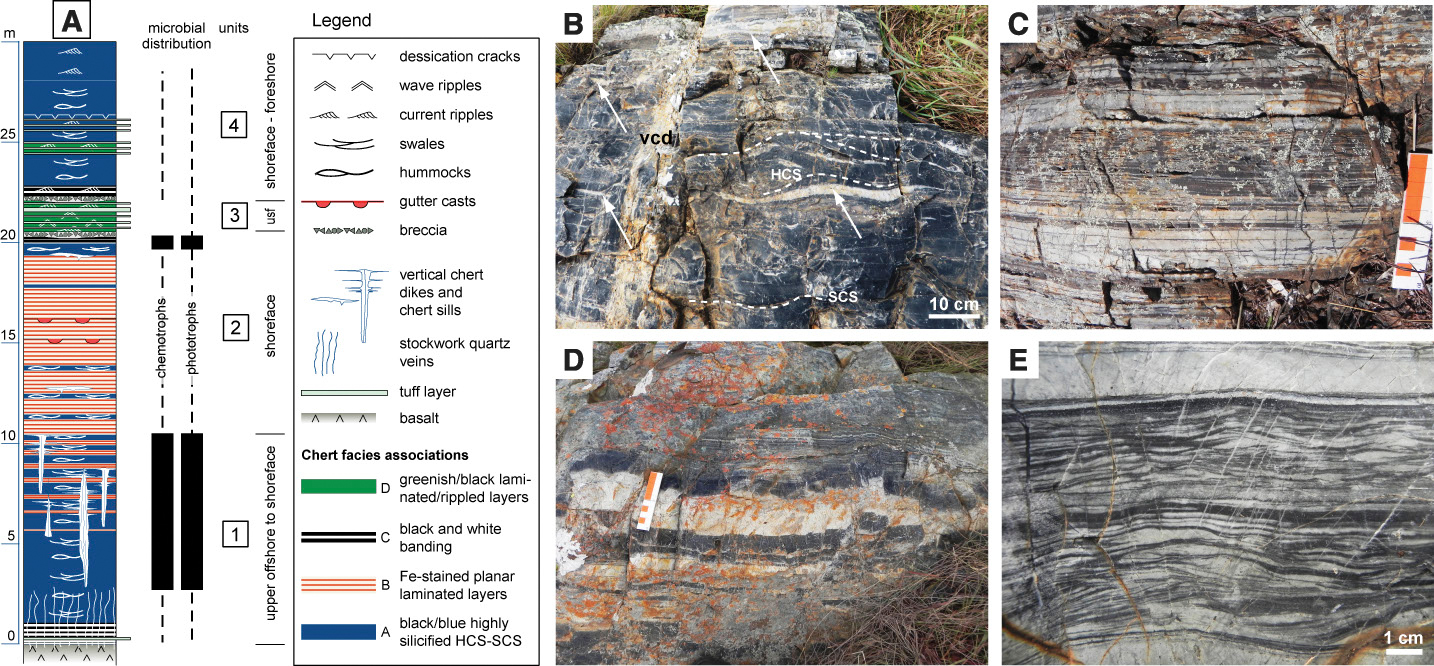
Stratigraphy and facies associations of Josefsdal Chert, South Africa. Stratigraphic column (A) comprises four stratigraphic units (1–4) consisting of four interbedded sedimentary (chert) facies associations (A–D) that represent sedimentation in shifting upper offshore to foreshore environments. (B) Swaley and hummocky cross-stratification, deposited by storms in the upper offshore to shoreface, dominate Unit 1, which also exhibits abundant, penecontemporaneous, hydrothermal white to translucent, vertical chert dikes (vcd) and thin chert sills (facies A). (C) Iron-stained, poorly sorted, rhythmically laminated sediments of facies B, interpreted to have been deposited in a shoreface setting that was periodically tidally influenced. (D) Hydrothermal black and white banded chert constitutes facies C. (E) Planar-laminated volcanic accretionary lapilli and ash, comprising Unit 3, were intermittently reworked into small current and wave ripples. Facies D is inferred to have been deposited in an upper shoreface setting. Unit 4 contains alternations of facies A (with rare dessication cracks), C, and D that accumulated in shoreface to foreshore settings. Biosignatures occur ubiquitously in all facies; they are generally uncommon but dense in the vicinity of paleo-hydrothermal activity. Westall et al. (2015).

Preserved biofilms (saccharine-rich films produced by Bacteria both to secure themselves in place in aquatic environments and to help them interact with those environments) are found throughout the Josephdal Chert, though they are better preserved close to areas of palaeohydological activity (i.e. the vents producing the silica-rich waters). These comprise both films occurring on bedding surfaces, interpreted as having been produced by photosynthetic Bacteria, and clotted structures within finer-grained sediments, interpreted as having been produced by chemoautrophic Bacteria (Bacteria which obtained energy by processing chemicals within the sediments).

Types of carbonaceous material in the Josefsdal Chert, South Africa. (A) Dark wavy, phototrophic laminae (type 1; black arrows) coexisting with dark, chemotrophic clots (type 2; labeled as C). (B), (C) Details of phototrophic biofilms showing entrapped detrital grains (arrows, B) and compensation of laminae over underlying clot (arrow, C). (D) Laminated, detrital type 3 carbonaceous matter, partly rippled (black arrow), with sedimented clot (white arrow). (E) Type 2 clots, whose irregular shape suggests insitu growth, co-occur with sedimented carbonaceous matter (white arrow). (F) Detrital fragment of well-preserved phototrophic biofilm in facies A. (G) Phototrophic laminae are generally poorly preserved in the coarse sands of facies A (and facies D). Westall et al. (2015).


The bedding horizon films were found to be highly depleted in carbon-13 (the heavier of the two most abundant stable isotopes of carbon), which is generally accepted as evidence of photosynthesis (which preferentially uses carbon-12), supporting the idea that these films were produced by photosynthetic, rather than some other, possibly non-biological, phenomenon.

See also…

In the nineteenth century the origin of life seemed an intractable problem for palaeontologists, with large complex animal fossils appearing in the Cambrian explosion, but scientists having access to neither examples of earlier fossils nor the means with which to examine them. However from the early twentieth...


The potential of there being life on Mars has been a stalwart of popular fiction for over a century, though to date no signs of actual life have been...


The blood plasma and lymph of modern animals is similar in chemical composition to seawater, strongly supporting the idea that animal life began in the oceans, but the liquid inside our cells has a quite different chemistry, suggesting that cells themselves first...


Follow Sciency Thoughts on Facebook.