Showing posts with label Centaur Asteroids. Show all posts

Wednesday, 26 August 2020

Small Bodies Tell the Story of the Solar System: A Scientific Rationale for a Multi-Target Small Body Sample Return Program.

Small bodies are time-capsules of different eras of Solar System history from the most primitive materials within the solar system to evolved pieces of larger bodies. While small bodies include asteroids, comets, dwarf planets, Trojans, Centaurs, trans-Neptunian objects, small satellites, and interplanetary dust, a diverse selection of small bodies either reside near Earth or have been scattered by the gravity of the planets onto near-Earth orbits, ultimately making all parts of the solar system accessible to exploration. Furthermore, the surfaces of many small bodies can be affordably accessed with spacecraft due to their low gravity and non-existent or sparse atmospheres. While our meteorite collections are an important source of knowledge about solar system history, they are a biased and incomplete representation of small body astromaterials.

In a paper published on the arXiv database at Cornell University on 16 July 2020, Seth Jacobson of Michigan State University, Maitrayee Bose of Arizona State University, Dennis Bodewits of Auburn University, Marc Fries of NASA's Johnson Space Center, Devanshu Jha of MVJ College of Engineering, Prajkta Mane of the Lunar and Planetary Institute, Larry Nittler of the Carnegie Institution of Washington, Scott Sandford of NASA's Ames Research Center, and Michelle Thompson of Purdue University, present a scientific rationale for a multi-target small body sample return program including the Earth-based laboratory analysis of returned samples.

Small bodies record the radial compositional gradients of material that were present in the protosolar disk, and they represent all stages of the formation and early evolution of the Solar System. Primitive small bodies are the debris left over from planet formation and contain examples of the primordial ingredients from which the planets and life arose. Small bodies record internal processing such as aqueous alteration, thermal metamorphism, melting and differentiation. These evolved small bodies record processes that occurred during the formation and evolution of planets. Thus, small bodies trace growth from primordial condensates and presolar/interstellar grains to pebbles, planetesimals, and planetary embryos to planets. Since catastrophic collisions can completely shatter protoplanets, small bodies can be samples of core, mantle, or crustal material of once much larger bodies. Indeed, this is the only known reservoir of accessible core and, potentially, deep mantle material. Small bodies also record the history of the Solar System such as the dynamical evolution of the Solar System, the evolution of surface materials through time and as they approach the Sun, and the primordial cosmochemical gradients established within the solar nebula. Samples from small bodies in the solar system represent a diverse set of materials, and study of these materials in terrestrial laboratories can provide information about the history and evolution of the Solar System in ways that cannot be determined by remote and in situ observations.

Small bodies from throughout the Solar System have been scattered onto orbits that are accessible by spacecraft from Earth on reasonable mission timescales and budgets. Near-Earth asteroids are sourced from throughout the Main Belt, although parts of the Main Belt itself can be directly accessible for sample return using launch vehicles in development. The moons and Trojans of Mars are also directly within reach. Jupiter-family and long-period comets can have perihelions within 1 Astronomical Unit and are representative examples of the Kuiper Belt and Oort Cloud, respectively. NASA, the European Space Agancy, and the Japan Aerospace Exploration Agency have a long history of successful operations around small bodies. Sample return missions to small bodies have historically been more limited, but past and current missions include NASA’s Stardust and OSIRIS-REx missions and the Japan Aerospace Exploration Agency’s Hayabusa and Hayabusa2 missions.

 
Stardust sample return capsule in a temporary cleanroom at the Michael Army Air Field in Utah. NASA.

Because of their low gravity and lack of atmospheres, many small bodies are accessible using spacecraft missions in the Discovery and New Frontiers classes, as demonstrated by completed missions such as Near-Earth Asteroid Rendezvous, Stardust, Deep Impact, and Dawn, current missions such as New Horizons and OSIRIS-REx, as well as future missions such as Psyche and Lucy. These missions have shown that exploration of small bodies can provide an extremely effective means of learning the story of the origin and evolution of the solar system and demonstrate the potential value provided by future missions. In particular, the science returned by these missions have opened new questions, some of which can only be approached with the in-depth investigation of returned samples.

 
Artist's rendering showing the OSIRIS-REx spacecraft descending towards Asteroid Bennu to collect a sample of the asteroid’s surface. NASA.

The science goals of small body exploration are to establish the early conditions of the solar nebula, understand how materials evolved during the stages of planetary growth, and determine the source of the building blocks of Earth including water and other ingredients necessary for life. These goals are responses to the fundamental questions: ‘What is out there in the universe?’, ‘What is the history of Earth and the solar system?’, and ‘How did life arise on Earth and may it have arisen elsewhere?’ that not only drive the public imagination but have historically driven significant investments in science. While in-situ spacecraft exploration provides detailed information that cannot be obtained from remote telescopic observations, small body sample return missions are the only mechanism to fully connect astrophysical observations, in-situ spacecraft exploration, and meteorite analysis.

 
Artist's impression of the Hayabusa Space Probe arriving at Asteroid Itokawa. Japan Space Agency.

By ‘sample return mission’ Jacobson et al. refer to the acquisition of material (dust particles, surface material, drill cores, captured gases, ices, etc.) by a collecting device on a spacecraft, their return to Earth, and their analysis in a laboratory on Earth. Sample return missions and supporting infrastructure (cameras onboard the spacecraft, ground-based telescopes, etc.) must also characterize the local, regional, and global context of the sampled location.

 
Mosaic of images of Asteroid Eros taken by the Near-Earth Asteroid Rendezvous probe from an orbital altitude of 200 kilometers, providing  an overview of the eastern part of the asteroid's southern hemisphere. In this view, south is to the top and the terminator (the imaginary line dividing day from night) lies near the equator. The conspicuous depression just above the centre of the frame is the saddle-shaped feature Himeros. NASA.

Of all investigative methods, sample return missions provide the deepest insight into a planetary body, because returned samples can be analyzed by the most advanced laboratory techniques in terrestrial laboratories with the highest precision and detection limits and which are not achievable in remotely operated planetary missions, while still in the context of landed and remote sensing observations. This effectively allows the mission’s payload to consist of all the world’s analytical instrumentation. First, many of these analyses cannot be performed in space due to technological or cost limitations. Second, Earth-based laboratories can achieve measurement accuracies and precisions superior to in situ measurements, often with very small sample quantities. Third, returned samples can be and have historically been partially preserved for study in the future by methods that have yet to be developed. Earth-based laboratory analysis of returned samples from small bodies provides detailed information regarding the sample’s geologic characterisation, petrology, and mineralogy. Moreover, laboratories can perform high precision geochemical measurements including molecular, elemental, and isotopic compositions, which can be used for radiometric dating. Using these rich datasets, the history of both the individual parent body as well as the population they represent, can be determined.

 
An artist's impression of the Deep Impact spacecraft delivering a special impactor into the path of Comet Tempel 1. NASA.

Characterisation of returned samples from small bodies can also contextualize laboratory analyses of meteorites and interplanetary dust particles collected on Earth. Laboratory analyses of extraterrestrial materials retrieved on Earth have, and continue to, provide answers to fundamental questions about the early solar system, but because in most cases the sources of the materials cannot be directly determined, their properties cannot be fully put into their parent body context. Returned samples overcome this issue and provide sample-asteroid connections and parent body context without ambiguity. For instance, Stardust connected interplanetary dust particles to cometary dust and Hayabusa connected ordinary chondrite meteorites to S-type asteroids. Thus, by collecting samples with known provenance, sample return missions not only produce unique discoveries of their own, but also enrich the value of laboratory meteorite and dust particle studies by revealing connections between these unique sample sets.

 
View of Dwarf Planet Ceres combining images taken during Dawn's first science orbit in 2015 using the framing camera's red, green and blue spectral filters. NASA/JPL/Caltech/UCLA/MPS/DLR/IDA.

Ground-based telescopic observations of small bodies and astrophysical disks (protoplanetary and debris), spacecraft-based remote and in-situ exploration, and theoretical modeling are enriched by sample return investigations. For instance, competing theoretical models of planet formation can now satisfactorily explain modern-day astrophysical properties such as masses and orbits of planets and small bodies, but have significantly different hypotheses regarding the histories of growth and evolution of those bodies as recorded in their chemical and isotopic compositions. Returned samples provide definitive evidence to test these hypotheses and break existing model degeneracies. Similarly, degeneracies between interpretations of remote observations either from astrophysical telescopes or in-situ spacecraft can only be broken by laboratory investigations that, due to sample preparation and analysis requirements, must occur on Earth. Astrophysical observations, in-situ spacecraft investigations, and Earth-based laboratory analyses are distinct nodes in a continuum of understanding small bodies that become tightly linked by a small body sample return program, enhancing the scientific return of all.

 
Image of Kuiper Belt Object Arrokoth made by the New Horizons Space Probe. NASA/Johns Hopkins University Applied Physics Laboratory/Southwest Research Institute/Roman Tkachenko.

Despite the lack of existence of a defined small body sample return program, two successful missions have returned samples from small bodies: NASA’s Stardust Discovery mission, which returned both dust particles from comet 81P/Wild 2 and interstellar dust, and the Japan Aerospace Exploration Agency’s Hayabusa mission, which returned surface samples from asteroid 25143 Itokawa. These two missions clearly illustrate the power of sample return as both have provided unprecedented constraints on specific small bodies and on their relation to extant meteoritic materials. With respect to Stardust , the collection, return, and terrestrial analysis of a few thousand particles from the coma of Wild 2 demonstrated that comets - generally thought to have formed in the outer protosolar nebula - nonetheless contain materials that must have been formed and altered in both the inner and outer parts of the protosolar nebula. This provides clear proof that comets are not, as once thought, pristine collections of interstellar materials and that dust was mixed throughout the entire extent of the disk. Furthermore, laboratory analyses confirmed the long suspected connection of many interplanetary dust particles to cometary sources. Similarly, with respect to the Japan Aerospace Exploration Agency’s Hayabusa mission, laboratory analysis of a few nanograms of Itokawa particles, tens to hundreds of microns in diameter, confirmed a long-suspected connection between S-type asteroids and ordinary chondrite meteorites. This analysis also revealed a rich and complex history of the asteroid’s parent body formation and evolution over billions of years and provided unprecedented information about space weathering processes on asteroids. The measurements that led to all of these discoveries could never have been made by remote or in situ instruments, but instead required the state-of-the-art instrumentation available in terrestrial laboratories, much of which wasn’t even developed at the time the missions were designed and launched.

 
Artist's impression of the planned Psyche Space Probe above Asteroid Psyche. NASA.

Two ongoing sample return missions include the Japan Aerospace Exploration Agency’s Hayabusa2 mission, which is returning with surface samples from 162173 Ryugu, and NASA’s OSIRIS-REx mission, which is in the process of collecting surface samples at 101955 Bennu. These missions targeted C-type asteroids to test the hypothesised connection to carbonaceous chondrite meteorites. The returned samples will have known provenance, rock surfaces unaffected by passage through Earth’s atmosphere, and are predicted to contain examples of the primitive material that delivered water and carbon to Earth. While there are distinct differences in hydration as observed by remote spectroscopy, the overall similarity between the two targets creates an opportunity to compare and contrast the returned samples in the context of individual parent body evolution. Overall, these missions demonstrate the desire for returned samples, and prove, beyond doubt, the technical feasibility of sample return missions from small bodies.

 
Diagram illustrating the  orbital path of the Lucy Probe. The spacecraft’s path (green) is shown in a frame of reference where Jupiter remains stationary, giving the trajectory its pretzel-like shape. After launch in October 2021, Lucy has two close Earth flybys before encountering its Trojan targets. In the L4 cloud Lucy will fly by (3548) Eurybates (white) and its satellite, (15094) Polymele (pink), (11351) Leucus (red), and (21900) Orus (red) from 2027-2028. After diving past Earth again Lucy will visit the L5 cloud and encounter the (617) Patroclus-Menoetius binary (pink) in 2033. As a bonus, in 2025 on the way to the L4, Lucy flies by a small Main Belt asteroid, (52246) Donaldjohanson (white), named for the discoverer of the Lucy fossil. After flying by the Patroclus-Menoetius binary in 2033, Lucy will continue cycling between the two Trojan clouds every six years. NASA.

Beyond the selection of missions for flight, NASA has also recognized the importance of supporting sample-return science with the development and advancement of laboratory methods for eventual analysis of returned samples. NASA initiated the Sample Return and Laboratory Instrumentation and Data Analysis Program, now the Laboratory Analysis of Returned Samples program, that funded both PI-built advanced instruments such as MegaSIMS, SARISA, and CHILI, as well as the acquisition of commercial instruments. NASA’s Planetary Science Division has further supported acquisition of commercial instrumentation (e.g., electron microscopes, mass spectrometers, FTIR, Raman, etc) for individual PIs and facilities through the Planetary Major Equipment program, in many cases expressly to support analysis of returned samples (as well as meteoritic and/or terrestrial samples). These instruments are available for individual PI use at a variety of institutions, including universities, research institutes, and National Labs or as part of user facilities available to the community at large. Large scale user facilities such as synchrotron X-ray and neutron beam sources are also available and have been extensively used for returned sample analysis. All this unique instrumentation is currently being used but needs continued funding for development work and updating existing instrumentation to satisfy the needs for future returned sample analyses (for an extensive review see the National Academies Report, 'Strategic Investments in Instrumentation and Facilities for Extraterrestrial Sample Curation and Analysis').

Image of comet 81P/Wild 2 made by the Stardust probe on 2 January 2004. Wikimedia Commons/NASA.

While the history of small body sample return and analysis demonstrates high scientific returns, the scope of existing returned samples only begins to fill the domain of possible science. As described above, small body exploration science goals encompass the entire history of the solar system, and samples returned from small bodies, likewise, cover this incredible territory. To understand the early conditions of the solar nebula, sample return mission targets may include comets and undifferentiated asteroids. To understand planetesimal growth and internal processing, targets may include larger asteroids such as Ceres or their fragments that show evidence of aqueous alteration, thermal metamorphism, and other processes at their surfaces. To understand planet formation and evolution, targets may include asteroids that appear similar to expected planetary components such as crustal, mantle, or core material. To understand the delivery to Earth of compounds essential for life such as water and organics, targets may include icy and volatile-rich comets as well as active and/or hydrated asteroids. These are only a few examples of the rich diversity of science objectives and associated potential targets that could be transformed into competitive sample return missions.


Asteroid Itokowa, visited by the Japan Space Agency's Hayabusa mission in November 2005. New Technology Telescope/European Sothern Observatory.

Collecting such a rich set of returned samples to achieve these science goals is not without challenges that must be addressed. While some samples may be 'scooped' from a gravelly surface, others will require a more precise and careful collection. For instance, samples from surfaces rich in salts as observed on Ceres would provide key constraints on internal body processes as well as the initial accretion location of the body. However, experience with salt clasts in ordinary chondrite meteorites shows that the handling and analyses of such friable material is extremely challenging. As another example, samples rich in particular volatiles are missing from our meteorite collections because reentry through the Earth’s atmosphere destroys such material. Volatile compounds include the water ice and organics that are essential for life on Earth, and so tracing the origin and evolution of volatile-rich materials is crucial to understanding why life arose here and the potential for life elsewhere. Successfully sampling and transporting such volatile compounds either cryogenically or non-cryogenically, in an intentionally altered state, are major spacecraft instrument design goals. Ambitious sample return missions will deliver exciting results unobtainable through other means, but will require advance investment in instrumentation and mission design.

Hubble Space Telescope image of dust particles being shed by Comet Schwassmann-Wachmann-3. NASA.

The high science value of returned samples is enabled by the extensive and precise capabilities of Earth-based laboratories. For instance, firmly linking asteroids and meteorites requires detailed lab comparisons such as those used by Hayabusa to connect ordinary chondrites and S-type asteroids as well as by Stardust to connect comets and interplanetary dust particles. There are still many well-studied meteorites whose origins are only hypothesized. For instance, identifying the parent body and origin story of iron and stony-iron achondrites is a major science objective that will require laboratory comparison of returned samples. Such knowledge would mark major progress towards the goal of understanding how growing protoplanets differentiate. Relatedly, there are a number of asteroids with rarer spectral appearances, of which it is unclear if they are represented in our meteorite collections at all, such as the A-, O-, R-, E-, M-, and non-Vestoid V-type asteroids. Hypotheses for the origin of these objects include silicate pieces of differentiated bodies, and they may be the key for understanding how the geochemistry of large protoplanets change with growth. Petrologic experiments and meteoritic comparison is only possible with returned samples and laboratory analysis.

 Artist's impression of the New Horizons Space Probe. NASA/Johns Hopkins University Applied Physics Laboratory/Southwest Research Institute.

Small body investigations began as telescopic observations and meteoritic analyses and, in the past decades, have since included spacecraft-based remote and in-situ analyses. While all of these investigations should continue to be supported by funding agencies including remote and in-situ spacecraft-based investigations, the time is now to create a New Frontiers-like program to support a set of spacecraft missions to bring back samples from a diverse set of small bodies and to increase support for Earth-based laboratories to properly handle and study returned samples. The most effective small body sample return program would have these components: (1) opportunities for small body sample return spacecraft missions, (2) opportunities to develop spacecraft sampling and sample preservation technology, (3) opportunities to create or enhance existing Earth-based laboratory facilities, (4) opportunities to examine existing returned samples and/or their data products.

 Image of haze layers above Pluto taken by the Ralph/Multispectral Visible Imaging Camera on the New Horizons spacecraft. NASA.

The number and diversity of small body targets means that no single mission could accomplish the full set of achievable scientific objectives made possible by small body sample return missions. Ideally, sample return missions should be supported with their own mission program with its own funding line within the planetary sciences division at NASA. Alternatively, the regular calls from the Discovery and New Frontiers programs should always be broad enough to include small body sample return as a potential mission profile and/or commitments should be made for selection of sample return missions on a regular basis. The very strong science cases for small body sample return missions will make them highly competitive against other possible mission profiles. Given the large diversity of possible sample return science goals requiring New Frontiers-level support, it’s important for that program to consider a wide variety of targets. In short, given the diversity of possible small body sample return missions, it is essential that NASA provide regular opportunities for such missions to be flown.

Image of Asteroid Vesta made on 24 July 2011 by the Dawn spacecraft. Wikimedia Commons/NASA/JPL/MPS/DLR/IDA/Björn Jónsson.

Space agencies, such as the Japan Aerospace Exploration Agency and European Space Agency, will continue or start to conduct their own sample return programs; Jacobson et al. believe it is critical that NASA support participating scientist programs for these non-NASA led missions. Relatedly, NASA should encourage the participation of international colleagues in sample return missions as well as the Earth-based study of returned samples. Likewise, NASA should work to maintain access for US-based scientists to returned samples obtained by foreign space agencies.


NASA should continue to maintain stable, well-funded research and analysis programs as the backbone for scientific advancement and as an enabler for future missions to small bodies. It is essential that either a new dedicated program be introduced or the PICASSO and MatISSE programs be enhanced to support the development of spacecraft sampling and onboard sample preservation technologies. As the volume of returned samples grows, NASA must increase the funding to LARS as well as preserve/increase funding to related research and analysis programs such as Emerging Worlds and Solar System Workings including support for Planetary Major Equipment requests. The connective nature of returned samples is reflected in the wide number of NASA programs necessary to support their study and return their full science value. Lastly, NASA should maintain and update current facilities at Johnson Space Center and, potentially, elsewhere to store returned samples. As the variety of returned samples increases, NASA will need to develop new storage facilities, new procedures for sample handling and access. NASA should require that sample documentation, measurements, and other data products be archived appropriately, ideally at a Planetary Data System node.

A part of the Allende Meteorite, a carbonaceous chondrite. James St. John/Ohio State Univerisity/Flikr/Wikimedia Commons.

Small body sample return investigations are a human endeavor that should be accessible to anyone interested. From large spacecraft mission teams to the smaller research teams supported by research and analysis programs, those selected to conduct the science should represent the diversity of humanity. This can only be achieved if NASA prioritizes accessibility and inclusivity when designing competitive research programs, and if international participation is encouraged. Given historic injustices and existing inequality, NASA will need to consciously build accessibility and inclusivity into a small body sample return program. Proactive measures may include continued support of participating scientist programs to join spacecraft mission teams, maintaining transparent and fair systems to access returned samples with appropriate oversight, and preference to funding facilities that provide for guest access including training and support.

Weekeroo Station Iron Meteorite, etched slice. Exhibit at the Center for Meteorite Studies, Arizona State University, Tempe, Arizona. Wikimedia Commons.

In order to tell the story of the solar system, a multi-target small body sample return program should include: (1) Opportunities for small body sample return spacecraft missions, either as a standalone program or to always include small body sample return as an admissible mission profile in the Discovery and New Frontiers programs. (2) Introduction of a competitive program for developing spacecraft sampling and sample preservation technologies or opportunities to propose these technologies under the PICASSO and MatISSE programs. (3) Opportunities to create or enhance existing Earth-based laboratory facilities via increased support of Laboratory Analysis of Returned Samples and the Planetary Major Equipment program. (4) Regular opportunities to examine existing returned samples and/or their data products via increased support of Laboratory Analysis of Returned Samples and related research and analysis programs such as Solar System Workings and Emerging Worlds.Proactive measures to ensure accessibility, equitableness, and inclusivity, such as participating scientist programs as well as equitable access to returned samples and user facilities.

See also...


Follow Sciency Thoughts on Facebook. 


Tuesday, 4 August 2020

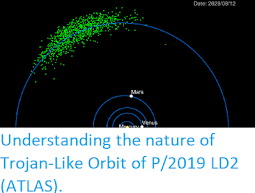
Understanding the nature of Trojan-Like Orbit of P/2019 LD2 (ATLAS).

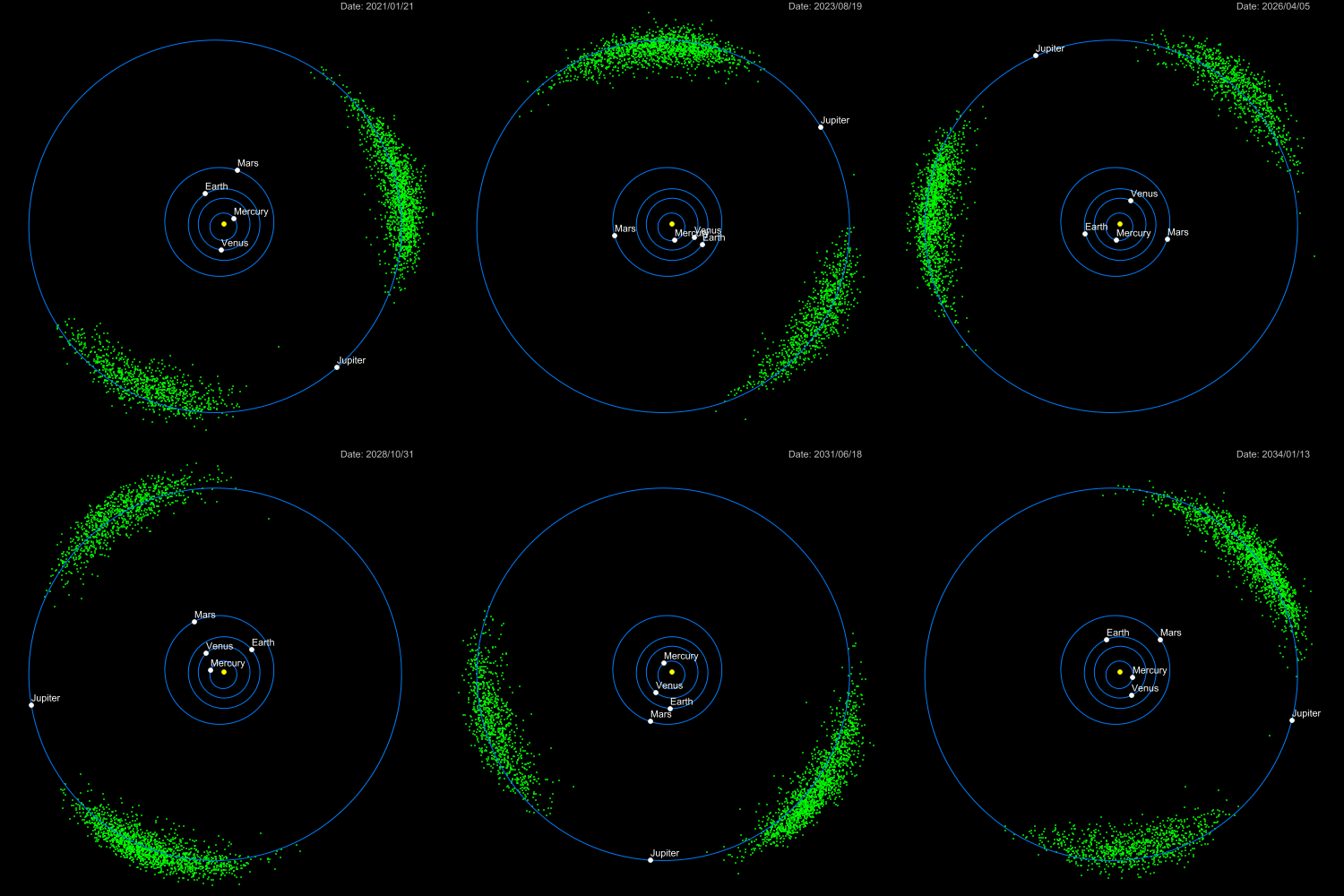
The Jupiter Trojans are small solar system bodies that share Jupiter’s orbit around the Sun and reside in one of two 'clouds' associated with the stable L4 and L5 Lagrange regions located 60 ahead of and behind the planet in its orbit. Their origins are currently uncertain, with potential scenarios under debate including formation near their current locations and capture by Jupiter from source regions farther out in the Solar System. Observational studies have shown the population to consist primarily of C-, P-, and D-type asteroids, where measurements of low densities for some objects indicate that they could be highly porous, volatile-rich, or both. Thermal models have shown that water ice could remain preserved on Jupiter Trojans over the age of the solar system under just 10 cm of dust at their poles to 10 m of regolith elsewhere. Thus, cometary activity could be possible on Trojans, perhaps triggered by impacts and driven by hypervolatile species like carbon monoxide or carbon dioxide. No active Trojans have been reported to date, however.

Animation showing the motion of the Jupiter Trojan Asteroids. Petr Scheirich/Astronomical Institute of the Czech Academy of Sciences/NASA.

P/2019 LD2 was discovered on 10 June 2019 at a heliocentric distance of 4.666 AU (4.666 times the average distance at which the Earth orbits the Sun) by the 0.5-m Asteroid Terrestrial-Impact Last Alert System telescope on Mauna Loa in Hawaii. Suspected cometary activity in discovery images analysed by the ATLAS team was confirmed by follow-up observations on 11, 13, and 29 June 2019. The object currently has Jupiter Trojan-like orbital elements, with a semimajor axis (average distance from the Sun) of 5.3279 AU, an eccentricity of  0.1407, and inclination relative to the plain of the Solar System of 11.517. If P/2019 LD2 is in fact a Jupiter Trojan, it would represent a unique opportunity to study the volatile content and behavior of a member of this population of objects for the first time and to use the results of those investigations to constrain models of solar system formation.

The calculated orbit and current position of  P/2019 LD2 (ATLAS). JPL Small Body Database.

However, a heliocentric ecliptic latitude and longitude plot of P/2019 LD2 and other Jupiter Trojans at the time of the object’s discovery gives an indication that P/2019 LD2 might not be a true Jupiter Trojan, as it much closer to Jupiter in ecliptic longitude (roughly 10°) than any other Jupiter Trojans (roughly 40-100°) and does not clearly belong to either the L4 or L5 clouds. Dynamical analyses suggest that P/2019 LD2’s orbital elements are unstable, inconsistent with the behavior expected of a true Jupiter Trojan, while similar analyses disputing P/2019 LD2’s classification as a Jupiter Trojan were reported by amateur astronomers Sam Deen and Tony Dunn in posts to the Minor Planet Mailing List.

In a paper published on the arXiv database at Cornell University on 28 July 2020, and submitted to the journal Icarus, Henry Hsieh of the Planetary Science Institute and the Institute of Astronomy and Astrophysics at Academia Sinica, Alan Fitzsimmons of the Astrophysics Research Centre at Queens University Belfast, Bojan Novaković of the Department of Astronomy at the University of Belgrade, and Larry Denneau and Aren Heinze of the Institute for Astronomy at the University of Hawaii, present numerical integration results confirming and characterizing the non-Trojan-like dynamical behavior of P/2019 LD2 and briefly discuss the implications of this object for current and future surveys.

To assess P/2019 LD2’s dynamical nature, Hsieh et al. generated 100 dynamical clones drawn from the multivariate normal distribution for the object (as of i June 2020), defined by an orbital covariance matrix, provided by the JPL Small Bodies Database. Dynamical clones werer used to assess the amount of potential divergence due to chaos in P/2019 LD2’s predicted orbital evolution that could occur due to the object’s orbital element uncertainties. Hsieh et al. also performed the same procedure for six reference Jupiter Trojans: (588) Achilles, (624) Hektor, and (659) Nestor from Jupiter’s L4 Trojan cloud and (617) Patroclus, (884) Priamus, and (1172) Aneas from the L5 cloud. They then conducted backward and forward numerical integrations for all objects and their clones for 1000 years in each direction, using the Bulirsch-Stöer integrator in the Mercury N-body integration package. To study the long-term stability of P/2019 LD2, Hsieh et al. conducted forward integrations for 1 million years for all test particles. All integrations accounted for gravitational perturbations from the seven major planets except for Mercury and used an initial time step of 0.1 days. In all integrations, particles are removed when they reach over 100 AU from the Sun. Non-gravitational forces were not included.

An image of P/2019 LD2 (ATLAS) taken from the Las Cumbres Observatory at Cerro Tololo in Chile on 11 June 2019. James Armstrong/Institute for Astronomy/Las Cumbres Observatory/Space.com.

Hsieh et al. confirm that P/2019 LD2 is only temporarily in a Jupiter Trojan-like orbit, while they find its overall dynamical behavior to be that of an active Centaur transitioning into a Jupiter-family comet. Hsieh et al. found that P/2019 LD2’s semimajor axis became Jupiter Trojan-like (with a semi-major axis of between 5.0 and 5.4 AU) in July 2018 and will remain in that range until February 2028. The transitions into and out of P/2019 LD2’s current orbit correspond to close encounters with Jupiter for all P/2019 LD2-associated test particles (i.e., the object itself as well as all of its dynamical clones) Hsieh et al.'s integrations when the object passed within 0.09 AU (or 0.25 of the Jupiter Hill radius, where 0.355 AU is Jupiter’s Hill radius; the radius within which an object can potentially become a satellite of Jupiter) from Jupiter on 20 February 2017, and will pass within 0.12 AU (0.34 Jupiter Hill radius) from Jupiter on 12 May 2028.

Immediately prior to reaching its current Jupiter Trojan-like orbit in July 2018, P/2019 LD2’s orbital elements. An object is considered a Centaur if both its perihelion (the closest point on its orbit to the Sun) and its semi-major axis (average distance from the Sun) fall between the orbit's of Jupiter and Neptune, and it is not in a 1:1 mean-motion resonance with any planet. P/2019 LD2 is expected to return to a Centaur-like orbit in February 2028 and remain there until February 2063, when a very close encounter with Jupiter at 0.03 AU (0.08 of the Jupiter Hill radius) in January 2063 will lower both its semimajor axis and perihelion distance to well inside the orbit of Jupiter, at which point, the object will be considered a Jupiter Family Comet. For comparison, integrations of our reference Trojans indicate that they remain on stable orbits for the duration of both our backward and forward 1000-year integrations. While the eccentricities of some of these objects drift smoothly over time and their semi-major axis and perihelion exhibit small oscillations, Hsieh et al. see none of the sharp orbital element changes exhibited by P/2019 LD2.

Hsieh et al. found that the orbital evolution trajectories of P/2019 LD2 and all of its dynamical clones in our integrations between 1851 and 2063 are nearly identical, suggesting that their results likely reliably capture P/2019 LD2’s true orbital evolution during this period. However, before and after this time period, which is bracketed by close encounters with Jupiter at distances of 0.5 AU (1.4 of the Jupiter Hill radius) in November 1850 and 0.03 au (0.08 of the Jupiter Hill radius) in January 2063, trajectories from Hsieh et al.'s integrations for P/2019 LD2 and its dynamical clones diverge widely. This divergence is a result of the chaotic nature of P/2019 LD2’s orbit, especially during close encounters with Jupiter, and indicates that predictions about the object’s dynamical behavior before 1851 or after 2063 should be regarded as highly uncertain. Consideration of non-gravitational perturbations due to cometary outgassing could introduce even more uncertainty to our analysis of P/2019 LD2’s orbital evolution, but given the expected weakness of any cometary activity at these large heliocentric distances, Hsieh et al. expect outgassing perturbations to be essentially negligible compared to e ffects from the close encounters with Jupiter.

In Hsieh et al.'s 1 million year forward integrations of its nominal orbit, the semi-major axis of P/2019 LD2 passes 100 AU (and is removed from the integrations) in 990 000 years (with many significant orbital element changes during that time), while the semi-major axis all but three of its dynamical clones also pass 100 AU within 1 million years with a median lifetime of 110 000 years. This dynamical evolutionary behavior is consistent with current short-period comets, and contrasts sharply with our six reference Trojans, all of which remain in e ffectively the same orbits for the full 1 million year integrations, further highlighting the dynamical distinction between P/2019 LD2 and true Jupiter Trojans.

Despite the findings described above, it is possible that P/2019 LD2 could have been a true Jupiter Trojan in the past and was driven onto its current orbit by non-gravitational perturbations arising from its cometary activity or other e ects. Jupiter Trojans are expected to occasionally escape from their stable orbits due to chaotic di usion or collisions, and potentially contribute to other populations such as Centaurs and Jupiter Family Comets, and cometary non-gravitational perturbations could certainly accomplish similar e ffects. Given the object’s clearly un-Trojan-like recent orbital history, however, we consider this to be an implausible scenario. There is no reason that P/2019 LD2’s current transient resemblance to Jupiter Trojans should suggest that it is necessarily more likely than any other Centaur to have been a Jupiter Trojan in the past. Nonetheless, a future analysis of escape trajectories from the Trojan clouds involving non-gravitational perturbations due to cometary outgassing could be useful for assessing the potential contribution of active Jupiter Trojans to the Centaur and Jupiter Family Comets populations. In the meantime, observational characterisation of P/2019 LD2’s surface to determine if it has the ultrared colours of other Centaurs or has C-, P-, or D-type colours similar to other Jupiter Trojans would be very useful for confirming the object’s true origin.

While P/2019 LD2 is not a true Jupiter Trojan, its discovery is nonetheless instructive. Current surveys like ATLAS will continue to discover active objects, some of which may belong to populations not previously known to exhibit activity, and upcoming surveys like the Vera C. Rubin Observatory’s Legacy Survey of Space and Time promise to discover even more. The temporary capture of objects onto Trojan-like orbits is not expected to be frequent, but also not exceedingly rare, where Hsieh et al. note that temporary satellite captures could also be found to have nominally Trojan-like orbital elements. As such, more cases like P/2019 LD2 should be expected in the future.

Computationally scalable approaches for accurately dynamically classifying objects of interest discovered by wide-field surveys in a timely manner will be needed for both largescale population studies and investigations of individual targets, especially as discovery rates increase. To identify true Jupiter Trojans, possible approaches include using Lyapunov Characteristic Exponent values or proper orbital elements to ensure that a given object is in a stable 1:1 mean-motion resonance with Jupiter. Both proper orbital elements and Lyapunov Characteristic Exponent values are currently provided by the AstDyS-2 website for all numbered and multi-opposition Jupiter Trojans, and preparations are being made to continue doing so in the Legacy Survey of Space and Time era, although their computation typically requires relatively high-quality orbits. For newly discovered objects of high interest that have lower-quality orbits, it may be useful to develop mechanisms for performing more rapid preliminary dynamical analyses using N-body integrations as was done in this work (perhaps also allowing for cometary non-gravitational perturbations).

While recent sharp decreases in P/2019 LD2’s semimajor axis and perihelion distance are perhaps the most plausible trigger of its current activity, tidal disruption or resurfacing from the object’s close encounter with Jupiter in 2017 could also have contributed to making cometary activity more likely by disrupting surface material and excavating buried surface ice. In this regard, systematic N-body integration analyses could also be useful for identifying small bodies that have experienced recent close planetary encounters so that they can be monitored for possible cometary activity.

See also...


Follow Sciency Thoughts on Facebook.

Friday, 28 December 2018

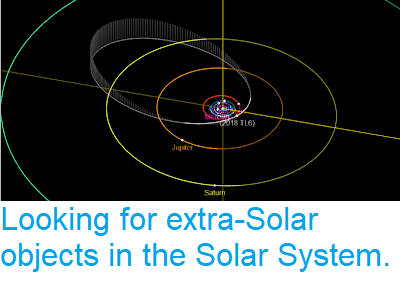
Looking for extra-Solar objects in the Solar System.

Whilst astronomers have known for a long while that our Solar System was likely to contain objects of extra-Solar origin (i.e. from outside the system), but since the passage of interstellar object `Oumuamua (or 1I/2017 U1, or A/2017 U1) through the Inner Solar System in 2017, interest in the subject has grown. This has led to a search for other extra-Solar objects within the Solar System, with one more object, asteroid (514107) 2015 BZ509, having been suggested as to be a possible candidate object, on the basis of an orbit unlikely to have originated within the Solar System.

In a paper published on the  arXiv database at Cornell University Library on 23 November 2018, and submitted for publication in the Monthly Nottices of the Royal Astronomical Society, Amir Siraj and Abraham Loeb of the Department of Astronomy, Harvard University, describe a method for looking for new extra-Solar objects within our Solar System, and suggest four more candidate objects.

Siraj and Loeb estimate that about twelve extra-Solar objects enter the Solar System each century, and that there are about 6000 such objects in the Solar System at any given time. In order to determine where to look for such objects they used a computer model of the Solar System to plot the course of simulated extra-Solar objects through the system, finding that 2.571% of such objects were captured due to gravitational interactions with the Sun and Jupiter.

These objects became captured in orbits with average distances from the Sun of between 0.49 AU (i.e. 49% of the distance of the distance at which the Earth orbits the Sun) and 2000 AU, with 25%  of objects orbiting at an average distance of less than 6.9 AU, 50% at less than 13 AU, and 75% at less than 28 AU. Furthermore, the objects had aphelion distances (furthest points from the Sun on their orbits) of up to 4000 AU, with an average of 21 AU from the Sun, with 25% of objects having aphelions of less than 9.6 AU and 75% at distances of less than 50 AU. The objects had an average perihelion (closest point on their orbit to the Sun) of 4.0 AU, with 25% having perihelions of less than 2.6 AU and 75% having a perihelion of less than 4.9 AU.

The objects had an avarage orbital eccentricity of 0.74 (where 0.00 is a circular orbit and 1.00 is a straight line), with 50% of objects having an eccentricity of between 0.54 and 0.89. The objects had an average inclination to the plain of the Solar System of 33 °, and 50% of objects orbiting at inclinations of between 24 ° and 47 °, and a maximum inclination of 160°. Finally these objects had an average orbital period of 42 years, with  25% of objects having orbital periods of less than 17 years and 75% of objects having orbital periods of less than 140 years.

In order to look for candidate extra-Solar objects, Siraj and Loeb concentrated on the Centaurs, a population of Solar System bodies on paths that cross the orbits of the major planets of the Outer Solar System (a body is defined as a Centaur if its orbit brings it no closer to the Sun than the planet Jupiter, but its average distance from the Sun is less than that of Neptune). They searched previously published records for Centaurs with average distances from the Sun of between 6.9 AU and 28 AU, and eccentricities of between 0.54 and 0.89, and concentrated on objects with inclinations to the Solar plain of greater than 77° (the majority of extra-Solar objects are predicted to have inclinations lower than this, however the majority of non-extra-Solar objects also have lower inclinations, and objects with such high inclinations are thought to be more likely to have an extra-Solar origin, since the the majority of Centaurs are thought to have a common origin, having been pulled inwards from the Scattered Disk by the gravitational pull of the planet Neptune, and it is very difficult for such objects to reach highly inclined orbital paths).

They found four objects that matched these criteria, 2018 TL6, which has an orbit that takes it from 1.72 to 14.8 AU from the Sun, with an average of 8.26, an inclination of 170.9° (or an inclination of 9.1° and a retrograde orbit, an orbit in the opposite direction to almost everything else in the Solar System), and an eccentricity of 0.79, 2017 SV13, which has an orbit that takes it from 2.01 to 17.3 AU from the Sun, with an average of 9.65, an inclination of 113.2°, and an eccentricity of 0.79, 2011 SP75, which has an orbit that takes it from 2.27 to 36.8 AU from the Sun, with an average of 19.54, an inclination of 109.1°, and an eccentricity of 0.88, and 2017 RR2, which has an orbit that takes it from 2.63 to 44.7 AU from the Sun, with an average of 23.65, an inclination of 89.1°, and an eccentricity of 0.89.

The orbit and current position of asteroid 2018 TL6, a Centaur and potential extra-Solar object. JPL Small Body Database Browser.

Siraj and Loeb further note that the previously nominated candidate extra-Solar object, (514107) 2015 BZ509, falls within the possible candidate extra-Solar object range established by their model, but does not fall within the most likely part of the distribution range, having an average distance from the Sun and an average eccentricity lower than 75% of the simulated objects (though they do note that these parameters would do make it much easier to spot, and therefore what might be expected of one of the first such objects detected).

The orbit and current position of asteroid 2017 RR2, a Centaur and potential extra-Solar object. JPL Small Body Database.

See also...

https://sciencythoughts.blogspot.com/2018/12/looking-for-colour-changes-on-surface.htmlhttps://sciencythoughts.blogspot.com/2018/10/looking-for-origin-of-asteroid-514107.html
https://sciencythoughts.blogspot.com/2017/10/asteroid-a2017-u1-passes-earth.htmlhttps://sciencythoughts.blogspot.com/2016/02/deciphering-rings-of-10199-chariklo.html
https://sciencythoughts.blogspot.com/2012/11/four-more-asteroids-found-to-be-co.htmlhttps://sciencythoughts.blogspot.com/2012/05/neptunes-trailing-trojans.html
Follow Sciency Thoughts on Facebook.
Tuesday, 25 December 2018

Looking for colour changes on the surface of 174P/Echeclus following a cometary outburst.

The Centaurs are a population of Solar System bodies on paths that cross the orbits of the major planets of the Outer Solar System. A body is defined as a Centaur if its orbit brings it no closer to the Sun than the planet Jupiter, but its average distance from the Sun is less than that of Neptune. The orbits of Centaurs are inherently unstable, due to their frequent close encounters with the major planets, and objects are thought to typically remain a part of this population for no more than ten million years, with new Centaurs being recruited from the Solar System’s Scattered Disk by the gravity of Neptune, and older members of the group either being knocked out of the Solar System altogether or progressing inwards to become Jupiter Family Comets (a comet with a period of under 20 years; the time a comet takes to orbit the sun is referred to as a 'period', the term 'year' being reserved for planets).

The Trans-Neptunian Objects that make up the Scattered Disk are typically reddish in colour, which is attributed to the presence of hydrocarbons on their surfaces that have been irradiated by the Sun for billions of years, while Jupiter Family Comets tend to be neutral in colour. The Centaurs can be split into two populations in terms of colour, one reddish like the Trans-Neptunian Objects, the other Neutral in colour like the Jupiter Family Comets. As Centaurs migrate towards the Inner Solar System, they undergo bouts of cometary activity, in which chunks of the icy material that make up the bodies are heated by the Sun to above their sublimation point (comets are made up of different ices, including water, carbon dioxide and carbon monoxide, which sublimate – pass directly from a solid to a gaseous state – at different temperatures), causing any dust or other material above them to be lost into space, forming a coma (cometary halo) around the body. This process of coma-formation has been directly observed on Jupiter Family Comet 67P/Churyumov-Gerasimenko by the European Space Agency's Rosetta Spacecraft, and is thought to be the driving mechanism of colour change in the Centaurs, as repeated bursts of cometary activity lead to the red hydrocarbon dust on the surface being lost, and the exposure of neutrally coloured ices beneath.

174P/Echeclus is a Centaur with a perihelion (point on its orbit at which it is closest to the Sun) of 5.82 AU (i.e. 5.82 times as far from the Sun as the planet Earth, and just outside the orbit of Jupiter) and an average distance from the Sun of 10.68 AU (10.68 times as far from the Sun as the Earth and slightly outside the orbit of Saturn). It was discovered in March 2000, and since then has been observed to undergo a series of cometary outbursts, the first in December 2005, then two in May 2011, one in August 2016 and one in December 2017.

In a paper published on the  arXiv database at Cornell University Library on 29 November 2018, Tom Seccull and Wesley Fraser of the Astrophysics Research Centre at Queen's University Belfast, Thomas Puzia of the Institute of Astrophysics at the Pontificia Universidad Católica de Chile, Alan Fitzsimmons, also of the Astrophysics Research Centre at Queen's University Belfast, and Guido Cupani of the Osservatorio Astronomico di Trieste, present the results of a spectrographic analysis of 174P/Echeclus, based upon observations of the object made before and after the August 2016 outburst with the X-Shooter Spectrograph mounted on the European Southern Observatory's Very Large Telescope in Chile.

The X-Shooter Spectrograph is a medium resolution echelle spectrograph with three arms, that can make simultaneous observations at three separate parts of the light spectrum, 0.30-0.56 μm (near UV to blue), 0.55-1.02 μm (visible light) and 1.02-2.48 μm (near infrared).

This instrument was used to observe 174P/Echeclus on two occasions, on 3 August 2014, when it had been inactive for over three years, and on 7-8 October 2016, roughly six weeks after the August 2016 outburst, when the coma from that outburst was still present. On both occasions stars in the field with known light spectra were used to calibrate the spectrograph, with HD 198289, HIP 107708, and HIP 105408 included in the 2014 observations and HIP 107708 and HD 16017 in the October 2016 observations (the presence of HIP 107708 in both sets of observations provides extra support for the validity of the calibration).

A debiased, flat-fielded, 45 second r' exposure of Echeclus and its coma, observed with X-Shooter's Acquisition and Guiding Camera on 7 October 2016. The dashed ring has a radius of 26’’ (~ 1 x 10⁵ km at Echeclus) and is centred on the nucleus, marking the point at which the radially averaged surface brightness of the coma blends into that of the background sky. The small black rectangle marks the size and average orientation of X-Shooter's slit while obtaining spectra of Echeclus on 7 October 2016. Seccull et al. (2018). 

Seccull et al. could find no difference between the light spectra of 174P/Echeclus in August 2014 and October 2016. This is does not present any difficulty for the theory that the outbursts progressively change the colour of Centaurs, as it could indicate that the outburst occurred over an area too small to be observed from the Earth, or pointing away from us at the time of the observations; this observation neither supports nor contradicts the theorem.

The coma generated by the August 2016 outburst still largely surrounded 174P/Echeclus at the time of the October 2016 observations, and therefore was also captured by these observations. Surprisingly, this coma was markedly blue in colour, not just compared to the (reddish) parent body, but compared to the visual spectrum of the Sun. This could be a result of sorting within the coma, as larger hydrocarbon molecules tend to be bluer than smaller ones, and become bluer as they are broken down by solar irradiation, and hydrocarbon molecules are known to make up about 50% of the material within cometary halos. This would have the effect that as smaller hydrocarbon molecules are lost from the coma into surrounding space the coma would become dominated by larger molecules and their break-down product, and therefore become progressively bluer. Should enough material from sorted, large-molecule comas settle back onto the parent body, this could potentially have the effect of neutralising the red colour of that body, providing an explanation for the apparent colour change seen in Centaurs. However, it cannot be ruled out that the blue colour observed is the result of the angle from which the coma was observed, a result of light refraction within the cometary halo.

A zoomed contour plot of the top image after it was smoothed with a gaussian filter. It has linear scaling, and shows the observed morphology of Echeclus' coma, which is similar to that observed in our g' filter image on the same night. The lowest contour is set at one standard deviation of the background noise above the median background level. The + symbol marks a background source that is unrelated to Echeclus. Seccull et al. (2018). 

See also...

https://sciencythoughts.blogspot.com/2018/10/looking-for-origin-of-asteroid-514107.htmlhttps://sciencythoughts.blogspot.com/2016/02/deciphering-rings-of-10199-chariklo.html
https://sciencythoughts.blogspot.com/2013/10/asteroids-in-retrograde-orbits.htmlhttps://sciencythoughts.blogspot.com/2012/11/four-more-asteroids-found-to-be-co.html
https://sciencythoughts.blogspot.com/2012/05/neptunes-trailing-trojans.htmlhttps://sciencythoughts.blogspot.com/2012/03/stability-of-neptunes-trojan-asteroids.html
Follow Sciency Thoughts on Facebook.