The World Health Organization has validated The Gambia
for having eliminated Trachoma as a public health problem, making it
the second country in the World Health Organisation’s African Region to achieve this milestone, according to a press release issued on 20 April 2021. 'This is a great step towards the 2030 goals set by the recently
launched 2021–2030 road map for neglected tropical diseases,' said Ren Minghui, the World Health Organisation’s Assistant Director-General for Universal Health
Coverage/Communicable and Noncommunicable
Diseases. 'Gambia has become the second country this year, after
Côte d’Ivoire, to eliminate a neglected tropical disease.'
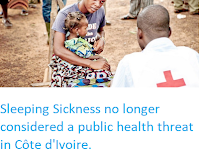
A Gambian mother getting checked for Trachoma. Trachoma is a neglected
tropical eye disease. Infection mainly affects children, becoming less
common with increasing age. Gambia Eye Health Programm/World Health Organisation.
The Gambia’s success in eliminating Trachoma is largely attributed to strong
collaboration with partner organisations to implement the World Health Organisation’s SAFE strategy. 'This is a remarkable achievement that has saved children, mothers and
families from preventable visual impairment or blindness, and improved
their quality of life and well-being,' said Matshidiso Moeti, the World Health Organisation’s
Regional Director for Africa. 'It is also a clear sign that we can achieve significant milestones
through dedicated efforts in tackling health challenges in the region.'
At the heart of the efforts against trachoma are Gambian community
volunteers, who have played a crucial role in mobilizing communities and
promoting behaviour change.
A 2018–2019 survey on Trachomatous Trichiasis (the advanced, blinding
stage of trachoma) in Gambia found that the prevalence of this condition
among people aged 15 years and above ranged from 0% to 0.02%, well
under the threshold required
for elimination of Trachoma as a public health problem. This is a huge achievement compared to the mid-1980s, when a national
survey estimated that Trachoma was responsible for almost 1 out of 5
cases of blindness, countrywide.
Trachoma is a neglected tropical eye disease. Infection mainly affects
children, becoming less common with increasing age. The long-term
consequences of infection develop years or even decades later. In
adults, women are up to 4 times more likely than
men to be affected by the blinding complications of Trachoma, mainly
due to their close contact with infected children.
The Gambia and the World Health Organisation will continue to closely monitor previously endemic
populations to ensure there is a rapid, proportionate response to any
resurgence of the disease.
Despite The Gambia’s success, Trachoma remains endemic in 27 countries in the World Health Organisation’s African Region, and 29 countries on the African continent overall.
Progress against neglected tropical diseases has alleviated the Human
and economic burden they impose
on the world’s most disadvantaged communities. The 2021–2030 road map for neglected tropical diseases seeks to prevent, control, eliminate or eradicate 20 diseases
by 2030.
Globally, Trachoma remains a public health problem in 45 countries, with
an estimated 137 million people living in areas endemic for the
disease. Significant progress has been made over the past few years,
the number of people requiring antibiotic
treatment for Trachoma elimination in the African Region fell by 72
million from 189 million in 2014 to 117 million in 2020.
Trachoma is a devastating eye disease caused by infection with the Bacterium Chlamydia trachomatis. The infection spreads from person to
person through contaminated fingers, fomites and flies that have come
into contact with discharge from the eyes
or nose of an infected person.
Environmental risk factors for Trachoma transmission include poor
hygiene, overcrowded households, inadequate access to water, and
inadequate access to, or use of, proper sanitation facilities.
Repeated infections in childhood lead to scarring of the inner side of
the upper eyelids, resulting in inward turning of the eyelid margin,
with the lashes touching the globe. This is a painful condition known
as Trachomatous Trichiasis, if
left untreated, this condition can result in visual impairment and
blindness.
In 1996, the World Health Organisation launched the WHO Alliance for the Global Elimination of Trachoma by 2020. With other partners in the Alliance, the World Health Organisation
supports country implementation of the SAFE strategy and the
strengthening of national capacity through epidemiological
assessment, monitoring, surveillance, project evaluation and
resource mobilisation.
Elimination of Trachoma is inexpensive, simple and extremely cost-effective, yielding a high rate of net economic return.
Chlamydia trachomatis is a member of the Chlamydiae, a diverse group of Bacteria which are generally pathogenic. Most well understood members of Chlamydiae are intracellular parasites of Animals and single-celled Eukaryotes, and it has long been presumed that these Bacteria were obligate parasites, incapable of living or reproducing outside of Eukarotic cells. However, some free-living species have recently been discovered in deep marine environments, although little is yet known about the life-cycle of these Bacteria.
See also...


.png)


.png)


.png)