The Ediacaran Fauna comprises a group of fossils from the Late
Ediacaran Period, found at sites around the world and pre-dating the Cambrian
Explosion, which is considered to indicate the origin of the majority of modern
animal groups, and in particular those with mineralized skeletons. Some
biologists have suggested that these organisms represent an entirely separate
experiment in multicellular organization (referred to as Vendozoans), and that
they are not ancestral to any modern animals (collectively referred to as
Metazoans). Others see similarities between some members of the Ediacaran Fauna
and extant animal groups, and suggest that they fossil assemblages contain
members of the Phyla Porifera (Sponges), Cnidaria (Jellyfish, Corals, Sea
Anemones etc.) and even groups such as Molluscs and Echinoderms. Under this
second hypothesis the Ediacaran fossils represent true Metazoan Animals,
although some of them probably belong to groups now extinct.
The specimens were collected by the Australian National Facility
Research Vessel ORV Franklin in 1986, from two site on the Australian
continental shelf at depths of 1000 and 400 metres, as parts of bulk samples
containing benthic bathyal invertebrates with a sled which collected both
sediments and organisms from the seafloor. Larger specimens were removed by
hand, then the samples were passed through a number of sieves, before washing
and storing in 80% ethanol for later analysis. The specimens were taken to
Canberra for examination, where they were inadvertently treated with absolute
alcohol instead of 80% ethanol, resulting in some damage to the specimens
(strong shrinkage and rendering the specimens glassy and brittle), and
furthermore making them unsuitable for genetic analysis. Once the uniqueness of
the specimens was realised, the collection sites were revisited in the hope of
collecting more, but both locations were found to be bleached (denuded of
epibenthic invertebrates)
The specimens are considered to belong to a new genus, named Dendrogramma in reference to its
branching gastric system, and this is placed within a new family, named Dendrogrammatidae.
It is considered highly likely that these animals belong to a completely new
Phylum, but due to the damage caused to the specimens, the lack of genetic data
and the inability to locate any further specimens, Just et al. refrain from establishing any higher taxonomy.
The first new species is named Dendrogramma enigmatica,
in reference to its enigmatic nature. The species is described from 13
specimens collected from a depth of 1000 m off Point Hicks and 1 specimen
collected from a depth of 400 m off the Freycinet Peninsula on Tasmania. These
are roughly mushroom-shaped, with a disk-shaped body and a stalk. The mouth is
at the end of the stalk, connected to the body by a gastrovascular canal or
pharynx within the stem, then branches numerous times within the body disk. The
disk has a distinct notch and the mouth has two lobes. The largest specimen is
11 mm in diameter and has a 7.8 mm stem.
Dendrogramma enigmatica. (A, B) Lateral views; (C) aboral view, (D) adoral view. Photographs
taken after shrinkage. Just et al. (2014).
The second species is named Dendrogramma discoides,
in reference to the shape of its body-disk, which lacks the notch seen in Dendrogramma enigmatica. This species is
described from four specimens collected from a depth of 1000 m off Point Hicks.
The largest is about 17 mm in diameter, with a 4.5 mm stalk. This species has
three lobes to the mouth rather than two.
Dendrogramma discoides, (A) aboral view. (B) Enlargement of (A) showing gastrovascular canal
(stippled) of stalk (pharynx) and point of connection to the first branching
node of gastrovascular system of the disc. (C) Oblique oral view of trilobed mouth-field
with mouth opening in centre; entire pharyngeal part of the gastrovascular
system is shown. Just et al. (2014).
The new animals have a simple diploblasic bodyplan, with two dermal
layers, the epidermis (outer skin) and the gastrodermis (lining of the
gastrovascular system) separated by a gelatinous mesoglea (tissue thought to
have a structural role, helping the animal keep its shape, but no other
function). This is seen in two other groups of living animals, the Cnidarians
(Jellyfish etc.) and the Ctenophores (Comb Jellies). However they have no other
anatomical features seen in either of these groups.
Traditional classifications of modern animals have always regarded
the Porifera (Sponges) as the sister group of all other animals, due to their
lack of a permanent body structure or tissue (a Sponge squeezed through a sieve
and broken into its component cells can simply reassemble itself) and
resemblance to colonies of the single-celled Choanoflagellates. The Cnidaria
and Ctenaphora, having similar levels of organisation are considered to be
ancient branches on the animal family tree, predating the origin of the Bilateria
(the group including all familiar animals other than Cnidarians, Sponges and
Comb Jellies). However recent genetic studies have suggested that the
Ctenaphores might be the most ancient branch on the animal family tree,
diverging before the Sponges and reaching their current level of organization
through parallel evolution rather than a close relationship with the
Cnidarians.
This clearly has implications for the phylogenetic position of Dendrogramma. If the Cnidaria and
Ctenaphora are closely related then Dendrogrammai s
likely to be closely related to both, but if they are only distant cousins,
then the position of Dendrogramma on
the animal family tree is harder to determine.
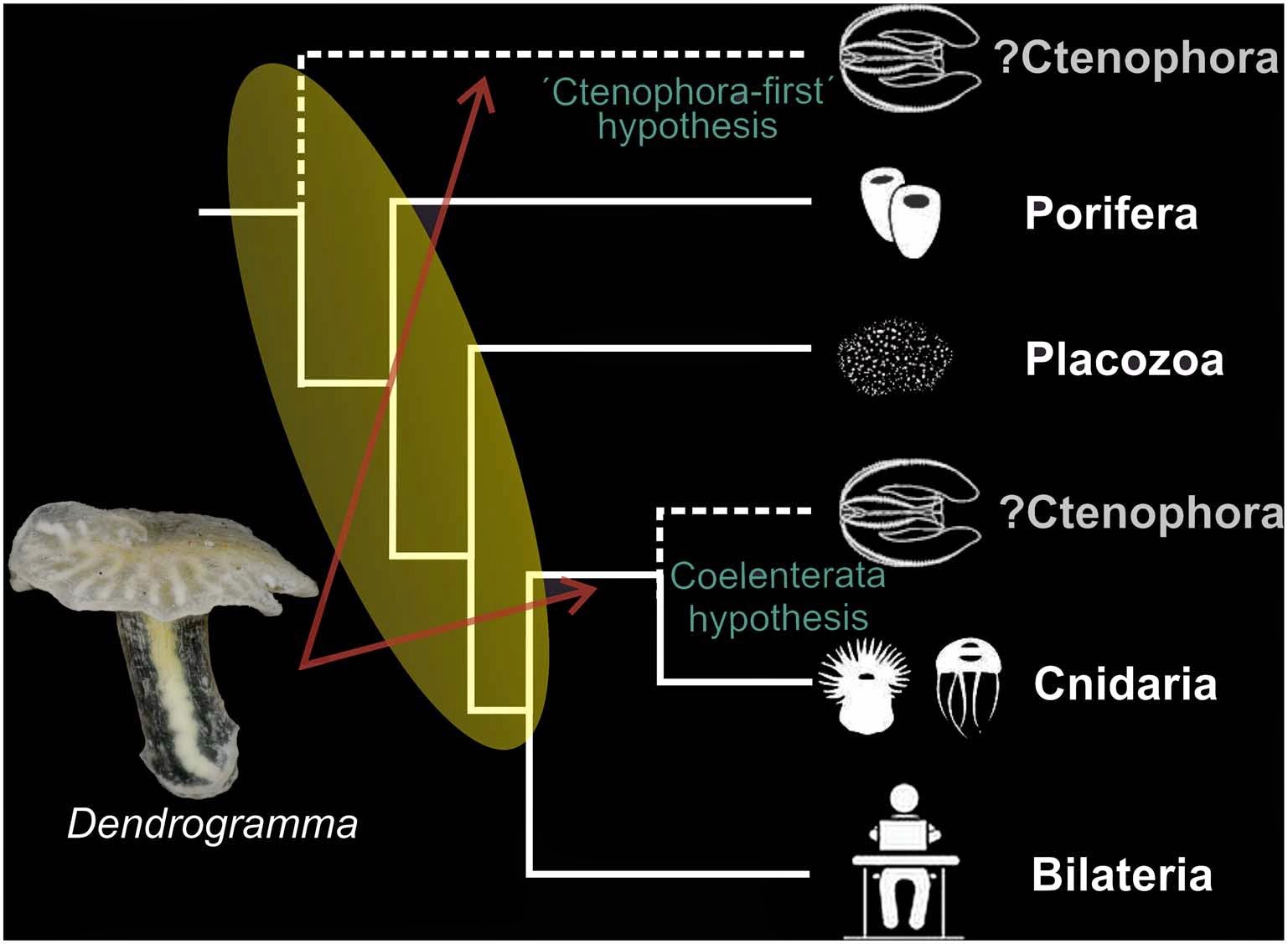
Possible positions of Dendrogramma in a simplified phylogeny showing the deepest splits
in the metazoan Tree of Life. The position of Ctenophora is controversial so
two possibilities have been shown with dashed lines, one as sister group to the
remaining metazoans (the ‘Ctenophora-first’ hypothesis), and one as sister
group to Cnidaria (Coelenterata hypothesis). Just et al. suggest that Dendrogramma most
likely is related to Ctenophora and/Cnidaria (red arrows) due to general
similarities in body organisation. However, depending on the position of Ctenophora
and on whether certain aspects of Dendrogramma
(e.g., mesoglea and gastrovascular system) are ancestral for Metazoa or
modified, Dendrogramma can be
positioned in a variety of ways below Bilateria (yellow oval). Just et al. (2014).
Dendrogramma also shows a resemblance to some fossils from the Ediacaran fauna,
notably Albumares brunsae, Anfesta stankovskii, and Rugoconites. These fossils
share a similar morphology to Dendrogramma,
with a disc-shaped body containing a system of branching canals similar to the
gastrovascular system of Dendrogramma,
although all are considerably larger. In addition Albumaresbrunsae and Anfestastankovskii
have tri-lobed mouths, similar to those seen in Dendrogramma discoides. The branching system of Rugoconites tenuirugosus appears initially branch three times, while
that of Dendrogramma always branches
twice (giving its branches a ‘Y’ shape), but Just et al. estimate that if Dendrogramma
was also preserved in the same position, then it would also appear to have an
initial three-way branch, suggesting that this could also be an artefact in Rugoconites tenuirugosus.
(1)Albumares brunsae,
(2) Anfesta stankovskii, (3) Rugoconites enigmaticus. Just et al. (2014).
This means that if the phylogenetic position of Dendrogramma can be resolved, then this can be used to infer that
of Albumares, Anfesta, and Rugoconiteste, providing
further insight into the relationships between Ediacaran and modern faunas, and
helping to resolve the Vendazoan hypothesis (since if Dendrogramma can be shown to be related to a modern animal group,
then presumably the Ediacaran fossils that resemble it also do so).
See also…
The fossils of the Ediacaran Period record the first widespread
macrofossils in the rock-record. Many of these fossils do not appear to belong
to any modern group, but instead are thought to belong to an extinct taxa
(sometimes known as ‘Vendobionts’), which may-or-may-not be related to modern
Animals, though some fossils have been linked to Sponges (a group which...
Most modern animal groups appear abruptly at, or very shortly after, the
beginning of the Cambrian period, 542 million years ago. The Cambrian
starts abruptly with a layer of small shelly fossils that are hard to
assign to any group, which are then replaced abruptly by fossils
belonging to more familiar groups; arthropods, molluscs, brachiopods,
etc., which then persist...


