Showing posts with label Hagfish. Show all posts

Friday, 21 June 2024

The deep history of the Hagfish.

The deep oceans serve as refugia for many groups of Animals which have effectively vanished in the shallow seas, including Coelacanths, Vampire Squid, Crinoids and Brittlestars, the living graptolite genus Rhabdopleura and other colonial Hemichordates, and several lineages of deep-sea Isopods, all of which seem to have diverged from their closest shallow-marine relatives more than 200 million years ago. Although generally thought of as evolutionary relicts, most of these groups appear to have undergone significant evolutionary diversification since entering the deep seas.

The Vertebrates underwent their first major evolutionary radiation in the oceans between the Ordovician and the Devonian, or between about 480 and 360 million years ago. Most living deep-sea Vertebrates, however, belong to a few relatively young groups, stemming from diversification events less than 100 million years ago. 

Although the first Vertebrates were jawless, by the End of the Devonian these had largely been eclipsed by jawed taxa, and today only two groups of Jawless Vertebrates survive, the Hagfish, Myxiniformes, and the Lampreys, Petromyzontiformes. The relationship between these groups, as well as the timing of divergence events between them, and within each group, remains unclear, though comparative genomic analysis has now confirmed that the two groups can be regarded as sister taxa (a variety of other relationships had been proposed, including a sister relationship between the Lampreys and Jawed Vertebrates, with the Hagfish being more distantly related to the two).

Hagfish form a significant proportion of the total biomass of Vertebrates on the deep ocean floor, with most species found on the continental slopes and ocean floors, between 200 m and 3 km beneath the surface, where they form an important part of the benthic ecosystem. Some species are found on the shallower ocean shelves, but these are rare. 

Hagfish have an Eel-like body with poorly developed eyes, a loose, scale-less skin, a minimal skeleton comprising a cartilaginous skull and rudimentary vertebrae, several auxiliary hearts, a mouth surrounded by barbels (short tentacles), a single nostril, and a single semicircular canal. The tongue of the Hagfish comprises a cartilaginous plate with two pairs of horny teeth, used to seize food and draw it into the mouth. 

In a paper published in the journal BMC Ecology & Evolution on 13 June 2024, Chase Doran Brownstein of the Department of Ecology and Evolutionary Biology at Yale University, and Thomas Near, also of the Department of Ecology and Evolutionary Biology at Yale University, and of the Yale Peabody Museum, present a time-calibrated phylogenetic tree for the Myxiniformes using data from fossils as well as a genetic dataset which includes 60% of living species of Hagfish.

Brownstein and Near were able to obtain sequences for the mitochondrial COI and 16S ribosomal DNA genes for 44 species of Hagfish from the GenBank database. This sample included two species of Rubicundus, two species of Neomyxine, 14 species of Myxine, and 26 species of Eptatretus, with an additional three potential species of Eptatretus from India, Japan, and Korea. the problematic ‘Notomyxine’ (= Myxine) tridentiger and several species   previously classified in ‘Quadratus’ and ‘Paramyxine'. 

This represents more than 50% of all known extant Hagfish species, although it does not include the problematic genus Nemamyxine, known only from two preserved specimens collected in the mid-twentieth century, with no genetic material available. This makes it impossible to place the genus Nemamyxine within a phylogenetic tree based upon genetic analysis, although Brownstein and Near note that it is thought to have close affinities to the genus Rubicundus, but also that there are problems with the validity of the genus. Both Nemamyxine and Rubicundus are defined as having an extremely slender body and an anteriorly placed ventral finfold that originates anterior of the ventral gill apertures, but this is also seen in many members of the genera Myxine and Eptatretus, as well as the Late Cretaceous fossil Hagfish, Tethymyxine tapirostrumNemamyxine is also defined as having a slender body depth and high slime pore counts, but these are also widespread in elongated Hagfish.

The first of two known specimens of Nemamyxine elongata, one of two described species in the genus Nemamyxine, which was found dead in a net in the Kaituna River on the Bay of Plenty on North Island, New Zealand, in 1958, and thought to have been a fishery discard. A second specimen was later recovered by a trawler from  the Canterbury Bight on the east coast of South Island, from a depth of between 132 and 140 m. Museum of New Zealand Te Papa Tongarewa.

Brownstein and Near constructed phylogenies using both maximum likelihood and Bayesian methods, and the online Clustal Omega tool at the European Molecular Biology Laboratory - European Bioinformatics Institute online resource portal to aid in 16S alignments. For outgroups they used the jawed Ornate Birchir, Polypterus ornatipinnis, West African Lungfish, Protopterus annectens, and Australian Ghostshark, Callorhincus milii, and the Lampreys Geotria australis, Petromyzon marinus, and Lampetra fluviatilis.

A molecular clock methodology with fossils was used to calibrate the divergence of clades. This is challenging for Hagfish, as the fossil record for the group is extremely limited, and most fossils assigned to the group are poorly preserved and/or of dubious placement. The putative stem-hagfish Myxinikela siroka from the Late Carboniferous Francis Creek Shale of Illinois was included in the study, as was the Late Cretaceous crown group Hagfish Tethymyxine tapirostrum from the Hâdjula Lagerstätte of Lebanon, as were a number of fossil Lampreys (phylogenetically the closest group to the Hagfish).

The putative stem-Hagfish Myxinikela siroka from the Late Carboniferous Francis Creek Shale of Illinois. Miyashita (2020).

Data on the habitat preference of Hagfish species was collected from the FishBase database, with two identified environments, continental shelf (less than 200 m) and continental slope (more than 200 m). These were used to make a probability-based estimation of the ancestral state of Hagfish groups using the R package, with the possibility that species might be flexible in their choice of habitat taken into account using the fitpolyMk function.

Brownstein and Near consistently recovered the three major lineages of Hagfish (the Rubicundinae, Eptatretinae and Myxininae) as  valid and distinct taxa. The genus Neomyxine was recovered as the sister taxon the genus Myxine within the family Myxininae,  rather than being the sister group to all other extant Hagfish, as have been found by some previous studies. The Family Rubicundinae was recovered as the outgroup to other extant Hagfish, something which has been found by some previous studies. The study also suggests that the genera Quadratus and Paramyxine should be included within the genus Eptatretus, and the species Notomyxine tridentiger should be included within the genus Myxine.

Hagfish phylogeny and tempo of diversification. Tip-dated Bayesian maximum clade credibility phylogeny of jawless fishes from two independent runs in BEAST 2.6.6 showing the interrelationships of the major lineages of hagfishes. Bars indicate 95% highest posterior density intervals for divergence times at nodes. Outgroups not shown. Grey bars are at nodes supported by posterior values of 0.90 or more, clear bars are at nodes supported by posterior values of 0.89 or less. Gray columns indicate mass extinction events. Dagger (†) indicates extinct species known from the fossil record. Pie charts indicate ancestral state reconstructions of habitat for each node, where purple represents the probability of a slope component (either slope or shelf-slope) at each node and salmon indicates the probability of continental shelf habitat being ancestral. Inset includes the transition matrix from the polymorphic character ancestral reconstruction analysis (note that purple here is exclusively slope, as opposed to purple denoting slope/shelf-slope at nodes in the phylogeny). Photograph of Eptatretus stoutii is courtesy Douglas FudgeBrownstein & Near (2024).

The results of the study suggest that the three major Hagfish groups diverged from one-another during the Palaeozoic. This did not change when the Carboniferous Myxinikela siroka was included in the matrix, suggesting that the use of this taxon as a calibration point is valid. Brownstein and Near note that they excluded the Mazon Creek 'Hagfish' Gilpichthys greenei from the study, as the affinities of this abundant fossil are now considered highly doubtful. Other phylogenetic studies have included this species, recovering it as either a stem Hagfish, or a Jawless Fish of uncertain affinities. Brownstein and Near suggest that these fossils may be difficult to interpret phylogenetically as most had decayed somewhat before preservation.

The putative Hagfish Gilpichthys greenei from the Mazon Creek fossil beds. Earth Science Club of Northern Illinois.

Brownstein and Near consistently found that the crown Hagfish (a crown Hagfish is any species, living or fossil, which is descended from the last common ancestor of all living Hagfish) arose in the Early Permian, and the split between the Eptatretinae and Myxininae occurred in the Early Triassic. Both events are substantially older than previous studies have suggested, with the diversification of major Hagfish clades until now assumed to have happened in the Middle-to-Late Cretaceous. Brownstein and Near note that the use of mitochondrial DNA has been linked to the overestimation of the age of some groups of Ray-finned Fish, but cannot see how this would lead to the discrepancy between their study and earlier studies of Hagfish which also used mitochondrial DNA. Instead they suggest that the variance is due to the increased number of living species in their study, combined with a stricter approach to the inclusion of fossil species, with less certain species such as Gilpichthys greenei excluded. 

This revised timeline removes a 120 million year gap between the separation of the Hagfish and their closest relatives (the Lampreys), as well as showing that the group have survived three major extinction events, including the End Permian, which wiped out 81% of marine species. This makes the crown group Hagfish one of the oldest known Vertebrate crown groups, and far older than most other marine Vertebrate groups. 

The reconstruction of the Ancestral habits of the Hagfish suggests that the oldest members of the group occupied the continental slopes (more than 200 m beneath the surface) during the Late Palaeozoic. This is despite all known fossil Hagfish coming from coastal slope or estuarine environments. All the major Hagfish groups apparently first appeared on the continental slopes, or at least as organisms with flexible requirements able to inhabit both the continental slopes and shelves.

Hagfish and Lampreys have been the sole surviving jawless Vertebrates since the Triassic Extinction. This makes them important to our understanding of the earliest Vertebrates, although probably atypical of these. 

Brownstein and Near's study suggests that the crown group Hagfish emerged during the Permian, with the three major extant groups having appeared by the end of the Early Triassic, 20-30 million years after the oldest putative Hagfish fossils. It is likely that the stem group Hagfish appeared during a significant radiation event after the extinction of the jawless Ostracoderms at the end of the Devonian. 

Hagfish have a simple bodyplan, which has remained essentially unchanged for a very long time, notably so compared to other ancient Vertebrate groups such as the Teleosts, Chondrichthyans, and Lissamphibians. This highly specialised anatomy appears to have developed before the End of the Permian.

This deep diversification is different to the situation seen in Lampreys, where the extant groups all appear to have derived from a series of regional diversification events within the past 100 million years. Hagfish species appear to have diverged from their closest relatives an average of 31.6 million years ago, compared to 1-2 million years for most Lampreys. The most ancient division for a single species is that for Eptatretus cheni, which appears to have diverged from other members of the genus Eptatretus in the Jurassic. This is a similar timing for the division between the living Neoselachian Sharks and Rays, the Tuatara, Sphenodon punctatus, and the Squamates, or the Salamanderfish, Lepidogalaxias salamandroides, and all other Teleosts.

Eptatretus cheni, not notably different to other members of the genus Eptatretus, but separated from them since the Jurassic. Fish Database of Taiwan/FishBase.

Hagfish taxonomy is a challenging field, due to the conservative morphology of these organisms, and the inaccessible environments in which they live. The widespread genus Rubicundus is the only genus in the family Rubicundinae, and forms the sister group to all other Hagfish, but was not recognised as a distinct genus until 2013. Brownstein and Near's study implies that this genus split from its closest living relatives in the Permian. 

A Pink Hagfish, Rubicundus eos. The genus Rubicundus appears to have diverged from all other extant Hagfish in the Permian. Museum of New Zealand Te Papa Tongarewa.

Brownstein and Near's study also highlights that deep marine habitats have been utilised by Hagfish since the origin of the group in the Permian. Lineages of Myxine and Eptatretus found in shallower continental shelf environments appear to have diversified into these shallower waters relatively recently, with fossil Hagfish from shallow marine environments probably the result of similar diversification events. This makes the Hagfish the Vertebrates the group with the longest history in deep marine environments, with a continuous habitation of these environments long predating the arrival of the ancestors of any extanct Chondrichthyan or Teleost found in the deep seas. 

This inhabiting of deep-sea environments may explain how the group has persisted so long with relatively little apparent evolutionary innovation. Although the group has not  occupied deep marine environments for as long, the oldest surviving Chondrichthyan lineages, such as the Goblin Sharks, Frilled and Sevengill Sharks, Chimeras, and Ratfish, all inhabit deep environments. Thus thee deep sea. environment appears to be a refugia for Vertebrate groups able to live there, offering a degree of protection against  extinction events which heavily impact the shallow seas.

Nevertheless, Hagfish appear to have undergone significant diversification within deep sea environments, with many distinct lineages arising over the time they have dwelt there.

Most Vertebrate groups found in the deep seas have colonised these environments within the last 100 million years. In contrast, many Invertebrate groups have long deep marine lineages. This has led to the view that the deep seas can act as a refugia for groups that can live there during mass extinction events that affect the shallow seas.  Until now, no Vertebrate group has been seen as truly endemic to this refugium, but Brownstein and Near's study suggests that the deep seas are the principle habitat for Hagfish, with modern and fossil shallow-water species being the result of repeated colonisations from deeper marine environments.

See also...

Thursday, 2 July 2020

Eptatretus wandoensis: A new species of Hagfish from the Korea.

Hagfish, Myxinidae, are currently classified into six genera and 81 species worldwide. They are characterised by an Eel-like body shape and 1–16 pairs of gill apertures and gill pouches; however, they have no jaws, eyes, or fins. Recent research using morphological and molecular characteristics revealed that hagfishes comprise three subfamilies: Eptatretinae, Myxininae, and Rubicundinae. There have been several unresolved issues regarding the number of recognized genera in the subfamily Eptatretinae; however, its genera were recently reorganised taxonomically based on morphological and molecular data. Currently, the Eptatretinae includes a single genus, Eptatretus, which is characterised by the presence of more than two pairs of gill apertures; notably, Eptatretus is the most species-rich Myxinid genus, currently comprising 51 valid species in the northwestern Pacific Ocean (e.g. Korea, Taiwan, and Japan) and coastal waters around Asia (e.g. China, Philippines, and Vietnam). Surveys of the deep sea and other hard-to-reach areas using special-purpose submarines are increasingly revealing new or cryptic species worldwide. 

In a paper published in the journal ZooKeys on 13 April 2020, Young Sun Song and Jin-Koo Kim of the Department of Marine Biology at Pukyong National University, describe a new species of Eptatretus, based on examinations of both morphological and genetic characteristics of Hagfish specimens from the southwestern Sea of Korea.

The new species is called Eptatretus wandoensis, where 'wandoensis' means 'from Wando' in reference to Wando County in South Korea; the new species is described from three specimens caught in Fish traps at depths of 60-80 m off the coast of Yeoseo Island, which forms part of Wando County. 

Sampling location of Eptatretus wandoensis in Korea. Song & Kim (2020).

The body of Eptatretus wandoensis is elongated; laterally compressed at the trunk and strongly compressed at the tail. The rostrum is slightly blunt and round. Nasal-sinus papilla are absent. Eyespots are present. The pre-eyespot area is shorter than the branchial region. There are three pairs of barbels on the head, the first and second barbels are nearly equal in size; the third barbel is longer. The tips of the third barbels extend at the mouth. There are five pairs of gill pouches and apertures; the gill apertures are arranged in a regularly spaced straight line. Teeth are comb-like, arranged in two rows with tips sharp and curved rearward; in the outer row there are 3 multicusped and 7–8 unicusped teeth; in the inner row, there are 2 multicusped and 8–9 unicusped teeth; the total number of cusps is 40–43. The dental muscle is thick and long, the posterior tip of the dental muscle is located in first the first gill pouuch. There are 14-18 prebranchial slime pores, 4 branchial slime pores, 46-49 trunk slime pores, and 9-11 tail slime pores, for a total of 74-82. The osterior-most efferent branchial duct is confluent with the pharyngocutaneous duct on the left side, forming a larger aperture. All efferent branchial ducts are equal in length. The ventral aorta consists of two side branchial arteries and one medial section, bifurcating at approximately the third or fourth gill pre. The first through third pairs of afferent branchial arteries, which cannot be regarded as branches of the ventral aorta, branch from side branchial arteries; however, the fourth and fifth afferent branchial arteries on left and right branch from the medial section of the ventral artery. The ventral fin-fold is weakly developed or vestigial, beginning approximately at the middle of the body and extending to the cloaca. The caudal fin-fold is weakly developed, beginning posterior to the cloaca and extending around the tail to the dorsal surface.

Overall view of Eptatretus wandoensis, (A) holotype, PKU 62167, 292.0 mm in total length, (B) paratype, PKU 62169, 202.0 mm total length, (C) paratype, PKU 62171, 290.0 mm total length, (D) paratype, PKU 62173, 275.0 mm total length, photographed prior to preservation. Scale bars are 1 mm. Song & Kim (2020).

The body is uniformly dark brown or purplish dorsally and white ventrally; a white mid-dorsal line is conspicuous, beginning from the upper region of the first prebranchial slime pore to around the tail. The eyespots are conspicuous; the whole barbels are pale, as is the area around mouth. Each gill aperture and pharyngocutaneous duct aperture has a white margin; most slime pores are blackish, except for those of the tail region, which are the same as the surrounding skin in colour. The area around the cloaca is white; the ventral fin-fold has a white line along the ventral midline; the posterior margin of the caudal fin is pale.

See also...

https://sciencythoughts.blogspot.com/2020/07/sinogaleaspis-shankouensis-new-material.htmlhttps://sciencythoughts.blogspot.com/2019/04/hagfish-from-late-cretaceous-hadjula.html
https://sciencythoughts.blogspot.com/2019/01/tarimspira-artemi-new-species-of.htmlhttps://sciencythoughts.blogspot.com/2016/12/ontogeny-in-siphonodellid-conodonts.html
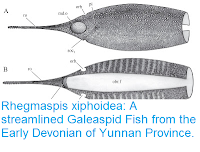
https://sciencythoughts.blogspot.com/2015/09/rhegmaspis-xiphoidea-streamlined.html
Follow Sciency Thoughts on Facebook.

Thursday, 18 April 2019

Hagfish from the Late Cretaceous Hâdjula Lagerstätte of Lebanon.

Hagfish, Myxinoidea, are scavenging Jawless Fish, found in deep marine environments, noted for the prodigious production of sticky slime as a defence mechanism. They are one of only two surviving groups of Jawless Fish, along with the Lampreys, Petromyzontiformes, which are parasitic organisms that attach themselves to Fish with a toothy sucker, and have a reproductive cycle that involves breeding in freshwater environments then migrating to the sea. As the only surviving Jawless Fish these organisms are of great interest to taxonomists (scientists that study the relationships between organisms), for the evidence they can provide on the evolution of Vertebrates as a whole. The earliest taxonomic schemes placed the Hagfish and Lampreys along with a variety of Palaeozoic Jawless Fish in a single group, the Agnathia, with all jawed Vertebrates grouped together as the Gnathostomata. The development of cladistic classification systems (computerised analysis of relationships within the group based entirely upon shared common features rather than assumed relationships) has suggested that the Lampreys might be more closely related to the Gnathostomes than they are to Hagfish, making the Hagfish a very ancient member of the Vertebrate lineage, which branched off before the common ancestor of Lampreys and Gnathostomes. The advent of molecular genetic classification techniques has complicated this situation further, suggesting that the Hagfish and Lampreys are more closely related to one-another than either is to the Gnathostomes, with the two groups being collectively called the Cyclostomes, and the Hagfish thought to have lost many features found in Lampreys and Gnathostomes secondarily due to the extreme environments they inhabit and their specialised lifestyle. However, this did not end the debate on Hagfish classification as molecular taxonomy, whilst considered highly accurate for closely related organisms, is known to be less reliable with organisms only distantly related, with no surviving (or surveyed) intermediate relatives; in such cases a phenomenon called long-chain attraction can cause some distantly related organisms to appear more closely related than others, as random genetic drift causes them to share more DNA sequences by pure chance, something which could be the case with ancient groups such as the Hagfish, Lampreys, and Gnathostomes.

To date only three putative fossil Hagfish have been described, Gilpichthys greenei, and Myxinikela siroka, from the Carboniferous Mazon Creek Formation ans Francis Creek Shale of Illinois and Myxineidus gononorum, from the Carboniferous Montceau-les-Mines Lagerstätte of France, though of these only Myxinikela siroka is now thought likely to be a true Hagfish.

In a paper published in the journal PNAS on 5 February 2019, Tetsuto Miyashita of the Department of Organismal Biology and Anatomy at the University of Chicago, and the Department of Biological Sciences at the University of Alberta, Michael Coates, also of the Department of Organismal Biology and Anatomy at the University of Chicago, Robert Farrar and Peter Larson of the Black Hills Institute of Geological Research, Phillip Manning and Roy Wogelius of the School of Earth and Environmental Sciences at the University of Manchester, Nicholas Edwards, also of the School of Earth and Environmental Sciences at the University of Manchester, and of the Stanford Synchrotron Radiation Lightsource at the SLAC National Accelerator Laboratory, Jennifer Anné, again of the School of Earth and Environmental Sciences at the University of Manchester, and of the Children’s Museum of Indianapolis, Uwe Bergmann, also of the Stanford Synchrotron Radiation Lightsource at the SLAC National Accelerator Laboratory, and Richard Palmer and Philip Currie, also of the Department of Biological Sciences at the University of Alberta, describe a new species of Hagfish from the Late Cretaceous Hâdjula Lagerstätte of Lebanon.

The new species is named Tethymyxine tapirostrum, where ‘Tethymyxine’ means ‘Tethys Hagfish’, in reference to the ancient ocean in which the Hâdjula deposits were laid down, and ‘tapirostrum’ means ‘tapering snout’. The species is described from a single specimen preserved on a slab of lithographic limestone; this is a Hagfish 313 mm in length, preserved lying on its left side with its head twisted counter-clockwise to expose its underside. Like other specimens from the Hâdjula Lagerstätte the specimen shows excellent soft-tissue preservation, in this case including 133 slime glands, eight branchial pouches, and the tentacular cartilage.

Synchrotron rapid-scanning X-ray fluorescence mapping of the specimen revealed that the preserved tissues of the specimen were enhanced in Aluminium, Phosphorous, Sulphur, Manganese, Iron, Copper, Zinc, and Arsenic, relative to the surrounding matrix, while the matrix shows raised levels of Silicon, Calcium and Mercury relative to the preserved tissues, giving a very clear outline to the specimen. Some of the specimen is obscured by glue and paint, potentially making it hard to tell soft tissue features from curatorial artefacts, but these could be clearly distinguished using X-ray absorption spectroscopy, as neither contained any organic sulphur compounds, which were present in both the preserved tissues of the specimen and the matrix.

Tethymyxine tapirostrum, a fossil Hagfish from the Cenomanian of Lebanon. Specimen in right lateral view: (A) photograph; (B) interpretive drawing; (C) false-colour composite of distributions of three selected chemical elements (blue is calcium; green is iron; red is phosphorous) from synchrotron rapid-scanning X-ray fluorescence. The visceral anatomy of the specimen in composite photograph (D) and interpretive drawing (E) in the following colour codes: black for liver lobes; brown for branchial pouches; dark grey for intestine; light grey for preserved amorphous tissues; pink for slime glands; stippled grey for other soft tissues that are preserved with distinct outlines. The cranial anatomy of the specimen in interpretive drawing (F) in which preserved structures are indicated in grey shades and stipples. Abbreviations: ant, anterior; int, intestine; L, left branchial pouch; l, left side; lva, liver, anterior lobe; lvp, liver, posterior lobe; post, posterior; R, right branchial pouch; r, right side. Miyashita et al. (2019). 

The absence of a mineralized skeleton in the specimen rules out the possibility of the specimen being a Bony Fish, such as an Eel, while the absence of an oral sucker, tectal cartilages, branchial basket, dorsal fins, and other features rules out the possibility of it being a Lamprey, while it shows several clear features associated with Hagfish such as a long snout, branchial pouches behind the head and slime glands.

The head is shorter as a proportion of total body length than in living Hagfish, the snout more tapered, and the protruding nasohypophyseal tube appears to be absent. The keratinous tooth plates are preserved in association with the anterior lingual cartilages, though their number and shape are hard to define. The number of branchial pouches (eight) is greater than is found in most, but not all, living species. A structure the right position and shape to be the heart is also enriched in Iron, while the apparent intestine extends between the anterior and posterior liver lobes. The slime glands are clearly marked by their profile, and show elevated levels of chlorine, titanium, manganese, iron, copper, nickel, zinc, mercury, and particularly of calcium, phosphorous, and sulphur, consistent with the tightly coiled, mucin-coated α-keratin threads, which have a high calcium phosphatic content. The number of slime glands (133) is higher than in any living Hagfish, but not exceptionally so (the species Rubicundus eos typically has 128-130 slime glands on each side).

A cladistic analysis carried out including Tethymyxine tapirostrum and based entirely upon morphological, rather than genetic, features, suggests that this new species is a member of the crown group Hagfish (i.e. a descendent of the last common ancestor of all living Hagfish), while the Carboniferous Myxinikela siroka was found to be a stem group Hagfish (i.e. a member of the Hagfish lineage, but one which lived before the last common ancestor of all living Hagfish). Interestingly, and unlike previous attempts to classify Hagfish using only morphological features, Hagfish and Lampreys were found to be sister groups, grouped together as the Cyclostomes, with the Carboniferous Gilpichthys greenei and Myxineidus gononorum found to be stem group Lampreys.

This classification scheme also suggests that the Euconodonts are the sister group of the Cyclostomes, while the Anaspids (bony Jawless Fish from the Palaeozoic) are the sister group of the Cyclostomes plus the Euconodonts, the three groups together forming an Agnathian clade, which is the sister group of the jawed Gnathostomes.

A time-scaled phylogenetic tree of Cyclostomes. (A) Summary tree showing Cyclostome relationships. Maximum parsimony and Bayesian inferences converged onto each other in placing Tethymyxine within the Hagfish crown group and supporting Cyclostome monophyly. The precise topology is from the maximum parsimony analysis. Node ages represent median of 95% highest posterior density interval distribution in a Bayesian molecular clock analysis of mitogenomic sequences (16S and COI) under fossilized birth–death model. The crown group of Cyclostomes is united by at least two morphological characters (shown on each stem): keratinous tooth plates (yellow) and periocular position of trunk muscles (red). At Top Right, the nasohypophyseal profiles are compared in ventral view among three selected crown-group Hagfish (B) Tethymyxine tapirostrum; (C) Rubicundus eos; (D) Eptatretus stoutii. To show morphological divergence among the three major crown groups of living vertebrates (E) Myxinoids; (F) Petromyzontiforms; (G) Gnathostomes, each is accompanied by a chondrocranium in left lateral view (green: neural crest-derived nasohypophyseal skeleton; red: mesodermally derived neurocranium; blue: neural crest-derived pharyngeal skeleton). Filled squares represent occurrences of the terminal taxa. Crown nodes are each indicated by a filled circle, and total nodes by an empty circle. Abbreviations: nha,nasohypophyseal aperture; nhb, nasohypophyseal barbels; mo, mouth; ob, oral barbels. Miyashita et al. (2019). 

See also...

https://sciencythoughts.blogspot.com/2019/01/tarimspira-artemi-new-species-of.htmlhttps://sciencythoughts.blogspot.com/2016/12/ontogeny-in-siphonodellid-conodonts.html
https://sciencythoughts.blogspot.com/2016/07/gladiopycnodus-byrnei-new-species-of.htmlhttps://sciencythoughts.blogspot.com/2015/09/rhegmaspis-xiphoidea-streamlined.html
https://sciencythoughts.blogspot.com/2014/11/scavengers-on-jellyfish-carcasses-on.html
Follow Sciency Thoughts on Facebook.

Saturday, 1 November 2014

Scavengers on Jellyfish carcasses on the ocean floor.


Jellyfish (and other gelatinous organisms) form a major part of the marine ecosystems, and in parts of the world have been shown to be increasing due to human activities, which often remove species that would otherwise control Jellyfish numbers. Many Jellyfish species undergo periodic ‘blooms’ in which very large numbers appear due to some environmental stimulus, then after briefly dominating the local environment, dying en masse and sinking to the ocean floor. This represents a major relocation of nutrients from the pelagic zone (i.e. open water) to the seafloor, and is likely to have some impact on life there. While the rapid consumption of Fish carcasses on the deep ocean floor is well documented, the fate of Jellyfish in a similar environment is unclear, and there have been sightings of masses of Jellyfish on the seafloor off the coast Côte d’Ivoire and in the Gulf of Oman which were untouched by scavengers, leading to speculation that such carcasses would be broken down only by bacterial action, with the nutrients then incorporated into marine sediments and lost to the ocean ecosystem.

In a paper published in the Proceedings of the Royal Society SeriesB: Biological Sciences on 15 October 2014, Andrew Sweetman of the InternationalResearch Institute of Stavanger, Craig Smith of the University of Hawaii atManoa, Trine Dale of the Norwegian Institute for Water Research and DanielJones of the National Oceanography Center at the University of Southampton describe the results of a series of experiments to determine the fate of Jellyfish carcasses on the ocean floor.

Sweetman et al. took frozen and thawed specimens of two Jellyfish species, Periphylla periphylla and Cyanea capillata and of the Mackerel, Scomber scombrus, and placed them on plates with attached cameras that could be lowered to the ocean floor. Fresh (unfrozen) specimens of Periphylla periphylla were also used. The samples were then lowered to the seafloor in the Sognefjorden off the coast of Norway in October 2012, an area where the water is about 1250 m deep. To ensure that the different experiments did not interfere with one-another (deep marine scavengers are thought to hunt largely by sense of smell), the samples were deposited at least 2 km apart.

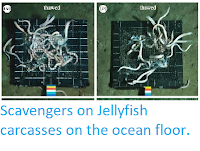
All of the samples were rapidly consumed, being visited by a number of scavengers including the Atlantic Hagfish, Myxine glutinosa, a Galatheid Crab, Munida tenuimana, a Decapod Shrimp, probably Pontophilus norvegicus, and large numbers of Lysianassid Amphipods, Orchomenella obtusa, showing that nutrients in the bodies of Jellyfish falling to the seafloor in the Sognefjorden are clearly not lost to the ecosystem, being instead recycled by marine scavengers.


 (a) Myxineglutinosa scavengers swarming at the Scomber scombrus bait. (b) Myxine glutinosa voraciously feeding on thawed Periphylla periphylla bait. (c) Myxine glutinosa and Munida tenuimana feeding on a single fresh Periphylla periphyllacarcass. (d)Munida tenuimana and Decapod Shrimp feeding on thawed Cyanea capillata bait. The black bait plate is 50 by 50 cm with gridlines separated by 5 cm. Sweetman et al. (2014).

However the different scavengers did show preferences for different prey, suggesting that changes in Jellyfish abundance does have an impact on the seafloor ecosystem. The Mackerel, Scomber scombrus, samples attracted large numbers of Hagfish, Myxine glutinosa, who consumed the majority of the high nutrient flesh, followed by a second wave of invertebrate scavengers, primarily Galatheid Crabs and Lysianassid Amphipods who consumed the rest of the corpse. Hagfish were also the first to arrive at the Periphylla periphylla sites, preferentially consuming some tissues (probably the high energy gonads) before leaving. They were then replaced by a phase of consumption by Galatheid Crabs and Lysianassid Amphipods, then finally a third phase of consumption by the Decapod Shrimps, which had shown little interest in the Mackerel bait. The Hagfish largely avoided the Cyanea capillatabait, possibly due to the large amount of mucus this species produces, which is toxic to fish and may be noxious to Hagfish even after the Jellyfish has been dead some time.

These findings are significantly at odds with observations made previously off the coast Côte d’Ivoire and in the Gulf of Oman. Sweetmanet al. suggest that in these instances large build-ups of inorganic carbon, sulphide compounds and ammonium may have made the local environment hostile to the scavengers, resulting in the persistence of Jellyfish carrion on the seafloor. Alternatively this may be the result of seasonality; the Sognefjorden experiments were carried out in October, a time of year when Jellfish (and other plankton species) die-offs are expected to occur, and when deep-sea scavengers may be primed to look for this source of nutrients. It is possible that Jellyfish carcasses persist for longer at other times of year because scavengers are not seeking them, or are engaged in other behaviour.

See also…

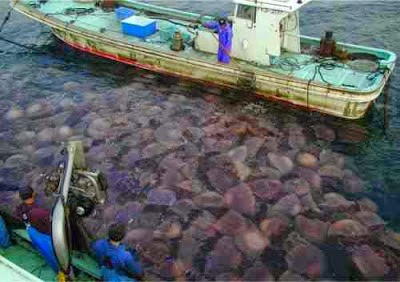
While instantly familiar and biologically simple, Jellyfish (Scyphozoa) are still in many ways poorly understood, with frequently poorly understood life-cycles and population structures, leading to unexpected shifts in population and sudden blooms of large numbers of Jellyfish, which can impact on commercial fisheries or...

The Oskarshamn Nuclear Power Plant in Kalmar County on Sweden's southeast coast was forced to...


 Many scientists and conservationists are worried about the state of the world's oceans. Many important marine ecosystems are known to be under stress: once prolific fisheries have collapsed; dead zones lacking oxygen...

Follow Sciency Thoughts on Facebook.