Showing posts with label Hesperorniform Birds. Show all posts

Saturday, 11 February 2017

A Hesperornithiform Bird from the Late Cretaceous of the Canadian High Arctic.

Hesperornithiforms were a group of toothed Seabirds known from the Late Cretaceous of North America and Eurasia, with their maximum diversity found around the shores of the Western Interior Seaway of North America. They are interpreted as having been pursuit-diving, Fish-eating seabirds similar to modern Gannets and Boobies.

In a paper published in the Canadian Journal of Earth Sciences on 29 July 2016, Laura Wilson of the Sternberg Museum of Natural History at Fort Hays State University and the Department of Geological Sciences at the University of Colorado, Boulder, Karen Chin also of the Department of Geological Sciences and of the Museum of Natural History at University of Colorado, Boulder, and Stephen Cumbaa of the Canadian Museum of Nature, describe a new Hesperornithiform specimen from the Late Cretaceous Kanguk Formation of Devon Island in Nunavut Territory, in the Canadian High Arctic.

The specimen comprises the left and right femora, four teeth, partial left and right ilia, rib fragments, and assorted bone fragments. This is refereed to the genus Hesperornis, but not to species level due to the fragmentary nature of the material. The specimen is believed to have become disarticulated while exposed on the seafloor before being buried, and was further damaged when exposed prior to excavation, with some material being lost at this time as it could not be extracted from the permafrost.

Scanning electron microscope photomicrographs of the four teeth preserved with NUVF 286. Note the recurved crown, fine crenulations in the enamel, and absence of serrations. Wilson et al. (2016).

Hesperornithiform Birds are generally reconstructed as having been Fish-eating Birds, consuming small-to-medium sized Fish which were actively pursued in the water. However no such Fish are known from the Kanguk Formation, or other deposits from the Late Cretaceous High Arctic, raising questions about the diet of the Hesperornithiform Birds found there. It is possible that such Fish were possible in the High Arctic at this time, but that they have not been preserved, but given the good fossil record of large Fish, other Vertebrates and Invertebrates from these deposits, Wilson et al. suggest this is unlikely.

As an alliterative they suggest that Arctic ecosystems in the Late Cretaceous may, as is the case now, have had much shorter food chains than those at lower latitudes. Mesozoic Arctic ecosystems are somewhat of a mystery to palaeontologists, as temperatures at the time were to warm for the formation of permanent pack ice as it the case today, but the Earth's tilt would still have caused long periods of winter darkness, thus creating an environment with no direct analogue today. Wilson et al. suggest that this may have been similar enough to modern Arctic ecosystems to prevent the development of long food chains, instead leading to a situation similar to that seen today in which large animals at the top of the food chain feed directly on small invertebrates at the bottom, such as the Krill fed upon by many large Animals today.

See also...

http://sciencythoughts.blogspot.co.uk/2017/01/tingmiatornis-arctica-ornithurine-bird.htmlhttp://sciencythoughts.blogspot.co.uk/2016/12/preserved-plumage-in-immature.html
http://sciencythoughts.blogspot.co.uk/2016/04/chongmingia-zhengi-new-species-of-bird.htmlhttp://sciencythoughts.blogspot.co.uk/2015/11/fumicollis-hoffmani-new-species-of.html
http://sciencythoughts.blogspot.co.uk/2015/06/preserved-feathers-in-enantiornithine.htmlhttp://sciencythoughts.blogspot.co.uk/2015/01/preserved-stomach-contents-in-early.html
Follow Sciency Thoughts on Facebook.

Friday, 20 November 2015

Fumicollis hoffmani: A new species of Hesperornithiform Bird from the Late Cretaceous Niobrara Chalk of Kansas.

The Hesperornithiforms were a distinctive group of toothed Birds that appeared in the Early Cretaceous and persisted till the end of that period. They are thought to have been among the first Birds to adapt to an aquatic lifestyle, apparently having been powerful swimmers with proportion driven by the enlarged hind legs, though like other Cretaceous toothed Bird groups they are not thought to have any living descendants.

In a paper published in the journal PLoS One on 18 November 2015, Alyssa Bell and Luis Chiappe of the Dinosaur Institute at the Natural History Museum ofLos Angeles County, describe a new species of Hesperornithiform Bird from the Late Cretaceous Smoky Hill Member of the Niobrara Chalk of Kansas.

The species is named Fumicollis hoffmani, where 'Fumicollis' means 'Smoke Hill' in Latin and 'hoffmani' honours Karen and Jim Hoffman for their generous support of the Natural History Museum of Los Angeles County and in particular the Dinosaur Institute. The species is described from a single specimen, which was initially discovered in 1937 and thought to be a specimen of Baptornis advenus, but which has now been shown to be a separate species. The specimen comprises eight vertebrae, numerous fragments of ribs, plus most of the ilium, ischium, and pubis, some of the left half of the pelvis, part of the pygostyle (tailbone made from fused vertebrae), most of the left hindlimb and part of the right.

Reconstruction of Fumicollis hoffmani. Bell & Chiappe (2015).

Fumicollis hoffmani shows a mixture of traits seen in other Late Cretaceous Hesperornithiforms and more 'primitive' traits seen in earlier members of the group. However Bell and Chiappe believe that the 'primitive' traits of Fumicollis hoffmani relate to its size; most known Late Cretaceous Hesperornithiforms were quite large, while earlier members of the group were generally small.

The Smokey Hills Member is thought to have been laid down over a period of about five million years, but has produced a rich and diverse assemblage of Hesperornithiforms. This does not necessarily mean that all the species were present at the same time, though it leaves a very limited period for different species to replace one-another. Bell and Chiappe suggest that the diverse assemblage potentially represents an assemblage of Birds with different ecological requirements living in the same area. This can be seen today in Penguins around the Antarctic Peninsula and nearby islands, where up to six different species can be found living in the same area. While the Penguins are all essentially similar, being aquatic Birds feeding on Fish, the different species are all different sizes, and therefore feed at different depths, allowing the different species to live in the same area without directly competing with one-another.

See also...

http://sciencythoughts.blogspot.co.uk/2015/06/preserved-feathers-in-enantiornithine.htmlPreserved feathers in an Enantiornithine Bird from the Early Cretaceous Crato Formation of Brazil.                                                                               While feathers have been known in fossil Birds from...
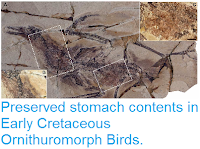
http://sciencythoughts.blogspot.co.uk/2015/01/preserved-stomach-contents-in-early.htmlPreserved stomach contents in Early Cretaceous Ornithuromorph Birds.                     The Early Cretaceous Jehol Group of China has produced a remarkable number of well-preserved fossils of Mesozoic Birds, adding greatly to our understanding of the early history of this group...
http://sciencythoughts.blogspot.co.uk/2015/01/bird-eggs-from-late-cretaceous-colonial.htmlBird eggs from a Late Cretaceous colonial nesting site in Argentinean Patagonia.                In the 1980s a large collection of Avian eggs were uncovered at the campus of the National University of Comahue at Neuquén City in Argentinean Patagonia. These ages were located on a single bedding...

Follow Sciency Thoughts on Facebook.