Showing posts with label Hirudinids. Show all posts

Saturday, 27 August 2016

Glossiphonia balcanica & Dina prokletijaca: Two new species of Leech from the Balkan Peninsula.

Leeches, Hirudinida, are highly specialised Annelid Worms, related to Oligochaetes (Earthworms), or possibly a highly specialised group within the Oligochaeta. They are best known for the habit of sucking blood from Vertebrate animals, but many are carnivores, hunting and consuming Invertebrate prey. Most Leeches are found in freshwater environments, though marine and terrestrial forms are also known; many show remarkably sophisticated parental care for Annelid Worms. All Leeches, regardless of their diet, can be distinguished by the presence of two suckers, one at each end, and by their internal segmentation, which, unlike the segmentation seen in other Annelids, does not match the external segmentation.

In a paper published in the journal Ecologica Montenegrina on 10 July 2016, Clemens Grosser of Elstertrebnitz in Saxony (Germany), Vladamir Pešić of the Department of Biology at the University of Montenegro, Violata Berlajolli of the University of "Haxhi Zeka" and Bogić Gligorović, also of the Department of Biology at the University of Montenegro, describe two new species of Leech from Montenegro and Kosovo.

The first new species is placed within the Family Glossiphoniidae, flattened Leaches with reduced forward suckers that live in freshwater and typically feed on the blood of aquatic Vertebrates, assigned to the genus Glossiphonia and given the specific name balcanica, in reference to the Balkan Peninsula, where it was found. These are small almost disk-shaped Leeches, reaching 10 mm in length and 8 mm in width, amber in colour and having three pairs of eyes arranged in two rows. The species was found in fast-running waters in both Kosovo and Montenegro, being most abundant on the Mediterranean side of Montenegro.

Glossiphonia balcanica in dorsal view (inset: eyes). Grosser et al. (2016).

The second new species described is placed within the Family Erpobdellidae, elongate freshwater Leeches that hunt aquatic invertebrates rather than sucking blood, assigned to the genus Dina and given the specific name prokletijaca, after the Prokletije Mountain Range of the Western Balkan Peninsula, that runs from northern Albania to Kosovo and eastern Montenegro. These are small stocky |Leeches, reaching 23 mm in length and 4.5 mm in width. The are grey in colour with two dark stripes on their dorsal surface, and have greatly reduced eyes. The species was found around natural springs in deciduous Beech forests in the Prokletije Mountains of Kosovo.

Dina prokletijaca in (A) dorsal and (B) lateral views. Grosser et al. (2016).

See also...

http://sciencythoughts.blogspot.co.uk/2014/04/a-new-species-of-earthworm-from-spain.htmlA new species of Earthworm from Spain. Earthworms play a major role in the formation of soils in many parts of the world (though soils can and do form in there absence), ingesting and breaking larger...
http://sciencythoughts.blogspot.co.uk/2013/06/two-new-species-of-earthworm-from-korea.htmlTwo new species of Earthworm from Korea. Earthworms play a major role in the formation of soils in many parts of the world (though soils can and do form in there absence), ingesting and breaking larger portions of organic material and producing a nitrogen rich humus. This role in soil formation makes them...
http://sciencythoughts.blogspot.co.uk/2012/07/new-species-of-carnivorous-leech-from.htmlNew species of carnivorous Leech from Taiwan.                                                    Leeches are a group of Annelid Worms (segmented Worms) best...
Follow Sciency Thoughts on Facebook.

Sunday, 1 June 2014

African Tigerfish observed snatching Barn Swallows from the air.

A variety of Fish are known to occasionally take Birds as prey. Sharks and other large carnivorous marine Fish will frequently feed on Seabirds on the water surface, and in freshwater aquatic environments Bass, Eels, Piranhas, Pike and Catfish have all been observed to take avian prey, either from the water surface, from land close to the water, or from overhanging vegetation. Uniquely, the African Tigerfish (Hydrocynus spp.) has a reputation for taking Birds on the wing; this has been reported by numerous authors from 1945 onwards, but these reports have all been based upon anecdotal evidence, never witnessed by the authors themselves as part of an organized study.

In a paper published in the Journal of Fish Biology on 19 December 2013, Gordon O’Brien, Francois Jacobs, S Evans and Nico Smit of the Water Research Group (Ecology) at the Unit of Environmental Sciences and Management at North-West University report direct observation of feeding on Birds in flight by a population of the African Tigerfish (Hydrocynus vittaltus) at Schroda Dam, an artificial lake in the Mapungubwe National Park in Limpopo Province, South Africa.

The Shroda Dam was constructed in 1993 as a storage lake, and covers 4 100 000 m³. The African Tigerfish (Hydrocynus vittaltus) was deliberately introduced to the lake in 2003. The lake is considered to be nutrient poor compared to typical Hydrocynus vittaltus environments, and the Fish spend a higher proportion of their time foraging than has been reported in other populations. However they typically avoid open waters during the hours of daylight, probably due to the presence of the African Fish Eagle (Haliaeetus vocifer).

In February 2011 a number of Fish that had been radio-tagged as part of a study into their behaviour were observed to be breaking this taboo, and becoming highly active in open waters during the mid-morning. Direct observation of the lake revealed that the fish were striking at Barn Swallows (Hirundo rustica), a migratory Bird which visits the lake seasonally, both drinking on the wing and hunting small Insects close to the water surface. None of the radio-tagged Fish was observed capturing a Barn Swallow, though other Fish were on numerous occasions, and some instances were filmed with a hand-held camcorder.

The Tigerfish employed two different strategies when hunting Birds. Some Fish chased the Birds at the surface prior to striking, while others remained deeper in the water and suddenly lunged upwards at Birds. This second hunting behaviour was more successful, capturing a Bird on roughly one-in-three attempts (as opposed to about one-in-seven for the chase and lunge technique), but involved compensating for light refraction at the water surface, something not all the fish appeared able to do.

Avivorous behavioural strategies adopted by Hydrocynus vittatus in the Schroda Dam man-made lake. (a) Flight path of the prey Hirundo rustica, (b) surface pursuit strategy of Hydrocynus vittatus to overcome surface image shift due to light refraction (angle θ) and (c) direct aerial strikes by adult Hydrocynus vittatus that compensate for the image shift (not drawn to scale). O’Bien et al. (2013).

Since the Shroda Dam is a new environment for the Tigerfish, and fast-moving Barn Swallows are a fairly difficult Bird to target from the water, O’Brien et al. suggest that this behaviour is likely to be quite widespread in Tigerfish, and that it would be worth investigating at other localities.

See also…


Catfish (Siluriformes) are a large, diverse group of freshwater and shallow marine Fish, found on every continent except Antarctica. They are primarily benthic detrivores, but show a very wide rage of trophic adaptations. They show the widest range of sizes of any group of Boney Fishes, with the smallest species...


Piranhas are carnivorous Characid Fish from the Amazon river basin with a reputation for stripping large animals to the bone in seconds. While this reputation is unquestionably exaggerated, Piranhas are still formidable predators, capable of delivering powerful bites and tackling large prey. In the Late Miocene South America was home to a much larger fish, Megapiranha paranensis, which is thought to have...


Follow Sciency Thoughts on Facebook.

Tuesday, 24 July 2012

New species of carnivorous Leech from Taiwan.

Leeches are a group of Annelid Worms (segmented Worms) best known for their habit of latching onto larger organisms and sucking their blood, although many Leeches, possibly the majority, do not actually do this, being instead carnivores preying on smaller invertebrates. The majority of known species live in freshwater or are amphibious, able to leave the water in damp environments. Members of the genus Orobdella are specialist carnivores of other Annelid Worms, known from Japan, Korea and the Russian Far East.

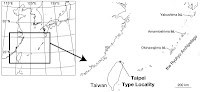
In a paper published in the journal ZooKeys on 11 June 2012, Takafumi Nakano of the Department of Zoology at the Graduate School of Science at Kyoto University and Yi-Te Lai of the Institute of Zoology at the National Taiwan University and the Department of Biology at the University of Eastern Finland describe a new species of Orobdella from Taipei, the capitol of Taiwan, the first species described from the country.

Map of Taiwan and the surrounding area, showing the location where the new Leech was found. Nakano & Lai (2012).

The new species is named Orobdella ketagalan, after the indigenous Ketagalan people of the Taipei Basin. It is distinguished from other members of the genus by the anatomy of its reproductive system, and by genetic data; gene sequencing of Orobdella ketagalan revealed that it was most closely related to members of the genus from the Ryukyu Archipelago, a string of islands belonging to Japan that connect Taiwan to Kyushu, the most southwesterly of Japan's main islands. It is a flattened segmented worm, slightly over 7 cm in length.

Orobdella ketagalan. (A) Dorsal view. (B) Ventral view. Scale bar is 5 mm. Nakano & Lai (2012).


Follow Sciency Thoughts of Facebook.