Showing posts with label Fresshwater Ecosystems. Show all posts

Monday, 26 December 2016

Panaqolus tankei, a new species of Tiger Pleco from the Xingu Basin of Brazil.

Armoured Catfish, Loricariidae, are large Catfish that have bodies covered with extensive bony scales and mouthparts modified to form suckers that are found in most freshwater ecosystems in South America. They are widely traded in the aquarium trade as 'Plecs' or 'Plecos', with stripey forms known as 'Tiger Plecos', and a number of species are known in the aquarium trade that have not yet formally been described in the scientific literature.

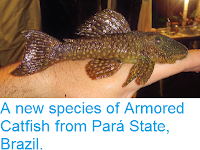
In a paper published in the journal PLoS One on 9 November 2016, Christian Andreas Cramer of the Center for Human Genetics at Philipps-University Marburg and the Laboratório de Ictiologia e Pesca at the Universidade Federal de Rondónia and Leandro Melo de Sousa of the Laboratório de Ictiologia at the Universidade Federal do Pará describe a new species of Armoured Catfish from the Xingu Basin of Pará State in Brazil.

The new species is placed in the genus Panaqolus, and given the specific name tankei, in honour of the aquarist Andreas Tanke, for his dedication to the study of Plecs of the genus Panaqolus, andfor being the first person to breed the new species in captivity. The species is small-to-medium sized for a Loricariid, with the largest recorded individual measuring 83 mm in length. The species has a yellowish brown base colouration with darker stripes.

Live coloration of Panaqolus tankei, from the region of Vitória do Xingu (live aquarium specimen). Ralf Heidemann in Cramer & de Sousa (2016).

The species is found on the lower Xingu River, downstreamBeloMonte Waterfalls, typically being found associated with sunken trees and wood. A major hydroectric power plant is currently beinf constructed on the middle reaches of the Xingu, and what effect this will have on the many Catfish species found in the river, the majority of which have very limited distributions, is unclear.

Typical habitat of Panaqolus tankei. Riverbank in Lower Xingu. Cramer & de Sousa (2016).

See also...
http://sciencythoughts.blogspot.co.uk/2014/09/a-new-species-of-armoured-catfish-from.htmlhttp://sciencythoughts.blogspot.co.uk/2014/05/a-new-species-of-armored-catfish-from.html
http://sciencythoughts.blogspot.co.uk/2013/12/a-new-species-of-catfish-from-minas.htmlhttp://sciencythoughts.blogspot.co.uk/2013/11/two-new-species-of-armored-catfish-from.html
http://sciencythoughts.blogspot.co.uk/2013/06/a-new-species-of-armored-catfish-from.htmlhttp://sciencythoughts.blogspot.co.uk/2012/03/new-species-of-armored-catfish-from.html
Follow Sciency Thoughts on Facebook.

Saturday, 27 August 2016

Glossiphonia balcanica & Dina prokletijaca: Two new species of Leech from the Balkan Peninsula.

Leeches, Hirudinida, are highly specialised Annelid Worms, related to Oligochaetes (Earthworms), or possibly a highly specialised group within the Oligochaeta. They are best known for the habit of sucking blood from Vertebrate animals, but many are carnivores, hunting and consuming Invertebrate prey. Most Leeches are found in freshwater environments, though marine and terrestrial forms are also known; many show remarkably sophisticated parental care for Annelid Worms. All Leeches, regardless of their diet, can be distinguished by the presence of two suckers, one at each end, and by their internal segmentation, which, unlike the segmentation seen in other Annelids, does not match the external segmentation.

In a paper published in the journal Ecologica Montenegrina on 10 July 2016, Clemens Grosser of Elstertrebnitz in Saxony (Germany), Vladamir Pešić of the Department of Biology at the University of Montenegro, Violata Berlajolli of the University of "Haxhi Zeka" and Bogić Gligorović, also of the Department of Biology at the University of Montenegro, describe two new species of Leech from Montenegro and Kosovo.

The first new species is placed within the Family Glossiphoniidae, flattened Leaches with reduced forward suckers that live in freshwater and typically feed on the blood of aquatic Vertebrates, assigned to the genus Glossiphonia and given the specific name balcanica, in reference to the Balkan Peninsula, where it was found. These are small almost disk-shaped Leeches, reaching 10 mm in length and 8 mm in width, amber in colour and having three pairs of eyes arranged in two rows. The species was found in fast-running waters in both Kosovo and Montenegro, being most abundant on the Mediterranean side of Montenegro.

Glossiphonia balcanica in dorsal view (inset: eyes). Grosser et al. (2016).

The second new species described is placed within the Family Erpobdellidae, elongate freshwater Leeches that hunt aquatic invertebrates rather than sucking blood, assigned to the genus Dina and given the specific name prokletijaca, after the Prokletije Mountain Range of the Western Balkan Peninsula, that runs from northern Albania to Kosovo and eastern Montenegro. These are small stocky |Leeches, reaching 23 mm in length and 4.5 mm in width. The are grey in colour with two dark stripes on their dorsal surface, and have greatly reduced eyes. The species was found around natural springs in deciduous Beech forests in the Prokletije Mountains of Kosovo.

Dina prokletijaca in (A) dorsal and (B) lateral views. Grosser et al. (2016).

See also...

http://sciencythoughts.blogspot.co.uk/2014/04/a-new-species-of-earthworm-from-spain.htmlA new species of Earthworm from Spain. Earthworms play a major role in the formation of soils in many parts of the world (though soils can and do form in there absence), ingesting and breaking larger...
http://sciencythoughts.blogspot.co.uk/2013/06/two-new-species-of-earthworm-from-korea.htmlTwo new species of Earthworm from Korea. Earthworms play a major role in the formation of soils in many parts of the world (though soils can and do form in there absence), ingesting and breaking larger portions of organic material and producing a nitrogen rich humus. This role in soil formation makes them...
http://sciencythoughts.blogspot.co.uk/2012/07/new-species-of-carnivorous-leech-from.htmlNew species of carnivorous Leech from Taiwan.                                                    Leeches are a group of Annelid Worms (segmented Worms) best...
Follow Sciency Thoughts on Facebook.