Showing posts with label Kilauea. Show all posts

Wednesday, 18 July 2018

Tourists injured after lava bomb strikes boat by coast of Hawai'i.

Twenty three people have been injured, three of them seriously, after a lava bomb (chunk of lava thrown from a volcano, in either liquid or solid form) from Mount Kilauea struck a tour boat of the coast of Hawai'i on Monday 16 July 2018. The volcano began erupting from a new fissure on its eastern flank on 3 May 2018, since when a series of fissures have opened up, producing several major lava flows, which have destroyed many homes and other properties, and at least one of which has reached the sea, producing a laze (toxic haze resulting from hot lava hitting water, producing chemical-laden steam, which had led to the U.S. Coast Guard imposing a 50 m exclusion zone around areas of the coast that were being reached by the lava, though the boat struck by the lava bomb despite being outside this zone.

Damage to a tourist boat struckby a lava bomb off the coast of Hawai'i on 16 July 2018. Hawai'i Department of Land and Natural Resources.

The islands of Hawai'i have formed as a result of hotspot volcanism, with a mantle plume hotspot currently located under Big Island, Hawai'i, and each of the other islands being the result of previous activity from the same hotspot, with the oldest Islands in the northwest and newest in the southeast. A volcanic hotspot is an area where magma from deep inside the Earth is welling up through the overlying plate (in this case the Pacific) to create volcanism at the surface. Volcanoes move as they erupt, swelling as magma enters their chambers from bellow, then shrinking as that magma is vented as lava.

 The position of the Hawai'i Hotspot relative to the islands of Hawai'i. Joel Robinson/USGS/Wikimedia Commons.

See also...

https://sciencythoughts.blogspot.com/2018/05/hawaiian-man-injured-by-lava-bomb-from.htmlhttp://sciencythoughts.blogspot.co.uk/2018/05/eruption-on-mount-kilauea-hawaii-leads.html
http://sciencythoughts.blogspot.co.uk/2016/08/sewage-spill-closes-beaches-at-honolulu.htmlhttp://sciencythoughts.blogspot.co.uk/2015/05/crater-collapse-triggers-explosion-on.html
http://sciencythoughts.blogspot.co.uk/2014/09/homes-threatened-by-lava-flow-on-big.htmlhttp://sciencythoughts.blogspot.co.uk/2014/08/magnitude-45-earthquake-on-big-island.html
Follow Sciency Thoughts on Facebook.

Monday, 21 May 2018

Hawai'ian man injured by lava bomb from Mount Kilauea.

A Hawai'ian man has suffered a broken leg after being struck by a lava bomb (chunk of lava thrown from a volcano, in either liquid or solid form), described as being as heavy as a refrigerator, from Mount Kilauea on Hawai'i (or 'Big') Island on Sunday 20 May 2018. The man is described as having been on his balcony at the time of the incident. The volcano began erupting from a new fissure on its eastern flank on 3 May 2018, since when a series of fissures have opened up, producing several major lava flows, which have destroyed many homes and other properties, and at least one of which has reached the sea, producing a laze (toxic haze resulting from hot lava hitting water, producing chemical-laden steam. At the same time the volcano has produced a number of gas and ash columns, some of which have reached over three kilometres in height, which are described as being particularly rich in hydrochloric acid, sulphur dioxide and volcanic glass.

Lava flow on Mount Kilauea. USGS/AP.

The islands of Hawai'i have formed as a result of hotspot volcanism, with a mantle plume hotspot currently located under Big Island, Hawai'i, and each of the other islands being the result of previous activity from the same hotspot, with the oldest Islands in the northwest and newest in the southeast. A volcanic hotspot is an area where magma from deep inside the Earth is welling up through the overlying plate (in this case the Pacific) to create volcanism at the surface. Volcanoes move as they erupt, swelling as magma enters their chambers from bellow, then shrinking as that magma is vented as lava.

 The position of the Hawai'i Hotspot relative to the islands of Hawai'i. Joel Robinson/USGS/Wikimedia Commons.

See also...

http://sciencythoughts.blogspot.co.uk/2018/05/eruption-on-mount-kilauea-hawaii-leads.htmlhttp://sciencythoughts.blogspot.co.uk/2016/08/sewage-spill-closes-beaches-at-honolulu.html
http://sciencythoughts.blogspot.co.uk/2015/05/crater-collapse-triggers-explosion-on.htmlhttp://sciencythoughts.blogspot.co.uk/2014/09/homes-threatened-by-lava-flow-on-big.html
http://sciencythoughts.blogspot.co.uk/2014/08/magnitude-45-earthquake-on-big-island.htmlhttp://sciencythoughts.blogspot.co.uk/2014/06/magnitude-41-earthquake-on-western.html
Follow Sciency Thoughts on Facebook.

Saturday, 12 May 2018

Fissure eruption on Mount Kilauea, Hawai'i, leads to evacuations and destruction of homes.

Mount Kilauea, a 1247 m shield volcano (dome shaped volcano made up largely of layers of lava) on eastern Hawai'i (or 'Big') Island, began erupting on Thursday 3 May 2018, when lava began to spew  from a 150 m rift on the eastern flank of the volcano, prompting local authorities to enforce a mandatory evacuation in the neighbourhoods of Leilani Estates and Lanipuna Gardens, both about 40 km from the crater of the volcano. Since then about 35 homes in the Leilani Estates have been destroyed by lava, although the main threat to human safety is not considered to be the lava, which is slow moving and can generally be avoided, but from poisonous sulphur dioxide gas which is also emitting from the fissure.

Burning homes ignited by lava in Leilani Estates, Hawai'i, on 6 May 2018. Trevor Hughs/USA Today.

The eruption has caused a 300 m drop in the level of the Halema‘uma‘u Lava Lake in the caldera of Mount Kilauea, as lava escapes from the fissure, which has concerned vulcanologists at the Hawai'i Volcano Observatory, as the shrinking lake has led to debris falling into the crater, something which has historically led to explosive eruptions on the volcano when the lava lake begins to refill and finds its way obstructed (explosive eruptions on shield volcanoes are otherwise extremely rare. This last happened in 1924, when about 14 tonnes of material was thrown from the caldera in a series of explosive eruptions caused by steam building up beneath debris that had fallen into the crater, throwing a material up to 270 m from the crater and resulting in the death of an onlooker.

Ash column over  Mount Kilauea on 3 May 2018. USGS.

The islands of Hawai'i have formed as a result of hotspot volcanism, with a mantle plume hotspot currently located under Big Island, Hawai'i, and each of the other islands being the result of previous activity from the same hotspot, with the oldest Islands in the northwest and newest in the southeast. A volcanic hotspot is an area where magma from deep inside the Earth is welling up through the overlying plate (in this case the Pacific) to create volcanism at the surface. Volcanoes move as they erupt, swelling as magma enters their chambers from bellow, then shrinking as that magma is vented as lava.

The position of the Hawai'i Hotspot relative to the islands of Hawai'i. Joel Robinson/USGS/Wikimedia Commons.

See also...

http://sciencythoughts.blogspot.co.uk/2016/08/sewage-spill-closes-beaches-at-honolulu.htmlhttp://sciencythoughts.blogspot.co.uk/2015/05/crater-collapse-triggers-explosion-on.html
http://sciencythoughts.blogspot.co.uk/2014/09/homes-threatened-by-lava-flow-on-big.htmlhttp://sciencythoughts.blogspot.co.uk/2014/08/magnitude-45-earthquake-on-big-island.html
http://sciencythoughts.blogspot.co.uk/2014/06/magnitude-41-earthquake-on-western.htmlhttp://sciencythoughts.blogspot.co.uk/2013/12/pickup-truck-swallowed-by-sinkhole-on.html
Follow Sciency Thoughts on Facebook.

Tuesday, 5 May 2015

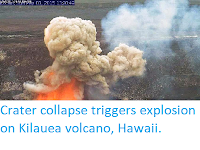
Crater collapse triggers explosion on Kilauea volcano, Hawaii.

A portion of the rim of the Halema‘uma‘u Crater on Mount Kilauea, Hawaii, collapsed on Sunday 3 May 2015, triggering a dramatic, but harmless explosion. Halema‘uma‘u is a small crater located within the main caldera of Kilauea, which contains a lava lake. This lava lake has been at its highest levels since 2008 this month, actually overtopping the rim of the crater on Saturday 29 April, and in addition releasing a large amount of volcanic gas. This appears to have weakened the rocks around the rim of the crater, eventually leading to a partial collapse with rocks tumbling into the crater. The sudden impact of the rocks onto lava with a high dissolved gas content triggered an explosive release of gas, similar to a shaken fizzy drink bottle, throwing fragments of rock up to 85 m from the crater.

The 30 April 2015 Halema‘uma‘u Crater explosion. United States Geological Survey.

The islands of Hawaii have formed as a result of hotspot volcanism, with the hotspot currently located under Big Island, Hawai'i, and each of the other islands being the result of previous activity from the same hotspot, with the oldest Islands in the northwest and newest in the southeast. A volcanic hotspot is an area where magma from deep inside the Earth is welling up through the overlying plate (in this case the Pacific) to create volcanism at the surface. Volcanoes move as they erupt, swelling as magma enters their chambers from bellow, then shrinking as that magma is vented as lava.

See also...

Homes in the community of Kaohe Homesteads on Big Island, Hawaii, are being threatened by a lava flow from the Kilauea Volcano, that have reached 1.6 km from the settlement and could potentially reach it in five to...


The United States Geological Survey recorded a Magnitude 4.5 Earthquake at a depth of 16.8 km on te northern part of Big Island, Hawaii, slightly before...


The United States Geological Survey recorded a Magnitude 4.1 Earthquake close to the surface on western Molokai Island, Hawaii, sllightly after...


Follow Sciency Thoughts on Facebook.

Saturday, 6 September 2014

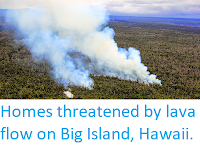
Homes threatened by lava flow on Big Island, Hawaii.

Homes in the community of Kaohe Homesteads on Big Island, Hawaii, are being threatened by a lava flow from the Kilauea Volcano, that have reached 1.6 km from the settlement and could potentially reach it in five to seven days according to the Hawaiian Volcano Observatory. Kilauea is a shield volcano (flat or dome shaped volcano that frequently emits lava flows but seldom if ever undergoes explosive episodes producing ash columns) on the south of Big Island, which has been continuously spewing lava since 1983, though during this time a number of different vents have opened and closed. Most of these lava flows have been relatively harmless, though 213 buildings and 14 km of roads have been destroyed by lava since the eruption began. The lava currently threatening Kaohe Homesteads is issuing from a new vent that opened on 27 June 2014, and has been advancing at a rate of about 250 m per day. It is not thought that it will be possible to divert the lava flow without threatening other communities.

Burning forest in the path of the Kilauea lava flow. Hawaiin Volcano Observatory.

The islands of Hawaii have formed as a result of hotspot volcanism, with the hotspot currently located under Big Island, Hawai'i, and each of the other islands being the result of previous activity from the same hotspot, with the oldest Islands in the northwest and newest in the southeast. A volcanic hotspot is an area where magma from deep inside the Earth is welling up through the overlying plate (in this case the Pacific) to create volcanism at the surface. Volcanoes move as they erupt, swelling as magma enters their chambers from bellow, then shrinking as that magma is vented as lava.

Map charting the progress of the lava flow currently threatening Kaohe Homesteads, as of Thursday 4 September 2014. Hawaiian Volcano Observatory.

See also...


The United States Geological Survey recorded a Magnitude 4.5 Earthquake at a depth of 16.8 km on te northern part of Big Island...


The United States Geological Survey recorded a Magnitude 4.1 Earthquake close to the surface on western Molokai Island, Hawaii...


The United States Geological Survey recorded a Magnitude 3.6 Earthquake at a depth of 7.7 km, 41 km to the south of Hilo...

Follow Sciency Thoughts on Facebook.