Showing posts with label Lunar Eclipse. Show all posts

Friday, 27 February 2026

Total Lunar Eclipse to be visible from East Asia, East Australia, Oceania, the Pacific Ocean, and western North America.

A total Lunar Eclipse will occur on Wednesday 3 March 2026, starting at 8.45 am GMT. It will be visible across the eastern parts of Asia, Australia, and Indonesia, as well as the rest of Oceania and the Pacific Ocean, the western part of North America, and parts of Antarctica. In Southeast, South, and Central Asia, western Australia and Indonesia, and much of North, Central, and South America, Greenland, and the Caribbean, part of the eclipse will be visible, although in these areas the Moon will either rise part way through the eclipse, or set before it is complete in these areas.

Areas from which the 3 March 2026 Lunar Eclipse will be visible. Dominic Ford/In the Sky.

The Moon produces no light of its own, but 'shines' with reflected light from the Sun. Thus at Full Moon the Moon is on the opposite side of the Earth to the Sun, and its illuminated side is turned towards us, but at New Moon the Moon is between the Earth and the Sun, so that its illuminated side is turned away from us.

How the phases of the Moon are caused by the relative positions of the Earth, Sun and Moon. Karl Tate/Space.com.

Lunar eclipses occur when the Moon passes through the Earth's shadow. This can only happen at Full Moon (unlike Solar Eclipses, which happen only when the Moon passes between the Earth and the Sum, and therefore only occur at New Moon), but does not happen every Lunar Month as the Sun, Moon and Earth are not in a perfect, unwavering line, but rather both the Earth and the Moon wobble slightly as they orbit their parent bodies, rising above and sinking bellow the plane of the ecliptic (the plane upon which they would all be in line every month). 

The phases of the 3 March 2026 Lunar Eclipse. Leah Tiscione/Sky & Telescope.

See also...

Saturday, 6 September 2025

Total lunar eclipse to be visible from Asia, Africa, Australasia, and Eastern Europe.

A total Lunar Eclipse will occur on Sunday 7 September 2025, starting at 4.27 pm GMT. It will be visible across the entirety of Australia, Indonesia, Asia apart from areas of the Russian Far East, the Indian Ocean, and the eastern half of Africa. In Eastern Europe, much of Central and West Africa, New Zealand, Melanesia, and Micronesia, part of the eclipse will be visible, although in these areas the Moon will either rise part way through the eclipse, or set before it is complete in these areas.

Areas from which the 7 September 2025 Lunar Eclipse will be visible. Dominic Ford/In the Sky.

The Moon produces no light of its own, but 'shines' with reflected light from the Sun. Thus at Full Moon the Moon is on the opposite side of the Earth to the Sun, and its illuminated side is turned towards us, but at New Moon the Moon is between the Earth and the Sun, so that its illuminated side is turned away from us.

How the phases of the Moon are caused by the relative positions of the Earth, Sun and Moon. Karl Tate/Space.com.

Lunar eclipses occur when the Moon passes through the Earth's shadow. This can only happen at Full Moon (unlike Solar Eclipses, which happen only when the Moon passes between the Earth and the Sum, and therefore only occur at New Moon), but does not happen every Lunar Month as the Sun, Moon and Earth are not in a perfect, unwavering line, but rather both the Earth and the Moon wobble slightly as they orbit their parent bodies, rising above and sinking bellow the plane of the ecliptic (the plane upon which they would all be in line every month). 

Phases of the 7 September 2025. NASA Eclipse Website.

See also...

Wednesday, 12 March 2025

Total lunar eclipse to be visible from the Americas.

A total Lunar Eclipse will occur on Friday 14 March 2025, starting at about 5.09 am GMT. It will be visible across the entire of the Americas, as well as much of the Atlantic and Pacific Oceans, and the eastern tip of Russia. Part of the eclipse will be visible from western parts of Africa and Europe, as well as much of East and Southeast Asia, and Australasia, although in these areas the Moon will either rise part way through the eclipse, or set before it is complete in these areas.

Areas from which the 14 March 2025 Lunar Eclipse will be visible. Dominic Ford/In the Sky.

The Moon produces no light of its own, but 'shines' with reflected light from the Sun. Thus at Full Moon the Moon is on the opposite side of the Earth to the Sun, and its illuminated side is turned towards us, but at New Moon the Moon is between the Earth and the Sun, so that its illuminated side is turned away from us.

How the phases of the Moon are caused by the relative positions of the Earth, Sun and Moon. Karl Tate/Space.com.

Lunar eclipses occur when the Moon passes through the Earth's shadow. This can only happen at Full Moon (unlike Solar Eclipses, which happen only when the Moon passes between the Earth and the Sum, and therefore only occur at New Moon), but does not happen every Lunar Month as the Sun, Moon and Earth are not in a perfect, unwavering line, but rather both the Earth and the Moon wobble slightly as they orbit their parent bodies, rising above and sinking bellow the plane of the ecliptic (the plane upon which they would all be in line every month). 

Phases of the Lunar Eclipse that will be seen on 14 March 2025. The times are given in GMT. Sky & Telescope.

See also...

Tuesday, 17 September 2024

Partial Lunar Eclipse on 18 September 2024.

A partial Lunar Eclipse will occur on Wednesday 18 September 2024, starting at 0.41 am GMT. The whole eclipse will be visible across all of South America and the Atlantic, and most of North America, Europe, Africa, and parts of the Middle East, while part of the eclipse will be visible from the northwest of North America, the Horn of Africa, European Russia, the remainder of the Middle East, and parts of western Asia and the Indian Ocean. although in these areas the Moon will either rise part way through the eclipse, or set before it is complete.

Areas from which the 28 October 2023 Lunar Eclipse will be visible. Dominic Ford/In the Sky.

The Moon produces no light of its own, but 'shines' with reflected light from the Sun. Thus, at Full Moon the Moon is on the opposite side of the Earth to the Sun, and its illuminated side is turned towards us, but at New Moon the Moon is between the Earth and the Sun, so that its illuminated side is turned away from us.

Lunar eclipses occur when the Moon passes through the Earth's shadow. This can only happen at Full Moon (unlike Solar Eclipses, which happen only when the Moon passes between the Earth and the Sum, and therefore only occur at New Moon), but does not happen every Lunar Month as the Sun, Moon and Earth are not in a perfect, unwavering line, but rather both the Earth and the Moon wobble slightly as they orbit their parent bodies, rising above and sinking bellow the plane of the ecliptic (the plane upon which they would all be in line every month).

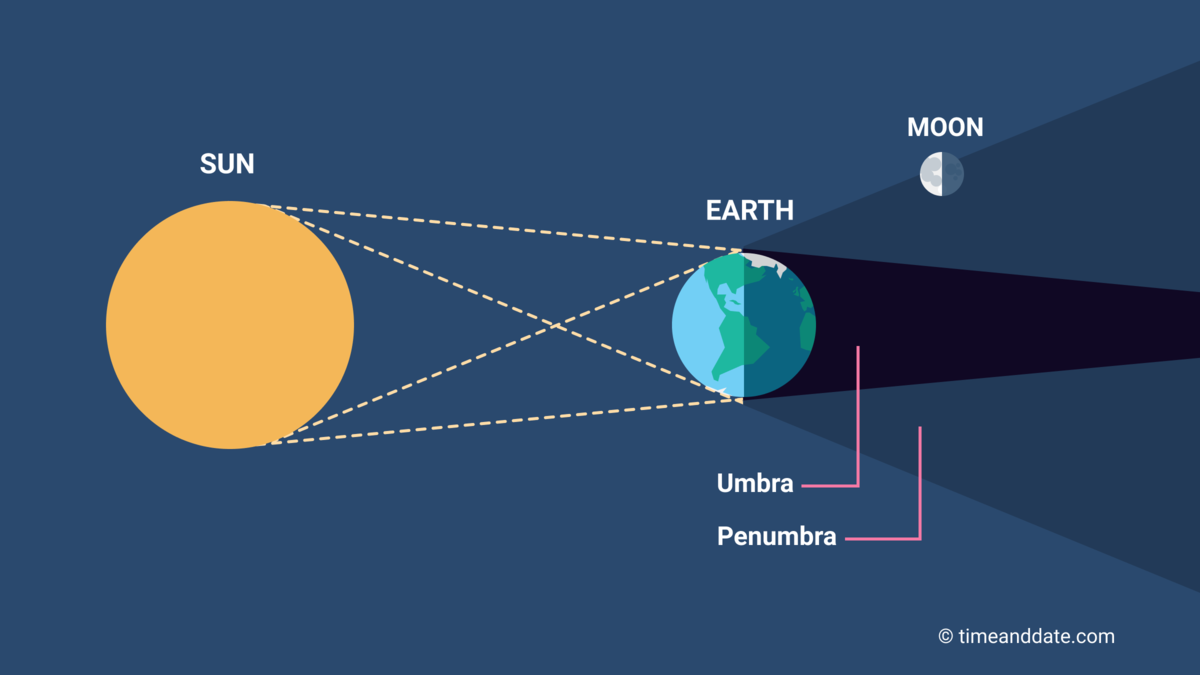
Because the Moon is passing through a shadow, rather than being blocked from our view, it does not completely disappear during an eclipse like the Sun, but in a total Lunar Eclipse goes through two distinct phases of dimming, the Penumbra, when it is still partially illuminated by the Sun, and the Umbra, when the Earth completely blocks direct sunlight from the Moon. This does not result in complete darkness, as the Moon is still partially lit by reflected Earthlight, but it does turn a deep, dark red colour.  In a partial eclipse the Earth passes completely through the Moon's penumbra, but only partly through its umbra.  

Phases of the 18 September 2024. NASA Eclipse Website.

See also...

Sunday, 24 March 2024

Penumbral lunar eclipse to be visible from the Americas, Western Europe, West Africa, Eastern Australia, New Guinea, Oceana, Japan, the Russian Far East, and the Pacific and Atlantic Oceans.

A penumbral Lunar Eclipse will occur on Monday 25 March 2024, starting at 4.53 am GMT and ending at 9.32 am GMT. The whole eclipse will be visible across all of the Americas except eastern Brazil, while part of the eclipse will be visible from the remainder of Brazil, Western Europe, West Africa, Eastern Australia, New Guinea, Oceana, Japan, the Russian Far East, and the Pacific and Atlantic Oceans, although in these areas the Moon will either rise part way through the eclipse, or set before it is complete.

Map showing areas from which the 25 March 2023 penumbral lunar eclipse will be visible. Time and Date.

The Moon produces no light of its own, but 'shines' with reflected light from the Sun. Thus, at Full Moon the Moon is on the opposite side of the Earth to the Sun, and its illuminated side is turned towards us, but at New Moon the Moon is between the Earth and the Sun, so that its illuminated side is turned away from us.

Lunar eclipses occur when the Moon passes through the Earth's shadow. This can only happen at Full Moon (unlike Solar Eclipses, which happen only when the Moon passes between the Earth and the Sum, and therefore only occur at New Moon), but does not happen every Lunar Month as the Sun, Moon and Earth are not in a perfect, unwavering line, but rather both the Earth and the Moon wobble slightly as they orbit their parent bodies, rising above and sinking bellow the plane of the ecliptic (the plane upon which they would all be in line every month).

Because the Moon is passing through a shadow, rather than being blocked from our view, it does not completely disappear during an eclipse like the Sun, but in a total Lunar Eclipse goes through two distinct phases of dimming, the Penumbra, when it is still partially illuminated by the Sun, and the Umbra, when the Earth completely blocks direct sunlight from the Moon. This does not result in complete darkness, as the Moon is still partially lit by reflected Earthlight, but it does turn a deep, dark red colour.  In a penumbral eclipse only the first of these phases occurs.

(Top) The geometry of the Earth's shadow. Within the Earth's penumbral shadow, the planet covers some fraction the Sun's disk. Only within the smaller umbra does the Earth cover the entirety of the Sun's disk. Any areas of the Moon's surface that pass through the penumbra appear darker than usual as the Earth is obstructing some of the sunlight that usually illuminates them. Areas within the umbra, meanwhile, receive no illumination from the Sun at all. Time and Date. (Bottom) The passage of the Moon through the Earth's penumbral shadow during the 25 March 2024 penumbral lunar eclipse. Guy Ottewell/EarthSky.

See also...