Showing posts with label Perseus. Show all posts

Wednesday, 6 December 2023

A James Webb Space Telescope image of Protostar HH 797.

An image taken by the James Webb Space Telescope shows Herbig Haro object 797 (HH 797) in previously unseen detail. A Herbig Haro object is an elongate gas nebula formed by jets of gas blown on the stellar winds emerging from the poles of a young protostar colliding with gas and dust left over from the cloud from which the star formed at speeds of several hundred kilometres per second.

HH 797, a narrow, horizontal nebula that stretches from edge to edge of the lower half of the image. NASA/ESA/CSA.

HH 797 lies close to the IC 348 star-forming region within the constellation of Perseus, which is a little over a thousand light years from Earth. The IC 348 cluster is about 2 million years old, and contains about 400 stars, about half of which still have circumstellar disks.

HH 797 cannot be seen at visible wavelengths, as it is still buried within the cloud of dust and gas from which it has formed; the James Webb image has been taken in the infra-red part of the spectrum, collecting light emitted by excited hydrogen and carbon monoxide molecules heated to thousands of degrees centigrade by the interaction of the gas jets and the surrounding cloud.

The light emitted by the gas at the southern end of the plumes (bottom right) has been shown to be slightly red shifted as it reaches us, implying that the southern end of the plume is moving away from us, while the light from the gas at the northern end of the plume (bottom left) is slightly blue shifted, indicating that it is moving towards us.

The central part of the HH 797 nebula, from which the gas plumes are emerging. The protostar itself is invisible, creating a dark area. NASA/ESA/CSA.

See also...

Follow Sciency Thoughts on Facebook.

Follow Sciency Thoughts on Twitter.


Sunday, 6 August 2017

The Perseid Meteors.

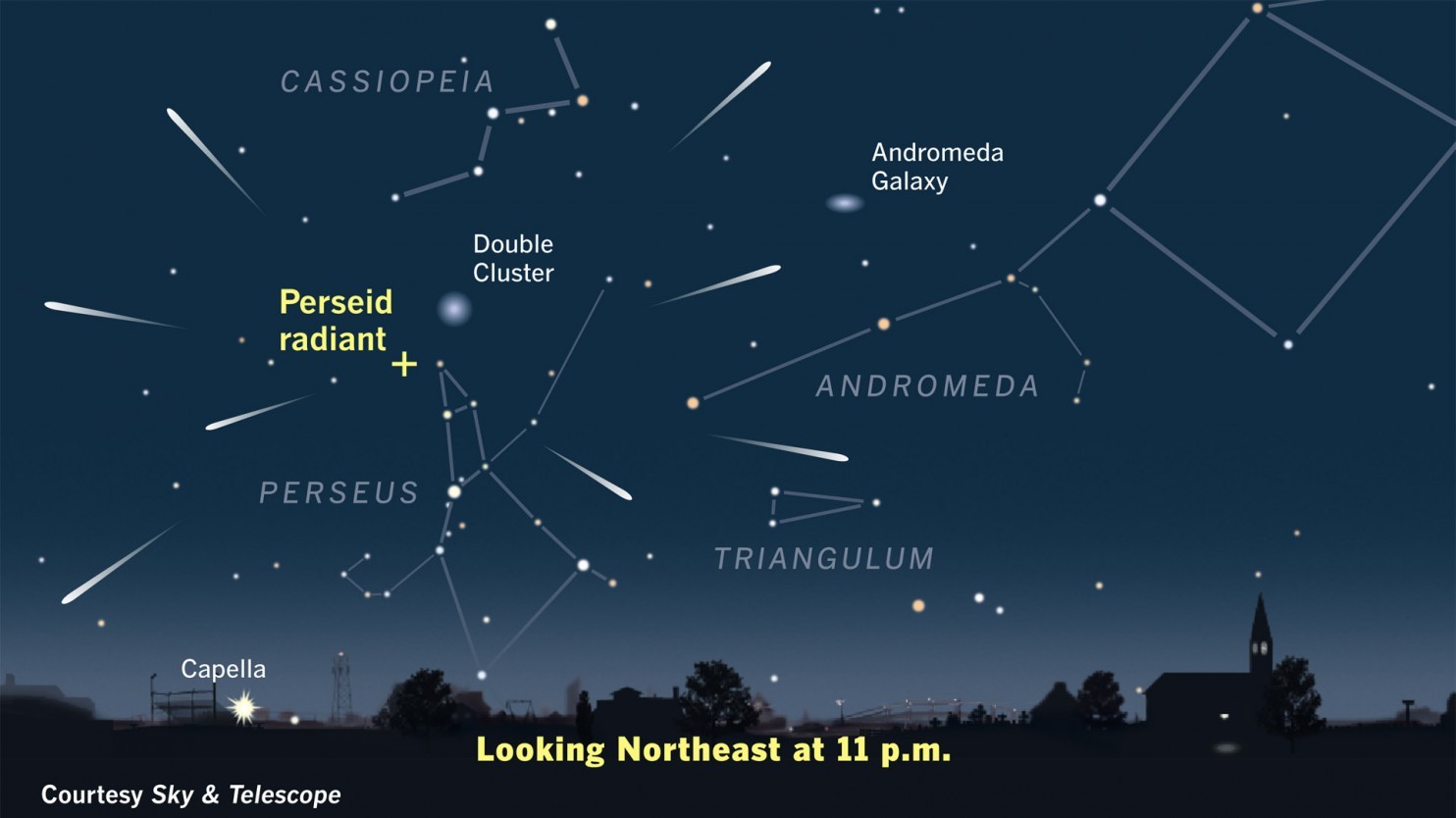
The Perseid Meteor shower lasts from late July to early September each year, and are expected to be at a peak on Friday 11-Saturday 12 August 2017. The Moon is expected to be quite bright on that night, with the full Moon having fallen on Monday 7 August, and will be rising slightly before 11.00 pm local time on 11 August (this will b the same wherever you are on Earth), which could hamper viewing from most parts of the globe. The shower is expected to be particularly intense this year, possibly reaching 80-150 meteors per hour. The Perseids get their name from the constellation of Perseus, in which the meteors have their radiant (the point from which they appear to originate).
 
The radiant of the Perseid Meteors. Time and Date.
 
The shower is caused by the Earth passing through the trail of the Comet 109P/Swift-Tuttle, and encountering dust from the tail of this comet. The dust particles strike the atmosphere at speeds of over 200 000 km per hour, burning up in the upper atmosphere and producing a light show in the process. 
 
Comet 109P/Swift Tuttle imaged during its last close approach to the Earth in 1992. Gerald Rhemann/Discover Magazine.
 
The Earth does not need to pass close to 109P/Swift-Tuttle for the meteor shower to occur, it simply passes through a trail of dust from the comet's tail that is following the same orbital path. Comet 109P/Swift-Tuttle itself only visits the Inner Solar System once every 133 years, last doing so in 1992, on an eccentric orbit tilted at 113° to the plane of the Solar System (or 67° with a retrograde orbit - an orbit in the opposite direction to the planets - depending on how you look at it), that takes it from 0.95 AU from the Sun (95% of the distance at which the Earth orbits the Sun) to 51.22 AU from the Sun (51.22 times as far from the Sun as the Earth, more than three times as far from the Sun as Neptune and slightly outside the Kuiper Belt, but only scraping the innermost zone of the Oort Cloud). The comet is next expected to visit the Inner Solar System in 2126, reaching about 22 950 00 km  (0.15 AU) from Earth in August of that year.
 
See also...

http://sciencythoughts.blogspot.co.uk/2017/07/fireball-meteor-over-washington-state.htmlhttp://sciencythoughts.blogspot.co.uk/2017/07/the-delta-aquarid-meteors.html
http://sciencythoughts.blogspot.co.uk/2017/05/the-2017-eta-aquarid-meteors.htmlhttp://sciencythoughts.blogspot.co.uk/2017/04/gobekli-tepe-does-ancient-anatolian.html
http://sciencythoughts.blogspot.co.uk/2017/04/the-lyrid-meteors.htmlhttp://sciencythoughts.blogspot.co.uk/2017/04/fireball-over-southern-united-sates.html
Follow Sciency Thoughts on Facebook.

Friday, 5 August 2016

The Perseid Meteors.

The Perseid Meteor shower lasts from late July to early September each year, and are expected to be at a peak on Thursday 11- Friday12 August 2016. The Moon is expected to be quite bright on that night, however it will be setting at about 1.00 am local time on 12 August (this will b the same wherever you are on Earth), which should mean could viewing from most parts of the globe. The shower is expected to be particularly intense this year, possibly reaching 80-150 meteors per hour. The Perseids get their name from the constellation of Perseus, in which the meteors have their radiant (the point from which they appear to originate), which will be rising at about 10.00 pm local time on 11 August.

 The radiant of the Perseid Meteors. National Astronomical Observatory of Japan.

The shower is caused by the Earth passing through the trail of the Comet 109P/Swift-Tuttle, and encountering dust from the tail of this comet. The dust particles strike the atmosphere at speeds of over 200 000 km per hour, burning up in the upper atmosphere and producing a light show in the process. 

The Earth does not need to pass close to 109P/Swift-Tuttle for the meteor shower to occur, it simply passes through a trail of dust from the comet's tail that is following the same orbital path. Comet 109P/Swift-Tuttle itself only visits the Inner Solar System once every 133 years, last doing so in 1992. It is currently 36.4 AU from the Earth (i.e. 36.4 times as far from the Earth as the Sun, more than twice the distance between Neptune and the Sun) on an eccentric orbit tilted at 113° to the plane of the Solar System (or 67° with a retrograde orbit - an orbit in the opposite direction to the planets - depending on how you look at it), that takes it from 0.95 AU from the Sun (95% of the distance at which the Earth orbits the Sun) to 51.22 AU from the Sun (51.22 times as far from the Sun as the Earth, more than three times as far from the Sun as Neptune and slightly outside the Kuiper Belt, but only scraping the innermost zone of the Oort Cloud).

 The orbit of 109P/Swift-Tuttle. Note that this is almost entirely below the plain of the Solar System. JPL Small Body Database Browser.


109P/Swift-Tuttle is currently 36.4 AU from the Sun (i.e. 36.4 times as far from the Sun as Earth and some way outside the orbit of Neptune) ans 37.2 AU from the Earth. The comet is next expected to visit the Inner Solar System in 2126, reaching about 22 950 00 km  (0.15 AU) from Earth in August of that year.

See also...

http://sciencythoughts.blogspot.co.uk/2016/05/the-eta-aquarid-meteors.htmlThe Eta Aquarid Meteors.                              The Eta Aquarid Meteor Shower will peak before dawn on Thursday 5 and Friday 6 May 2016, with up to 45 meteors per hour at it's peak, radiating from the constellation of Aquarius. This does not spend long above the horizon in the Northern Hemisphere at...
http://sciencythoughts.blogspot.co.uk/2016/04/bright-fireball-meteor-seen-over.htmlBright fireball meteor seen over Southern California.                                                    The American Meteor Society has received reports of a bright fireball meteor being seen over much of southern California slightly at about 9.30 pm local time on Monday 23 April 2016 (about 4.30 am on...
http://sciencythoughts.blogspot.co.uk/2016/04/lyrid-meteors-to-be-visible-next-week.htmlLyrid Meteors to be visible next week.         The Lyrid Meteors will be visible between Saturday 16 and Monday 25 April 2006, with peak acticity on Friday 22 April, when the number of meteors may exceed 20 per hour. However with the Full Moon also falling on... 
Follow Sciency Thoughts on Facebook.  

Wednesday, 12 August 2015

The 2015 Perseid Meteors.

The Perseid Meteor shower lasts from late July to early September each year, and are expected to be at a peak on 12-13 August 2015, which falling slightly before the new moon of 14 August, should mean could viewing from most parts of the globe. At the peak of the shower there can be 50-100 meteors per hour. The Perseids get their name from the constellation of Perseus, in which the meteors have their radiant (the point from which they appear to originate).

The radiant of the Perseid Meteors. Sky and Telescope.

The shower is caused by the Earth passing through the trail of the Comet 109P/Swift-Tuttle, and encountering dust from the tail of this comet. The dust particles strike the atmosphere at speeds of over 200 000 km per hour, burning up in the upper atmosphere and producing a light show in the process. 

The Earth does not need to pass close to 109P/Swift-Tuttle for the meteor shower to occur, it simply passes through a trail of dust from the comet's tail that is following the same orbital path. Comet 109P/Swift-Tuttle itself only visits the Inner Solar System once every 133 years, last doing so in 1992. It is currently 36.4 AU from the Earth (i.e. 36.4 times as far from the Earth as the Sun, more than twice the distance between Neptune and the Sun) on an eccentric orbit tilted at 113° to the plane of the Solar System (or 67° with a retrograde orbit - an orbit in the opposite direction to the planets - depending on how you look at it), that takes it from 0.95 AU from the Sun (95% of the distance at which the Earth orbits the Sun) to 51.22 AU from the Sun (51.22 times as far from the Sun as the Earth, more than three times as far from the Sun as Neptune and slightly outside the Kuiper Belt, but only scraping the innermost zone of the Oort Cloud).

The orbit of 109P/Swift-Tuttle. Note that this is almost entirely below the plain of the Solar System. JPL Small Body Database Browser.

109P/Swift-Tuttle is next expected to visit the Inner Solar System in 2126, reaching about 22 950 00 km  (0.15 AU) from Earth in August of that year.

See also...

Comet C/2014 Q1 (PANSTARRS) reached its perihelion (the closest point on its orbit to the Sun) on Monday 6 July 2015, when it was 0.31 AU from the Sun (i.e. 0.31 times the average distance...


2015's Eta Aquarid Meteors.
The Eta Aquarid Meteor Shower will be at a peak on Tuesday 5/Wednesday 6 May 2014, with up to 45 meteors per hour at its peak, radiating from the constellation of Aquarius...


The effect of the Perseid Meteor Shower on the Lunar Exosphere.
The Moon lacks a dense atmosphere in which gases can interact to create weather systems or undergo chemical reactions, but it...


Follow Sciency Thoughts on Facebook.

Monday, 11 August 2014

The Perseid Meteor Shower.

The Perseid Meteor shower lasts from late July to early September each year, and are expected to be at a peak on 12-13 August 2014, slightly after the Full Moon on 10 August, which may make the meteors harder to spot than when they occur at darker times of the month. At the peak of the shower there can be 50-100 meteors per hour. The Perseids get their name from the constellation of Perseus, in which the meteors have their radiant (appear to originate).

The radiant of the Perseid Meteors. NASA.

The shower is caused by the Earth passing through the trail of the Comet 109P/Swift-Tuttle, and encountering dust from the tail of this comet. The dust particles strike the atmosphere at speeds of over 200 000 km per hour, burning up in the upper atmosphere and producing a light show in the process. 

The Earth does not need to pass close to 109P/Swift-Tuttle for the meteor shower to occur, it simply passes through a trail of dust from the comet's tail that is following the same orbital path. Comet 109P/Swift-Tuttle itself only visits the Inner Solar System once every 133 years, last doing so in 1992. It is currently 35.6 AU from the Earth (i.e. 35.6 times as far from the Earth as the Sun, more than twice the distance between Neptune and the Sun) on an eccentric orbit tilted at 113° to the plane of the Solar System (or 67° with a retrograde orbit - an orbit in the opposite direction to the planets - depending on how you look at it), that takes it from 0.95 AU from the Sun (95% of the distance at which the Earth orbits the Sun) to 51.22 AU from the Sun (51.22 times as far from the Sun as the Earth, more than three times as far from the Sun as Neptune and slightly outside the Kuiper Belt, but only scraping the innermost zone of the Oort Cloud).

The orbit of 109P/Swift-Tuttle. Note that this is almost entirely below the plain of the Solar System. JPL Small Body Database Browser.

109P/Swift-Tuttle is next expected to visit the Inner Solar System in 2126, reaching about 22 950 00 km  (0.15 AU) from Earth in August of that year.

See also...


Witnesses reported seeing a fireball over southern Ontario slightly after 4.15 pm local time on Sunday 4 May 2014. The incident was also captures on a number of cameras, and Peter Brown of the Meteor Physics Group at Western University has suggested that it was...


The Eta Aquarid Meteor Shower will be at a peak on Monday 5/Tuesday 6 May 2014, with up to 45 meteors per hour at it's peak, radiating from the constellation of Aquarius. This does not spend long above the horizon in...


The Ursid Meteors are expected to peak on 22 December this year, with the shower being potentially visible to some extent between 17 and 26 December. The extent of the shower is variable, some...


Follow Sciency Thoughts on Facebook.

Monday, 5 August 2013

The Perseid Meteors.

The Perseid Meteor shower lasts from late July to early September each year, and are expected to be at a peak on 12-13 August 2013, slightly after the New Moon on 6 August, which should guarantee a good display. At the peak of the shower there can be 50-100 meteors per hour. The Perseids get their name from the constellation of Perseus, in which the meteors have their radiant (appear to originate).

The radiant of the Perseid Meteors. Seattle Astronomy

The shower is caused by the Earth passing through the trail of the Comet 109P/Swift-Tuttle, and encountering dust from the tail of this comet. The dust particles strike the atmosphere at speeds of over 200 000 km per hour, burning up in the upper atmosphere and producing a light show in the process. 

The Earth does not need to pass close to 109P/Swift-Tuttle for the meteor shower to occur, it simply passes through a trail of dust from the comet's tail that is following the same orbital path. Comet 109P/Swift-Tuttle itself only visits the Inner Solar System once every 133 years, last doing so in 1992. It is currently 34.7 AU from the Earth (i.e. 34.7 times as far from the Earth as the Sun, further than the distance between Neptune and the Sun) on an eccentric orbit that takes it far bellow the plain of the Solar System.

The orbit and current position of Comet 109P/Swift-Tuttle. Image created using the JPL Small Body Database Browser.

Wednesday, 8 August 2012

The Perseid Meteors.

The Perseid Meteor shower lasts from late July to early September each year, peaking on 12-13 August. This year this will coincide with a waning crescent Moon, hopefully making for a good display from many parts of the Earth; at the peak of the shower there can be 50-100 meteors per hour. The Perseids get their name from the constellation of Perseus, in which the meteors appear to originate.

Sky map showing the origin point of the Perseid Meteors; all the meteors appear to radiate from this point. NASA.

The shower is caused by the Earth passing through the trail of the Comet 109P/Swift-Tuttle, and encountering dust from the tail of this comet. The dust particles strike the atmosphere at speeds of over 200 000 km per hour, burning up in the upper atmosphere and producing a light show in the process. There is little chance of any meteors reaching the Earth, a meteorite that fell over California during the Lyrid Meteor shower in April is not thought to have been related to the shower, which is made of dust sized particles, but to have been the remains of an unrelated object, with a mass of up to 70 tonnes, striking the atmosphere at the same time.

The Earth does not need to pass close to 109P/Swift-Tuttle for the meteor shower to occur, it simply passes through a trail of dust from the comet's tail that is following the same orbital path. Comet 109P/Swift-Tuttle itself only visits the Inner Solar System once every 133 years, last doing so in 1992. It is currently 33.8 AU from the Earth (i.e. 33.8 times as far from the Earth as the Sun, further than the distance between Neptune and the Sun) on an eccentric orbit that takes it far bellow the plain of the Solar System.

The position of Comet 109P/Swift-Tuttle on 8 August 2012. JPL Small-Body Database Browser.


Follow Sciency Thoughts on Facebook.