Showing posts with label Plesiosaur. Show all posts

Tuesday, 3 October 2017

Arminisaurus schuberti: A new species of Pliosaur from the Early Jurassic of North Rhine-Westphalia, Germany.

The Plesiosaurs were Mesozoic marine reptiles that arose in the Late Triassic or Early Jurassic and persisted till the Late Cretaceous. They were related to modern lizards and snakes, but were fully aquatic, the largest species reaching 15 m in length. All species seem to have been strict carnivores, and at least one species gave birth to live young. Plesiosaurs are thought to have been fully aquatic from their first appearance; having evolved from Nothosaurs, a group of semi-aquatic marine Reptiles. The Plesiosaurs are divided into two groups, the short-necked Pliosaurs and the long-necked Elasmosaurs.

In a paper published in the journal Alcheringa on 15 September 2017, Sven Sachs of the Naturkunde-Museum Bielefeld, and Benjamin Kear of the Museum of Evolution at Uppsala University, describe a new species of Pliosaur from the Early Jurassic Amaltheenton Formation of Bielefeld in North Rhine-Westphalia, northwest Germany.

The new species is named Arminisaurus schuberti, where 'Arminisaurus' honours Arminius, a chieftan of the Germanic Cherusci people, who defeated three Roman legions under Publius Quinctilius Varus at the Battle of the Teutoburg Forest in 9 AD, and 'schuberti' honours Siegfried Schubert, who obtained the specimen from which the species is described from the Beukenhorst-II industrial clay pit in the Bielefeld. The species is named from a fragmentary specimen comprising the posterior section of the right mandibular ramus with the surangular, angular, prearticular and articular, eight isolated teeth and other dental fragments, ten cervical vertebrae, an incomplete pectoral vertebra, at least seven dorsal vertebrae, seven caudal vertebrae and various cervical-, dorsal-, possible sacral-caudal- and gastral ribs, as well as components of what may be the clavicle and interclavicle, together with the complete right and partial left scapula, a propodial, epipodial, six mesopodials and 19 phalanges abd other indeterminate bone fragments.

Arminisaurus schuberti, dorsal vertebra in (A) anterior and (B) lateral view. Dorsal neural spine in anterior view (C). Caudal vertebra in (D) articular, (E) lateral, (F) dorsal and (G) ventral views. Dorsal rib (H), caudal rib or hemapophysis (I), gastral rib (J) and ?sacral rib (K). Scale bars are 30 mm. Abbreviations: con, concavity; hf, hemapophyseal facet; nc, neural canal; ns, neural spine; rf, rib facet; tp, transverse process. Sachs & Kear (2017).

See also...

http://sciencythoughts.blogspot.co.uk/2016/08/stenorhynchosaurus-munozi-new-species.htmlhttp://sciencythoughts.blogspot.co.uk/2015/10/aristonectine-elasmosaur-remains-from.html
http://sciencythoughts.blogspot.co.uk/2015/04/resurrecting-unfortunate-dragon.htmlhttp://sciencythoughts.blogspot.co.uk/2015/01/a-new-placodont-specimen-from-late.html
http://sciencythoughts.blogspot.co.uk/2014/03/a-leptocleidid-plesiosaur-from-early.htmlhttp://sciencythoughts.blogspot.co.uk/2013/08/a-pliosaur-from-jurassic-coast-of-dorset.html
Follow Sciency Thoughts on Facebook.

Saturday, 17 October 2015

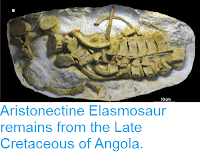
Aristonectine Elasmosaur remains from the Late Cretaceous of Angola.


The Aristonectines were a group of poorly understood Elasmosaurs (long-necked Plesiosaurs) known from the Late Jurassic of the Northern Hemisphere and Late Cretaceous of the Southern Hemisphere. Two species have been described from the Late Jurassic of England and Wyoming, and a further two species from the Late Cretaceous South America, Antarctica and New Zealand, and a number of un-named partial specimens are also known. They had wide snouts with a large number of small teeth, and necks with a large number of short, wide vertebrae, but their ecology and lifestyle is not known.

In a paper published in the Netherlands Journal of Geosciences on 18 February 2015, Ricardo Aráujo of the Museu da Lourinhã and the Huffington Department of Earth Sciences at Southern Methodist University, Michael Polcyn, also of the Huffington Department of Earth Sciences at Southern Methodist University, Johan Lindgren of the Department of Geology at Lund University, Louis Jacobs, again of the Huffington Department of Earth Sciences at Southern Methodist University, Anne Schulp of the Naturalis Biodiversity Center, Octávio Mateus of the Museu da Lourinhã and GeoBioTec at the Universidade Nova de Lisboa and António Olímpio Gonçalves and Maria Morais of the Departamento de Geologia at the Universidade Agostinho Neto describe a series of Aristonectine Elasmosaur remains from the Late Cretaceous Mocuio Formation of Bentiaba in Namibe Province, Angola.

The remains comprise four specimens, the first comprising a series of thirteen cervical and dorsal vertebrae with dorsal and pectoral ribs and a partial femur, the second comprising one ischium, one femur, six autopodial elements and two sacral ribs, the third comprising two autopodial elements, one phalanx, two partial coracoids, partial propodial, two neural arches and five cervical and one pectoral centra, and the fourth comprising two coracoids, two humeri, two vertebral centra and some rib fragments.

The first Aristonectine Elasmosaur from Bentiaba. Aráujo et al. (2015).

The specimens are too fragmentary to be formerly described as a new species, however comparison of these remains to other Aristonectine specimens suggests they cannot be differentiated from other fragmentary remains from Chile and New Zealand, possibly indicating that these may all represent specimens of a single, widespread species.

See also…

In the early 1860s a 5 m Plesiosaur was excavated from the Early Jurassic Blue Lias Formation at Street-on-the-Fosse in Somerset. This was subsequently...

The Plesiosaurs were Mesozoic marine reptiles that arose in the Late Triassic or Early Jurassic and persisted till the Late Cretaceous. They were related to modern lizards and snakes, but were fully aquatic, the largest species reaching 15 m in length. All species seem to have been strict carnivores, and at least...


Plesiosaurs were large, fully marine reptiles from the Jurassic and Cretaceous, with both fore- and hind-limbs modified into large flippers. They evolved from the...


Follow Sciency Thoughts on Facebook.

Tuesday, 28 April 2015

Resurrecting the Unfortunate Dragon.


In the early 1860s a 5 m Plesiosaur was excavated from the Early Jurassic Blue Lias Formation at Street-on-the-Fosse in Somerset. This was subsequently described as Plesiosaurus megacephalus, and placed on public display at the Bristol City Museum and Art Gallery, where it remained until 24 November 1940, when along with many other artefacts stored in the museum, it was destroyed in an air raid during the Second World War, and apparently lost to science.

However prior to its destruction several plaster castes of the specimen were made, three of which survive today in the collections of the Natural History Museum in London, the Geology Museum at Trinity College Dublin and the British Geological Survey at Keyworth in Nottingham, and several other specimens from a variety of other Early Jurassic sights around England have been nominated as potential members of the species.

In a paper published in the journal Palaeontologica Electronica in April 2015, Adam Smith of the Nottingham Natural History Museum formally redescribes the species from the available material, designating a neotype specimen and evaluating which specimens that have been referred to the species should in fact be referred to it.

Historical photograph of the holotype skeleton of ‘Plesiosaurus’megacephalus. Photograph taken from glass plate negative in the Bristol City Museum & Art Gallery, originally published by Swinton (1948). Length of skeleton equals 4960 mm. Smith 2015.

In the 1860s little was known about Plesiosaurs, and the generic name ‘Plesiosaurus’ was applied to all specimens discovered. Since then it has become understood that these were a large and diverse group of creatures, and split into several families and numerous genera. The generic name ‘Plesiosaurus’ is now known to be quite inappropriate for the Street-on-the-Fosse specimen, as it was a member of the family Rhomaleosauridae. It has also been referred to as a member of the genera Rhomaleosaurus, Thaumatosaurus and Eurycleidus, though Smith does not feel that any of these designations are correct, instead creating a new generic name, Atychodracon, meaning ‘Unfortunate-Dragon’, in reference to the destruction of the original specimen.

In addition to the original Street-on-the-Fosse specimen, a second partial specimen from the same location has been referred to the species, as have two specimens from Barrow-upon-Soar in Leicestershire (one more-or-less complete and another partial and somewhat poorly preserved), and a complete specimen from Wilmcote in Warwickshire. Smith excludes the Warwickshire specimen from the species, believing it instead to represent a member of a new, undescribed species, but includes all the other specimens.

In zoological nomenclature a type specimen, or holotype, is designated when a new species is described, so that other specimens thought to belong to the same species can be compared to it. In the event that this type specimen is lost or destroyed the International Commission on ZoologicalNomenclature allows the designation of a new specimen as a neotype, so long as it is possible to confirm that it belongs to the same species as the original specimen. The plaster castes and photographs of the missing Bristol specimen of Atychodracon megacephalus provide a good reference point for establishing such a neotype, and Smith therefore designates the more complete of the Leicestershire specimens to be the neotype of the species.

See also…

The Plesiosaurs were Mesozoic marine reptiles that arose in the Late Triassic or Early Jurassic and persisted till the Late Cretaceous. They were related to modern lizards and snakes, but were fully aquatic, the largest species reaching 15 m in length. All species seem to have been strict carnivores, and at least...
 
http://sciencythoughts.blogspot.co.uk/2013/08/a-pliosaur-from-jurassic-coast-of-dorset.htmlA Pliosaur from the Jurassic Coast of Dorset. The Pliosaurs were Mesozoic marine reptiles that arose in the Late Triassic or Early Jurassic and persisted till the Late Cretaceous. They were related to modern lizards and snakes, but were fully aquatic, the largest species reaching 15 m in length. All species seem to have been strict carnivores, and at least one species gave birth to live young. Plesiosaurs are thought to have been fully aquatic from their first appearance; they are...
http://sciencythoughts.blogspot.co.uk/2013/08/new-species-of-placodont-from-middle.htmlNew species of Placodont from the Middle Triassic of the Netherlands.                            Placodonts were a group of Sauropterygian Reptiles (a group related to Snakes and Lizards that includes the better known Pliosaurs and Plesiosaurs which survived to the end of the Mesozoic) from the mid-to late Triassic. They were large animals, ranging one to...
Follow Sciency Thoughts on Facebook.

Sunday, 16 March 2014

A Leptocleidid Plesiosaur from the Early Cretaceous of the Isle of Wight.

The Plesiosaurs were Mesozoic marine reptiles that arose in the Late Triassic or Early Jurassic and persisted till the Late Cretaceous. They were related to modern lizards and snakes, but were fully aquatic, the largest species reaching 15 m in length. All species seem to have been strict carnivores, and at least one species gave birth to live young. Plesiosaurs are thought to have been fully aquatic from their first appearance; they are thought to have evolved from Nothosaurs, a group of semi-aquatic marine Reptiles. The term Sauropterygians is used to include the Nothosaurs and the Pliosaurs, plus the Pachypleurosaurs; Lizard-like aquatic Reptiles. The Sauropterygians are considered to be the sister group of the Squamates - Snakes and Lizards.

In a paper published in the Journal of Systematic Palaeontology on 11 December 2012, Roger Benson of the Department of Earth Sciences at the University of Cambridge, Hilary Ketchum of the University Museum of Zoology at the University of Cambridge, Darren Naish of the School of Earth & Environmental Sciences at the University of Portsmouth and the National Oceanography Centre at the University of Southampton and Langan Turner, also of the School of Earth & Environmental Sciences at the University of Portsmouth, describe a new species of Plesiosaur from the Early Cretaceous the Shepherds Chine Member of the Vectis Formation at Shepherds Chine, in Brighstone Bay on the south-west coast of the Isle of Wight.

The specimen is considered to be a member of the Leptocleidia, a poorly understood group of Cretaceous Plesiosaurs, of somewhat uncertain affinities. It is named Vectocleidus pastorum, where ‘Vectocleidus’ derives from a combination of Vectis, the Latin name for the Isle of Wight, and Leptocleidus, the first described species of the Leptocleidia, and ‘pastorum’ is Latin for ‘Shepherds’, a reference to the location where the specimen was found.

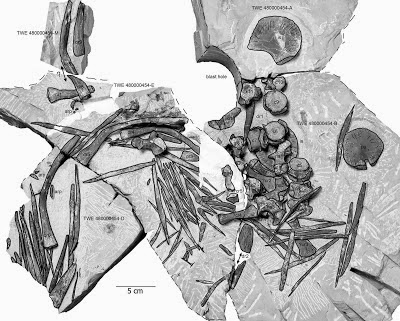
The specimen comprises three blocks, recovered separately by different collectors, upon which a partial post-cranial skeleton is preserved.

Vectocleidus pastorum; blocks one and two). In line drawing (B), grey shading indicates matrix. Abbreviations: caud. rib, caudal rib; cerv, cervical vertebra; clav, clavicle; cor, coracoid; dors, dorsal vertebra; hum, humerus; l., left; na, neural arch; pect, ‘pectoral’ (anterior dorsal) vertebra; phal, phalanx; r., right; scap, right scapula. Scale bars (in A) 100 mm. Benson et al. (2012).

The phylogenic position of the Leptocleidia is somewhat uncertain, as most known specimens are rather fragmentary; they are often considered to be Pliosaurs related to the Jurassic Rhomaleosaurids, or highly derived Plesiosaurs related to the Cretaceous Polycotylids. While Vectocleidus pastorum is known only from a single, incomplete, specimen, it is well enough preserved to exhibit clear Leptocleid affinities, as well as several features associated with highly derived Plesiosaurs. For this reason Benson et al. suggest that it supports the theory that the Leptocleids have a close affinity with the Polycotylids.

The suggested phylogenic affinities of the Leptocleids. Benson et al. (2012).


Follow Sciency Thoughts on Facebook.

Wednesday, 13 June 2012

A Plesiosaur from the Early Jurassic of Portugal.

Plesiosaurs were large, fully marine reptiles from the Jurassic and Cretaceous, with both fore- and hind-limbs modified into large flippers. They evolved from the Triassic Nothosaurs, Crocodile-like semi-aquatic reptiles related to Lizards, and persisted as a numerous and diverse group  until the end of the Cretaceous.

In 1897-8 the French palaeontologist Henri Émile Sauvage described a partial Plesiosaur skull and mandible (specimen number MG33 at the Geological Museum in Lisbon) from the Early Jurassic São Gião Formation (technically Toarcian, 183-175.6 million years old) of Alhadas in Central Portugal, as Plesiosaurus sp., but refined from any more detailed classification.

In a paper published in the journal Acta Palaeontologica Polonica on 20 May 2012, Adam Smith of the Birmingham Science Museum, Ricardo Araújo of the Roy M. Huffington Department of Earth Sciences at Southern Methodist University and the Museu da Lourinhã and Octávio Mateus of the Centro de Investigação em Ciência e Engenharia Geológica at the Faculdade de Ciências e Tecnologia at the Universidade Nova de Lisboa and the Museu da Lourinhã, redescribe and formally name MG33.

 
Specimen MG33 in (A) right lateral, (B) left lateral, (C) dorsal, and (D) ventral views; (1) photographs, (2) interpretive drawings. Smith et al. (2012).

Smith et al. conclude that MG33 is an Elasmosaur, a member of a group of Plesiosaurs that evolved exceptionally long necks and reached lengths of between 3 and 14 m. They formally name the specimen as Lusonectes sauvagei, Sauvage's Portuguese swimmer.


Follow Sciency Thoughts on Facebook. 

Saturday, 13 August 2011

A Pregnant Plesiosaur.

The plesiosaurs were a group of marine reptiles that appeared in the Middle Triassic, about 230 million years ago and went extinct in the KT extinction at the end of the Cretaceous, 65 million years ago. They are thought to have evolved from Nothosaurs, a group of semi-aquatic marine reptiles. The plesiosaurs are thought to have been fully aquatic from the outset. The term sauropterygians is used to include the nothosaurs and the plesiosuars, plus the pachypleurosaurs; lizard-like aquatic reptiles. The sauropterygians are thought to be related to the squamates - snakes and lizards.

A reconstruction of Pistosuarus, generally considered to be the earliest plesiosaur. It does not appear to be well suited to life on land.

The plesiosaurs are split into two taxonomic groups, the plesiosaurs proper and the pliosaurs (plus a few early species of uncertain affinities). The pliosuars were aquatic reptiles with short necks, elongated heads and powerful jaws, with many conical teeth (ideal for seizing large prey). They ranged from 4 m to 25 m in length and appeared in the Late Triassic, persisting till the end of the Cretaceous.

Reconstruction of a pliosaur attacking a mosasaur (large Mesozoic marine lizard) by paleo-artist Dan Varner.

The plesiosaurs proper are divided into five families, the Elasmosaurs, the Plesiosuarids, the Polycotylids, the Cimoliasaurs, and the Cryptoclids.

The elasmosaurs appeared in the Late Triassic; they had very elongate necks and small heads. The earliest species were about 3 m long, but some later species reached 14 m in length.

Reconstruction of Elasmosaurus by artist Doug Henderson.

The plesiosaurids currently include the single genus Plesiosaurus, the genus after which the whole group has been named. Since almost all plesiosaurs have started in this group then been moved out it is quite likely that this group will be further revised. Plesiosaurus was a long-necked, small headed form, though not as extreme as the Elasmosaurs. It is from the Lower Jurassic.
Reconstruction of Plesiosaurus by artist Adam Stuart Smith.

The polycotylids are a Cretaceous group with long snouts and short necks, superficially resembling the pliosaurs.

Reconstruction of Polycotylus by illustrator Carl Buell.

The cimoliasuars are probably an artificial group. The group includes a number of incomplete skeletons of plesiosaurs from the Jurassic and Cretaceous, as well as one (dubious) Palaeogene specimen. Cimoliasaurs tend to have intermediate neck and snout lengths.

The cryptoclidids are a group of medium sized plesiosaurs with long necks and broad, flat heads. They ranged from the Middle Jurassic to the end of the Cretaceous.

A reconstruction of Cryptoclidus, by palaeo-artist Alain Bénéteau.

A paper in the 12 August 2011 edition of the journal Science Robin O'Keefe of the Department of Biology at Marshall University and Luis Chiappe of the Natural History Museum of Los Angeles County describes for the first time a specimen of a plesiosaur which is apparently pregnant. If correct this settles a long standing dilemma for plesiosaur specialists. Plesiosaurs are clearly not not well adapted to land dwelling, so scientists had long suspected that they might be able to reproduce without venturing onto land. However no evidence of this had ever been found (unlike in ichthyosaurs, where the phenomenon is well documented), and not all reptiles have the potential to bear live young.

All crocodiles, most turtles and some birds and squamates (snakes and lizards) have temperature-dependent sex determination. This system uses an outside factor, temperature, to determine sex; above a certain temperature embryos will develop as one sex, bellow it as the other. This works fine for an egg-laying reptile, particularly one with a large brood size where there will be a temperature difference within the nest, but a large marine reptile is very likely to maintain a constant body temperature, which would result in all embryos developing as the same sex - not a good survival strategy.

Mammals, birds and most squamates use chromosomal sex determination. Under this system a species has sex two chromosomes. One chromosome is present in all individuals, the other only in individuals of one sex. Thus mammals have X and Y chromosomes; females have two X chromosomes males an X and a Y. Everyone inherits an X chromosome from their mother, and either an X or a Y chromosome from their father. All mammals develop as females, unless they have a Y chromosome.

This works well for mammals; the Y chromosome leads to the production of hormones that modify a potentially female animal to become male, but not so well for birds. Birds have sex chromosomes referred to as Z and W. A bird with two Z chromosomes in male, one with a Z and a W is female. In birds the presence of a W chromosome leads to the production of hormones that turn a potentially male individual female. This prevents the emergence of live births in birds; a baby bird developing inside its mother would be exposed to female hormones and develop as a female regardless of its chromosomes.

The sauropterygans (nothosaurs and plesiosaurs) are thought to be closely related the squamates, where chromosomal sex determination is the commonest method of sex determination, so it would not be surprising if this was the case in plesiosaurs.

In 2009 a paper in the Zoological Journal of the Linnean Society detailed a long-term study of sex-determination in squamates by Martina Pokorná and Lukáš Kratochvíl of the Department of Ecology at Charles University in Prague, which strongly indicated that the ancestral state in squamates was temperature dependent sex-determination, and that chromosomal sex determination has evolved several times within the group. Both the XY and ZW systems of sex determination are present within the squamates, and are likely to have evolved separately from a non-chromosomal system. This implies that the common ancestor of the sauropterygans and squamates used a temperature dependent sex determination system; the most that can be said is that the groups clearly had the potential to develop chromosomal sex determination.

The pregnant specimen described by O'Keefe and Chiappe (LACM 129639) was discovered in Kansas in the 1980s, and has been in the collection of the Natural History Museum of Los Angeles County ever since. It is not immediately obvious that this is a pregnant specimen; the fetus is not intact could potentially be the last meal of the adult rather than its young, though the pregnancy theory is supported by the absence of more common food material such as belemnites (Mesozoic molluscs) etc.

LACM 129369.

In addition LACM 129369 is a Polycotylus latippinis from the very end of the Cretaceous. P. latippinis is a highly derived species, not thought to be ancestral to any other form of plesiosaur, so it cannot be used to directly infer that other species bore live young. It would clearly have been useful to a plesiosaur, and it is considered likely that the ability arose in a nothosaur ancestor of the plesiosaurs. However this remains just as much a theory as it did before the re-examination of specimen LACM 129369.

A reconstruction of Polycotylus as a live-birthing animal, by science illustrator Stephanie Abramowicz.

See also The Weymouth Pliosaur and Reptiles on Sciency Thoughts YouTube.