Showing posts with label Stem Group Turtles. Show all posts

Thursday, 26 December 2019

Asmodochelys parhami: A new species of Ctenochelyid Turtle from the Late Cretaceous of Alabama and Mississippi.

Sea Turtles, Chelonioidea, are the most ancient group of living Marine Tetrapods, with s fossil record dating back about 90 million years. However, the exact age of the group is debatable, as it is not clear which fossil species should be included within the Crown Group Turtles (i.e. the group that includes everything descended from the last common ancestor of all living Sea Turtles), and which species represent Stem Group Turtles (i.e. members of groups which branched off from the main Turtle lineage before the last common ancestor of all all living Sea Turtles, and which may therefore represent separate invasions of the marine environment. In particular the position of the Protostegids, a group of marine Turtles that appear in the fossil record around 30 million years before any other marine Turtle group, is considered highly problematic, as the Protostegids appear 30 million years before any other Marine Turtle group.

In a paper publishd in the journal Royal Society Open Science on 18 December 2019, Andrew Gentry of the Department of Biology at the University of Alabama at Birmingham, and the Department of Collections at the McWane Science Center, and Jun Ebersole and Caitlin Kiernan, also of the Department of Collections at the McWane Science Center, describe a new species of fossil Turtle from the Late Cretaceous Demopolis Chalk of Alabama and Mississippi.

The Demopolis Chalk outcrops across a wide area of Alabama, Mississippi, and Tennessee, and comprises calcareous marine sediments laid down in the outer part of the Mississippi Embayment during the Campanian Stage (roughly 80 to 75 million years ago). The formation produces a range of vertebrate fossils, including Dinosaurs, Marine Reptiles, Sharks, and Bony Fish.

The new species is named Asmodochelys parhami, where 'Asmodochelys' means 'Asmodaios-Turtle', in reference to Asmodaios, a Demon in Christian, Jewish, and Islamic mythology who is associated with the sin of lust, and who, according to Islamic legend, was entombed in stone on the sea floor by King Solomon, and 'parhami' honours James Parham, former Curator of Palaeontology at the Alabama Museum of Natural History. The species is described from three partial Turtle shells, the most complete one (MSC 35984) coming from Alberta in Wilcox County, Alabama and the others from Sumter County in Alabama (MSC 40935), and Oktibbeha County in Mississippi (MMNS 3958).

The Wilcox County specimen comprises the nuchal, four neurals, two epineurals, eight left peripherals, five right peripherals, a partial first suprapygal, two costals of the left side, two costals of the right side, and approximately half of the left hyoplastron (all scutes of the shell), plus one cervical vertebra, while the Sumter County comprises one complete costal, three medial peripherals, four posterior peripherals, three neurals, two epineurals, the first suprapygal and the left xiphiplastron, and the Oktibbeha County specimen comprises two left peripherals, one neural, one epineural, both suprapygals and a complete pygal. These Turtles are reconstructed as having been between 1.0 and 1.5 m in length.

Representative elements and composite reconstruction of Asmodochelys parhami. (a) Nuchal, first and second left peripherals, and first right peripheral (MSC 35984) in dorsal view. (b) Third right peripheral (MSC 35984) in dorsal view. (c) Second right costal (MSC 35984) in dorsal view. (d), (e) Fourth neural and second epineural (MSC 35984) in dorsal (d ) and left lateral (e) views. (f) First and second neural (MSC 35984) in dorsal view. (g) Fourth right costal (MSC 35984) in dorsal view. (h), (i) Fifth right peripheral in posterior (h) and dorsal (i) views. (j), (k) Fourth left peripheral (MSC 35984) in dorsal (j) and posterior (k) views. (l), (m) Seventh right peripheral (MSC 35984) in posterior (l) and dorsal (m) views. (n), (o) Fifth left peripheral (MSC 35984) in dorsal (n) and posterior (o) views. (p), (q) Sixth neural and third epineural (MSC 35984) in dorsal ( p) and right lateral (q) views. (r,s) Sixth left peripheral (MSC 35984) in dorsal (r) and posterior (s) views. (t) Fifth left costal (MSC 35984) in dorsal view. (u) Seventh neural (MSC 35984) in dorsal view. (v) First suprapygal (MSC 35984) in dorsal view. (w) Sixth right costal (MSC 35984) in dorsal view. (x) Suprapygals and pygal (MMNS 3958) in dorsal view. (y) Tenth left peripheral (MMNS 3958) in posterior view. (z) Eighth–tenth right peripherals (MMNS 3958) in dorsal view. Dashed lines represent scute sulci. Gentry et al. (2019).

Asmodochelys parhami is condired to be a member of the Ctenochelyidae, a group characterised by a laterally serrated shell, extensive costal and plastral fontanelles, and the presence of epineurals positioned at various intervals along the neural series. A phylogenic reconstruction for the group including Asmodochelys parhami suggests that the Ctenochelyidae are the sister group to the Crown Group Chelonioidea, with the Protostegids being the sister group to the Ctenochelyidae plus the Crown Group Chelonioidea.

See also...

https://sciencythoughts.blogspot.com/2019/12/learthback-turtle-found-on-beach-in.htmlhttps://sciencythoughts.blogspot.com/2019/10/florida-fish-and-wildlife-conservation.html
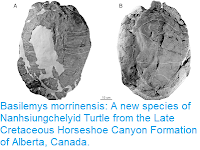
https://sciencythoughts.blogspot.com/2019/01/police-seize-hundreds-of-turtles-from.htmlhttps://sciencythoughts.blogspot.com/2018/12/basilemys-morrinensis-new-species-of.html
https://sciencythoughts.blogspot.com/2018/11/large-numbers-of-cold-stunned-sea.htmlhttps://sciencythoughts.blogspot.com/2018/11/leatherback-turtle-dies-in-aquarium.html
Follow Sciency Thoughts on Facebook.

Tuesday, 13 October 2015

Pappochelys rosinae: A Proto-Turtle from the Middle Triassic of Badem Württemberg, Germany.

Turtles have a fairly good fossil record, as would be expected for animals with bony shells inhabiting aquatic and marine habitats, but the origins of the group remain poorly understood. Molecular studies have suggested that they are members of the Diapsid Clade, which also includes Snakes, Lizards, Dinosaurs (including Birds) and Crocodiles, and probably closely related to the Archosaurs (Dinosaurs and Crocodiles), but anatomically they are very different to any other Tetrapod group, and the absence of any skull openings has led to the suggestion that they branched out from the other Amniotes (Vertebrates capable of laying eggs on dry land) very early in the history of the group, possibly even before the Synapsids (the group that includes the modern Mammals).

To date only two stem-group Turtles (animals on the way to becoming Turtles, and more closely related to Turtles than to any other group) have been described. The 260 million-year-old Eunotosaurus from South Africa is a Lizard-like animal, which has broad trunk ribs with a 'T'-shaped cross section, which form a protective case around the internal organs. The 220 million-year-old Odontochelys from China is much more Turtle-like, with a developed plastron (lower shell portion) and a beaked mouth, though it still retains side teeth and its dorsal surface is protected by flattened ribs rather than a carapace. The oldest known true Turtles with fused plastrons and carapaces are 216 million-year-old and come from Thailand and Germany,

In a paper published in the journal Nature on 20 July 2015, Rainer Schoch of the Staatliches Museum für Naturkunde Stuttgart and Hans-Dieter Sues of the Department of Paleobiology at the Nationa lMuseum of Natural History describe a new stem-group Turtle from the Middle Triassic Erfort Formation at Schumann Quarry in Baden-Würtremburg, Germany.

 
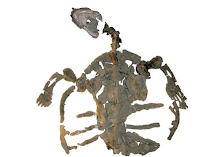
The first described specimen of Pappochellys rosinae. Rainer Schoch/Staatliches Museum für Naturkunde Stuttgart.


The new species is named Pappochelys rosinae, where 'Pappochelys' means 'Grandfather Turtle' in Greek and 'rosinae' honours Isabell Rosin, who prepared the fossils from which the species is described. The species is described from two specimens, an articulated partial skeleton lacking a skull and a disarticulated skeleton with a partial skull, though reference is made to a further 18 specimens.

Skeletal elements from which the skull of Pappochelys rosinae was reconstructed. Schoch & Sues (2015).

Pappochelys rosinae was a small, flattened, elongate animal about 20 cm in length. It lacks a true plastron (ventral shell) but has a number of large, paired bony gastrula (bony plates produced within the dermal layer) covering its ventral surface, structures which had been predicted for ancestral Turtle-like animals, but not previously seen. As in Eunotosaurus and Odontochelys the dorsal surface is protected by thick, flattened ribs with a 'T'-shaped cross section. Pappochelys lacks a beak, retaining teeth in the front and sides of its mouth and (importantly) retains two pairs of skull openings, features which clearly identify it as a Diapsid, strongly supporting the genetic evidence for a Diapsid origin for Turtles.


 Reconstruction of Pappochelys rosinae, showing the position of the skeletal elements that would become the shell in later Turtles. Rainer Schoch/Staatliches Museum für Naturkunde Stuttgart.


See also...

http://sciencythoughts.blogspot.co.uk/2015/10/desmatochelys-padillai-protostegid.htmlDesmatochelys padillai: A Protostegid Turtle from the Early Cretaceous of Colombia.        The Protostegid Turtles were a group of Turtles known from the Cretaceous that are thought to have been members of the Chelonioidea, the group that includes the two living Marine Turtle groups, the Chelonidoidea (Sea Turtles) and Dermochelyidae (Leatherback...
http://sciencythoughts.blogspot.co.uk/2014/04/a-fossil-turtle-from-early-cretaceous.htmlA fossil Turtle from the Early Cretaceous Jehol Biota.                                                      One of the first Vertebrate fossils described from the Jehol Biota was Manchurochelys manchoukuoensis, a Eucryptodire Turtle from the Yixian Formation of Liaoning Province, China. The first specimen of this...
http://sciencythoughts.blogspot.co.uk/2013/08/a-new-species-of-turtle-from-late.htmlA new species of Turtle from the Late Cretaceous of Morocco.                                   Turtles are aquatic reptiles with a shell that encases their body, and into which the head and limbs can be retracted at least partially. They have a fossil record that dates back to the Late Triassic, about 220 million...

Follow Sciency Thoughts on Facebook.