Saturday, 18 October 2025
Chelonia mydas: The Green Sea Turtle no longer considered to be Endangered as population recovers.
Saturday, 9 August 2025
Tavachelydra stevensoni: A new species of Snapping Turtle from the Palaeocene of Colorado.
Snapping Turtles, Chelydroidea, are found today from northern South America to Southern Canada, forming an important component of many North American freshwater ecosystems. Despite being widespread and numerous, there are only five species alive today. Stem group-Chelydroids (i.e. species which are more closely related to living Chelydroids than to any other group), known as pan-Chelydroids, first appeared in the Late Cretaceous, although many fossils are fragmentary, as the shells of Snapping Turtles are less heavily fused than other Turtle groups and tend to disarticulate soon after death, limiting our understanding of this group. Due to this no Cretaceous pan-Chelydroids have been described to date, although post-Cretaceous species have been described from across Laurasia.
In a paper published in the Swiss Journal of Palaeontology on 5 August 2025, Tyler Lyson, Holger Petermann,Salvador Bastien,Natalie Toth,Evan Tamez‑Galvan, and Sadie Sherman of the Department of Earth Sciences at the Denver Museum of Nature & Science, and Walter Joyce of the Department of Geosciences at the University of Fribourg, describe a new species of pan-Chelydroid Turtle from the Early Palaeocene Corral Bluffs of the Denver Basin in Colorado.
The Coral Bluffs are a series of outcrops of Latest Cretaceous to Eocene outcrops in El Paso County in the southern Denver Basin, to the east of Colorado Springs. The sequence is well-dated, with three documented magnetic reversals 30n/29r, 29r/29n, and 29n/28r), a pollen-defined Cretaceous/Palaeocene boundary, and a volcanic ash layer which has been dated using lead and uranium isotopes. These bluffs have produced abundant Vertebrate remains from the Puercan North American Land Mammal Age, including Denverus middletoni, one of two known Early Palaeocene pan-Chelydroid Turtles, which together form the earliest described members of the group.
The new species is named Tavachelydra stevensoni, where 'Tavachelydra' is a combination of 'Tava' from the Ute/Nuuchiu name for Pike's Peak Tavá-Kaavi, which can be directly translated as 'Sun Mountain'), and -chelydra, a common suffix for Turtles, which derives from the Greek 'khéludros', meaning 'water serpent', while 'stevensoni' honours the late Brandon Stevenson, a dear friend of Tyler Lyson andlong-time supporter of the Corral Bluffs project.
The new species is described from five specimens, DMNH EPV.141854, the holotype, which consists of a disarticulated, but associated, skeleton, comprising a nearly complete carapace and plastron and a complete pelvis, and three paratypes, DMNH EPV.143100, an articulated complete carapace and partial right hypo- and hypoplastron, DMNH EPV.143200, a hypo- and xiphiplastra, and DMNH. EPV.134087, a poorly preserved, but complete cranium.
Specimens of Tavachelydra stevensoni are large, with carapace reaching almost 50 cm in length. This is four times the size of Denverus middletoni, the other pan-Chelydroid Turtle from the Denver Basin. Within the Coral Bluffs fauna only one Turtle, Axestemys infernalis, is larger, while a second, Neurankylus sp., is about the same size. It also appears to be one of the rarer species in a Turtle-rich fauna, and since other thin-shelled species, such as Hoplochelys clark, are relatively abundant, this appears to be a reflection of actual rarity rather than a reflection of poor preservational potential. All the known specimens of Tavachelydra stevensoni have been found in deposits associated with ponds, rather than river channels (the most abundant environment in the Coral Bluffs deposits), suggesting that they preferred such an environment in life. The skull of Tavachelydra stevensoni is large and broad, with flat biting surfaces, which suggests a durophagous diet (eating hard food, such as shellfish). This is noteworthy, as there is evidence that durophagous species and groups may have preferentially survived the End Cretaceous Extinction.
A phylogenetic tree constructed by Lyson et al. placed Tavachelydra stevensoni as the sister species to the extant Snapping Turtles, with later European and Asian species less closely related. This is unsurprising, as while these species are more recent, they are less likely to be ancestral to modern species restricted to North America. Denverus middletoni was also recovered as only distantly related to extant Chelydrids, indicating it was a member of a lineage which did not survive till today.
See also...
Tuesday, 15 August 2023
Monitoring Cetaceans in the Azores.
Gathering data on the numbers and movements of far-ranging ocean Animals such as Cetaceans is notoriously difficult, which is unfortunate, as such Animals are considered to be key indicators of the condition of marine ecosystems, with current concerns about the long-term health of the marine environment making such data particularly crucial. The Marine StrategyFramework Directive requires European Union member states with coasts to monitor the biodiversity of their territorial waters in order to maintain the marine environment. However, this does not include dedicated Cetacean surveys, due to the complexity and expense of maintaining such programs. This leaves Cetacean surveys largely in the hands of citizen scientists and commercial organizations.
The highly charismatic nature of Whales and Dolphins makes them ideal for citizen science projects, with the public often keen to take a role in their conservation. Whale watching tours have become popular tourist activities in many parts of the world in recent decades, providing both a tool for educating the public about marine ecology and an excellent opportunity for scientific programs studying Whales to piggyback onto the commercial activity. Such programs have proven particularly good for gathering long-term data on Whales within areas where tours are carried out. Whale-watching tours are therefore a cost-effective tool for monitoring Whale populations, particularly in areas where funding is limited or unavailable. Successful examples include the ORCA Survey Network operating in UK waters, the Fixed Line Transect Mediterranean monitoring Network, which works from European Atlantic and Mediterranean ferries, the CETUS project, which operates from cargo boats out of Macaronesia (the Azores, Madeira, the Canaries, and the Cape Verde islands) and mainland Portugal, and the Kakila database, which gathers data from Whale watching tours in the Caribbean. Data gathered from such sources has led to numerous publications on the distribution, movements, and habitat preferences of Cetaceans.
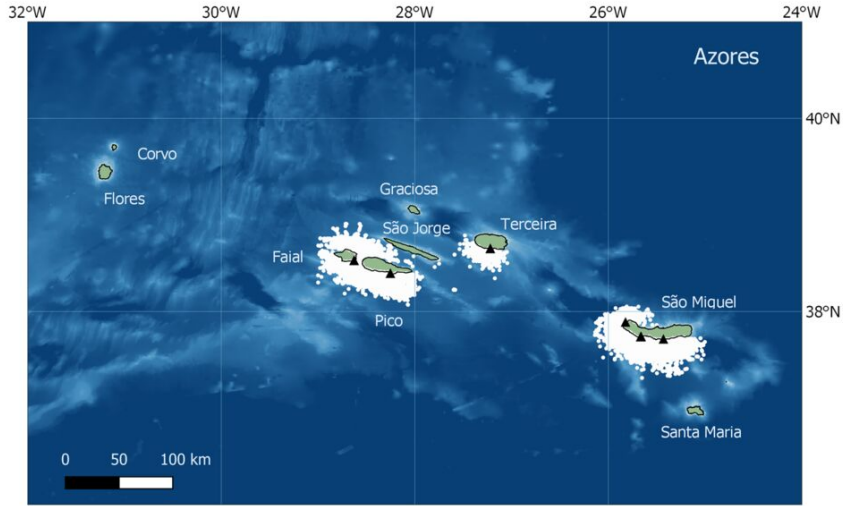
The Azores Islands are located in the North Atlantic Ocean at 36-41° North and 24-32° West. The archipelago is composed of nine volcanic islands organised into three groups separated by deep waters (i.e. deeper than 2000 m): the Western (Flores and Corvo), Central (Faial, Pico, Graciosa and Terceira) and Eastern groups (São Miguel and Santa Maria). The archipelago presents a well-defined oceanographic seasonality: March is usually the coldest month (average sea surface temperature 15°C), while the highest temperatures are generally reached in September (average sea surface temperature 25°C). The spring bloom is noticeable each year by the increase in chlorophyll concentrations, which drastically drop to oligotrophic conditions during summer.
The people of the Azores have been linked to Cetaceans since the islands were first colonised in the fifteenth century, when early settlers are known to have harvested Whales stranded on beaches or found dead at sea. In the mid eighteenth century, whalers from North America began to visit the islands in pursuit of Sperm Whales, Physeter macrocephalus, often recruiting local people as crew for their vessels. The Azoreans learned the techniques used by the Americans, and adapted them to their own needs, replacing spotters mounted high upon ships with spotters at high points on land, and using these to guide small boats towards sited Whales in the same way.
Over time the oil for which Sperm Whales was hunted was replaced by oil from other sources, making Whaling less profitable, and the practice began to die out in the 1960s. In 1982, Portugal ratified the Moratorium of theInternational Whaling Commission, and in 1986 Whaling was officially banned in all Portuguese territories, including the Azores, where the last two Sperm Wales were killed in 1987.
The whaling industry provided the first accurate data on Whales collected in the Azores, with whalers collecting data on changes in the distribution of Whales over time, the first accurate descriptions of the Animals, and even the first records of their eating giant Cephalopods. In 1987 the government of the Azores, with support from the European Union, invited the International Fund for Animal Welfare to carry out a feasibility study on the potential for developing a Whale-watching industry in the Islands. The first tours were carried out from Pico Island in 1989, and rapidly became popular with tourists. Some the earliest recruits to the new business were former lookouts from the Whaling industry, and they were soon followed by former whalers, who worked as skippers on the new boats, brining with them their expertise in the ecology and behaviour of the Whales. In 1993 Whale-watching tours also began from São Miguel Island, with tours later starting from Faial and Terciera islands.
To date, 28 species of Whales and Dolphins have been observed around the Azores, making the islands one of the most popular Whale-watching destinations in the world. From the outset, the Whale-watching industry in the Azores was built on an ecotourism model, with regulations developed through collaboration between the tour operators, the scientific community, and the government of the Azores. The first Bienal das Baleias conference was held in Lajes do Pico in October 1998, with the various groups involved seeking to come to a consensus on further developing an ecologically friendly industry. As a consequence of this, legislation was introduced in 1999, which required the mandatory collecting of data on Whales by the tour boats, although this proved to be highly impractical, and was quickly dropped, although all parties involved agreed that a system of gathering this data was needed, both to develop the Whale-watching industry and to further the study and conservation of the Whales.
The MONICET project grew out of a discussion at the 2006 Bienal das Baleias conference, with a scientific consortium working with three Whale-watching companies to develop a methodology for collecting data in a scientifically usable manner, and a remit to develop a database to store this data, all funded by a grant from the Azores government.
In a paper published in the Biodiversity Data Journal on 8 August 2023, Laura González García of the Institute of Marine Sciences at the University of the Azores, Marc Fernández of the Marine and Environmental Sciences Centre of the Agência Regional para o Desenvolvimento da Investigação Tecnologia e Inovação, and José Azevedo, also of the Institute of Marine Sciences at the University of the Azores, describe the methodology used by the MONICET project, the data gathered by that project so far, and ways in which this data might be used by researchers outside the Azores.
González García et al. describe eleven years of MONICET data, collected between 2009 and 2020, and provided by 11 of the 23 Whale watching companies active in the Azore, operating out of four of the nine volcanic islands which make up the Azores (Azores Experiences and Peter Whale Watch from Faial Island; Aqua Açores and Espaço Talassa from Pico Island; Futurismo Azores Adventures, Picos de Aventura, Terra Azul, Terra do Pico and Sea Colors from São Miguel Island and Atlantiangra, Ocean Emotion and Picos de Aventura from Terceira Island). Not every company reported data every year; participitation in the project is voluntary, and data will always be accepted from any company wishing to participate. In the first year of the project only three companies reported data, while the greatest number was reached in 2019, when nine companies reported.
MONICET uses a collaborative platform to collect and disseminate data on Cetacean sightings and movements, as well as photo images used for Whale identification. The data is collected on a voluntary basis, and is available to all interested persons, including the general public.
Whale-watching tours in the Azores typically last 2.5-3 hours, with most companies operating two tours per day, although some run three per day in the peak of the tourist season. Tours operate from São Miguel Island year-round, but from the other islands is more seasonal, typically running from May to September. In all cases, Whales are first spotted from land, with experienced spotters guiding boats to the Cetaceans. This typically results in at least one Whale encounter per trip, with boats moving to the Whales then slowing down for periods of observation.
The data used by MONICET is typically gathered by trained guides on board the boats (often trained biologists), who record the times at which the boats leave and return to their home ports, the location of the boats throughout their voyage (recorded with a GPS system), and the time, location, and species of any Whales encountered, as well as the number of Whales, their approximate age (adults, juveniles or calves), and behaviour, as well as other data about weather, sea conditions etc. Guides are provided with annual training on data collection by MONICET.
During the period recorded in González García et al.'s data, 37 000 sightings were recorded of 22 Cetacean and three Turtle species, including Minke Whale, Balaenoptera acutorostrata, Sei Whale, Balaenoptera borealis, Bryde's Whale, Balaenoptera edeni, Blue Whale, Balaenoptera musculus, Fin Whale, Balaenoptera physalus, Humpback Whale, Megaptera novaeangliae, Common Dolphin, Delphinus delphis, Short-finned Pilot Whale, Globicephala macrorhynchus, Long-finned Pilot Whale, Globicephala melas, Risso's Dolphin, Grampus griseus, Killer Whale, Orcinus orca, False Killer Whale, Pseudorca crassidens, Striped Dolphin, Stenella coeruleoalba, Atlantic Spotted Dolphin, Stenella frontalis, Bottlenose Dolphin, Tursiops truncatus, Pygmy Sperm Whale, Kogia breviceps, Sperm Whale, Physeter macrocephalus, North Atlantic Bottlenose Whale, Hyperoodon ampullatus, Sowerby's Beaked Whale, Mesoplodon bidens, Blainville's Beaked Whale, Mesoplodon densirostris, True's Beaked Whale, Mesoplodon mirus, and Cuvier's Beaked Whale, Ziphius cavirostris, as well as Loggerhead Turtle, Caretta caretta, Green Turtle, Chelonia mydas, and Leatherback Turtle, Dermochelys coriacea.
One problem noted by González García et al. is that the MONICET data tends to reflect the commercial preferences of the tourist industry. Thus spotters will guide boats towards more appealing Cetaceans, such as families of Sperm Whales or active pods of Dolphins, over Beaked or diving Whales which spend little time at the surface. The data set is presumed to be good, given the training and experience of the guides, but some caution needs to be applied to sightings of more elusive Whales, as these are less often seen, and spend less time at the surface where they can be identified.
Some types of Whale will alter their behaviour in response to the presence of boats; this is particularly true of Dolphins, which tend to break off other activities in order to investigate Human visitors. For this reason, the activity of Whales is recorded when the boats first arrive, although there is a danger that the Whales may already have been affected by the presence of earlier boats.
See also...
Follow Sciency Thoughts on Facebook.
Follow Sciency Thoughts on Twitter.
Saturday, 29 April 2023
Rafetus swinhoei: Last known female Swinhoe's Softshell Turtle has died, bringing the species to the brink of extinction.
The last known female Swinhoe's Softshell Turtle, Rafetus swinhoei, has died. The Turtle, which was 1.56 m long and weighed 93 kg was found dead at Hoan Kiem Lake in Hanoi, Vietnam, on Sunday 23 April 2023, by a volunteer with a local Turtle conservation program. A necropsy will be carried out to determine the cause of death (the term 'autopsy' is reserved for investigations of Human deaths). The Hoan Kiem Turtle was confirmed to be female during a capture-release survey in 2020, bringing hopes that it might be possible to start a breeding program for the species; the previous last known female died in a zoo in China in 2016, having never laid any eggs, despite mating with a male owned by the zoo several times.
Swinhoe's Softshell Turtles were formerly known from two geographic regions, the Yangtze River Basin in China and the Red River Basin in Vietnam (fossil specimens suggest the species had a wider range in the Pleistocene and Early Holocene), but the population has been effectively wiped out in both areas, due to hunting, egg collecting, and habitat modification by Humans. The global population now comprises a single male population in Suzhou Zoo in Jiangsu Province, China, and a second male known only from environmental DNA in Xuan Khanh Lake near Hanoi.
See also...
Follow Sciency Thoughts on Facebook.
Follow Sciency Thoughts on Twitter.
Wednesday, 7 December 2022
Fossil eggshells from the Early Cretaceous Okurodani Formation of Gifu Prefecture, Japan.
The past three decades have seen the discovery of a large quantity of fossil eggs from several Lower Cretaceous deposits in Japan, notably the Yezo Group of Hokkaido, the Kuwajima Formation of Ishikawa Prefecture, and the Ohyamashimo Formation in Hyōgo Prefecture. These include eggs which are thought to have come from Ornithopod and Theropod Dinosaurs (including Oviraptosaurs, Troodontids, and Birds). These findings add to the known palaeobiodiversity of these areas, by indicating the presence of groups not known from the skeltal fossil record. However, the majority are of Aptian or Albian age (121.4-100.5 million years old), with earlier examples being much rarer.
The Okurodani Formation outcrops in the Shokawa area of northwestern Gifu Prefecture, and is considered to be of Hauterivian age (i.e. between 132.9 and 129.4 million years old). This formation has produced a variety of Vertebrate remains, including Dinosaurs, aquatic Tetrapods and Fish, as well as a number of fragmentary egg pieces, which have been assumed to have been of Dinosaurian origin, but never formally investigated.
In a paper published in the journal Historical Biology on 24 November 2022, Rina Uematsu of the Graduate School of Science and Technology at the University of Tsukuba, Kohei Tanaka of the Faculty of Life and Environmental Sciences at the University of Tsukuba, Shohei Kozu of the Gifu Prefectural Museum, Shinji Isaji of the Natural History Museum and Institute of Chiba, and Shizuo Shimojima of Takayama City, describe the known egg material from the Okurodani Formation, and discuss the implications this has for the known biodiversity of the environment which produced these strata.
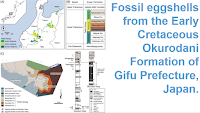
All the fossils examined in the study were collected between 1988 and 2009 by Shizuo Shimojima, Masatoshi Okura and Satoru Sakamoto, from the Okurodani Formation, a 220 m thick sequence of shale, alternating sandstone and mudstone, and sandstone beds, which forms part of the Itoshiro Subgroup of the Middle Jurassic to Lower Cretaceous Tetori Group, which has been dated to between 133 and 129 million years old, based upon uranium-lead dates obtained from layers of volcanic tuff within the formation.
Sevem fragments of eggshell and two eggshell impressions were found within black mudstone layers within the Okurodani Formation. These mudstone layers are also rich in Plant fossils and freshwater Molluscs, and are interpretted as having been laid down in a network of stagnant pools or oxbow lakes within a floodplain environment. Vertebrate remains, predominantly Fish scales and Turtle shells, but also including Frogs, small Lizards, and Choristoderes (Crocodile-like Diapsids of uncertain affinities) are typically preserved in three dimensions (i.e. not compressed), which implies rapid burial with minimal movement. Dinosaur fossils are rare in these layers, but the teeth of Ornithopods, Sauropods, and Verociraptorines have been found, as well as the tarsometatarsus of an Enantiornithine Bird.
The first two eggshell fragments discussed, GPM-Fo-1923 and 09/Cr/89/01, are assigned to the Oofamily Testudoolithidae (i.e. Turtle Eggs). These fragments are approximately 5 x 6 mm and 3 x 3 mm, respectively, and are assumed to have come from the same egg, based upon cross-sections of the joint and the overall shape of the fragments when jointed. However their precise origin is unclear, because they were collected by Masatoshi Okura, who has since passed away, and are now housed in separate museums. The outer surfaces of both shells are strongly abraded and show nodular patterns composed of tightly packed shell units. Based upon the curvature of the eggshell, the original egg would have been about 22 mm in diameter.
These shells show two separate layers, separated by an undulating horizontal boundary. In the upper layer, needle-like crystals radiate outward from the boundary. Although less prominent, such acicular crystals are also found in the lower layer; the crystals develop concentrically from the organic cores, making the basal parts of the shell units rounded in shape. Under polarised light, the eggshell exhibits irregular extinction patterns.
Turtle eggs typically have only a single layer, so the structure of the these eggshells, with two distinct layers, each with a different type of crystals, is distinctly unTestudine. Apparently double-layered Turtle eggshells can be produced taphonomically, by when two shell fragments happen to come to rest with one sitting inside the other, or as a result of a pathology - gravid female Turtles, suffering from some king of environmental stress, can retain eggs instead of laying them, depositing additional layers of minerals on the surface of the egg during the process. Neither of these appears to be the case in this instance, rather the eggs appear to have been altered diagenetically, with the outer portion of the shell having been recrystalised as a result of contact with external chemistry.
Based upon the morphology of these eggshell fragments, it is estimated that they were laid by a small Cryptodiran Turtle, with a carapace length of less than 200 mm.
The next five specimens, GPM-Fo-1294, 1295, 1296, 1297, and 1298 are placed within the Oofamily Prismatoolithidae, which is typified by a two-layered structure and an ornamented shell surface. They are assigned to a new oospecies, with GPM-Fo-1925 as the holotype, and given the name Ramoprismatoolithus okurai, where 'Ramoprismatoolithus' derives from 'Ramo-' from the Latin 'ramus', meaning branch, plus '-prismatoolithus', from the oofamily name, in reference to the reticulate ridges on the other surface of the eggshell, and 'okurai', honours the late Masatoshi Okura who pioneered the discovery of fossil eggshells and other Vertebrate remains in Shokawa.
All of these specimens are fragmentary; no intact examples of this new oospecies are known. The outer surface of these shells is distinctly sculpted, with low ridges arranged in elaborate reticulated patterns. The shells range from 0.31 to 0.61 mm in thickness, with the average being 0.46 mm. Seen under a scanning electron microscope, a near-vertical, unbranching, pore canal could be observed, increasing slightly in width towards the surface of the egg.
These eggshells show two layers, which appears to be an original feature rather than something produced by diagenetic alteration, with a lower mammillary layer (the inner layer of many eggs, which is made up of small calcium carbonate crystals, which are easily disolved and provide a source of calcium for the growing embryo) and the upper prismatic layer (made up of larger crystals, which provides structural strength to the egg) observable. These are separated by a gradual boundary. The mammillary layer makes up about one fifth to one sixth of the shell's thickness, and is comprised of acicular crystals radiating from what were presumably organic cores. The base of this layer is abraded, probably due to absorption of calcium by the growing embryo. The prismatic layer is made up of narrow, columnular crystals, visible under polarised light. Vesicles can be seen in this layer under the scanning electron microscope.
Based upon the thickness of the shell fragments, the original Ramoprismatoolithus okurai eggs are calculated to have had an average mass of 99.39 g, which assuming an egg twice as long as it is wide, would give an original size of about 57 x 133 mm.
Prismatoolithid eggs are generally accepted to have been laid by Troodontid Dinosaurs, as intact eggs assigned to the oofamily have been found with Troodontid embryos inside. However, it has been suggested that some eggs assigned to this oofamily might have been laid by early Birds.
The small estimated size of the Ramoprismatoolithus okurai eggs leads Uematsu et al. to conclude the Animal which laid them weighed somewhere between twelve and seventeen kilograms, small for a Theropod Dinosaur, but not implausible for a non-Avian Maniraptoran.
The final two specimens described are GPM-Fo-1929, an impression of part of an outer eggshell surface measuring 6 × 7 mm, and 09/Cr/88/07, a possible impression of part of an inner eggshell surface, measuring 2 x 2 mm. Neither of these specimens preserves any of the original eggshell material. The outer surface impression GPM-Fo-1929 bears a strong resemblance to the outer surface of the Ramoprismatoolithus okurai egg fragments, with reticulate ornamentation and the remains of several pore openings. The inner shell fragment impression, 09/Cr/88/07, is smooth, with no discerning features which would allow it to be associated with any known egg fossil.
The specimens described by Uematsu et al. are the oldest known fossil eggshells from Japan, and provide additional information on biodiversity within the Early Cretaceous Tetori Group, within which skeletal material is scarce, demonstrating that Turtles and small Dinosaurs were nesting in the area.
The eggs assigned to Ramoprismatoolithus okurai are likely to have been laid by a Troodontid, or closely related Maniraptoran Theropod. Okurodani Formation yields teeth of possible Velociraptorinae, and other strata within the Tetori Group (likely to be roughly co-eval, but laid down in different environments within the same landscape) have produced possible Oviraptorosauria and Dromaeosauridae, as well as the Therizinosaur-related Fukuivenator paradoxus. However, all of these groups are known to produce non-prismatic shells with microstructures unlike that of the Oofamily Prismatoolithidae. This strongly suggests that the Ramoprismatoolithus okurai eggs were produced by a small Maniraptoran Theropod not represented in the skeletal fossil record of the Tetori Group.
Troodontids, and basal Paravians (the group that includes Troodontids, Birds, and Dromaeosaurs) in general are scarce in Early Cretaceous deposits, both as skeletal and egg remains. Examples are known from the US, Spain, and China, and all Early Cretaceous small non-Avian Theropods known from East Asia come from two formations in northeastern China, the Yixian and Huajiying. Thus the discovery of the Ramoprismatoolithus okurai eggs in Japan is a significant contribution to our understanding of the distribution of mall non-Avian Theropods from the early Early Cretaceous of East Asia.
See also...
Follow Sciency Thoughts on Facebook.
Follow Sciency Thoughts on Twitter.
Friday, 10 June 2022
Chelydropsis aubasi: A new species of Snapping Turtle from the Middle Eocene of France.
Snapping Turtles, Chelydridae, form an important part of modern North American freshwater ecosystems, but have a relatively poor fossil record, largely because their shells are relatively thin compared to other Turtle groups, and tend to disarticulate rapidly after death. However, the fossil record we do have suggests that the group originated in North America in the Late Cretaceous, with subsequent dispersals into Europe and Asia (where they arrived in the Oligocene or earlier and became locally extinct in the Pliocene) and South America (where they arrived in the Pleistocene or earlier, and are still present).
The dispersal patterns of Snapping Turtles appear to have been different from those of other Turtle groups. The European Turtle fauna of the Cretaceous and Palaeocene comprised indigenous lineages of Thremydids, Helochelydrids, and Pleurosternids, with occasional influxes from elsewhere. This indigenous Turtle population disappeared around the time of the Palaeocene-Eocene Thermal Maximum, and was subsequently replaced by a new fauna including Carettochelyids, Pan-geoemydids, Pan-testudinids, Podocnemidids, and Trionychids. All of these Turtles are present in Asia, which led palaeontologists the theorise that this new influx came entirely from that continent, but more recent studies have suggested that some European groups, most notably the Trionychids, appear to be more closely related to North American faunas than to those of Asia, possibly implying a dispersal into Europe via Greenland. Snapping Turtles appeared to have arrived in Europe much later, with the Earliest known examples from the Late Oligocene, suggesting an arrival into Europe quite separate from the Palaeocene-Eocene Thermal Maximum, and its immediate after-effects. There have been reports of older Snapping Turtle remains from the Eocene of France, although none of this material has ever been formally described.
In a paper published in the journal The Anatomical Record on 6 June 2022, Walter Joyce of the Department of Geosciences at the University of Fribourg, Jean-Luc Landréat of Soissons in France, and Yann Rollot, also of the Department of Geosciences at the University of Fribourg, describe a Snapping Turtle from the Middle Eocene deposits of the Chéry-Chartreuve Sandpit in the Department of Aisne, France.
The Chéry-Chartreuve Sandpit lies half way between the towns of Soissons and Reims, and contained sediments laid down in a transition from a marine to a continental setting. The pit was worked as a quarry in the 1990s and 2000s, exposing a fosiliferous layer at the base of the sequence, from which numerous fossils were extracted by Pierre Louis, Maurice Sabatier, and Jean-Luc Landréat, with the blessing of the quarries' owner, Charles Aubas. An area of about 10 000 m² of the fossil-bearing layer was exposed during this process, the whole of which was removed. This produced an extensive Vertebrate fossil fauna, including Birds, Crocodilians, Fish, Mammals, and Turtles, the majority of which are very well preserved, with little or no crushing or diagenetic darkening. Relatively little of this assemblage has been described to date. The precise age of this deposit has not yet been determined, but it is probably Bartonian (Middle Eocene or between 42.1 and 37.71 million years old.
The Snapping Turtle is placed in the genus Chelydropsis, and given the specific name aubasi, in honour of the late Charles Aubas, who owned the Chéry-Chartreuve Sandpit quarry and both permitted and supported the activities of palaeontologists there. This species is described from a collection of shell elements including, a neural III and IV withpartial right costa, a right peripheral I, a right peripheral II, a right peripheral III, a left peripheral IV and V, a left peripheral VI, a left peripheral VII, a right peripheral VIII, a left peripheral XI, a left epiplastron, an entoplastron, a left hyoplastron a partial right hyoplastron, a partial left hypoplastron, the lateral portion of a right hypoplastron, and , a partial left xiphiplastron.
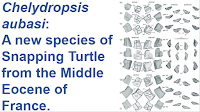
Chelydropsis aubasi, Middle Eocene (MP15, early Bartonian) of Chéry-Chartreuve, Aisne, France. 3D models of select costals and neurals. (a) NMB CHC.33, a neural II; (b) NMB CHC.465, a neural II; (c) NMB CHC.3, a neural III and IV with partialright costal IV; (d) NMB CHC.157, a neural IV; (e) NMB CHC.431, two fused posterior neurals; (f) NMB CHC.156, a posterior neural; (g) NMB CHC.34, a posterior neural; (h) NMB CHC.155, a posterior neural; (i) NMB CHC.154, a posterior neural; (j) NMB CHC.158, aposterior neural; (k) NMB CHC.466, medial portion of a left costal II; (l) NMB CHC.32, medial portion of a right costal IV; (m) NMBCHC.509, distal portion of a costal. Abbreviations: Co, costal; ne, neural; Ve, vertebral scute. Joyce et al. (2022).Fossils of Snapping Turtles are often highly incomplete, and the Animals themselves can be morphologically variable within species, while different species are often very similar, making it difficult to differentiate species. This has led to a high level of confusion in the taxonomy of fossil Snapping Turtles. A total of fifteen extinct species have been proposed from European fossils to date, although Joyce et al. suggest that three might be a more reasonable number (some experts in the field go as low as two), these being Chelydropsis decheni, found in deposits dating from the Late Eocene to the Middle Miocene, Chelydropsis murchisoni, dating from the Middle Miocene and Chelydropsis ponitica, from the Late Miocene to Early Pliocene.
The new species, Chelydropsis aubasi, does show some resemblance to Chelydropsis decheni, the earliest known species, but Joyce et al. feel that the differences that it does posses, combined with the chronological separation from all known specimens of that species, warrants its description as a new species.
See also...
Follow Sciency Thoughts on Facebook.
Follow Sciency Thoughts on Twitter.


.png)


.png)