Showing posts with label Alto Adige. Show all posts

Thursday, 26 March 2026

Avalanche kills two in the Italian Alps.

Two people have been killed and another five injured, three severely, following an avalanche on Mount Hohe Ferse (or Tallone Grande), a 2669 m peak in the Eastern Rhaetan Alps of Italy's Alto Adige (or South Tyrol) Province, on Saturday 21 March 2025. The avalanche, which is described as having been about 150 m wide, occurred at an altitude of about 2400 m, and caught 25 skiers in total.

Rescue workers searching for people trapped beneath the snow following an avalanche on Mount Hohe Ferse in the Eastern Rhaetan Alps on Saturday 21 March 2026. Corpo Nazionale Soccorso Alpino e Speleologico.

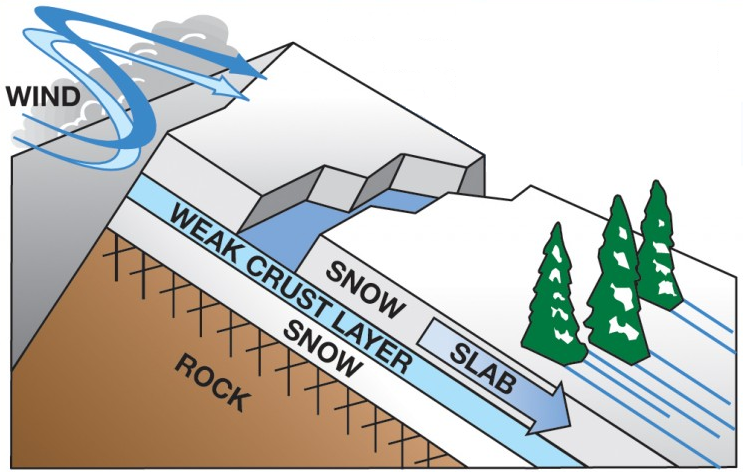
Avalanches are caused by the mechanical failure of snowpacks; essentially when the weight of the snow above a certain point exceeds the carrying capacity of the snow at that point to support its weight. This can happen for two reasons, because more snow falls upslope, causing the weight to rise, or because snow begins to melt downslope, causing the carrying capacity to fall. Avalanches may also be triggered by other events, such as Earthquakes or rockfalls. Contrary to what is often seen in films and on television, avalanches are not usually triggered by loud noises. Because snow forms layers, with each layer typically occurring due to a different snowfall, and having different physical properties, multiple avalanches can occur at the same spot, with the failure of a weaker layer losing to the loss of the snow above it, but other layers below left in place - to potentially fail later.

Diagrammatic representation of an avalanche, showing how layering of snow contributes to these events. Expedition Earth.

The incident brings the number of people killed in avalanches in Europe this winter to 127, including 33 in Italy, 31 in France, 29 in Austria, 15 in Switzerland, eight in Spain, six in Slovakia, and one each in Poland and Andorra. This means that this snow season in Europe (which is not yet over) has already produced the second highest recorded number of deaths, exceeded only by the winter of 2017/18, when 147 people died. 

This high number of fatalities appears to be linked to the warming climate, which has several knock-on effects that can lead to avalanches. Firstly, warmer conditions over the Atlantic lead to higher evaporation levels and therefore more moist air flowing over Europe, which tends to precipitate out as snow when it encounters cold updraughts above the continent's mountain ranges. Secondly, the snow itself is warmer, in many places failing to form the deeply frozen lower layers that tend to keep the snowpack in place. Finally, the higher temperature of the atmosphere tends to lead to windier conditions, which also prevents snow settling in a single place, often leading to moving drifts, which are much more prone to avalanching than solid snowpack.

See also...


Sunday, 10 May 2020

Avalanches kill two in northern Italy.

Two people have died in separate avalanches in northern Italy on the same day, Saturday 9 May 2020. A 23-year-old man was caught by an avalanche on the north side of Mount Tofana di Rozes, to the east of Cortina, and dragged about 200 m by the snow. In a separate incident a man was killed by another avalanche on the Folgaria Plateau, to the south of Trento, while walking his Dog. This weekend has been the first time many Italians have been able to visit the mountains, following a severe lockdown in response to this year's Coronovirus epidemic. However, it has also coincided with a sharp rise in temperatures, leading to a rapid thawing which has raised the avalanche risk considerably.

The approximate location of Mount Tofana di Rozes, where a 23-year-old man was killed by an avalanche while skiing on 9 May 2020. Google Maps.

Avalanches are caused by the mechanical failure of snowpacks; essentially when the weight of the snow above a certain point exceeds the carrying capacity of the snow at that point to support its weight. This can happen for two reasons, because more snow falls upslope, causing the weight to rise, or because snow begins to melt downslope, causing the carrying capacity to fall. Avalanches may also be triggered by other events, such as Earthquakes or rockfalls. Contrary to what is often seen in films and on television, avalanches are not usually triggered by loud noises. Because snow forms layers, with each layer typically occurring due to a different snowfall, and having different physical properties, multiple avalanches can occur at the same spot, with the failure of a weaker layer losing to the loss of the snow above it, but other layers below left in place - to potentially fail later.

Diagrammatic representation of an avalanche, showing how layering of snow contributes to these events. Expedition Earth.

See also...

https://sciencythoughts.blogspot.com/2019/11/venice-suffers-worst-flooding-in-53.htmlhttps://sciencythoughts.blogspot.com/2019/10/flights-over-sicily-disrupted-by.html
https://sciencythoughts.blogspot.com/2019/08/eruption-on-mount-stromboli.htmlhttps://sciencythoughts.blogspot.com/2019/08/around-200-people-evacuated-from-their.html
https://sciencythoughts.blogspot.com/2019/07/tourist-killed-by-eruption-on-stromboli.htmlhttps://sciencythoughts.blogspot.com/2019/05/mount-etna-enters-new-eruptive-phase.html
Follow Sciency Thoughts on Facebook.

Saturday, 3 November 2018

Fifteen confirmed dead as storm system sweeps across Italy.

At least fifteen people have died as a storm system swept across Italy and into Central Europe this week. The first fatalities occurred on Saturday 27 October 2018 at Crotone in Calabria, when a landslide hit workers carrying out emergency repairs to a sewer amid heavy rainfall, killing four. Landslides are a common problem after severe weather events, as excess pore water pressure can overcome cohesion in soil and sediments, allowing them to flow like liquids. Approximately 90% of all landslides are caused by heavy rainfall. Further deaths were reported on Monday 29 and Tuesday 30 October, as storm surges hit ports around the coast, heavy rain and snowfall fell across the north of the country, and central regions were hit by high winds and tornadoes, one of which killed a man in the city of Terracina in Latina.

Flood hit shops in Venice this week. EPA.

In the Alto Adige (or Sud Tyrol) Region in the far north a woman was killed when a landslide hit her house in Trento, where a fisherman was found dead some hours after going to check on a boat on a nearby lake, and a volunteer firefighter was killed in a separate incident. In the northern Emilia Romagna Region a 63-year-old kite-surfer died after being thrown against rocks near Rimini on the east coast. In the Veneto Region a 61-year-old man died after his car was swept away by a flash flood another man died after being hit by a falling tree, and the city of Venice was hit by a three metre storm surge, causing extensive flooding. In Naples a 21-year-old student was killed by another falling tree.

 Landslide at Volterra in the Pisa Region of Italy this week. Twitter.

Problems continued later in the week, with a further four deaths reported on Thursday 1 November,  with two further deaths in Trento, a man who fell from a roof while carrying out repairs and another man who died after a falling tree hit his car, and in the Val D'Aosta Region when another tree fell on a car with an elderly couple inside, killing them both.

A yacht belonging to Piers Berlesconi (son of the former Prime Minister Silvio Berlusconi) that sank in Rapallo Harbour, Genoa, during a storm this week. Reuters.

Elsewhere this week a number of luxury yachts were destroyed in the port of Rapallo in Genoa, where a storm surge described as 'reminiscent of a tsunami' broke through a harbour break wall and drove them onto the shore, and a number of luxury cars bound for export to the Middle East were destroyed in a fire at the port of Savona, thought to have been caused by salt water getting into a car battery during flooding.

Flooding near the Colosseum in Rome on Tuesday 30 October 2018. AP.

Most storms form due to heating of air over the sea in tropical zones. As the air is heated the the air pressure drops and the air rises, causing new air to rush in from outside the forming storm zone. If this zone is sufficiently large, then it will be influenced by the Coriolis Effect, which loosely speaking means the winds closer to the equator will be faster than those further away, causing the storm to rotate, clockwise in the northern hemisphere and anticlockwise in the southern hemisphere.

 A road partially blocked by a wind-blown gazebo at Badia Prataglia in Tuscany. Arezzo Fire Brigade.

Whilst the high winds associated these storms is extremely dangerous, the real danger from such storms is often the flooding. Each millibar drop in air pressure can lead to a 1 cm rise in sea level, and large storms can be accompanied by storm surges several meters high. This tends to be accompanied by high levels of rainfall, caused by water picked up by the storm while still at sea, which can lead to flooding, swollen rivers and landslides; which occur when waterlogged soils on hill slopes lose their cohesion and slump downwards, over whatever happens to be in their path.

See also...

https://sciencythoughts.blogspot.com/2018/04/ursus-arctos-marsicanus-rare-marsican.htmlhttps://sciencythoughts.blogspot.com/2018/02/families-evacuated-from-their-homes.html
https://sciencythoughts.blogspot.com/2017/12/volcanic-activity-on-mount-stromboli.htmlhttps://sciencythoughts.blogspot.com/2017/09/gaseous-emissions-kill-three-family.html
https://sciencythoughts.blogspot.com/2017/08/earthquake-kills-two-in-italian-island.htmlhttps://sciencythoughts.blogspot.com/2017/03/eight-injured-following-phraetic.html
Follow Sciency Thoughts on Facebook.