Showing posts with label Avalanche. Show all posts

Tuesday, 7 January 2025

Skier killed by avalanche in Wyoming.

A skier has died and a second has been injured following an avalanche on Breccia Cliff in Togwotee Pass, Teton County, Wyoming, on Saturday 4 January 2024. The deceased has been identified as Kenneth Goff, 36, from Lander in Fremont County, Wyoming, who is described as having been a nurse and experienced mountaineer. The skiers are reported to have been part of a party of  four who were ascending a slop on skins (strips of material which are attached to the bottom of skis to prevent backsliding, enabling the skier to climb slopes), when they caused a large slab of snow to come loose, burying Goff, and causing injuries to the lower leg of a second skier.

The site of an avalanche which killed a skier and injured a second in Teton County, Wyoming, on Saturday 4 January 2024. Teton County Search and Rescue.

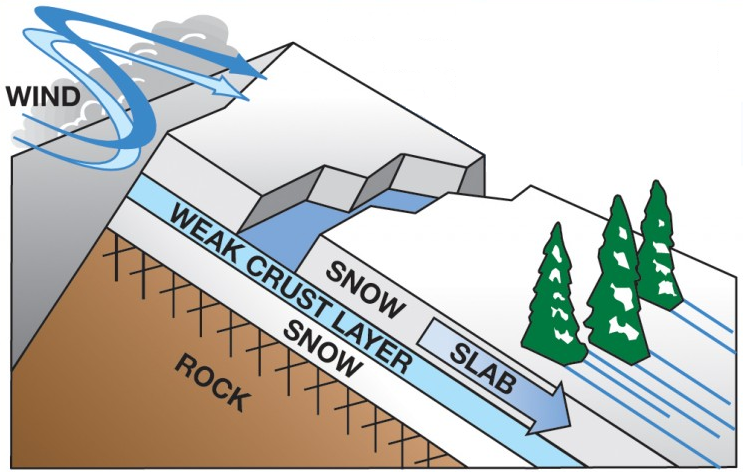
Avalanches are caused by the mechanical failure of snowpacks; essentially when the weight of the snow above a certain point exceeds the carrying capacity of the snow at that point to support its weight. This can happen for two reasons, because more snow falls upslope, causing the weight to rise, or because snow begins to melt downslope, causing the carrying capacity to fall. Avalanches may also be triggered by other events, such as Earthquakes or rockfalls. Contrary to what is often seen in films and on television, avalanches are not usually triggered by loud noises. Because snow forms layers, with each layer typically occurring due to a different snowfall, and having different physical properties, multiple avalanches can occur at the same spot, with the failure of a weaker layer losing to the loss of the snow above it, but other layers below left in place - to potentially fail later.

Diagrammatic representation of an avalanche, showing how layering of snow contributes to these events. Expedition Earth.

Emergency services in Teton County were alerted to the location of the avalanche by an automated call from an iPhone, however, this only provided the location of the incident, not any information about it. This led to multiple rescue teams being deployed, utilising skis, snowmobiles, and a helicopter. In the event, both the helicopter and snowmobiles were forced to turn back due to bad weather, but a party of volunteers on skis was able to reach the location of the avalanche and effect a rescue. Teton County Search and Rescue have warned outdoor sports enthusiasts to be aware of weather conditions when planning expeditions, and also to place limited reliance on automated calls from mobile phones as a way of contacting the emergency services, as these are relatively new technologies and only provide limited information; they advise always backing this up with an actual call or text if possible.

See also...

Monday, 23 January 2023

Avalanche kills at least 28 in Tibet.

At least 28 people have died following an avalanche in southeast Tibet on Friday 20 January 2023. The incident happened at about 8.00 am local time, when several tonnes of snow slid onto a section of highway between the village of Pai in Mainling County and the Doxong La Tunnel in Medog County, burying dozens of cars carrying people trying to get to family homes for the Lunar New Year celebrations. Rescue workers now believe they have found all of the vehicles hit by the snow, with fifty three people having been found alive, five of them with serious injuries, while the bodies of 28 people who did not survive the event were also found.

Rescue workers searching for survivors following an avalanche in southeastern Tibet on Friday 20 January 2023. CCTV.

Avalanches are caused by the mechanical failure of snowpacks; essentially when the weight of the snow above a certain point exceeds the carrying capacity of the snow at that point to support its weight. This can happen for two reasons, because more snow falls upslope, causing the weight to rise, or because snow begins to melt downslope, causing the carrying capacity to fall. Avalanches may also be triggered by other events, such as Earthquakes or rockfalls. Contrary to what is often seen in films and on television, avalanches are not usually triggered by loud noises. Because snow forms layers, with each layer typically occurring due to a different snowfall, and having different physical properties, multiple avalanches can occur at the same spot, with the failure of a weaker layer losing to the loss of the snow above it, but other layers below left in place - to potentially fail later.

Diagrammatic representation of an avalanche, showing how layering of snow contributes to these events. Expedition Earth.

See also...

Follow Sciency Thoughts on Facebook.

Follow Sciency Thoughts on Twitter.


Saturday, 5 February 2022

Avalanche kills five in the Austrian Alps.

Five people have died, and another suffered minor injuries, following an avalanche in the municipality of Spiss in the Austrian Tyrol State on Friday 4 February 2022. No further details of the event have been released at this time, but it is thought to have been triggered by rapid warming of the air after a heavy snowfall earlier in the day. A total of 31 avalanches were recorded across the Tyrol on the same day, with one other person being injured in a separate incident.

 
The approximate location of the 4 February 2022 Spiss avalanche. Google Maps.

Avalanches are caused by the mechanical failure of snowpacks; essentially when the weight of the snow above a certain point exceeds the carrying capacity of the snow at that point to support its weight. This can happen for two reasons, because more snow falls upslope, causing the weight to rise, or because snow begins to melt downslope, causing the carrying capacity to fall. Avalanches may also be triggered by other events, such as Earthquakes or rockfalls. Contrary to what is often seen in films and on television, avalanches are not usually triggered by loud noises. Because snow forms layers, with each layer typically occurring due to a different snowfall, and having different physical properties, multiple avalanches can occur at the same spot, with the failure of a weaker layer losing to the loss of the snow above it, but other layers below left in place - to potentially fail later.

 
Diagrammatic representation of an avalanche, showing how layering of snow contributes to these events. Expedition Earth.

See also...


Follow Sciency Thoughts on Facebook.

Follow Sciency Thoughts on Twitter.


Tuesday, 11 January 2022

Avalanche kills two snowshoers and their dog in Colorado.

An avalanche has killed two snowshoers and their dog in Summit County, Colorado, according to the Colorado Avalanche Information Center. The incident happened on a flank of North Star Mountain on Saturday 8 January 2022, and was discovered by volunteers from the Summit County Rescue Group and Flight for Life, who began searching the area after the couple failed to return. They discovered an avalanche track 400 m wide and about 250 m long, where the bodies of all three victims were found buried by a rescue dog. The dead snowshoers have been identified as Hannah Nash, 25, and Drake Oversen, 35, both of Colorado Springs. This is the second fatal avalanche in Colorado this winter.

 
The scene of an avalanche where two snowshoers and their dog were killed on the flank of North Star Mountain, Colorado, on 8 January 2022. Colorado Avalanche Information Center/Summit County Rescue Group.

 Avalanches are caused by the mechanical failure of snowpacks; essentially when the weight of the snow above a certain point exceeds the carrying capacity of the snow at that point to support its weight. This can happen for two reasons, because more snow falls upslope, causing the weight to rise, or because snow begins to melt downslope, causing the carrying capacity to fall. Avalanches may also be triggered by other events, such as Earthquakes or rockfalls. Contrary to what is often seen in films and on television, avalanches are not usually triggered by loud noises. Because snow forms layers, with each layer typically occurring due to a different snowfall, and having different physical properties, multiple avalanches can occur at the same spot, with the failure of a weaker layer losing to the loss of the snow above it, but other layers below left in place - to potentially fail later.

 
Diagrammatic representation of an avalanche, showing how layering of snow contributes to these events. Expedition Earth.

See also...


Follow Sciency Thoughts on Facebook.

Follow Sciency Thoughts on Twitter.


Saturday, 6 February 2021

Avalanches kill four people in Colorado this week.

Four people have been killed in two separate avalanches in the state of Colorado in the past week. On Monday 1 February 2021 three skiers were killed by an avalanche at Ophir Pass near Silverton in San Juan County. They have subsequently been identified as Seth Bossung, Andy Jessen and Adam Palmer, all residents the town of Eagle in Eagle County. A fourth skier was also caught in the avalanche and buried, but onlt received minor injuries. On Thursday 4 February another Colorado man, identified as John Kuo, 41, of Vail, again in Eagle County, was caught in an avalanche in the East Vail Chutes, which was described as being about 700 m wide, and to have run downslope for about a kilometre. This brings the number of people killed by avalanches in Colorado so far this winter to eight, compared to six in the entire winter of 2019-2020.

 
Rescue workers in San Juan County, Colorado, searching for survivors after an avalanche on Monday ` February 2021. San Juan County Office of Emergency Management/Facebook.

Avalanches are caused by the mechanical failure of snowpacks; essentially when the weight of the snow above a certain point exceeds the carrying capacity of the snow at that point to support its weight. This can happen for two reasons, because more snow falls upslope, causing the weight to rise, or because snow begins to melt downslope, causing the carrying capacity to fall. Avalanches may also be triggered by other events, such as Earthquakes or rockfalls. Contrary to what is often seen in films and on television, avalanches are not usually triggered by loud noises. Because snow forms layers, with each layer typically occurring due to a different snowfall, and having different physical properties, multiple avalanches can occur at the same spot, with the failure of a weaker layer losing to the loss of the snow above it, but other layers below left in place - to potentially fail later.

Diagrammatic representation of an avalanche, showing how layering of snow contributes to these events. Expedition Earth.

See also...


Follow Sciency Thoughts on Facebook.

Follow Sciency Thoughts on Twitter


Thursday, 14 May 2020

Avalanche kills two Indian soldiers in Sikkim.

Two Indian soldiers have been killed after being caught in a avalanche while on a snow clearing patrol in Sikkim State on Thursday 14 May 2020. Lieutenant Colonel Robert T A and Sapper Sapala Shanmukha Rao were part of a patrol of eighteen soldiers who were caught in the avalanche in the Lugnak La Pass, about 5000 m above sealevel when they were caught by the avalanche. The other members of the patrol have been evacuated safely and are unhurt. Avalanches are a particular hazard in the high Himalayas at this time of year, as the spring thaw starts to weaken layers of snow that have built up over the long winter.

Lieutenant Colonel Robert T A, killed in an avalanche in Sikkim State, India, on 14 May 2020. Maram Naga/Facebook.

Avalanches are caused by the mechanical failure of snowpacks; essentially when the weight of the snow above a certain point exceeds the carrying capacity of the snow at that point to support its weight. This can happen for two reasons, because more snow falls upslope, causing the weight to rise, or because snow begins to melt downslope, causing the carrying capacity to fall. Avalanches may also be triggered by other events, such as Earthquakes or rockfalls. Contrary to what is often seen in films and on television, avalanches are not usually triggered by loud noises. Because snow forms layers, with each layer typically occurring due to a different snowfall, and having different physical properties, multiple avalanches can occur at the same spot, with the failure of a weaker layer losing to the loss of the snow above it, but other layers below left in place - to potentially fail later.

Diagrammatic representation of an avalanche, showing how layering of snow contributes to these events. Expedition Earth.

See also...

https://sciencythoughts.blogspot.com/2020/03/three-killed-after-landslide-hits-car.htmlhttps://sciencythoughts.blogspot.com/2016/08/thousands-evacuated-after-landslide.html
https://sciencythoughts.blogspot.com/2013/10/magnitude-53-earthquake-in-sikkim-state.htmlhttps://sciencythoughts.blogspot.com/2013/09/family-of-five-killed-by-landslide-in.html
https://sciencythoughts.blogspot.com/2011/09/himilayan-earthquake-18-september-2011.html
Follow Sciency Thoughts on Facebook.

Sunday, 10 May 2020

Avalanches kill two in northern Italy.

Two people have died in separate avalanches in northern Italy on the same day, Saturday 9 May 2020. A 23-year-old man was caught by an avalanche on the north side of Mount Tofana di Rozes, to the east of Cortina, and dragged about 200 m by the snow. In a separate incident a man was killed by another avalanche on the Folgaria Plateau, to the south of Trento, while walking his Dog. This weekend has been the first time many Italians have been able to visit the mountains, following a severe lockdown in response to this year's Coronovirus epidemic. However, it has also coincided with a sharp rise in temperatures, leading to a rapid thawing which has raised the avalanche risk considerably.

The approximate location of Mount Tofana di Rozes, where a 23-year-old man was killed by an avalanche while skiing on 9 May 2020. Google Maps.

Avalanches are caused by the mechanical failure of snowpacks; essentially when the weight of the snow above a certain point exceeds the carrying capacity of the snow at that point to support its weight. This can happen for two reasons, because more snow falls upslope, causing the weight to rise, or because snow begins to melt downslope, causing the carrying capacity to fall. Avalanches may also be triggered by other events, such as Earthquakes or rockfalls. Contrary to what is often seen in films and on television, avalanches are not usually triggered by loud noises. Because snow forms layers, with each layer typically occurring due to a different snowfall, and having different physical properties, multiple avalanches can occur at the same spot, with the failure of a weaker layer losing to the loss of the snow above it, but other layers below left in place - to potentially fail later.

Diagrammatic representation of an avalanche, showing how layering of snow contributes to these events. Expedition Earth.

See also...

https://sciencythoughts.blogspot.com/2019/11/venice-suffers-worst-flooding-in-53.htmlhttps://sciencythoughts.blogspot.com/2019/10/flights-over-sicily-disrupted-by.html
https://sciencythoughts.blogspot.com/2019/08/eruption-on-mount-stromboli.htmlhttps://sciencythoughts.blogspot.com/2019/08/around-200-people-evacuated-from-their.html
https://sciencythoughts.blogspot.com/2019/07/tourist-killed-by-eruption-on-stromboli.htmlhttps://sciencythoughts.blogspot.com/2019/05/mount-etna-enters-new-eruptive-phase.html
Follow Sciency Thoughts on Facebook.