Showing posts with label Balochistan. Show all posts

Monday, 4 January 2021

Militant group kills eleven miners in Pakistan.

Eleven coal miners have been killed in an attack on a mining camp in the Bolan District of Balochistan Province in Pakistan. The men were part of a group of fifteen miners who were attacked in a residential block at the mine, and had their hands and feet tied before having their throats cut. Four other miners survived the attack and are described as being in a 'critical condition' in a hospital in Macch. Responsibility for the attack has been claimed by the Islamic State group, and it is believed the attack was sectarian in nature, targeting the miners because they belonged to the Shi’ite Hazara minority rather than because of the mine's activities.

 
Ambulances arrive at a hospital in Macch, Balochistan, carrying survivors of a terrorist attack that targeted a coal mine in the province. EPA.

This is the first terrorist attack in Balochistan since April, when a suicide bomber killed 18 people, again in an attack aimed at the Hazara minority. However, such attacks have been a growing problem for the past decade, with Islamic State, the Taliban, and other militant Sunni Groups targeting Shia Muslims in Balochistan. The situation is made more complicated by another insurgency being waged by Balochistan nationalists, who wish to unite Balochistan Province with Sistan and Baluchestan Province in Iran and the Balochistan region of southern Afghanistan into a new, independent, state, and who sometimes carry out attacks on projects such as mines, which they see as exploiting the region's wealth for the benefit of outside interests. 

See also...


Follow Sciency Thoughts on Facebook.

Follow Sciency Thoughts on Twitter.


Friday, 19 July 2019

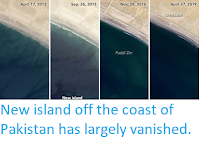
New island off the coast of Pakistan has largely vanished.

An island which formed off the coast of Pakistan following a Magnitude 7.7 Earthquake in September 2013 has largely disappeared. The island, named Zalzala Koh (which means 'Earthquake Mountain' in Urdu), is thought to have been caused by a mud volcano, the result of liquids or gasses being released suddenly from rocks into soft sediments, resulting in dramatic upwelling of mud and gas.The new island was found to be venting methane in a number of places, leading to the conclusion that a sudden change of pressure caused methane ice buried in the mud to thaw, causing it to expand rapidly and raise sediment to form the new island. Frozen methane in marine sediments is quite common, as the gas freezes at quite high temperatures under pressure. Mud volcanoes are a fairly common occurrence in Balochistan, though where they occur offshore, as is the case with this one, they are often eroded away by the sea fairly quickly.

 Series of satellite images of the Pakistan Coast near the port of Gwadar in Balochistan, taken between April 2013 and April 2019, showing the appearance and disappearance of the new island. Earth Observatory/NASA.

The Earthquake which formed the island had an epicentre roughly 400 km to the north of where the island formed, was felt as far away as New Delhi and Dubai, and resulted in over 800 fatalities, mainly in the Arawan District, where many buildings collapsed (around 90% of buildings were destroyed in communities close to the epicentre).

 Villagers in Labach in Arawan District forced to sleep outside following the destruction of their homes by the 24 September 2013 Earthquake. Arshad Butt/AP.

When Zalzala Koh first emerged it was roughly 18 m high and covered an area of approximately 30 by 76 m. However, it was formed entirely of unconsolidated mud and sand, and has been slowly washed away by the waters of the Arabian Sea since this time, and is no longer visible above the surface, though the water around the site of the former island is still prone to swirling turbulence, which indicates there is still a structure close to the water surface.

Residents of Gwadar investigating the new island on 25 September 2013. Behram Balochi/AFP/Getty Images.

See also...

https://sciencythoughts.blogspot.com/2019/05/millitant-group-kills-five-in-attack-on.htmlhttps://sciencythoughts.blogspot.com/2018/08/fourteen-confirmed-deaths-following.html
https://sciencythoughts.blogspot.com/2018/06/landslide-kills-three-in-zhob-district.htmlhttps://sciencythoughts.blogspot.com/2018/06/explosion-kills-four-miners-in.html
https://sciencythoughts.blogspot.com/2018/04/balochistan-miners-die-of-gas-poisoning.htmlhttps://sciencythoughts.blogspot.com/2017/02/magnitude-63-earthquake-on-coast-of.html
Follow Sciency Thoughts on Facebook.

Friday, 10 May 2019

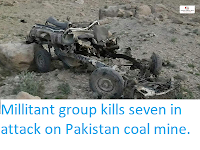
Millitant group kills seven in attack on Pakistan coal mine.

Five people have been killed in an attack on a coal mine in Balochistan Province, Pakistan. The incident happened on Thursday 9 May 2019, in the Harnai District in the northeast of the province, when gunmen opened fire on miners, killing two. This prompted the deployment of troops from the Balochistan Frontier Corps, who were then ambushed, with three soldiers killed when their vehicle was blown up by an improvised explosive device, and two further soldiers were killed in a shootout with the attackers.

The remains of a Balochistan Frontier Corps vehicle destroyed in an ambush in Balochistan Province, Pakistan, on 9 May 2019. The Bolochistan Post.

Responsibility for the attack has been claimed by Baloch Raaji Aajoi Sangar, a group demanding independence for Balochistan, which they feel is exploited for its mineral wealth by the Pakistan government, with little of the wealth generated reaching local people. The group has carried out a series of attacks on military personnel, workers at mines (which often employ large numbers of people from other parts of Pakistan) and Chinese nationals working on projects in the province.

See also...

https://sciencythoughts.blogspot.com/2018/08/fourteen-confirmed-deaths-following.htmlhttps://sciencythoughts.blogspot.com/2018/06/landslide-kills-three-in-zhob-district.html
https://sciencythoughts.blogspot.com/2018/06/explosion-kills-four-miners-in.htmlhttps://sciencythoughts.blogspot.com/2018/04/balochistan-miners-die-of-gas-poisoning.html
https://sciencythoughts.blogspot.com/2017/02/magnitude-63-earthquake-on-coast-of.htmlhttps://sciencythoughts.blogspot.com/2014/07/magnitude-44-earthquake-in-balochistan.html
Follow Sciency Thoughts on Facebook.

Thursday, 16 August 2018

Fourteen confirmed deaths following explosion at Balochistan coal mine.

Fourteen miners have now been confirmed dead following an explosion at a coal mine in Sanjidi, near Quetta in Balochistan Province, Pakistan, on Sunday 12 August 2018. Nineteen miners were reportedly about 1200 m below the ground when the explosion occurred, and while rescue workers are still attempting to locate the five missing men, their attempts are being hampered by a build-up of piousness gas in the mine, and there is thought to be little chance of finding any survivors.

The approximate location of the Sanjidi coal mine. Google Maps.

Coal is formed when buried organic material, principally wood, in heated and pressurised, forcing off hydrogen and oxygen (i.e. water) and leaving more-or-less pure carbon. Methane is formed by the decay of organic material within the coal. There is typically little pore-space within coal, but the methane can be trapped in a liquid form under pressure. Some countries have started to extract this gas as a fuel in its own right. When this pressure is released suddenly, as by mining activity, then the methane turns back to a gas, expanding rapidly causing, an explosion. This is a bit like the pressure being released on a carbonated drink; the term 'explosion' does not necessarily imply fire in this context, although as methane is flammable this is quite likely.

See also...

https://sciencythoughts.blogspot.com/2018/06/landslide-kills-three-in-zhob-district.htmlhttps://sciencythoughts.blogspot.com/2018/06/explosion-kills-four-miners-in.html
https://sciencythoughts.blogspot.com/2018/04/balochistan-miners-die-of-gas-poisoning.htmlhttps://sciencythoughts.blogspot.com/2017/02/magnitude-63-earthquake-on-coast-of.html
https://sciencythoughts.blogspot.com/2014/07/magnitude-44-earthquake-in-balochistan.htmlhttps://sciencythoughts.blogspot.com/2013/11/magnitude-49-earthquake-in-northeast.html


Follow Sciency Thoughts on Facebook.

Tuesday, 19 June 2018

Landslide kills three in Zhob District, Pakistan.

Three members of the same family have died and two more have been injured, after a landslide at Silyazzai in the Zhob District of Balochistan Province, Pakistan, on Sunday 17 June 2018,  Those involved are reported to be the family of Rahmatullah Safi, a freelance photographer and politician, who were visiting a local beauty spot as part of the Eid celebrations when the event occurred. The deceased have been identified as Najeebullah, 8, Raza Gul, 10, and Mohibullah, 13, while Rahmatullah Safi himself and an older son were injured.

Vehicle belonging to Rahmatullah Safi, destroyed in the 17 June 2018 Silyazzai landslide. Hafeezullah Sherani/Dawn.

The incident is reported to have occurred following heavy rains in the area associated with the Indian Summer Monsoon. Landslides are a common problem after severe weather events, as excess pore water pressure can overcome cohesion in soil and sediments, allowing them to flow like liquids. Approximately 90% of all landslides are caused by heavy rainfall. Zhob is an arid area which is not always reached by the monsoon, but this means that when the rains do reach it then it is particularly vulnerable to landslips, due to a lack of vegetation, which can help hold soil layers together and prevent such events.


The approximate location of the 17 June 2018 Silyazzia landslide. Google Maps.

Monsoons are tropical sea breezes triggered by heating of the land during the warmer part of the year (summer). Both the land and sea are warmed by the Sun, but the land has a lower ability to absorb heat, radiating it back so that the air above landmasses becomes significantly warmer than that over the sea, causing the air above the land to rise and drawing in water from over the sea; since this has also been warmed it carries a high evaporated water content, and brings with it heavy rainfall. In the tropical dry season the situation is reversed, as the air over the land cools more rapidly with the seasons, leading to warmer air over the sea, and thus breezes moving from the shore to the sea (where air is rising more rapidly) and a drying of the climate.

 Diagrammatic representation of wind and rainfall patterns in a tropical monsoon climate. Geosciences/University of Arizona.

See also...

http://sciencythoughts.blogspot.com/2018/06/explosion-kills-four-miners-in.htmlhttp://sciencythoughts.blogspot.com/2018/04/balochistan-miners-die-of-gas-poisoning.html
http://sciencythoughts.blogspot.com/2017/02/magnitude-63-earthquake-on-coast-of.htmlhttp://sciencythoughts.blogspot.com/2014/07/magnitude-44-earthquake-in-balochistan.html
http://sciencythoughts.blogspot.com/2013/11/magnitude-49-earthquake-in-northeast.htmlhttp://sciencythoughts.blogspot.com/2013/10/magnitude-53-earthquake-in-eastern.html
Follow Sciency Thoughts on Facebook.

Sunday, 3 June 2018

Explosion kills four miners in Balochistan Province, Pakistan.

Four workers died in a gas explosion at a mine in Balochistan Province, Pakistan, on the morning of Sunday 3 June 2018. The men were among nine who were below ground at the time of the explosion, which occurred in the Sinjawi area. Three of the men were killed in the initial blast, with the fourth dying later of his injuries, three other miners are still being treated for of their injuries. The deceased have been identified as Mohammad Rahman, Yar Khan, Badsha Wazir and Ghulam Mohammad.

The approximate location of the Sinjawi Coal Mine. Google Maps.

Coal is formed when buried organic material, principally wood, in heated and pressurised, forcing off hydrogen and oxygen (i.e. water) and leaving more-or-less pure carbon. Methane is formed by the decay of organic material within the coal. There is typically little pore-space within coal, but the methane can be trapped in a liquid form under pressure. Some countries have started to extract this gas as a fuel in its own right. When this pressure is released suddenly, as by mining activity, then the methane turns back to a gas, expanding rapidly causing, an explosion. This is a bit like the pressure being released on a carbonated drink; the term 'explosion' does not necessarily imply fire in this context, although as methane is flammable this is quite likely.

Coal is also comprised more or less of pure carbon, and therefore reacts freely with oxygen (particularly when in dust form), to create carbon dioxide and (more-deadly) carbon dioxide, while at the same time depleting the supply of oxygen. This means that subterranean coal mines need good ventilation systems, and that fatalities can occur if these break down.

See also...

http://sciencythoughts.blogspot.com/2018/04/balochistan-miners-die-of-gas-poisoning.htmlhttp://sciencythoughts.blogspot.com/2017/02/magnitude-63-earthquake-on-coast-of.html
http://sciencythoughts.blogspot.com/2014/07/magnitude-44-earthquake-in-balochistan.htmlhttp://sciencythoughts.blogspot.com/2013/11/magnitude-49-earthquake-in-northeast.html
http://sciencythoughts.blogspot.com/2013/10/magnitude-53-earthquake-in-eastern.htmlhttp://sciencythoughts.blogspot.com/2013/10/magnitude-47-earthquake-in-southern_21.html
Follow Sciency Thoughts on Facebook.

Thursday, 5 April 2018

Balochistan miners die of gas poisoning.

Six miners have died of asphyxiation in Balochistan Province, Pakistan, on Wednesday 4 April 2018. The precise cause of the incident is unclear, but it is understood that the incident happened at a coal mine in the Siah Kumb area of Surab District, which was unlicensed, and therefore is unlikely to have had adequate ventilation or other safety measures.

The approximate location of the Siah Kumb Coal Mine. Google Maps.

Coal is formed when buried organic material, principally wood, in heated and pressurised, forcing off hydrogen and oxygen (i.e. water) and leaving more-or-less pure carbon. Methane is formed by the decay of organic material within the coal. There is typically little pore-space within coal, but the methane can be trapped in a liquid form under pressure. Some countries have started to extract this gas as a fuel in its own right. When this pressure is released suddenly, as by mining activity, then the methane turns back to a gas, expanding rapidly causing, an explosion. This is a bit like the pressure being released on a carbonated drink; the term 'explosion' does not necessarily imply fire in this context, although as methane is flammable this is quite likely.

Coal is also comprised more or less of pure carbon, and therefore reacts freely with oxygen (particularly when in dust form), to create carbon dioxide and (more-deadly) carbon dioxide, while at the same time depleting the supply of oxygen. This means that subterranean coal mines need good ventilation systems, and that fatalities can occur if these break down.

See also...

http://sciencythoughts.blogspot.co.uk/2018/04/explosion-at-pakistan-coal-mine-kills.htmlhttp://sciencythoughts.blogspot.co.uk/2017/09/six-killed-in-landslip-at-quarry-in.html
http://sciencythoughts.blogspot.co.uk/2017/08/magnitude-46-earthquake-near-rawalpindi.htmlhttp://sciencythoughts.blogspot.co.uk/2017/02/magnitude-63-earthquake-on-coast-of.html
http://sciencythoughts.blogspot.co.uk/2016/10/magnitude-54-earthquake-in-khyber.htmlhttp://sciencythoughts.blogspot.co.uk/2016/04/flash-floods-and-landslides-kill-at.html
Follow Sciency Thoughts on Facebook.