Showing posts with label Bee Flies. Show all posts

Sunday, 23 October 2016

Thevenetimyia spinosavus: A new species of Bee Fly from Madagascar.

Madagascar is considered to be a biodiversity hotspot, with many plants and animals recorded there that are not known from any other location. One of the groups that has remarkably high diversity on the island are the True Flies, Diptera, with the island thought to be home to about three times as many Fly species as the entire of Africa. Despite this high diversity the Flies of Madagascar are not well studied, with some groups thought likely to show high diversity on the island hardly recorded at all; for example only seventeen species of Bee Fly have been recorded on Madagascar, out of a global total of about 4700 described species.

In a paper published in the journal Zootaxa on 12 October 2016, Natalia Maass of the University of Eastern Kentucky, Zachary Larmore and Mattew Bertone of the North Carolina State University and Michelle Trautwein of the California Academy of Sciences, describe a new species of Bee Fly from southern Madagascar.

The new species is placed in the genus Thevenetimyia, and given the specific name spinosavus, meaning 'spiny grandfather' a reference to the spines present on the Fly's scutum and scutellum and the white hairs on its body, which give it a 'granfatherly' appearance. The species is described from a single male specimen collected in the Zombiste National Park in southern Madagascar by Mike Irwin and Rasolondalao Harin’Hala in October 2002.

Thevenetimyia spinosavus, lateral view. Maass et al. (2016).

Thevenetimyia spinosavus is the first species of Thevenetimyia known from Madagascar, and only a single species is known from Africa, Thevenetimyia quedenfeldti from the Magreb Region of northwest Africa (Mauritania, Algeria, and Tunisia), with the majority of known species coming from the pine and chaparral belt of western North America.

See also...

http://sciencythoughts.blogspot.co.uk/2015/11/fossil-bee-flies-from-dominican.htmlFossil Bee Flies from the Dominican Republic and North America.                                     Bee Flies, Bombyliidae, are True Flies, Diptera, specialized for feeding on pollen and nectar, many of which have evolved long proboscises for nectar feeding. Many adult Bee Flies resemble Bees...


Follow Sciency Thoughts on Facebook.
 

Sunday, 15 November 2015

Fossil Bee Flies from the Dominican Republic and North America.

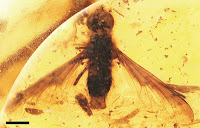
Bee Flies, Bombyliidae, are True Flies, Diptera, specialized for feeding on pollen and nectar, many of which have evolved long proboscises for nectar feeding. Many adult Bee Flies resemble Bees in shape and colouration, giving the group their name and providing the otherwise defenseless Flies with a degree of protection against predators. Bee Flies are important pollinators in many ecosystems, and aee found on every continent except Antarctica, but have a somewhat limited fossil record, probably due to their preference for drier habitats, which are not conducive for fossilization, particularly for small organisms such as Insects which produce no mineralized tissues. The majority of Bee Flies are parasitoids, i.e. their larvae mature inside the living bodies of other Insects, usually with fata consequences for the host, however unlike Wasps female Bee Flies do not lay their eggs directly upon their hosts, instead scattering them in areas where the emergent larvae, which are mobile with legs and eyes, are likely to encounter suitable hosts and enter them. The majority of Bee Flies cover their eggs with sediment structures called 'sand-traps' which enable them to avoid desiccation.

In a paper published in the journal Palaeontologica Electronica on 6 October 2015 Dale Greenwalt and Jonathan Wingerath of the Department of Paleobiology at the National Museum of Natural History and Neal Evenhuis of the Department of Natural Science at the Bishop Museum in Honolulu, describe two new fossil Bee Flies, one from Miocene Dominican Amber and the other from the Middle Eocene Kishenehn Formation of Montana.

The first specimen described is placed in the genus Anthrax, and given the specific name succini, which derives from 'succinum', the Lain for Amber. The specimen is female and 8.45 mm in length, with a wing length of 9.37 mm. It comes from Miocene Dominican Amber, but closely resembles the living Jamaican species Anthrax delicatulus, which has been reported from the Dominican Republic, differing only in the amount of pigment in the wings and the position of some wing veins.

Anthrax succini. Scale bar equals 2 mm. Greenwalt et al. (2015).

Greenwalt et al. believe that Anthrax succini is the first fossil specimen of the genus Anthrax described, though they note that a previous specimen was assigned to the genus by Standley Lewis in 1969. Anthrax dentoni was described from a fragmentary wing from the Early-to-Middle Miocene Latah Formation of northwestern Idaho. However while Greenwalt et al. do agree that the specimen is a Bee Fly, they do not believe that there is sufficient material to assign it to a specific genus.

Anthrax dentoni. (1) Photograph of the fossil. (2) Line drawing of venation. Scale bar equals 1 mm. Greenwalt et al. (2015).

The second new specimen described is placed in a new genus, Eoanomala, meaning 'dawn-anomaly'; it appears to be a member of the Exoprosopines, an still extant group, but has shorter wings compared to the body length than any living species, and has a long fleshy proboscis, whereas modern members of the group have either short or thin proboscises. It is given the specific name melas, meaning 'black'. The specimen is preserved on a fragment of oil shale from the Middle Eocene Kishenehn Formation of Montana, and is entirely black in colour. It is 6.09 mm in length with 6.04 mm wings, and of indeterminate sex.

Eoanomala melas. Scale bar equals 5 mm. Greenwalt et al. (2015).

See also...

http://sciencythoughts.blogspot.co.uk/2015/08/preservation-of-haemoglobin-derived.htmlPreservation of haemoglobin-derived chemicals in a fossil Mosquito from the Eocene of Montana.                                             The 1993 film Jurassic Park speculated that Dinosaur DNA might be extracted from blood preserved inside Mosquitoes, Culcidae, trapped in amber during...
http://sciencythoughts.blogspot.co.uk/2015/05/protoplecid-flies-from-middle-jurassic.htmlProtoplecid Flies from the Middle Jurassic Daohugou Biota of Inner Mongolia.       Protoplecid Flies are a group of True Flies, Diptera, known from Jurassic deposits across Eurasia. They are thought to be ancestral to the modern Bibionidae (March Flies and Love Bugs) and the group...
http://sciencythoughts.blogspot.co.uk/2015/04/tripius-gyraloura-sphaerularid-nematode.htmlTripius gyraloura, a Sphaerularid Nematode infecting the Arundo Gall Midge.           Sphaerularid Nematodes are highly virulent parasites of Insect hosts. While most parasites seek to keep their host alive for as long as possible, enabling them to live and produce offspring for as long as possible, Sphaerularids begging to reproduce at a high...
Follow Sciency Thoughts on Facebook.