Showing posts with label Dominican Amber. Show all posts

Thursday, 16 February 2023

Neoponera vejestoria: A Ponerine Ant from Miocene Dominican Amber, and its implications for the evolution of the ecological niches occupied by Ants in the Greater Antilles.

The makeup of modern ecological communities is determined by three factors, speciation, migration, and extinction. The first two of these can be largely understood through the examination of extant species, but our knowledge of past extinction events is entirely derived from the fossil record. Extinction events can create opportunities for surviving species to adapt into vacant niches, but can also lead to the vanishing of those niches, and of co-dependent niches and the organisms that occupy them. Island ecosystems are particularly vulnerable to extinction events, and their ecological communities are therefore particularly prone to being modified in this way. This makes the fossil history of island ecosystems, which are likely to have been shaped by numerous extinction events. of particular interest to evolutionary ecologists, although very few islands have fossil deposits that record past faunas in sufficient detail to be useful.

The island of Hispaniola in the Greater Antilles is home to 126 indigenous Ant species, drawn from a wide range of Neotropical groups which occupy different ecological roles. The island is also home to an excellent Fossil Lagerstätte, the Dominican Amber deposits, from which over 1100 species of Early Miocene Insects, including 86 species of Ants. The fauna recorded in this amber deposit is very similar to that of the modern Neotropics, with 84 of the described Ant species being placed in extant Neotropical genera. However, about a third of the genera found in the fossil fauna, while still present in the wider Neotropics, are absent from not just Hispaniola, but the wider Greater Antilles island group, implying that they have suffered local extinctions over the 16 million years since the amber was deposited. The ancient and modern faunas were studied by biologist Edward O. Wilson in the 1980s, who concluded that larger species and those with more specialize ecologies were more likely to have gone extinct. Since Wilson carried out his study, considerably more has been learned about both the fossil and living Hispaniolan Ant faunas, but Wilson's observations remain unchallenged.

In a paper published in the journal BMC Biology on 8 February 2023, Gianpiero Fiorentino of the Federated Department of Biological Sciences at the New Jersey Instituteof Technology, John Lattke of the Departamento de Zoologia at the Universidade Federal Do Paraná,  Adrian Troya of the Departamento de Biología at the Escuela Politécnica Nacional, Christine Sosiak, also of the Federated Department of Biological Sciences at the New Jersey Institute of Technology, Minsoo Dong of the Applied Biology Program at Kangwon National University, and Phillip Barden, again of the Federated Department of Biological Sciences at the New Jersey Institute of Technology, and of the Division of Invertebrate Zoology at the American Museum of Natural History, describe a new species of Ponerine Ant from Miocene Dominican Amber, and discuss its implications for the evolution of the ecological niches occupied by Ants in the Greater Antilles.

The new species is assigned to the Subfamily Ponerinae, one of the largest and most diverse Ant families, both in ecological and morphological terms, and to the genus Neoponera, which is one of the more diverse genera of Neotropical Ponerine Ants, with 58 extant species, divided among seven species groups. The majority of Neoponera species are arboreal in habit, which is unusual in Ponerine Ants, although the genus is quite ecologically variable, with individual species having lifestyle strategies which vary from generalist ground-dwelling hunters, to specialist Termite raiders, to mutuaslistic relationships with certain Trees, which they protect from herbivores in return for food and nesting spaces. Despite this ecological adaptability, the genus Neoponera does not appear to do well in island ecosystems, with a few species in the Lesser Antilles but none in the Greater Antilles or on other Neotropical islands.

The new species is named Neoponera vejestoria, where 'vejestoria' derives from the Spanish 'vejestorio' meaning an old person or thing. The new species is placed in the genus Neoponera on the basis of its eyers, which are convex eyes placed at about head mid-length (found in all members of the genus), its well developed aroliae (a lobe on the leg to which the pretarsus attaches, again well developed in all members of the genus), and its slit-shaped propodeal spiracle (breathing opening, found in most members of the genus). It resembles members of the foetida and aenescens species groups, being assigned to the former group on the basis of its well developed malar carinae (ridges on its 'cheeks') and the positioning of its eyes.

Photomicrographs of Neoponera vejestoria (Holotype, MNHNSD FOS 18.01). (A) Head in frontal view. (B) Body in dorsal view. (C) Body in lateral view. Scale bars: (A) 1 mm; (B), (C) 2 mm. Fiorentino et al. (2023).

Based upon its morphology, Neoponera vejestoria is thought to have been a ground-dwelling generalist predator. It is the first known fossil species within the genus Neoponera, as well as the first known fossil member of the Pachycondyla genus group of Ponerine Ants from the Neotropics. It is also the largest predatory Ant known from the island of Hispaniola, either in the Miocene Amber deposits or today, although it would only be considered a medium-sized compared to a wider sampling of Ants; most modern Ants on Hispaniola are quite small, and while the size-range present in the Miocene Ants is larger, none of them are exceptionally large.

Neoponera vejestoria (Holotype BALDR0443): (A) Lateral view of mesosoma; (B) Dorsal view of posterior mesosoma and propodeum; (C) Lateral view of gaster; (D) Ventral view of mesosoma; (E) Metatarsi 1-5; (F) Arolium and metatarsal claws; (G) Metapleural gland. Scale bars: (A) 2 mm, (B) 1 mm, (C) 2 mm, (D) 2 mm, (E) 0.25 mm, (F) 0.125 mm, (G) 0.25 mm. Fiorentino et al. (2023).

Living Ponerine Ants are less morphologically variable and, on average, smaller than fossil species. This is less true if only Ants from Hispaniola are considered, where the largest Ponerine Ants other than Neoponera vejestoria, livening or fossil, all belong to the genus Odontomachus, which is the only Ant genus on the island today containing medium-sized species. However, it is likely that the Dominican Amber deposits do not represent the full range of Miocene Ants on the island, and that other larger Ants may have existed on the island at that time.

Computerized tomographic reconstruction of Neoponera vejestoria to illustrate difficult to view characters. (A) Head in front view; (B) Profile view of mesosoma and gaster; Dorsal view of head, posterior mesosoma, and propodeum as a computerized tomographic reconstruction (C) and as a photograph of the fossil (D). Fiorentino et al. (2023).

Fiorentino et al.'s study suggests that the fauna of Hispaniola has been shaped not just by the extinction of lineages of Ants, but also the loss of the ecological niches which they once occupied. Predatory Ants on the island have always tended to be on the small side, but the range of sizes was clearly greater in the Early Miocene than it is today. Furthermore, Ants with more specialized feeding strategies, such as the Blind Army Ants of the genus Neivamyrmex, the Trap-jaw Ants, Acanthognathus spp., and the subterranean predatory Ants, Acanthostichus spp., have also died out on the island. The discovery that the island was once occupied by the Ponerine Ant Neoponera vejestoria provides further evidence of the modification of the island's ecological community through the extinction of certain ecological traits. Neoponera vejestoria is at least a third larger than any living predatory Ant on the island, which is a conspicuous difference in size, and likely to have been a ground-nesting generalist predator, which is not in itself unusual.

Artistic reconstruction of Neoponera vejestoria. Minsoo Dong in Fiorentino et al. (2023).

The Ant fauna of the Miocene of the island of Hispaniola is likely to be severely under-represented in Dominican Amber. The amber was formed from a resin extruded by a Leguminous Tree, and therefore best preserves the Insects which lived on, or at least visited the canopy of these trees, as well as, to a lesser extent, species which lived on the ground beneath. Insects which lived elsewhere on the island are highly unlikely to have been preserved at all. This could well imply that the Miocene size-range of Ants on the island was wider than has been preserved in the fossil record. Other lineages of larger Ants besides Neoponera appear to have been lost on Hispaniola, such as the large-bodied genus Paraponera, which is found in Dominican amber, but absent from the Caribbean region today.

Mammals, and other Vertebrates, often face selective pressures against larger sizes when groups become isolated on islands, but this is much harder to demonstrate in Insects, although it has previously been demonstrated in Carabid Beetles on European islands.

Excluding Neoponera vejestoria, the largest Ant species found on Hispaniola in both the Miocene and modern faunas belong to the genus Odontomachus. These Ants are ground dwelling generalist predators, something they share with Ants of the genus Neoponera. Today, these two Ant genera are seldom encountered on the same island, with Odontomachus being found on Hispaniola and the other islands of the Greater Antilles, as well as Cocos, Barbados, and Tobago, while Neoponera is only found on the island of Margarita. Fiorentino et al. therefore consider it possible that the two types of Ant compete for similar niches, which may have been a driver of the extinction of Neoponera on Hispaniola.

The discovery of Neoponera in Dominican Amber highlights the fact that these deposits still have much to tell us about the Miocene fauna of Hispaniola, and the way in which the island's ecology has changed over time, despite over five decades of study on the subject.

Neoponera vejestoria is clearly a distinct species, but nevertheless is morphologically very similar to extant species in the same genus, something which has been observed in other Ants from Miocene Dominican Amber. Most modern members of the genus Neoponera inhabit specialist niches, and the group is predominantly arboreal today, but some members are still ground-dwelling generalist predators, and it has previously been suggested that this is likely to be the ancestral state for the genus, a hypothesis supported by the discovery of Neoponera vejestoria, although the alternative hypothesis, that Neoponera vejestoria had secondarily adopted a ground-dwelling generalist lifestyle as an adaptation to island life, cannot be excluded.

The discovery of Neoponera vejestoria also sheds light on the history of the wider  Pachycondyla genus group (which includes Pachycondyla, Neoponera, and Dinoponera, among others), which are important members of Neotropical ecosystems, being the first fossil Ant confidently placed within the group, and the first fossil member of an extant genus in the group. Other fossils have previously been referred to this group, but none of them with confidence, and  Fiorentino et al. suggest that all of these specimens need re-examination, to shed better light on the history of the group. Molecular clock estimates of the age of the genus Neoponera have suggested that it first appeared between 26 and 12 million years ago, while the foetida species group has been thought to be no more than 12 million years old. A better understanding of the fossil record of the Pachycondyla genus group would clearly lead to better calibration of these molecular estimates.

The discovery of Neoponera vejestoria provides a rare example of island extinction in the fossil record. This is almost certainly linked to the body size of the species, which is likely to have placed it at greater risk of extinction in an island ecosystem. As the ecological niche occupied by Neoponera vejestoria is still in existence, this demonstrates that a large size in itself is a threat to Ant species on islands.

See also...

Follow Sciency Thoughts on Facebook.

Follow Sciency Thoughts on Twitter.


Monday, 12 June 2017

Five new species of Broad-nosed Weevil from Dominican Amber.

Weevils, Curculionidae, are one of the largest and most diverse groups of Beetles. They first appeared in the Early Cretaceous, becoming common and diverse by the end of that period. Broad-nosed Weevils, Entiminae, first appear in Early Eocene Fushan Amber from China. They have larvae which infest the roots of plants, a novel innovation on this group, which has allowed them to exploit a range of new environments, enabling them to diversify rapidly and spread widely during the Eocene.

In a paper published in the journal Paleontologica Electronica in May 2017, George Poinar of the Department of Integrative Biology at Oregon State University and Andrei Legalov of the Institute of Systematics and Ecology of Animals of the Siberian Branch of the Russian Academy of Sciences describe five new species of Entimine Weevil from amber mines in the northern part of the Dominican Republic.

Amber from the Dominican Republic is generally thought to be 15-20 million years old (i.e. Miocene in age), and is obtained from mines in the Cordillera Septentrional mountain range, where it is found as inclusions in turbiditic sandstones (marine landslip deposits). This secondary deposition makes it possible that the Amber is much older than the deposits in which it is found, possibly as old as 40 million years (Early Eocene). It was produced by a Leguminous tree, Hymenaea protera, which, based upon the ecology of the organisms found in the amber, is interpreted as having lived in moist tropical forests.

The first new species described is placed in the genus Diaprepes, which is still found in the Caribbean today, and given the specific name squamula, meaning scaly, in reference to the dense scaly covering of the Weevil. The species is described from a single specimen, 9.0 mm in length with a 0.6 mm snout, black in colour, with a dense covering of light, rounded scales. 

Ventral view of Diaprepes squamula, In Dominican amber. Scale bar is 1.0 mm. Poinar & Legalov (2017).

The second species described is placed in the genus Lachnopus, also still found in the Caribbean today, and given the specific name serraticrus, meaning ‘toothed-leg’, in reference to a pattern of prominent serrations on the Insect’s tibia. This species is also described from a single specimen, 7.4 mm in length with a 1.4 mm snout, black in colour with small, subcircular scales.

Lateral view of Lachnopus serraticrus in Dominican amber. Scale bar is 1.3 mm. Poinar & Legalov (2017). 

The third new species described is placed in the genus Apodrosus, another modern Caribbean genus, and given the specific name tinctocorpus, meaning ‘dyed body’ in reference to the colour of the body, which brown-black and lacks any markings. The species is described from a single specimen, 5.0 mm in length with a 0.8 mm snout, and small oval scales.

Lateral view of Apodrosus tinctocorpus in Dominican amber. Scale bar is 1.2 mm. Poinar & Legalov (2017).

The fourth new species is also placed in the genus Apodrosus, and given the specific name canalinasus, meaning ‘grooved-nose’ in reference to a distinctive furrow on the snout. The species is described from a single specimen, 4.5 mm in length, with a 0.8 mm snout, and covered in small oval scales.

Lateral view of Apodrosus canalinasus in Dominican amber. Scale bar is 0.8 mm. Poinar & Legalov (2017). 

The fifth new species described is placed in the genus Promecops, today found in the Caribbean, as well as in Central and South America, and given the specific name divarichela, meaning ‘spread-apart claws’, in reference to the free tarsal claws. The species is described from a single specimen 3.1 mm in length with a 0.4 mm snout, brown-black on colour and with curved, narrow scales.

Lateral view of Promecops divarichela in Dominican amber. Scale bar is 0.7 mm. Poinar & Legalov (2017).

See also...
 
http://sciencythoughts.blogspot.co.uk/2014/09/two-new-species-of-froghopper-from.html
http://sciencythoughts.blogspot.co.uk/2015/11/fossil-bee-flies-from-dominican.html

http://sciencythoughts.blogspot.co.uk/2014/08/a-new-species-of-pygmy-grasshopper-from.html
http://sciencythoughts.blogspot.co.uk/2015/02/a-new-species-of-weevil-from-jiangsu.html

http://sciencythoughts.blogspot.co.uk/2013/08/two-new-species-of-dustywing-from.html
http://sciencythoughts.blogspot.co.uk/2014/05/a-pine-cone-weevil-from-cretaceous.html


Follow Sciency Thoughts on Facebook.

Sunday, 15 November 2015

Fossil Bee Flies from the Dominican Republic and North America.

Bee Flies, Bombyliidae, are True Flies, Diptera, specialized for feeding on pollen and nectar, many of which have evolved long proboscises for nectar feeding. Many adult Bee Flies resemble Bees in shape and colouration, giving the group their name and providing the otherwise defenseless Flies with a degree of protection against predators. Bee Flies are important pollinators in many ecosystems, and aee found on every continent except Antarctica, but have a somewhat limited fossil record, probably due to their preference for drier habitats, which are not conducive for fossilization, particularly for small organisms such as Insects which produce no mineralized tissues. The majority of Bee Flies are parasitoids, i.e. their larvae mature inside the living bodies of other Insects, usually with fata consequences for the host, however unlike Wasps female Bee Flies do not lay their eggs directly upon their hosts, instead scattering them in areas where the emergent larvae, which are mobile with legs and eyes, are likely to encounter suitable hosts and enter them. The majority of Bee Flies cover their eggs with sediment structures called 'sand-traps' which enable them to avoid desiccation.

In a paper published in the journal Palaeontologica Electronica on 6 October 2015 Dale Greenwalt and Jonathan Wingerath of the Department of Paleobiology at the National Museum of Natural History and Neal Evenhuis of the Department of Natural Science at the Bishop Museum in Honolulu, describe two new fossil Bee Flies, one from Miocene Dominican Amber and the other from the Middle Eocene Kishenehn Formation of Montana.

The first specimen described is placed in the genus Anthrax, and given the specific name succini, which derives from 'succinum', the Lain for Amber. The specimen is female and 8.45 mm in length, with a wing length of 9.37 mm. It comes from Miocene Dominican Amber, but closely resembles the living Jamaican species Anthrax delicatulus, which has been reported from the Dominican Republic, differing only in the amount of pigment in the wings and the position of some wing veins.

Anthrax succini. Scale bar equals 2 mm. Greenwalt et al. (2015).

Greenwalt et al. believe that Anthrax succini is the first fossil specimen of the genus Anthrax described, though they note that a previous specimen was assigned to the genus by Standley Lewis in 1969. Anthrax dentoni was described from a fragmentary wing from the Early-to-Middle Miocene Latah Formation of northwestern Idaho. However while Greenwalt et al. do agree that the specimen is a Bee Fly, they do not believe that there is sufficient material to assign it to a specific genus.

Anthrax dentoni. (1) Photograph of the fossil. (2) Line drawing of venation. Scale bar equals 1 mm. Greenwalt et al. (2015).

The second new specimen described is placed in a new genus, Eoanomala, meaning 'dawn-anomaly'; it appears to be a member of the Exoprosopines, an still extant group, but has shorter wings compared to the body length than any living species, and has a long fleshy proboscis, whereas modern members of the group have either short or thin proboscises. It is given the specific name melas, meaning 'black'. The specimen is preserved on a fragment of oil shale from the Middle Eocene Kishenehn Formation of Montana, and is entirely black in colour. It is 6.09 mm in length with 6.04 mm wings, and of indeterminate sex.

Eoanomala melas. Scale bar equals 5 mm. Greenwalt et al. (2015).

See also...

http://sciencythoughts.blogspot.co.uk/2015/08/preservation-of-haemoglobin-derived.htmlPreservation of haemoglobin-derived chemicals in a fossil Mosquito from the Eocene of Montana.                                             The 1993 film Jurassic Park speculated that Dinosaur DNA might be extracted from blood preserved inside Mosquitoes, Culcidae, trapped in amber during...
http://sciencythoughts.blogspot.co.uk/2015/05/protoplecid-flies-from-middle-jurassic.htmlProtoplecid Flies from the Middle Jurassic Daohugou Biota of Inner Mongolia.       Protoplecid Flies are a group of True Flies, Diptera, known from Jurassic deposits across Eurasia. They are thought to be ancestral to the modern Bibionidae (March Flies and Love Bugs) and the group...
http://sciencythoughts.blogspot.co.uk/2015/04/tripius-gyraloura-sphaerularid-nematode.htmlTripius gyraloura, a Sphaerularid Nematode infecting the Arundo Gall Midge.           Sphaerularid Nematodes are highly virulent parasites of Insect hosts. While most parasites seek to keep their host alive for as long as possible, enabling them to live and produce offspring for as long as possible, Sphaerularids begging to reproduce at a high...
Follow Sciency Thoughts on Facebook.

Monday, 15 September 2014

Two new species of Froghopper from Dominican amber.

Froghoppers (Cercopoidea) are small members of the True Bug order (Hemiptera), related to Cicadas (Cicadoidea), Leafhoppers and Treehoppers (Membracoidea). They resemble Leafhoppers, but are smaller and more robust. Over 3000 species of Froghoppers have been described to date, they are found throughout the world and most numerous in the tropics, although tropical Froghoppers have not been extensively studied to date. Froghoppers are divided into three groups, the Clastopteridae, Epipygidae and Cercopidae (Spittlebugs), with the Clastopteridae thought to be the most ancient lineage. The fossil record of Froghoppers is not good enough to determine when the group diverged (all previously described fossils have been too poorly preserved or too ancient to place in any modern group), though based upon genetic data the Clastopteridae are thought to have diverged from other Froghoppers about 175 million years ago. The Clastopteridae are most numerous in the Americas, where they make up about 40% of known species, though all of these are placed in a single widespread genus, Clastoptera, the closest relative of which, the genus Iba is known only from three rare species from islands in Southeast Asia.

In a paper published in the journal Historical Biology on 3 January 2013, George Poinar of the Department of Zoology at Oregon State University, Andrew Hamilton of Agriculture and Agri-Food Canada and Alex Brown of Berkeley, California, describe two new species of Froghopper from Dominican Amber. Both species are placed within a new genus, named Prisciba, from ‘priscus’ meaning ‘ancient’ and Iba, the modern genus. This genus is placed within the Clastopteridae, the first fossil genus placed within a modern Froghopper group, and the first genus other than Clastoptera recorded from the Americas. Unfortunately the dating of Dominican amber is poorly understood, so the specimens could be anywhere from 45 to 15 million years old.

The first new species is named Prisciba serrata, meaning ‘serrated’, a reference to the margins of the protonum (expanded cuticle on the first segment of the thorax). Prisciba serrata is 4.0 mm in length, mostly chestnut brown in colour with darker markings. It originates from the La Bucara Amber Mine in the north of the Dominican Republic. The single known specimen is female.

Prisciba serrata in (1) dorsal, (2) ventral and (3) lateral views. Scale bars are 1 mm. Poiner et al. (2013).

The second new species is named Prisciba dominicana, in reference to the Dominican Republic where it was found. Prisciba dominicana is 4.0 mm in length, chestnut brown, light brown and yellow. It originates from the La Toca Amber Mine in the north of the Dominican Republic. The single known specimen is male.

Prisciba dominicana in (4) dorsal and (5) ventral views. Scale bars are 1 mm. Poiner et al. (2013).

See also…


Cicadas (Cicadoidea) are large members...


Cicadas (Cicadoidea) are large members...


Leafhoppers (Cicadellidae) are small members of the True-bug order, Hemiptera, with hind legs modified for...


Follow Sciency Thoughts on Facebook.

Saturday, 2 August 2014

A new species of Pygmy Grasshopper from Miocene Dominican amber.

Pygmy Grasshoppers (Tetrigidae) are small Orthopteran Insects related to True Grasshoppers, Crickets and Katydids, found across much of the globe but most numerous and diverse in the tropics. The name ‘Pygmy Grasshoppes’ is somewhat misleading, as they seldom feed on Grass, instead mainly consuming Bryophytes (Mosses), Algae, Lichens and only the occasional small vascular plant; the group are also known as Grouse Locusts or Ground Hoppers. Surprisingly for Orthopterans, many species are capable swimmers, and live semi-aquatic lifestyles. They are a large group today, with over 1700 described species, however their fossil record is rather limited, with only eight previously described species, including two from Cretaceous volcano-sedimentary deposits in Russia, two from Eocene Baltic amber, one from the Eocene Green River Formation of the US, one from the Miocene of Oeningen in Switzerland and two previous species described from Miocene Dominican amber.

In a paper published in the journal ZooKeys on 30 July 2014, Sam Heads and Jarred Thomas of the Illinois Natural History Survey at the Prairie Research Institute of the University of Illinois at Urbana-Champaign and Yinan Wang of Arlington Virginia, describe a new species of Pygmy Grasshopper from Miocene Dominican amber.

The new species is named Electrotettix attenboroughi, where ‘Electrotettix’ means ‘Amber-grasshopper’ and ‘attenboroughi’ honours Sir David Attenborough, the distinguished British broadcaster and naturalist, for his role in inspiring a generation of natural scientists. The species is described from a single female specimen, 8 mm in length. 

Electrotettix attenboroughi in left lateral view, photograph (top) and explanatory drawing (bottom). Heads et al. (2014).

Electrotettix attenboroughi resembles many modern members of the Subfamily Cladonotinae from the Caribbean, and is placed within this group. However all modern members of the Cladontinae are wingless, while a small hind-wing is preserved in Electrotettix attenboroughi. While it is not thought likely that this wing could have been used for flying, it is significant to find a residual wing in an Insect which appears to be more related to modern Caribbean Cladonotinae than modern non-Caribbean species, as this suggests that wing-loss has occurred separately at least twice within the group. 

The preserved right hindwing of Electrotettix attenboroughi. Scale bar is 0.25 mm. Heads et al. (2014).

The Cladonotinae are the dominant group of Pygmy Grasshoppers in the Caribbean comprising around 70% of modern species and all known fossils, though they are only a minor part of the fauna in neighbouring parts of Central and South America. The group appear to have a complex evolutionary history in the islands that matches the complex geological history of the islands themselves, where plate movements have driven the rapid formation, migration, breakup and merging of islands, as well as the development of mountain ranges within the islands, leading to a complex network of different micro-environments, connecting and separating to one-another  on a timescale of only a few million years, while reaming separate from any major landmass, a prefect environment for the rapid evolution of new species in a group of small, flightless Insects.

See also…


The Rancho La Brea Tar Pits of Los Angeles County are renowned worldwide for their well preserved late-Pleistocene fossils, notably...


The Dominican Republic hosts three sites noted for the production of exceptionally clear amber with numerous preserved Insects, together regarded as a fossil Lagarstätte. The amber is thought to be the preserved resin of an extinct tropical tree, Hymenaea protera, a type...


The Protogryllidae are a family of early Crickets known mainly from the Jurassic of Eurasia, with some members known from the Late...


Follow Sciency Thoughts on Facebook.

Monday, 19 August 2013

Two new species of Dustywing from Tertiary amber.

The Dustrywings (Coniopterygidae) are small (usually under 5 mm) Insects related to Lacewings and Ant-lions. They are numerous and widespread, being found in woodland all over the world, where they feed on small Arthropods living on trees and shrubs. Largely because of their affinity for woodland and small size, they have an excellent fossil recored, with specimens preserved in amber being found across much of the globe from the Cretaceous onwards.

In a paper published in the American Museum Novitates on 22 February 2013, David Grimaldi, Michael Engel and Paul Nascrimbene of the Division of Invertebrate Zoology at the American Museum of Natural History and Hukam Singh of the Birbal Sahni Institute of Palaeobotany in Lucknow, describe two new species of Dustywing from Tertiary amber, discovered as part of a wider study into members of the genus Spiloconis, and related members of the subfamily Aleuropteryginae.

The first new species described is placed in the genus Spiloconis, and given the specific name Spiloconis eominuta, where 'eo-' means dawn, or early, as well as implying the Eocene Epoch, from which the species dates and '-minuta' means minute, a reference to the size of the Insect. Spiloconis eominuta is described from two male specimens from a single piece of early Eocene Cambay amber, from the Tadkeshwar Lignite Mines in Surat District, Gujarat State, India, and is thought to be around 52 million years old. It is a notably small species, around 1.5 mm in length, but the specimens are definitely adults as larval forms do not have wings.

Two specimens of Spiloconis eominuta, both male, from early Eocene Cambay Amber. Grimaldi et al. (2013).

The forewing (top) and front part of the body of Spiloconis eominutaGrimaldi et al. (2013).

The second new species is placed in the closely related genus Neoconis, and given the specific name Neoconis paleocaribis, where 'paleocaribis' means ancient Caribbean. The species is described from a single female specimen from Miocene amber mined just north of Santiago in the Dominican Republic, thought to be between 17 and 20 million years old. The specimen is about 2.4 mm in length.

Neoconis paleocaribis, female specimen in Miocene Dominican Amber. Grimaldi et al. (2013).

The forewing of Neoconis paleocaribisGrimaldi et al. (2013).


Follow Sciency Thoughts on Facebook.

Tuesday, 11 June 2013

A new genus of fossil and extant long-legged Ants from the western Caribbean.

Ants of the Prenolepis group are small-to-medium sized ants dwelling in soil, leaf litter and rotting wood. The are typically omnivorous and form large colonies, and are distinguished by roughly triangular mandibles with between four and seven teeth, and 12-segmented antennae.

In a paper published in the journal Systematic Entomology in January 2012, John LaPolla and Robert Kallal of the Department of Biological Sciences at Towson University and Seán Brady of the Department of Entomology at the National Museum of Natural History describe a new genus of Ants within the Prenolepis group, including four previously described extant species from the Greater Antilles, and two new species, one extant species from Central America and one fossil species from Dominican Amber. 

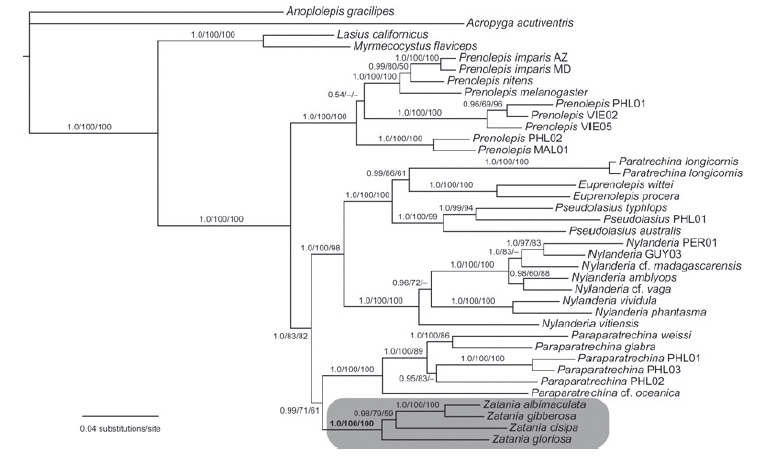
The new genus is given the name Zatania, meaning very long, a reference to the legs of the Ant species in the genus. These are brown, yellow-brown or reddish brown Ants 2-3 mm in length with 4-5 teeth per mandible; tooth four is reduced in some species and missing in others. A molecular phylogeny of four of the the extant species supports their diagnosis as a single evolutionary lineage (clade).

The three previously described species included in the group are Zatania albimaculata, previously Prenolepis gibberosa albimaculata (i.e. previously a subspecies of Prenolepis gibberosa) a reddish brown, tree foraging species from Cuba, Zatania cisipa, preciously Prenolepis crispa, a nocturnal yellow-brown species from Peurto Rico, which nests in hollow trees and forages on the forest floor,  Zatania gibberosa, (formerly Prenolepis gibberosa) a robust, dark brown species known from Cuba and Haiti and Zatania karstica, (formerly Prenolepis karstica) a dark brown, uniformly coloured species found living on steep-sided limestone hills in Cuba.

Workers of Zatania albimaculata (top), Zatania cisipa (upper middle),  Zatania gibberosa (lower middle) and Zatania karstica (bottom). Lapolla et al. (2012).

Male (top) and queen (bottom) of Zatania cisipa. Lapolla et al. (2012).

The new extant species is named Zatania gloriosa, after Playón de la Gloria in Mexico, where the species was first encountered; the species was also found in Honduras. Zatania gloriosa is a slender brown species with yellow markings. The species was found nesting in leaf litter in rainforests.

Queen (top) and male (bottom) of Zatania gloriosaLapolla et al. (2012).

The species preserved in amber is named Zatania electra (electra is Greek for amber). It is known from two specimens, one male and one worker. The colouration and lifestyle of the living Ants is not clear, though its preservation in amber suggests that it shared the association with trees seen in several modern species.

Zatania electra; worker preserved in amber (top left), line drawing of worker (bottom left) and line drawing of male (right). Lapolla et al. (2012).

Molecular phylogeny demonstrating the monophyly of Zatania and its phylogenetic position within the Prenolepis genus-group. The topology and branch lengths were inferred using Bayesian analyses. Support values are shown on branches in the following order: Bayesian posterior probabilities/maximum likelihood bootstrap proportions/maximum parsimony bootstrap proportions. Lapolla et al. (2012).


Distribution of extant Zatania species.


Follow Sciency Thoughts on Facebook.