
Bent-toed Geckos of the
genus Cyrtodactylus are found
across much of Southeast Asia. Recent studies have revealed the group
to contain many cryptic species (species which closely resemble other
species and which can only be differentiated by close morphological
examination or genetic analysis), which has revealed that many long
established species within the group are in fact species groups made
up of several similar but genetically distinct species. To date all
members of the genus from Java have been referred to two species,
Cyrtodactylus fumosus
and Cyrtodactylus marmoratus,
though it has been suspected for some time that this may not reflect
the true diversity of the genus on the island.
In
a paper published in the journal Zootaxa on 22 December 2015, Awal
Riyanto of the Museum Zoologicum Bogoriense of The IndonesianInstitute of Sciences, Lee Grismer of the Department of Biology at LaSierra University and Perry Wood of the Department of Biology at
Brigham Young University, describe a new species of Cyrtodactylus
from East Java.
The
new species is named Cyrtodactylus petani,
where 'petani' means
'farmer' in Indonesian; the specimens from which the species is
described having lived on farmland. The populations from which the
species is described were previously assigned to Cyrtodactylus
fumosus, and are similar, though
the species can be differentiated by physical examination;
Cyrtodactylus petani being
slightly shorter and having a different pattern of scales. The animals
have a camouflaged pattern, with brown, black and yellowish scales forming bands along the back and a lighter underside. The species was
found in a number of habitats, including embankments in paddy fields,
rocks and trees in farm gardens, rocks on a dry riverbed, artificial
(cement) riverbanks and trees in teak woodland, though always close
to the ground. The species is clearly highly adaptable, and able to
colonise disturbed, man-made environments as well as natural ones.
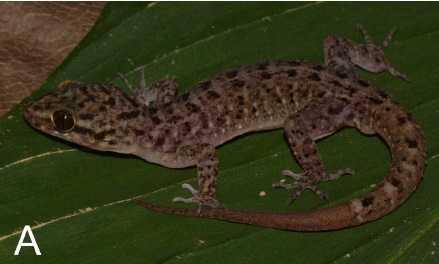
Cyrtodactylus
petani, male speciemen from
Jeladri Village in Pasuruan District, East Java. Riyanto et
al. (2015).
See
also...
 Calcified Lizard eggs with preserved embryos from the Early Cretaceous of Thailand. Among living Vertebrate groups,
Lizards show the most diverse range of reproductive strategies, with species
known that reproduce sexually...
Calcified Lizard eggs with preserved embryos from the Early Cretaceous of Thailand. Among living Vertebrate groups,
Lizards show the most diverse range of reproductive strategies, with species
known that reproduce sexually... A new species of Velvet Gecko from the southern Kimberley of Western Australia. Velvet Geckos of the genus Oeduraare medium to large Geckos found across much of northern and eastern Australia,
with isolated populations in the arid interior...
A new species of Velvet Gecko from the southern Kimberley of Western Australia. Velvet Geckos of the genus Oeduraare medium to large Geckos found across much of northern and eastern Australia,
with isolated populations in the arid interior...
Phasmid Geckos are small climbing Geckos of the genus Strophurus found across much of northern
Australia, where they inhabit stands of...
Follow Sciency Thoughts on Facebook.


