Showing posts with label Lizards. Show all posts

Tuesday, 2 August 2022

Three-dimensionally preserved Dinosaur remains from a new Jehol Biota outcrop in Inner Mongolia.

The Jehol Biota produces a wide range of exquisitely preserved Early Cretaceous fossils from locations across Liaoning, Inner Mongolia, and Hebei provinces in northeastern China. However, in almost all cases these are two-dimensionally preserved (i.e. flattened), with only a single site, an outcrop of the the Lujiatun Unit of the Yixian Formation in western Liaoning, producing fossils in three dimensions. The fossils from this location are predominantly Dinosaurs, with some Lizards and Mammals, and show signs of representing an area with an area with a different faunal composition and ecology to the rest of the Jehol Biota, as well as having a different taphonomy (mode of preservation).

In a paper published in the journal Acta Palaeontologica Polonica on 20 June 2022, Honggang Zhang of the College of Earth Science and Engineering, and Paleontological Institute at Shandong University of Science & Technology, Dongxiang Yu, also of the College of Earth Science and Engineering at Shandong University of Science & Technology, Yuhui Feng, also of the Paleontological Institute at Shandong University of Science & Technology, Rui Pei of the Key Laboratory of Evolutionary Systematics of Vertebrates at the Institute of Vertebrate Paleontology and Paleoanthropology of the Chinese Academy of Sciences, and Chang-Fu Zhou, again of the College of Earth Science and Engineering at Shandong University of Science & Technology, describe a second outcrop producing three-dimensionally preserved fossils from the Jehol Biota, this time located in the Ningcheng Basin of Inner Mongolia.

The new outcrop, at a site called Xidayingzi in Ningcheng County, comprises an outcrop of interbedded volcanic and sedimentary rocks about 80 m thick. The volcanic rocks here are predominantly basaltic andesites, rhyolitic breccia lavas and andesitic tuffs, while the sedimentary units are gravel-rich siltstones, sandstones, and conglomerates, all containing volcanically derived material.

Map of the Inner Mongolia, Liaoning and Hebei (A) showing location of the Xidayingzi site and the outcrops of the Lujiatun Unit of the Yixian Formation of the Jehol Biota in Beipiao, western Liaoning Province. Stratigraphic column (B) and corresponding photographic image (C) of the Early Cretaceous Xidayingzi site. Zhang et al. (2022).

Initial investigations at this site uncovered the remains of Dinosaurs from four different groups, plus Lizard and Mammal remains, all preserved in three dimensions and many in a semi-articulated state, although most material is individual bones.

Fossils found in the Xidayingzi site from the Early Cretaceous Ningcheng Basin, Inner Mongolia. (A) Sinovenator-like Troodontid Dinosaur (SDUST-V1062), the left pes is exposed in medial view. (B) Ceratopsian Dinosaur Psittacosaurus sp. (PMOL-AD00163), the maxilary teeth are loosely arranged and exposed in lateral view. (C) Neornithischian Dinosaur Jeholosaurus sp. (SDUST-V1063), the scapulocoracoid, humerus, ulna, and radius in lateral view. (D) Euhelopus-like Sauropod (SDUST-V1064), digital image of the tooth crown in medial view. (E) Indeterminated Lizard (PMOLAR00268), digital image of the fragmentary mandible in lingual view. (F) Symmetrodont-like Mammal (PMOL-AM00036), digital image of the mandible in lingual view. Zhang et al. (2022).

The most notable specimen from the site (SDUST-V1062) is the articulated post-cranial skeleton of a Troodontid Dinosaur, possibly a specimen of Sinovenator; the specimen resembles Sinovenator changii in most regards, but differs in having having a round anterior margin of the preacetabular process of the ilium and a moderately developed ambiens process of the pubis, and may therefore represent a second species in the genus.

Three Sauropod teeth were found at the site, two of them well preserved and similar to those of Euhelopus, a Titanosauriform of similar age to the Jehol Biota, but not previously reported from there.

Eight Neornithischian Dinosaur fossils were found at the site, with four being semi-articulated partial postcranial skeletons. These all resemble  Jeholosaurus shangyuanensis, a small Neornithischian previously only known from the Lujiatun Unit of the Jehol Biota.

Six specimens of Ceratopsian Dinosaurs were found, although these were rather fragmentary in nature. All appear similar to the early-diverging Psittacosaurus, often used as an index fossil for the Lower Cretaceous in East Asia, and common in the Jehol Biota. Curiously, the maxillary teeth of the new specimens appear to be spaced apart rather than being imbricated as in all other known Psittacosaurs, which may again indicate they belong to a new species.

A single fragment of a Lizard mandible (PMOL-AR00268) was found. This has pleurodont, conical, single-cusped, and closely packed teeth, which, are features common in a range of Mesozoic Lizards, and not helpful diagnostically.

Mammals are also represented by a single mandible (PMOL-AM00036), which has one premolar, five molars, and eight empty alveoli; the molars have acutely-triangulated molar cusps, which allows the specimen to be referred to the Symetrodonts, although this is a polyphyletic assemblage of Mammals, made up of members of different groups which converged on a similar morphology, possibly as a response to some Mesozoic ecological condition.

See also...

Online courses in Palaeontology

Follow Sciency Thoughts on Facebook.

Follow Sciency Thoughts on Twitter.


Wednesday, 13 July 2022

Geckos from the Early Eocene Dormaal Site in Belgium.

The Middle and Late Eocene Lizard faunas of Europe are relatively well known, thanks to a number of lagerstätten (deposits with exceptional preservation) such as the Messel Shale of Germany. However, the Lizards of the Early Eocene are much less well understood, due to a paucity of such sites. This is unfortunate, as this interval starts with the Palaeocene-Eocene Thermal Maximum at 56 million  years ago, the which saw the warmest temperatures of the past 66 million years, with Northern Europe developing a sub-tropical to tropical climate, and therefore presumably being a particularly good environment for Lizards.

One exception to this lack of Early Eocene is the Dormaal locality at  Zoutleeuw, eastern Belgium, where a fluvial deposit comprised of layers of clayey and lignitic (coal-rich) sands are interbedded with lenses of grey clays. These deposits are thought to have been laid down in a system of rivers and lagoons in the earliest Eocene, and have yielded a diverse fauna of Mammals, Lizards, Fish, Turtles, and Crocodiles.

In a paper published in the journal Royal Society Open Science on 29 June 2022, Andrej Čerňanský of the Department of Ecology at Comenius University in BratislavaJuan Daza of the Department of Biological Sciences at Sam Houston State University, Richard Smith of the Directorate Earth and History of Life at the Royal Belgian Institute of Natural SciencesAaron Bauer of the Department of Biology and Center for Biodiversity and Ecosystem Stewardship at Villanova University, Thierry Smith, also of the Directorate Earth and History of Life at the Royal Belgian Institute of Natural Sciences, and Annelise Folie of the Scientific Survey of Heritage at the Royal Belgian Institute of Natural Sciences, describe A new species of Gacko from the Dormaal Site.

Location of the earliest Eocene locality of Dormaal (MP7, Belgium) that has yielded Dollogekko dormaalensis and the early Eocene locality of Prémontré (MP10, France) that has yielded Laonogekko lefevreiČerňanský et al. (2022).

Geckos as a group have a poor fossil record, due to their lightly mineralised and easily disarticulated skeletons. The oldest known Geckos come from the Early Cretaceous amber deposits of Myanmar, with Geckos also known from Eocene Baltic Amber and Miocene Dominican Amber. Outside of these amber deposits, however, almost all fossil Geckos are known from isolated skeletal elements. Geckos have previously been recorded from the Dormaal locality, but never actually formally described.

The new species is named Dollogekko dormaalensis, where 'Dollogekko' honours the prominent Belgian palaeontologist Louis Dollo (1857-1931), combined with '-gekko' the Malay root word of the English 'gecko', often used as a suffix for generic names within the group, and 'dormaalensis' means 'from Dormaal'. The species is described from a single incomplete frontal bone (the bone that forms the forehead in Humans).

Dollogekko dormaalensis, the holotypic frontal IRSNB R 452 in (a) dorsal, (b) ventral, (c) right lateral,(d) left lateral and (e) anterior views. Čerňanský et al. (2022).

The frontal bones of Geckos tend to be highly distinctive at the species level, making it possible to reliably describe new taxa on these bones alone. The specimen from which Dollogekko dormaalensis is described comprises about the anterior half of the frontal bone, with the posterior half being lost. The preserved portion is 4.3 mm in length, is tubular-to-funnel-shaped (the whole bone would almost certainly have been hourglass shaped), and would have extended about ¾ of the way around the orbit. 

Dorsal view of the skull of some extant Geckos exhibiting diversity of frontal bone shape and sculpturing (yellow). (a) Carphodactylidae, Underwoodisaurus  milii (CAS  74744),  (b)  Diplodactylidae, Rhacodactylus  leachianus (MCZ–R15967), (c) Phyllodactylidae, Thecadactylus rapicauda (CAS 95146) and (d) Gekkonidae, Chondrodactylus angulifer (CAS 126466). Čerňanský et al. (2022).

In addition to the partial frontal from which Dollogekko dormaalensis is described, Čerňanský et al. also describe two fragments of dentary and a partial mandible from the same deposit. The dentary fragments appear to be from a Gecko about the same size as Dollogekko dormaalensis, while the partial mandible appears to come from an Animal about twice the size. Since the frontal bone from which Dollogekko dormaalensis is described is fully fused, and therefore presumed to come from an adult individual which has stopped growing, this appears likely to represent a separate species. The dentary fragments are of a size compatible with he frontal bone, but it is impossible to confirm that they belong to the same species, derive from a juvenile of the species which produced the mandible, or represent a third species. Due to this uncertainty, and the low value of mandible fragments for taxonomic purposes, none of these specimens are named, but instead referred to as Gekkota indet 1 (dentaries) and Gekkota indet 2 (mandible).

Gekkota indet. 1, the dentaries IRSNB R 454 and IRSNB R 453; Gekkota indet. 2, the mandible fragment IRSNB R 456 in(a), (e), (i) lateral, (b), (f), (j) medial, (c), (g), (k) dorsal, (d) ventral and (h) anterior views. Čerňanský et al. (2022).


See also...

Online courses in Palaeontology

Follow Sciency Thoughts on Facebook.

Follow Sciency Thoughts on Twitter.


Saturday, 13 February 2021

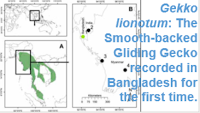
Gekko lionotum: The Smooth-backed Gliding Gecko recorded in Bangladesh for the first time.

Gliding Geckos are cryptic species distributed in the tropical forests of southeastern Asia, including southern China. Among the 60 species of Gekko, four Gliding Geckos are placed under the subgenus Ptychozoon, restricted to India, Indonesia, Singapore, the Philippines, and the mainland Southeast Asian countries. Although species of this subgenus have been recorded from northeastern India and Myanmar, they have not been reported from Bangladesh.

In a paper published in the Journal of Threatened Taxa on 26 November 2020, Rashedul Kabir Bhuiyan of the National Botanical Garden in Dhaka, Bangladesh, Fazle Rabbe of the Department of Zoology at the University of Dhaka, and the Padma Bridge Museum, Mohammad Firoj Jaman, also of the Department of Zoology at the University of Dhaka, and Ananda Kumar Das and Samiul Mohsanin, also of the Padma Bridge Museum, present the first country record of the Smooth-backed Gliding Gecko, Gekko lionotum, from Bangladesh.

Bhuiyan et al. found a freshly dead adult specimen in the Sangu Wildlife Sanctuary in Bandarban District, Bangladesh, which was later donated to Padma Bridge Museum. In the museum this specimen was identified as a Smooth-backed Gliding Gecko, Gekko lionotum, based on the body features and other morphometric measurements. Considered a rare specimen and a valuable resource for future studies, the Gecko was preserved in alcohol as a wet specimen. According to The Reptile Database, this species is distributed in India (Mizoram), Myanmar (Rakhine and Bago), Laos, Malaysia, Cambodia, Vietnam, and Thailand.

 
(A) Global distribution of Gecko lionotum. (B) New record (1) of Gecko lionotum from Sangu Wildlife Sanctuary, Bandarban Bangladesh, along with nearest previous record from (2) Ngengpui Wildlife Sanctuary, Mizoram, India (3) Chin Minbyin Village, Rakhine State, Myanmar (4) Chaung Gwa Village, Bago Division, Myanmar. Bhuiyan et al. (2020).

Bhuiyan et al. combined characters to identify the species from several previous works by other authors. The key characters were: snout-vent length 94.8 mm; the absence of imbricated scales to support parachute, dorsal tubercles and postorbital stripe; the presence of predigital notch in preantebrachial expansion; 14–15 lamellae in 4th toe; five caudal lobes fused to form terminal lobe of the tail and denticulated laterally with expansion; absence of caudal tubercles in tail terminus; angling is slight between caudal lobes. Bhuiyan et al. compared these characteristics with other species of the subgenus Ptychozoon. The characteristics clearly show the present specimen is Gekko lionotum.

Bhuiyan et al. measured morphometric characteristics using regular slide calipers with an accuracy of 0.1 mm. They compared their morphometric data with the specimen described by Samraat Pawar and Sayantan Biswas from Mizoram State in India. Bhuiyan et al.'s comparison matches the description given for specimens from Myanmar, and the nearest specimen from Mizoram, India. Bhuiyan et al. also observed the colour pattern and body shape of their specimen. The upper parts of the body are gray to dark gray and the underparts are yellowish with black spots. The anterior ventral part is light grayish-yellow and the posterior is dark grayish-yellow. Ten transverse, distinct, wavy, blackish-gray bands present in the dorsal side (one in the head, four in inter-limb area, five in the tail). The head is triangular, with two dark gray-brown bands running from eye to ear opening and a deep gray-brown band present at the central region. The neck is narrow, small, and brownish colour; thighs and arms are similar in color. The tail is slightly shorter than the snout-vent length, dark black at the tip, and both dorsal and ventral sides are covered with a dark gray-black band. The skin of limbs, toes, and fingers is extended and lamellae are yellowish-white in colour. Coloration of the body can perfectly match with woods and trees for camouflage.

 
Specimen of Gekko lionotum from the Sangu Wildlife Sanctuary in Bandarban District, Bangladesh, in (right) dorsal, and (left) ventral views. Bhuiyan et al. (2020).

Located in the southeast of the country, Bandarban District is a global biodiversity hotspot of the Indo-Malayan region, although the forest vegetation has been degraded by settlers, local inhabitants and others. Bhuiyan et al. believe that more new species can be found if proper effort is given, however, the richest biodiversity zone also attracts organised poachers to traffic wildlife resources, timber and illegal drugs. The discovery of the Lizard species indicates the probability of getting more novel species in this area. Bhuiyan et al. suggest more research work to expand knowledge and strictly manage the diversity of the zone with the leadership of the Bangladesh Forest Department.

See also...


Follow Sciency Thoughts on Facebook.

Follow Sciency Thoughts on Twitter.


Friday, 18 December 2020

Construction worker attacked by Komodo Dragon on Rinca Island, Indonesia.

A construction worker is being treated in hospital after being attacked by a Komodo Dragon on Rinca Island, part of East Nusa Tenggara Province in the Lesser Sunda Islands of Indonesia. Elias Agas, 46,was attacked by the Lizard while working on a new tourist resort on the island, Komodo National Park, and which was uninhabited before construction on the resort began earlier this year. The project has been strongly opposed by environmental groups in the area, who are concerned about the impact that it will have on the Lizards, and the potential for fuelling Human-Lizard conflict.

 
A Komodo Dragon, Varanus komodoensis. Sharp Photography/Wikimedia Commons.

Komodo Dragons, Varanus komodoensis, are found on the islands of Komodo, Rinca, Flores, and Gili Motang in East Nusa Tenggara Province. The species is considered to be Threatened under the terms of the International Union for the Conservation of Nature’s Red List of Threatened Species, due to its the small and fragmented population, and frequent fluctuations in the size of the subpopulations that make up the total population size. The small range of these Lizards, combined with the fact that they are prone to conflict with Humans (Komodo Dragons are large, powerful venomous, and prone to attacking both Humans and livestock), makes any Human development within their territory a potential threat to the species.

See also...


Follow Sciency Thoughts on Facebook.

Follow Sciency Thoughts on Twitter.


Tuesday, 20 August 2019

Varinus varus: Lace Monitor Lizard injures Queensland couple as they try to rescue Dog.

An elderly couple from Queensland are receiving hospital treatment after being attacked by a Lace Monitor Lizard, Varinus varus, while trying to save their Dog. The incident happened in a park at Shute Harbour, near Proserpine, at about 3.30 on Thursday 15 August 2019, when the Lizard, known locally as a Goanna, attacked the Long-haired Jack Russel Terrier, named Lily. The Dog owner, Reg Eggers, 72, tried to drive the Lizard off he was in turn attacked, receiving bites to the arms and leg, which caused him to lose a great deal of blood. When his wife tried to intervene she was also bitten. The couple were airlifted to a hospital for treatment, both they and the Dog survived.

A Lace Monitor, Varinus varus, near Mission Beach in Queensland in 2011. Donald Hobern/Flikr/Wikimedia Commons.

Lace Monitors are large Varanid Lizards, reaching about 2.5 m in length, which will take a wide variety of prey, including other Lizards, Birds and Mammals. Cats and small Dogs fall comfortably within the size range of their typical prey, and are often attacked; Humans are typically outside their size range and are generally left alone, but the Lizards can respond very aggressively if provoked, and have powerful bites and extremely sharp teeth.

Reg Eggers, 72, of Shute Harbour, Queensland, attacked by a Lace Monitor. Facebook/7News.

See also...

https://sciencythoughts.blogspot.com/2015/08/calcified-lizard-eggs-with-preserved.htmlhttps://sciencythoughts.blogspot.com/2015/12/albanerpetontids-frogs-and-lizards-from.html

https://sciencythoughts.blogspot.com/2013/08/the-biodiversity-of-beaded-lizards.htmlhttps://sciencythoughts.blogspot.com/2013/12/four-new-species-of-american-legless.html
https://sciencythoughts.blogspot.com/2013/03/a-venomous-lizard-from-late-cretaceous.htmlhttps://sciencythoughts.blogspot.com/2012/08/a-giant-monitor-lizard-from-miocene-of.html


Follow Sciency Thoughts on Facebook.
 

Saturday, 2 February 2019

Calumma roaloko: A new species of Chameleon from Madagascar.

The island of Madagascar has long been seen as a biodiversity hotspot, with a high number of endemic species (species found nowhere else). However, studies over the past two decades have shown that this biodiversity has been considerably underestimated for many groups, as better biological surveying has revealed both a large number of cryptic species (species which resemble other species so closely that they cannot be told apart by simple physical examination) and species with limited ranges or secretive habits that had been overlooked by earlier surveys. Among Vertebrates this newly discovered biodiversity has been particularly notable in three groups, the Primates (Lemurs), Anurans (Frogs), and Squamates (Snakes and Lizards).

In a paper published in the journal Zoosystematics and Evolution on 19 October 2018, David Prötzel of the Zoologische Staatssammlung München, Shea Lambert of the Department of Ecology and Evolutionary Biology at the University of Arizona, Tucson, Ginah Tsiorisoa Andrianasolo of the Mention Zoologie et Biodiversité Animale at the Université d’Antananarivo, Carl Hutter of the Biodiversity Institute and Department of Ecology and Evolutionary Biology at the University of Kansas, Kerry Cobb of the Department of Biological Sciences at Auburn University, Mark Scherz, also of the Zoologische Staatssammlung München, and of the Zoologisches Institut at the Technische Universität Braunschweig, and Frank Glaw, again of the Zoologische Staatssammlung München, describe a new species of Chameleon from Madagascar.

Chameleons are an exclusively Old World group of Iguanid Lizards closely related to the Agamids (or Dragon Lizards) which are also found only in the Old World, the two groups together being referred to as the Acrodonta. They are noted for their ability to change colour, though this ability is not found in all species. Chameleons also have highly specialised feet, with five toes arranged into two opposing groups, to aid movement in trees (where most species are found), highly modified eyes, which can be pivoted seperately, and a sticky tongue that can be launched as a projectile at prey items (usually Insects), which are then drawn back into the mouth.

The new species is placed in the endemic Malagasy genus Calumma, and given the specific name roaloko, which means 'two colours' in Malagasy, in reference to the patterning of the males of the species, which have a bright green upper side and a white underside (females are a drab brown all over). The species is described from five specimens, an adult male and an adult female, plus two subadult males and a subadult female. The adult male is 93.7 mm in length, the female 85.5 mm. Both sexes have a soft appendage on their snout, with the males having an indigo stripe that runs from this through the eye to the back of the head.

In-life photos of four specimens of Calumma roaloko; (a) subadult male; (b) adult male; (c) subadult male; (d) adult female. Prötzel et al. (2018).

All of the specimens were collected at an altitude of 1100 m above sea level in a fragment of rainforest close to the Analamazaotra Special Reserve and Andasibe-Mantadia National Park, and within an area called the Réserve de Ressources Naturelles du Corridor Ankeniheny-Zahamena, one of a series of newly protected area of rainforest fragments, currently administered by several local councils, but which it is planned to add to the country's national parks system. The fragment of rainforest in which the Chameleons was found currently measures less than 300 km³ and is considered to be shrinking. Calumma roaloko could potentially be found in neighbouring forest fragments, including those within the longer standing Analamazaotra and Andasibe-Mantadia national parks, or the privately run  Réserve de Vohimana, all of which contain larger areas of forest. However, since the species has not yet been located outside its original forest fragment, Prötzel et al. suggest that it should be classified as Endangered under the terms of the International Union for the Conservation of Nature’s Red List of Threatened Species.

 Posed photos of a subadult male specimen of Calumma roaloko; (a) Indigo coloration on the rostral appendage and head scalation is apparent; (b) portrait of the same specimen.

See also...

https://sciencythoughts.blogspot.com/2018/11/anolis-dracula-new-cryptic-species-of.htmlhttps://sciencythoughts.blogspot.com/2017/06/brachylophus-gau-new-species-of-south.html
https://sciencythoughts.blogspot.com/2016/12/sceloporus-goldmani-new-populations-of.htmlhttps://sciencythoughts.blogspot.com/2016/10/jeddaherdan-aleadonta-agamid-lizard.html
https://sciencythoughts.blogspot.com/2016/08/anolis-landestoyi-chameleon-like-anole.htmlhttps://sciencythoughts.blogspot.com/2016/04/tropidurus-sertanejo-new-species-of.html
Follow Sciency Thoughts on Facebook.

Monday, 12 November 2018

Anolis dracula: A new, cryptic, species of Anole from Colombia and Ecuador.

Anoles are small Iguanid Lizards found in the Southern United States, Mexico, Central America, the Caribbean, and South America as far south as Paraguay. They are excellent climbers, with adhesive pads on their feet similar to those seen in Geckos., but unlike Geckos are typically active during the day, when they are active predators of Insects and smaller Vertebrates, though some species will also eat fruit, flowers and nectar. Many species of Anole can change their colour to blend in with their background, and all can shed their tails to escape predators. Anoles are highly territorial, with both males and females having territories, though those of the males are larger and typically overlap with those of several females. Most Anoles have a large dewlap (a throat flap erected by a piece of cartilage in the neck), which tends to be brightly coloured and patterned both at (Human) visible wavelengths and in the near ultra-violet. The genus Anolis is the largest genus of terrestrial Vertebrates, with over 425 species, though most of this diversity is found in the Caribbean, where the Lizards have undergone multiple adaptive radiations. Each Island has its own set of Lizards, which tend to be most closely related to other Lizards on the same island, but a series of similar morphotypes, each adapted to a different ecological role, has appeared repeatedly on different islands.

In a paper published in the journal ZooKeys on 1 November 2018, Mario Yánez-Muñoz of the Unidad de Investigación at the Instituto Nacional de Biodiversidad, Carolina Reyes-Puig, also of the Unidad de Investigación at the Instituto Nacional de Biodiversidad, and of the Instituto de Zoología Terrestre and Museo de Zoología at the Universidad San Francisco de Quito, Juan Pablo Reyes-Puig, again of the Unidad de Investigación at the Instituto Nacional de Biodiversidad, and of the Fundación Red de Protección de Bosques and the Fundación Oscar Efrén Reyes, Julián Velasco of the Museo de Zoología ‘Alfonso L. Herrera’ at the Universidad Nacional Autónoma de México, and Fernando Ayala-Varela and Omar Torres-Carvajal of the Museo de Zoología at the Pontificia Universidad Católica del Ecuador, describe a new cryptic species of Anolis from southwestern Colombia and northwestern Ecuador.

Cryptic species are species that closely resemble other species, and cannot be separated by simple, non-invasive examination. While taxonomists have known about cryptic species for a long time, it was not realised how numerous such species were until taxonomists began to use genetics to determine relationships between species, about twenty years ago. The presence of cryptic species can have a profound influence on conservation efforts, as ‘species’ thought to be wide ranging with large populations and broad environmental tolerances can turn out to be complexes of closely related but reproductively isolated species, each with a smaller population and distribution, and narrower range of environmental tolerances.

The new species is named Anolis dracula, in reference to the Dracula Reserve in Carchi Province, Ecuador, which lies at the heart of the species range; the reserve in turn takes its name from the Dracula Orchids which it was set up to protect (some, but not all, Dracula Orchids are blood red). The species is found in Carchi and Imbabura provinces in Ecuador, and in Nariño Department, Colombia, with a total range of about 1582 km² in evergreen low montane forest at altitudes of between 1187 and 2353 m above sea level. The species appears tolerant of disturbance, and as well as being found in mature forests was found in secondary forest (forest in the process of regrowing after disturbance), pasture, and along the edge of roads. Anolis dracula is a large Anole Lizard distinguishable from closely related species in the same area only by genetic analysis, examination of the skull or examination of the male’s penis. The males tend to be dark brown with black, light brown and green bands, while the females are green with pink, turquoise or cream bands, but all can change colour to better blend in with their background or express their emotional state.

Colour variation in Anolis dracula. From top to bottom: Male, male, female, subadult male. Mario Yánez-Muñoz in Yánez-Muñoz et al (2018).

See also...

https://sciencythoughts.blogspot.com/2018/05/pristimantis-erythros-new-species-of.htmlhttps://sciencythoughts.blogspot.com/2017/12/trachemys-medemi-new-species-of-slider.html
https://sciencythoughts.blogspot.com/2017/10/atractus-cerberus-atractus-esepe.htmlhttps://sciencythoughts.blogspot.com/2017/09/bryodelphax-kristenseni-new-species-of.html
https://sciencythoughts.blogspot.com/2017/09/nipponnemertes-incainca-new-species-of.htmlhttps://sciencythoughts.blogspot.com/2017/07/parachemmis-julioblancoi-new-species-of.html
Follow Sciency Thoughts on Facebook.