Showing posts with label Reptiles. Show all posts

Saturday, 29 September 2012

New species of Snail-eating Snake from western Panama.

Snail-eating Snakes of the genus Sibon are small, slender snakes native to Central America. They are nocturnal and often have banded patterns, causing them to resemble Coral Snakes, or bright colours resembling those of arboreal Pit Vipers. Biologists call this Batesian mimicry, whereby a species of animal or plant mimics a more harmful species in order to deter predators.

In a paper published in the journal Zootaxa on 17 September 2012, Sebastian Lotzkat and Andreas Hertz of the Senckenberg Forschungsinstitut und Naturmuseum and the Institute for Ecology, Evolution & Diversity at Goethe-University and Gunther Kohler of the Senckenberg Forschungsinstitut und Naturmuseum describe a new species of Snail-eating snake from the Caribbean side of the Cordillera Central mountain range in Western Panama.

 Map of western Panama showing the locations where the new snake was located (squares), and where the related S. annulatus (upright triangles), S. longifrenis (pentagon), S. nebulatus (inverted triangles), and S. perissostichon (diamond) have been found. Shading reflects altitude, with darker gray at greater height, cross hatching indicates protected areas. Lotzkat et al. (2012).

The new species is named Sibon noalamina, where noalamina derives from the Spanish 'no a la mina!', or 'no to the mine', a slogan used by indigenous Ngöbe communities opposed to mining in the Serranía de Tabasará, in order to show the authors support for 'the Ngöbe’s struggle to protect their territory and environment, which is home to the new species described herein and many others, from profit-driven destructive interventions'.

Sibon noalamina is a 546 mm+ slender snake with a brown and yellow striped pattern, destingiushed by having only 5 pairs of supralabial scales (scales on the upper lip) and by having slightly keeled scales on the third, fourth and fifth dorsal rows on the midbody. The snakes were found living on vegetation, in ridgetop cloud forest with abundant epiphyts.


Sibon noalamina in life. Arrows indicate the rows of keeled scales. Lotzkat et al. (2012).
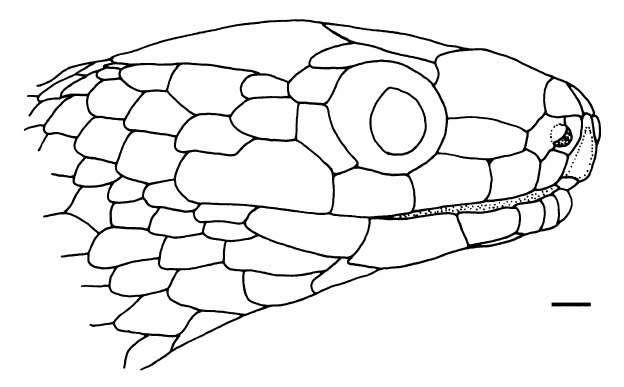


 Line drawing of the head of Sibon noalamina, showing the patern of the scales. Scale bar is 1 mm. Lotzkat et al. (2012).

 Two further specimens of Sibon noalamina, showing colour variation. Lotzkat et al. (2012).

Thursday, 28 June 2012

The Kandyan House Gecko; not extinct after all.

In 1853 Lieutenant Colonel Edward Frederick Kelaart (1819-1860) of the Ceylon Medical Service published a study of the fauna of Sri Lanka entitled Prodromus fauna Zeylanica,  in which he described (amongst other things) a description of a House Gecko from Kandy in the centre of the island, the ancient royal capitol, which he named Hemidactylus pieresii. For almost 160 years no more was heard of H. pieresii, and scientists have assumed the species to be lost.

In a paper published in the journal Zootaxa on 28 June 2012, Sudesh Batuwita of the Institute of Fundamental Studies and the Wildlife Conservation Society Biodiversity Research and Education Center at Hiyare Reservoir and Rohan Pethiyagoda of the Australian Museum, announce the rediscovery of Hemidactylus pieresii, during a study of the island's snakes and lizards commissioned by the Wildlife Heritage Trust of Sri Lanka

Batuwita & Pethiyagoda found the Geckos at Kandy and a number of other sights in the southeast of the island. They conclude that the species has not been missing, but rather has been widely identified as the closely related H. depressus.

Preserved specimen of Hemidactylus pieresii, the Kandyan House Gecko. Batuwita & Pethiyagoda (2012).

Hemidactylus depressus in lifeBatuwita & Pethiyagoda (2012). 

Map of Sri Lanka showing the original location where Hemidactylus pieresii was discovered (red square), the new locations where Hemidactylus pieresii was found (black squares) and the locations where Hemidactylus depressus was found. Batuwita & Pethiyagoda (2012).


Follow Sciency Thoughts on Facebook.

Saturday, 2 June 2012

A new species of Giant Side-Necked Turtle from the Palaeocene of Columbia.

Side-Necked Turtles are freshwater Turtles restricted to the Southern Hemisphere. They get their name from their inability to withdraw their heads completely into their shells, which causes them to fold their necks sideways beneath the lip of their upper shells. The group is split into two sub-groups; the African Side-Necked Turtles (Pelomedusidae), found in Eastern and Southern Africa, Madagascar and Norther South America, and the Austro-South American Side-Necked Turtles (Chelidae), found in Australia, New Guinea, Indonesia and South America. 

In a paper in the June 2012 edition of the Journal of Systematic Palaeontology, a team of scientists led by Edwin Cadena of the Department of Marine, Earth and Atmospheric Sciences at North Carolina State University, the Florida Museum of Natural History at the University of Florida and the Smithsonian Tropical Research Institute describe a new species of Palaeocene African Side-Necked Turtle from the Cerrejón Coal Mine in Columbia.

Map showing the location of the Cerrejón Mine. Cadena et al. (2012).

The new species is named as Carbonemys cofrinii, Cofrin's Coal Turtle, in honor of the late David Cofrin, a Floridan philanthropist noted for his support for the arts, education, nature preservation and community development.

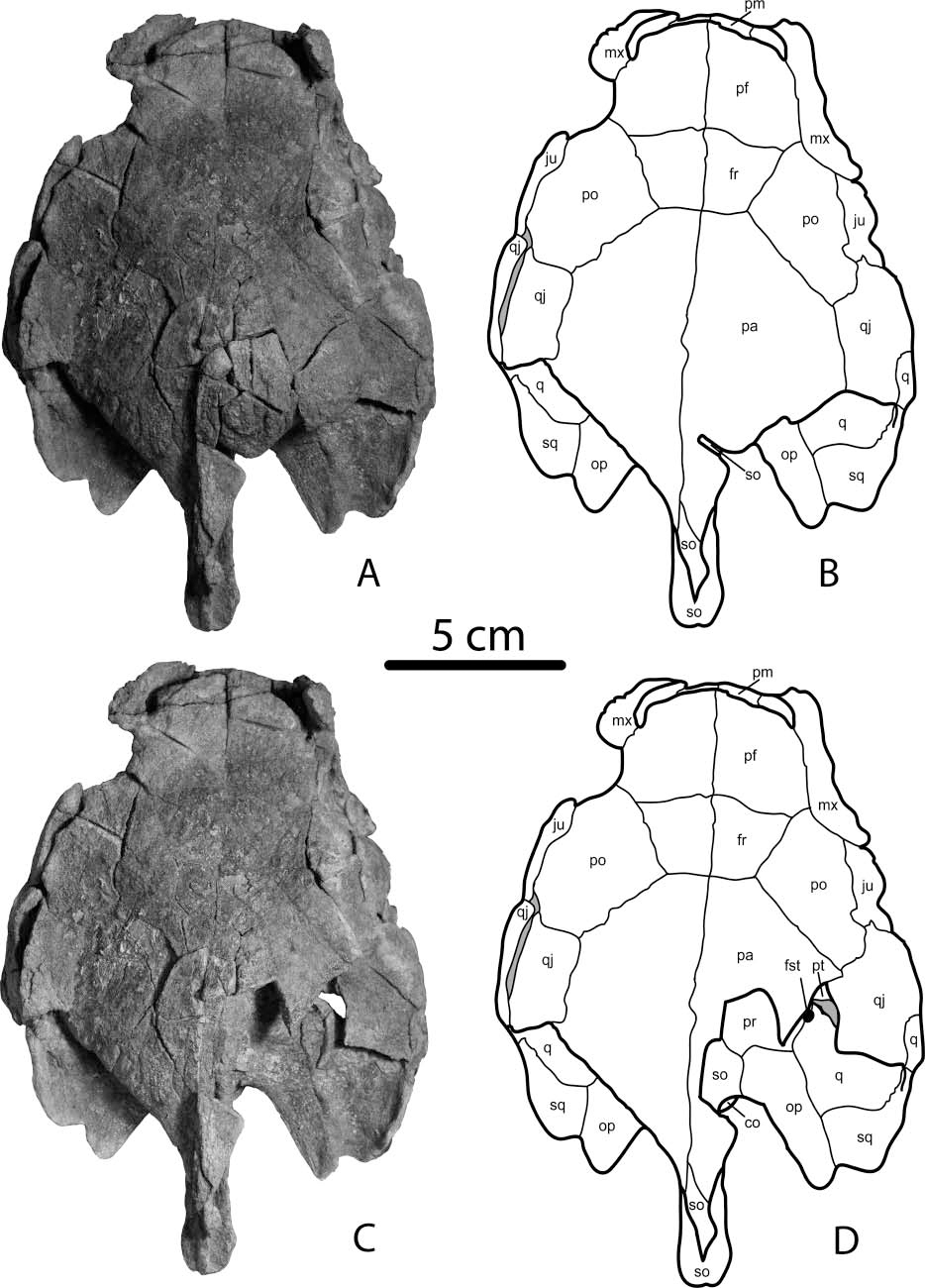
It is described from an isolated skull, 21 cm in length by 13 cm wide, from the 58-55 million year old, Upper Palaeocene Cerrejón Formation at the Cerrejón Mine.

Carbonemys cofrinii. (A) Photograph of skull, complete dorsal view. (B) Interpretive drawing of (A). (C) Skull without a portion of the parietal, showing the bones at the roof of the otic chamber. (D) Interpretive drawing of (C). Abbreviations: fr, frontal; fst, foramen stapedio temporale; ju, jugal; mx, maxilla; op, opisthotic; pa, parietal; pf, prefrontal; po, postorbital; pr, prootic; q, quadrate; qj, quadratojugal; so, supraoccipital; sq, squamosal. Cadena et al. (2012).

Carbonemys cofrinii. (A) Photograph of skull, complete ventral view. (B) Interpretive drawing of (A). Abbreviations: bo, basioccipital; bs, basisphenoid; cm, condylus mandibularis; co, condylus occipitalis, ju, jugal; mx, maxilla; op, opisthotic; pa, parietal; pal, palatine; pm, premaxilla; pp, processus paroccipitalis; pr, prootic; pt, pterygoid; ptp, processus trochlearis pterygoidei; q, quadrate; qj, quadratojugal; so, supraoccipital; sq, squamosal. Cadena et al. (2012).

Cadena et al. also describe two further Side-Necked Turtle finds from the same deposits. The first of these, described as Taxon A, is the nearly complete shell of a Turtle, 173 cm in length. This is the right sort of size to be the same species as Carbonemys cofrinii, but it is clearly a different specimen, and Cadena et al. decided not to assign it to the species without direct evidence. Whatever the case there were clearly large (~2 m) Side-Necked Turtles living in Northern Columbia during the Late Palaeocene, comparable with the largest Side-Necked Turtle ever known, Stupendemys geographicus (shell length 1.8 m), from the Miocene Venezuala, and the largest known Palaeocene Turtle of any description.

Taxon A. (A) Photograph of carapace (upper shell), dorsal view. (B) Interpretive drawing of (A). (C) Photograph of plastron (lower shell), ventral view. (D) Interpretive drawing of (C). Cadena et al. (2012).

The second undescribed Side-Necked Turtle is a group of four shells, about 20 cm in length, which are not formally described as they lack skulls, considered the by Cadena et al. the most important feature for classification purposes. One of these shows sign of having been bitten by a crocodile.

Taxon B. (A) Photograph of carapace. (B) Interpretive drawing of (A). (C) Photograph of plastron. (D) Interpretive drawing of (C). (E) Photograph of carapace. (F) Interpretive drawing of (E). (G) Photograph of plastron. (H) Interpretive drawing of (G). (I) Photograph of partial shell in dorsal view. (J) Interpretive drawing of (I), plastral elements in dark grey. (K) Photograph of partial shell in ventral view. (L) Interpretive drawing of (K), plastral elements in dark grey. (M) Photograph of nearly complete shell in dorsal view. (N) Interpretive drawing of (M), black spots represent crocodile bite marks. (O) Photograph of nearly complete shell in ventral view. (P) Interpretive drawing of (O), black spots represent crocodile bite marks. (Q) Photograph of the smallest turtle from the Cerrejón Formation, nuchal and costal 1 in ventral view. (R) Interpretive drawing of (Q) nuchal and costal 1 in dorsal view. Abbreviations: abd, abdominal scale; axb, axillary buttress; axs, axillary scar; c, costal; ent, entoplastron; epi, epiplastron; fem, femoral; gu, gular; hum, humeral; hyo, hyoplastron; hyp, hypoplastron; ins, inguinal scar; int, intergular; iscs, ischial scar; m, marginal; mes, mesoplastron; n, nuchal; p, peripheral; pec, pectoral; pl, pleural; pubs, pubis scar; pyg, pygal; sp, suprapygal; v, vertebral; xip, xiphiplastron. Cadena et al. (2012).

See also A new fossil bird from the Palaeocene of Brazil and Reptiles on Sciency Thoughts YouTube.

Follow Sciency  Thoughts on Facebook.

Monday, 12 March 2012

New species of Skink from northwest New Caledonia.

Skinks are smallish lizards with elongate bodies and reduced legs and necks. They are an ancient and successful group, found throughout the tropical, subtropical and warm temperate regions of the world, though individual species (of which there are over 12 000) may be threatened. Skinks can either lay eggs or bear live young (depending on species) and can be divided into tree-dwelling and ground-dwelling species, though this is an ecological rather than a taxonomic distinction; ground-dwelling species tend to have much more reduced limbs than tree-dwelling species, often being quite snake-like. Most skinks are insectivorous, but some will eat vegetable matter, or small rodents.

On 9 March 2012, in a paper in the journal Zootaxa, a team of biologists led by Ross Sadlier of the Section of Herpetology at the Australian Museum, describe the discovery of a new species of skink from the woodlands of northwest New Caladonia.

The species is described as Caledoniscincus constellatus, the Star-studded Caledonian Skink. It is a brown skink with a yellow underside and a white lateral stripe (stripe along its side), the adults of which are 46-57 mm in length. It is a tree-dwelling species found in Acacia Scrub and Mediterranean Woodland. Reproductive and feeding behavior were not recorded.

Male Star-studded Caledonian Skink, Caledoniscincus constellatus. From Sadlier et al. (2012).

There are two other species of Caladonian Skink with white lateral stripes, both of which share at least part of their range with C. constellatus. C. haplorhinus and C. austrocaledonicus. In C. constellatus the lateral stripe is broad and solid when it reaches the ear opening, but in C. haplorhinus, it is narrow and starting to break up. C. austrocaledonicus does not always have a lateral stripe, and where it does this does not reach the ear. Genetic studies have confirmed these are three separate species.

The heads of (A) C. constellatus, (B) C. haplorhinus, and (C) C. austrocaledonicus, showing the position of the lateral stripe at the head. From Sadlier et al. (2012).

C. constellatus is known only from two sites in the northwest of New Caledonia. These are threatened by deforestation by expanding agriculture and ranching, which fragments the landscape and makes it vulnerable to forrest fires, habitat loss due to nickel mining at the Koniambo Mine, and the harmful effects of the invasive Little Red Fire Ant (Wasmannia auropunctata). If these turn out to be the only places where it lives, then C. constellatus would meet the criteria for inclusion in the Critically Endangered category on the IUCN Red List.

Map of northern New Caledonia, showing the two locations where C. constellatus was found. From Sadlier et al. (2012).

The localities where C. constellatuswas found. (A) Acacia scrubland at Pointe de Vavouto. (B) Mediterranean Forrest on Massif Ouazangou. From Sadlier et al. (2012).

Sunday, 11 March 2012

Helodermatid Lizard from the Late Miocene-Early Pliocene of Tennessee.

Helodermatid Lizards are the only extant lizards that are truly venomous (Monitor Lizards such as the Komodo Dragon, Varanus komodoensis, deliver a bite laced with harmful bacteria, but are not actually venomous). There are two extant groups of Helodermatid Lizards; the Gila Monster, Heloderma suspectum, and Mexican Bearded Lizard, Heloderma horridum, currently restricted to the southwestern United States, western Mexico and Central America, where they inhabit deserts and semi-deserts as well as dry woodlands and grasslands, and the Bearded Lizards of the genus Pogona, which occupy similar areas in Australia.

The Gila Monster, Heloderma suspectum. A. Holycross/Reptiles of Arizona.

Helodermatid Lizards have distinctive osteoderms (bony plates in their skin) that are circular or hexagonal, dome shaped, and cover their entire body, fusing to the skull on the head. This is not seen in any other form of lizard, making fossil Helodermatid Lizards easy to identify (though these are not numerous, the group having apparently never been numerous).

The skull of The Gila Monster, Heloderma suspectum, showing the fused osteoderms. Will's Skull Page.

In a paper in the March edition of the journal Acta Palaeontologica Polonica, a team of scientists from the Department of Geosciences and the Don Sundquist Center of Excellence in Paleontology at East Tennessee State University led by Jim Mead describe the discovery of Helodermatid Lizard osteoderms from the Miocene-Early Pliocene Gray Fossil Site in Washington County, Tennessee. These are not enough to identify the lizards to species level but are distinctive enough that they can only come from a Helodermatid Lizard.

Osteoderms from the Gray Fossil Site (A-C) and the extant Mexican Bearded Lizard, Heloderma horridum (D-F). A-C₁ and D-F₁ apical view, C₂ & F₂ basal views of C₁ & F₁. From Mead et al. (2012).

The Gray Fossil Site was laid down in a sub-tropical forest at the boundary between the Miocene and the Pliocene. The forest was made up largely of Oaks (Quercus) and Hickory Trees (Carya) with some conifers, Elms (Ulmas), Birches (Betula), Ash (Fraxinus), Hackberry (Celtis), Alder (Alnus) and Willow (Salix). It had an understory of Buttercup Shrub (Corylopsis) and numerous vines including three types of wild grapes (Vitis) and Sinomenium, a woody vine today restricted to lowland tropical and subtropical forests in East Asia.

It is not clear whether the Gray Fossil Site Forest was a wet or dry ecosystem; some of the plant species there, such as Alders, are known to prefer wetlands others, such as grapes, prefer a drier climate. The animal fossils from the site include Alligator, and lungless Plethodontid Salamanders, which would tend to suggest a moister climate, but the presence of Helodermatid Lizard osteoderms, would suggest a drier climate over at least part of the forrest, it the animals had similar environmental preferences to today.

The location of the Gray Fossil Site. From Shunk, Driese & Clark (2006).

The earliest Helodermatid Lizard known is Primaderma nessovi from the Early Cretaceous of Utah. Other Cretaceous forms known are Paraderma bogerti from Wyoming, and Gobiderma pulchrum and Estesia mongoliensis, both from Mongolia. Known Tertiary forms are Eurheloderma from the Palaeocene of Wyoming, Eurheloderma gallicum from the Eocene of France, Lowesaurus matthewi from the Oligocene to Early Miocene of Colorado and Nebraska, Heloderma texana from the Miocene of Texas and some unnamed Miocene remains from Florida.

Fossil Helodermatid Lizard ellements (A) Left maxilla (upper jaw bone) from Eurheloderma gallicum, from the Eocene Phosphorites du Quercy of France. (B) Right maxilla of same. (C) Maxilla of Paraderma bogerti, from the Early Cretaceous of Wyoming. (D) Right frontal (forehead bone) of Lowesaurus matthewi, from the Oligocene White River Formation of Logan County, Colorado. (E) Cranial bone of Heloderma texana, from the Miocene Delaho Formation of Texas. (F) Skull of same. (G) Right maxilla of (D). From Mead et al. (2012).

This suggests that Helodermatid Lizards originated in what is now Eurasia or North America before the breakup of Pangaea in the Jurassic, and that the common ancestor of Australian and North American Helodermatid Lizards lived in the Cretaceous (rather than having a later, Gondwanan origin and reaching North America from the south with the join-up of the Americas at the beginning of the Pliocene). This would suggest that the preference for hot, dry climates is fairly ancient within the group, making it likely that at least part of the Gray Fossil Site Forest had a dry climate.

Ventral view of the skull of the Gila Monster, Heloderma suspectum, with osteoderms in place. From Mead et al. (2012).

The end of the Miocene and beginning of the Pliocene was a time of global cooling, as North and South America were joined by Central America, preventing the flow of ocean currents between the tropical Pacific and Atlantic Oceans (from this time onwards, all flow between Oceans has been in Antarctic waters). It also saw the spreading of grasslands replacing forests in many parts of the world, and the mixing of North and South American faunas.

Saturday, 3 March 2012

A new Bent-toed Gecko from Western Australia.

Bent-toed Geckos are widespread across South-East Asia, the Malay Archipelago and as far south as Victoria State, Australia. They are smallish Geckos noted for an outward bend in the middle digit of their hindlimbs, typically living in rainforest environments.

In a paper published in the journal Zootaxa on 9 February 2012, Aaron Bauer of the Department of Biology at Villanova University and Paul Doughty of the Department of Terrestrial Zoology at the Western Australian Museum describe a new Bent-toed Gecko from East Montalivet Island off the north coast of the Kimberley region of Western Australia.

The new species has been named as Cyrtodactylus kimberleyensis, the Kimberly Bent-toed Gecko. It is described from a single female presumed to be an adult because it was gravid (pregnant with an egg). This individual was about 45 mm long, making the new species the second smallest member of the genus if this individual is typical, surpassed only by C. laevigatus, a species from Komodo and Flores with an average length of adult 43 mm. It is brownish, elongate and slender.

Cyrtodactylus kimberleyensis in life. Bauer & Doughty (2012).

Cyrtodactylus kimberleyensis was discovered on a small island off the Kimberly Coast of Western Australia. It is the first species of Cyrtodactylus discovered in Western Australia, though there are five species known in Queensland. Interestingly Cyrtodactylus kimberleyensis appears to be more closely related to the Bent-toed Geckos of Timor and the Banda Arc than it is to those of Victoria and New Guinea, suggesting a separate Australian colonization event. Bauer & Doughty note that most species discovered in the forests of the coast and islands of Kimberly are related to species in the interior dry-grasslands of the region, and speculate about finding Cyrtodactylus kimberleyensis or related species on the mainland. They note that despite being a biodiversity hotspot the fauna of the area is not well studied, so other links with Timor and the Banda Arc may emerge with further study.

The Kimberly Coast of Western Australia, showing East Montalivet Island where Cyrtodactylus kimberleyensis was found. Bauer & Doughty (2012).

The individual discovered was gravid with a single egg. If this is typical then this is another way in which Cyrtodactylus kimberleyensis is distinctive, since small Geckos, like most small Lizards typically produce clutches of two eggs.

The hind foot of Cyrtodactylus kimberleyensis, showing why it is called a 'Bent-toed' Gecko. Scale bar is 2 mm. Bauer & Doughty (2012).

A Triassic Parareptile from South Africa.

The Parareptiles were a group of early Reptiles that flourished in the Permian. They were heavily depleted in the End Permian Extinction, but did survive into the Triassic. However they were never again a significant part of the fauna and disappeared before the start of the Jurassic, apparently unable to cope with competition from the emerging dinosaurs. The name 'Parareptiles' means beside the Reptiles, implying they might not be true members of that group, however it implies that they are a sister group to the crown Reptiles (i.e. all surviving Reptile groups shared a common ancestor more recently than the split with the Parareptiles), not that they should be seen as significantly different (like, for example, mammals are).

The Earl Triassic Parareptile Sauropareion anoplus was described in 2001 from a skull found in Barendskraal in the Middelberg District of Eastern Cape Province, South Africa. This specimen had a flattened, spade shaped head suggesting a burrowing lifestyle, but its post-cranial skeleton was only represented by a few vertebrae, making a detailed analysis of the animal's lifestyle impossible.

In a forthcoming paper in the journal Acta Palaeontologica Polonica, a team of scientists lead by Mark MacDougall of the Department of Biology at Cape Breton University in Sydney, Nova Scotia, describe three new Sauropareion anoplus from Vangfontein, also in Middelberg; a juvenile with a partially ossified skeleton, and two nearly complete adult skeletons.

One of the new skeletons (A) with interpretive drawing (B). Scale bar is 1 cm. From MacDougall et al. (2012).

The new skeletons have short, powerful limbs, but not the very developed spade-like limbs of a specialist burrower such as a mole, suggesting that while Sauropareion anoplus was capable of burrowing, it was probably not a specialist. It may have burrowed to escape predators, or to nest, but was unlikely to have spent its whole life digging.

Reconstruction of the life posture of Sauropareion anoplus. Scale bar 2 cm. From MacDougall et al. (2012).

See also Identifying Triassic footprints and Reptiles on Sciency Thoughts YouTube.