Showing posts with label Bubonic Plague. Show all posts

Sunday, 7 December 2025

Did an unknown volcanic eruption create the conditions for the Black Death to enter medieval Europe?

Between 1347 and 1353, the Black Death spread across Europe, killing up to 60% of the population, leading to long-lasting demographic, economic, political, cultural, and religious changes which changed the continent, and eventually the world, beyond recognition. Recent palaeogenetic studies have now confirmed the long held belief that the pandemic was caused by the Plague Bacterium, Yersinia pestis, a zoonotic disease with wild reserves in a number of Rodent species. Despite the presence of a wild reserve, outbreaks of Yersinia pestis in Human and Domestic Animal populations are quite rare, with only three documented pandemics of the disease. The first of these, the Plague of Justinian, began around 541 AD, and persisted into the eighth century. The second, the Black Death, began around 1338 in Central Asia, and persisted in places into the early nineteenth century. The third began in China in the 1770s, and spread around the world; arguably this third Plague pandemic is still ongoing, with all wild reserves and outbreaks outside Asia apparently derived from this source.

Studies of the archaeological, historical and ancient genomic records have suggested that the Black Death was a genetically distinct strain of the Yersinia pestis Bacterium which probably originated in arid foothills of the Tien Shan mountains west of Lake Issyk-Kul in modern-day Kyrgyzstan. This spread along the trade routes of Central Asia, entering Europe via the northern Black Sea region in the 1340s. Notably, the Black Death abruptly entered Venice and other Mediterranean ports in 1347, presumably through the importation of infected Fleas from the Black Sea reason. 

From this time, there were repeated outbreaks of Plague across Europe until the early nineteenth century, although it is unclear if these represent a series of re-introductions, or the presence of a wild-reserve within Europe. Nor is it entirely clear why the Plague appeared in multiple Mediterranean ports at the same time, having been established in the Black Sea region for some time prior to this, without previously making the jump, though it has been suggested by several people that some socio-economic challenge led to a change in Human behaviour at this time, giving the disease an opportunity to spread.

In a paper published in the journal Communications Earth & Environment on 4 December 2025, Martin Bauch of the Department Humans and Environment at the Leibniz Institute for the History and Culture of Eastern Europe, and Ulf Büntgen of the Department of Geography at the  University of Cambridge, the Global Change Research Institute of the Czech Academy of Sciences, and the Department of Geography at Masaryk University, present evidence for a volcanic eruption at an unknown location in the years prior to the Black Death reaching the Mediterranean, which caused a regional famine, leading traders to seek new sources of grain, and thereby opening the region to the arrival of the Plague.

Bauche and Büntgen note that there has been extensive previous research into potential links between a volcanically induced climate crisis at the start of the  Late Antique Little Ice Age and the onset of the Plague of Justinian, but little previous investigation into such a link to the onset of the Black Death. They also note that ice cores from Greenland and Antarctica have revealed a spike in sulphur concentrations in 1345 considerably larger than the one caused by the Mount Pinatubo eruption of 1991, which probably represents an injection of about 14 megatons of sulphur into the atmosphere. Furthermore, there were also major spikes in 1329, 1336 and 1341, representing eruptions which would have injected roughly 3.7, 0.7, and 1.2 megatons of sulphur into the atmosphere, respectively.

Weather records from Japan, China, Germany, France, and Italy, all record the years from 1345 to 1349 as being exceptionally cloudy. A lunar eclipse in 1345 is recorded as having been exceptionally dark by witnesses in both Bohemia and China; something which can be another sign of a high volcanic dust level within the atmosphere. 

Studies of tree rings have shown that trees in the Spanish Pyrenees produced 'blue rings' in 1345 and 1346, which are interpreted as signs severe cold spells during the growing seasons affected growth. The production of blue rings in consecutive years is considered exceptionally rare. Studies of wood density across the Northern Hemisphere have suggested a progressive cooling from 1345 to 1347, with 1347 being the coolest year since 1257, when a cold spell was linked to an eruption on Mount Samalas on Lombok Island, Indonesia. 

May–September (MJJAS) temperature anomalies from 1119–2020 AD (uncertainties are expressed by grey shading), based on 534 maximum latewood density (MXD) measurement series from living and relict samples from Mountain Pine, Pinus uncinata, trees from undisturbed upper treeline ecotones in the Spanish central Pyrenees.  The pre-Black Death cold phase is indicated by the vertical blue shading. The right-side double-stained thin section shows two consecutive Blue Rings that were formed in 1345 and 1346 AD in a Mountain Pine, Pinus uncinata, from the upper treeline in the central Spanish Pyrenees. Bauche & Büntgen (2025).

While it is harder to assess rainfall in past than temperature, tree-ring data suggests that the cool period from 1345 to 1347 was accompanied by a prolonged west-east dipole in Europe, with wetter conditions around the eastern Mediterranean and dryer conditions around the western Mediterranean. Morocco, the British Isles, northern France, the Low Countries, Germany and southern Scandinavia, all appear to have suffered dry conditions, while the Iberian Peninsula, Italy, and the Balkans, had high spring and summer rainfall in those years.

Bauche and Büntgen also examined historical records from across Europe and beyond, which show a declining agricultural output from across Europe from 1345, and in particular a failure of (environmentally sensitive) Grape crops from northwestern Italy. Severe flooding was also recorded in Italy in the autumn of 1345 and the springs of 1346 and 1347, along with accompanying problems such as soil erosion. The winter of 1344/45 was exceptionally cold and snowy in the Middle East, with the winters of 1345/46 and 1347/48 being marked by drought and Locust invasions. 

Late medieval Italy had a highly urbanised population, with a complex grain supply system in place to support this population. Many city states, including major centres such as Bologna, Florence, Genoa, Siena, and Venice, had limited farmland and large urban populations, consequently importing grain over long distances to redress this imbalance. Only Rome and Milan were largely self-sufficient. Cities developed communal granaries run by officials with the power to manage these granaries, source supplies of grain from elsewhere, and prevent the export of grain from cities troubled by poor harvests or military conflicts. Typically, managing grain supplies was the second-largest source of expenditure for any late medieval Italian city-state, behind only military spending. Maritime powers such as Venice, Genoa, and Pisa, negotiated treaties with grain-producing areas such as Apulia, Sicily, Sardinia, North Africa,  the Aegean and the Black Sea region. 

In 1346/7 severe famines were recorded across parts of Spain, southern France, northern and central Italy, Egypt, and the Levant. This led to spikes in the price of grain in Spain, Italy, Egypt, and even the Arabian Peninsula. Strict grain regulations were implemented in many Italian cities from 1346, at least in part to grain-shortage induced civil unrest.

Northern Italy suffered a series of famines during this interval, which appear unrelated to any political crisis, supporting a climate-related problem as the cause. Initially, this shortfall was met by increased imports from southern Italy, but it quickly became clear that this would not be sufficient to alleviate the crisis, and that more imports would be needed from further afield. 

At this time, Venice and Genoa were in a state of conflict with the Mongols of the Golden Horde, who had been trying to eliminate Italian power in the Black Sea region. This had led to the Italian cities blockading the ports of the Black Sea, preventing the Mongols from trading with the Mediterranean. However, the onset of famine in Italy led to a re-appraisal of this situation, with a ceasefire and renegotiation of trading arrangements leading to a restoration of grain trading, saving Venice from starvation.

The Plague Bacterium, Yersinia pestis, had been present in the Black Sea region for some time, and it is likely that it would eventually have reached the Mediterranean at some point. However, Bauche and Büntgen contest that the lifting of the trade embargo against the Golden Horde in response to the volcanically-induced famine affecting northern Italy was the immediate cause of the Black Death reaching multiple Mediterranean ports in a short interval. 

The trade embargo was lifted in 1347, and shortly thereafter, Venetian and Genoan trading vessels began entering the trading ports of the northern Black Sea and the Sea of Azov, returning to Italy laden with grain. The Plague appeared in Venice less than two months after the first such trading vessel. In March 1348 Venice lifted an embargo on the export of grain to Padua, with the first Plague outbreak there coming shortly after. Records of the grain trade to Florence and Sienna are less clear, but again the first Plague outbreaks in these cities were associated with the abating of the famine. Notably, this first wave of Plague outbreaks did not affect cities such as Rome, Milan,Verona, Ferrara, Ravenna, and Bari, which controlled larger grain producing areas, and were not involved in grain imports from the Black Sea region. Elsewhere around the Mediterranean, Marseille, Palma de Mallorca, and many other important port cities had Plague outbreaks before the end of 1347, probably as a result of grain shipments from Genoa. Smaller cities such as Savona, Ventimiglia, and Tunis, began to suffer outbreaks in April 1348, again probably linked to Genoan grain shipments. The reached Trento along with grain shipments from Venice, and from their spread across the Alps into northern Europe. 

Grain trade and plague dispersal. Main aspects of the Venetian, Genoese, and Pisan grain trade network that prevented much of Italy from starvation in 1347 AD but also brought the Plague Bacterium, Yersinia pestis, to Venice and other Mediterranean harbours during the second half of 1347 AD, from where it spread rapidly. Location of the tree ring-based climate reconstructions is indicated (with two sites in Scandinavia not shown). Map is an equal-area, pseudo-cylindrical Mollweide projection with greyscale referring to elevations above sea level. Bauche & Büntgen (2025).

In 1344, a decade-long papal embargo on trade with the Mameluke Sultanate was lifted, enabling Italian merchants to resume trade with the Middle East. Following the resumption of trade with the Black Sea region, Venetian ships began carrying grain to Alexandria, and the ports of the Levant, while Mameluke traders began visiting the ports of the Crimea. While individual shipments are harder to trace for these ports than those of Italy, these ships are probably responsible for the arrival of the Black Death in North Africa and the Middle East.

Thus the resumption of trade with the Black Sea region appears to have resolved the immediate problem of a widespread famine, but also led to the simultaneous import of the Black Death to ports around the Mediterranean. The subsequent rapid spread and high fatality rate for the disease may also have been a result of a population weakened by famine. The sophisticated trade system developed by the Italian city states to ensure against famine appears to have made those states, and their allies around the Mediterranean and Europe, particularly vulnerable to the spread of the Plague. Bauche and Büntgen conclude that the Black was not just a singular event, but rather the culmination of a prolonged crisis which began with a climate crisis and then a famine.

See also...

Tuesday, 7 July 2020

Bubonic Plague reported in Inner Mongolia, China.

A case of Bubonic Plague has been reported in Inner Mongolia, China, this week. A patient, described as a local herdsman, was admitted to a hospital in Urad Middle Banner (Middle Urad County), on Saturday 4 July 2020, where they are being treated with antibiotics in an isolation unit. A second suspected case, described as a fifteen-year-old, is also receiving treatment. Both are described as being in stable conditions. Left untreated, Bubonic Plague kills between 30% and 60% of those who become infected, and is thought to have been responsible for the Black Death outbreaks of the Middle Ages, which killed tens of millions of people across Asia, Europe, and Africa, but typically responds well to modern antibiotics.

The approximate location of the July 2020 Bubonic Plague outbreak. Google Maps.

Plague is caused by Yersinia pestis, the same Bacterium that causes Bubonic Plague. The Bacterium is indigenous to northern China, Mongolia, and the Russian Far East, with outbreaks of Plague being a regular occurrence. Yersinia pestis generally responds well to antibiotics, but the alarm caused by the diseases it causes can provoke excessive use, leading to shortages when they are most needed. Due to its high mortality and transmission rates outbreaks of Plague are always concerning, though the apparent ability of the Chinese healthcare system to contain an outbreak without fatalities is encouraging.

 Mass of Yersinia pestis Bacteria. Wikipedia.

Yersinia pestis is a Gram-negative, facultatively anaerobic (i.e. capable of using oxygen, but not needing it), rod-shaped Gammaproteobacteria, related to other pathogenic Bacteria such as Vibrio cholerae (Cholera), and Esherchia coli (food poisoning).It is a zoonotic disease, naturally occurring in a variety of Rodents, but capable of infecting Humans, typically via Fleas, which spread the disease by biting both their regular Rodent hosts and Humans. Zoonotic diseases can be particularly dangerous, as Humans are not part of their natural life-cycle, with the effect that they are not under evolutionary pressure to keep Human hosts alive in order to perpetuate themselves. Such diseases typically have short duration and a high fatality rate, though epidemics usually burn out quickly.

See also...

https://sciencythoughts.blogspot.com/2019/11/third-case-of-plague-reported-in-china.htmlhttps://sciencythoughts.blogspot.com/2019/10/legionnaires-disease-outbreak-in-north.html
https://sciencythoughts.blogspot.com/2019/05/bubonic-plague-kills-two-in-western.htmlhttps://sciencythoughts.blogspot.com/2017/12/cholera-outbreak-kills-forty-one-in.html
https://sciencythoughts.blogspot.com/2017/10/bacterial-infection-kills-125-000.htmlhttps://sciencythoughts.blogspot.com/2017/10/plague-outbreak-kills-at-least-30-in.html
Follow Sciency Thoughts on Facebook.

Sunday, 17 November 2019

Third case of Plague reported in China.

A third case of plague has been reported in China, with a 55-year-old man in Inner Mongolia reportedly being treated for the Bubonic form of the disease, which he is believed to have contracted after eating a wild-caught Rabbit earlier this month. This follows the two cases of the disease that were reported in Beijing earlier this week, with both patients also from Inner Mongolia and suffering from the Pneumonic form of Plague having been brought to a hospital in the city for specialist treatment. All three patients are being treated in isolation, with a number of people who have come into contact with them being monitored for symptoms. Pneumonic Plague is a variety of the disease, which infects the lungs and is spread through coughing, rather than the more usual Bubonic variety, which infects the lymph-nodes and is typically spread via the exchange of bodily fluids via a parasite vector such as a Flea.

Plague is caused by Yersinia pestis, the same Bacterium that causes Bubonic Plague. The Bacterium is indigenous to northern China, Mongolia, and the Russian Far East, with outbreaks of Plague being a regular occurrence. Yersinia pestis generally responds well to antibiotics, but the alarm caused by the diseases it causes can provoke excessive use, leading to shortages when they are most needed. The most recent fatalities due to the disease in the region having happened in April this year, when two Russian citizens died of the disease in Mongolia, and the most recent fatality in China having happened in Gansu Province in 2014. Due to its high mortality and transmission rates outbreaks of Plague are always concerning, though the apparent ability of the Chinese healthcare system to contain an outbreak without fatalities is encouraging.

 Mass of Yersinia pestis Bacteria. Wikipedia.

Yersinia pestis is a Gram-negative, facultatively anaerobic (i.e. capable of using oxygen, but not needing it), rod-shaped Gammaproteobacteria, related to other pathogenic Bacteria such as Vibrio cholerae (Cholera), and Esherchia coli (food poisoning).It is a zoonotic disease, naturally occurring in a variety of Rodents, but capable of infecting Humans, typically via Fleas, which spread the disease by biting both their regular Rodent hosts and Humans. Zoonotic diseases can be particularly dangerous, as Humans are not part of their natural life-cycle, with the effect that they are not under evolutionary pressure to keep Human hosts alive in order to perpetuate themselves. Such diseases typically have short duration and a high fatality rate, though epidemics usually burn out quickly.

See also...
https://sciencythoughts.blogspot.com/2019/10/legionnaires-disease-outbreak-in-north.htmlhttps://sciencythoughts.blogspot.com/2019/05/bubonic-plague-kills-two-in-western.html
https://sciencythoughts.blogspot.com/2018/09/almost-200-dead-in-nigerian-floods.htmlhttps://sciencythoughts.blogspot.com/2017/12/cholera-outbreak-kills-forty-one-in.html
https://sciencythoughts.blogspot.com/2017/10/bacterial-infection-kills-125-000.htmlhttps://sciencythoughts.blogspot.com/2017/10/plague-outbreak-kills-at-least-30-in.html
Follow Sciency Thoughts on Facebook.

Wednesday, 8 May 2019

Bubonic Plague kills two in western Mongolia.

Two people have died after contracting Bubonic Plague in the province of Bayan-Ulgii in Western Mongolia. The victims have been described as a 38-year-old man and his 37-year-old pregnant wife, who were ethnic Kazakh couple with Russian citizenship. They apparently contracted the disease after eating raw Marmot, a local folk remedy, despite warnings from local authorities about the dangers of this practise. The man is reported to have died on Saturday 27 April, and the woman on Monday 29; they are survived by four young children. The deaths prompted a six-day-long quarantine of the area, a measure intended to ensure that any further victims did not spread the disease to other parts of the country, but no more cases of the desease were found. Several foreign tourists temporarily trapped by the quarantine order have now been allowed to continue their journeys.

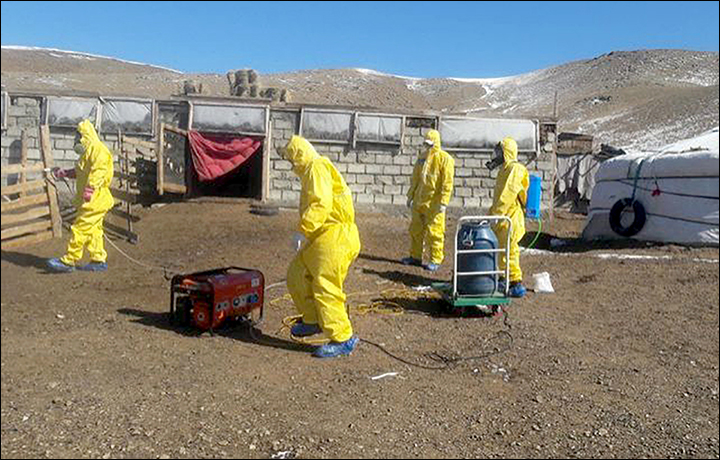
Officials in hazmat suits at a border post between Bayan-Ulgii and Russia during a quarantine imposed to prevent the spread of Bubonic Plague last week. The Siberian Times.

Plague is caused by Yersinia pestis, the same Bacterium that causes Bubonic Plague. The Bacterium is indigenous to Mongolia, with outbreaks of Plague being a regular occurrence. Yersinia pestis generally responds well to antibiotics, but the alarm caused by the diseases it causes can provoke excessive use, leading to shortages when they are most needed.

 Mass of Yersinia pestis Bacteria. Wikipedia.

Yersinia pestis is a Gram-negative, facultatively anaerobic (i.e. capable of using oxygen, but not needing it), rod-shaped Gammaproteobacteria, related to other pathogenic Bacteria such as Vibrio cholerae (Cholera), and Esherchia coli (food poisoning).It is a zoonotic disease, naturally occurring in a variety of Rodents, but capable of infecting Humans, typically via Fleas, which spread the disease by biting both their regular Rodent hosts and Humans. Zoonotic diseases can be particularly dangerous, as Humans are not part of their natural life-cycle, with the effect that they are not under evolutionary pressure to keep Human hosts alive in order to perpetuate themselves. Such diseases typically have short duration and a high fatality rate, though epidemics usually burn out quickly.

See also...

https://sciencythoughts.blogspot.com/2018/09/almost-200-dead-in-nigerian-floods.htmlhttps://sciencythoughts.blogspot.com/2017/12/cholera-outbreak-kills-forty-one-in.html
https://sciencythoughts.blogspot.com/2017/10/bacterial-infection-kills-125-000.htmlhttps://sciencythoughts.blogspot.com/2017/10/plague-outbreak-kills-at-least-30-in.html
https://sciencythoughts.blogspot.com/2017/10/cholera-outbreak-kills-over-2000-in.htmlhttps://sciencythoughts.blogspot.com/2017/09/cholera-kills-44-in-borno-state-nigeria.html
Follow Sciency Thoughts on Facebook.

Friday, 6 October 2017

Plague outbreak kills at least 30 In Madagascar.

An outbreak of Plague has killed at least 30 people in Madagascar since late August this year, according to the World Health Organisation, with many more having contracted the disease. Plague outbreaks are common in the Malagasy dry season (from May to October), with about 400 cases of the disease reported each year, however the rapidity with which this outbreak has spread, combined with the high mortality rate, has concerned medical authorities on the island. This is largely due to the fact that the majority of the cases reported, including 21 of the fatalities, have been of the Pneumonic variety of the disease, which infects the lungs and is spread through coughing, rather than the more usual Bubonic variety, which infects the lymph-nodes and is typically spread via the exchange of bodily fluids via a parasite vector such as a Flea. The majority of those who have died are thought to have been Malagasy citizens, though one is reported to have come from the Seychelles.

A health-worker spraying a classroom with insecticide in Antanarivo in order to stop the spread of Plague via Insect vectors. Anadolu Agency/Getty Images.

Plague is caused by Yersinia pestis, the same Bacterium that causes Bubonic Plague. The Bacterium is indigenous to Madagascar, with outbreaks of Plague being a regular occurrence during the dry season (May to October). The Pneumonic form of the illness is considered particularly worrying, as in this instance the lungs become infected with the disease, leading to coughing, which can spread the disease, and pneumonia, which can rapidly kill patients. Yersinia pestis generally responds well to antibiotics, but the alarm caused by the diseases it causes can provoke excessive use, leading to shortages when they are most needed.

Mass of Yersinia pestis Bacteria. Wikipedia.

Yersinia pestis is a Gram-negative, facultatively anaerobic (i.e. capable of using oxygen, but not needing it), rod-shaped Gammaproteobacteria, related to other pathogenic Bacteria such as Vibrio cholerae (Cholera), and Esherchia coli (food poisoning).It is a zoonotic disease, naturally occurring in a variety of Rodents, but capable of infecting Humans, typically via Fleas, which spread the disease by biting both their regular Rodent hosts and Humans. Zoonotic diseases can be particularly dangerous, as Humans are not part of their natural life-cycle, with the effect that they are not under evolutionary pressure to keep Human hosts alive in order to perpetuate themselves. Such diseases typically have short duration and a high fatality rate, though epidemics usually burn out quickly.

See also...

http://sciencythoughts.blogspot.co.uk/2017/10/cholera-outbreak-kills-over-2000-in.htmlhttp://sciencythoughts.blogspot.co.uk/2017/09/cholera-kills-44-in-borno-state-nigeria.html
http://sciencythoughts.blogspot.co.uk/2017/09/pneumonic-plague-outbreak-kills-at.htmlhttp://sciencythoughts.blogspot.co.uk/2017/09/legionnaires-disease-outbreak-linked-to.html
http://sciencythoughts.blogspot.co.uk/2017/03/five-confirmed-deaths-as-nigerian.htmlhttp://sciencythoughts.blogspot.co.uk/2017/03/listeria-outbreak-kills-two-in-us.html
Follow Sciency Thoughts on Facebook.

Saturday, 16 September 2017

Pneumonic Plague outbreak kills at least five in Madagascar.

At least five people have died in an outbreak of Pneumonic Plague in Madagascar in the last two weeks. The first death was recorded on 28 August in a public taxi near Tamatave. Two other passengers in the vehicle are believed to have contracted the illness at this time and died in Antanarivo within 24 hours. Since then a further two deaths have occurred, both in the Antanarivo area, and 349 other people have been treated for the disease, and authorities are urging anyone showing symptoms to seek immediate medical help.

Pneumonic Plague is caused by Yersinia pestis, the same Bacterium that causes Bubonic Plague. The Bacterium is indigenous to Madagascar, with outbreaks of Plague being a regular occurrence during the dry season (May to October). The Pneumonic form of the illness is considered particularly worrying, as in this instance the lungs become infected with the disease, leading to coughing, which can spread the disease, and pneumonia, which can rapidly kill patients. Yersinia pestis generally responds well to antibiotics, but the alarm caused by the diseases it causes can provoke excessive use, leading to shortages when they are most needed.

Mass of Yersinia pestis Bacteria. Wikipedia.

Yersinia pestis is a Gram-negative, facultatively anaerobic (i.e. capable of using oxygen, but not needing it), rod-shaped Gammaproteobacteria, related to other pathogenic Bacteria such as Vibrio cholerae (Cholera), and Esherchia coli (food poisoning).It is a zoonotic disease, naturally occurring in a variety of Rodents, but capable of infecting Humans, typically via Fleas, which spread the disease by biting both their regular Rodent hosts and Humans. Zoonotic diseases can be particularly dangerous, as Humans are not part of their natural life-cycle, with the effect that they are not under evolutionary pressure to keep Human hosts alive in order to perpetuate themselves. Such diseases typically have short duration and a high fatality rate, though epidemics usually burn out quickly.

See also...

http://sciencythoughts.blogspot.co.uk/2017/09/legionnaires-disease-outbreak-linked-to.htmlhttp://sciencythoughts.blogspot.co.uk/2017/03/five-confirmed-deaths-as-nigerian.html
http://sciencythoughts.blogspot.co.uk/2017/03/listeria-outbreak-kills-two-in-us.htmlhttp://sciencythoughts.blogspot.co.uk/2017/02/reducing-levels-of-pathogenic-bacteria.html
http://sciencythoughts.blogspot.co.uk/2016/12/first-case-of-locally-transmitted-zika.htmlhttp://sciencythoughts.blogspot.co.uk/2016/11/determining-origin-of-august-2016.html
Follow Sciency Thoughts on Facebook.