About 183 million years ago a
major eruptive episode in the Karoo-Ferrar Large Igneous Province of South
Africa lead to an abrupt rise in global atmospheric and oceanic temperatures,
leading to widespread oceanic anoxia which is reflected in the fossil record as
the Early Jurassic Toarcian Extinction Event. Extinction events are common in
the fossil record, and are widely used as proxies for environmental change.
However it is far from clear if all organisms in the marine community were
affected in the same way or at the same time, with the potential that sudden
changes in fossil community makeup could be misleading if not interpreted
correctly.
Danise et al. compared benthic and nektonic diversity levels to variations
in oxygen, carbon, strontium, sulphur and molybdenum isotope ratios and total
organic carbon levels in deposits of the Whitby Mudstone Formation, which was
laid down in the Cleveland Basin during the Early Toarcian, when it was located
at latitudes of between 30˚ and 40˚ north in part of the Laurasian Seaway.
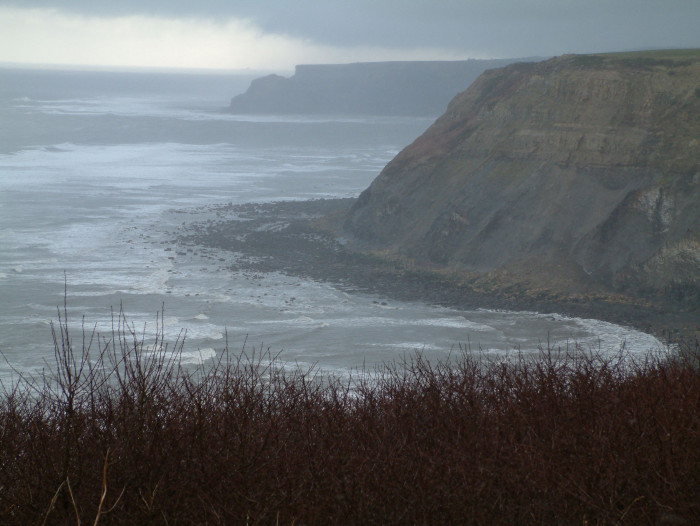
Study area (Cleveland Basin, UK) and location map of the sections that
form the composite stratigraphy. Maximum intertidal rock exposure shown in
white. Danise et al. (2015).
Molybdenum isotope levels are a
proxy for ocean anoxia, while carbon isotope levels reflect changes in the rate
at which organic matter is produced and buried and strontium isotope levels
reflect weathering of rocks on land. Oxygen isotope ratios are used to
determine temperatures, and sulphur isotope levels reflect productivity by
sulphate reducing Bacteria, which thrive under anoxic conditions, but also
require phosphorus from organic matter.
Danise et al. found that extinction and diversity levels in benthic and
nektonic communities across the Toarcian Extinction Event responded to different
isotope changes, suggesting that they were driven by different processes.
Following the initial extinction levels diversity levels recovered most quickly
in nektonic communities, reaching maximum diversity when the temperature was
warmest and sea levels were highest, which is likely to reflect high
phytoplankton productivity, followed by a recovery in oxygen levels in the
water column.
Benthic communities took longer
to recover and were dominated first by Bositra
radiata, which is interpreted as an epifaunal (surface-dwelling,
non-burrowing) filter feeder tolerant of low oxygen levels, then by a slightly
more diverse fauna dominated by Pseudomytiloides
dubius with occurrences of Bositra buchii
and Meleagrinella substriata, which
are all also is interpreted as an epifaunal filter feeder tolerant of low
oxygen levels.
Prior to the extinction event the
most abundant nektonic group were Belemnites (an extinct group of Squid-like
Cephalopods with internal shells) of the genus Passaloteuthis, which is interpreted to have lived in deep, cool
waters, while following the event these were replaced with members of the genus
Acrocoelites, interpreted to have
lived in shallower, warmer waters, which may also be a reaction to low oxygen
levels in deeper waters. These Belemnites were eventually replaced by Ammonites
(Cephalopod Molluscs with chambered external shells).
Specimen of the deep water Belemnite Passaloteuthis bisulcata from before the Toarcian Extinction Event. Wikimedia Commons.
The strongest correlation between
isotope ratios and extinctions was seen for molybdenum, with 40% of benthic
species turnover relating directly to this variable, suggesting that in the Early
Jurassic as now the main factor determining diversity in benthic marine
communities was dissolved oxygen levels. Following the main extinction event
diversity was also correlated with variations in strontium and carbon isotope
levels, which correlate to levels of erosion and organic matter burial.
For Nektonic communities
molybdenum isotope ratios are still important, but strontium isotope ratios
become more important, suggesting that diversity is more strongly related to
terrestrial erosion levels. During the Toarcian atmospheric carbon dioxide
levels are thought to have risen sharply due to emissions from the volcanoes of
the Karoo-Ferrar Large Igneous Province, leading to an increase in dissolved
carbon dioxide in rainwater (acid rain), which would in turn lead to higher
rates of weathering on land. This would lead to increased levels of nutrients
entering the marine environments, driving productivity in surface waters.
However the same atmospheric carbon dioxide would also have raised temperatures
in both the atmosphere and oceans (global warming) which would have led to
lower oxygen levels in the water column (warm water can hold less dissolved
oxygen than cool water), particularly in deeper waters which cannot replenish
their oxygen from the atmosphere.
Interestingly oxygen isotope
levels did not appear strongly correlated with extinction rates, despite the
fact that these are thought to reflect atmospheric temperature, the factor
which is thought to have driven ocean anoxia. Danise et al. suggest that this is because oxygen isotope levels are
obtained from Belemnite shells, and we may not fully understand how their
physiology and behaviour changed in response to environmental changes during
the extinction event.
Finally Danise et al. suggest that this decoupling
between factors affecting benthic and nektonic communities may be found in
other extinction events where it has not previously been looked for, and that
it may also be seen in modern faunas faced with similar environmental stresses,
given that Jurassic marine invertebrate faunas are thought to be quite close to
modern faunas in composition.
See also…
The Toarcian Oceanic Anoxic Event is an extinction event that took place in the Early Jurassic, about 183 million years ago. It took place in four phases, thought to have been related to Milankovitch Cycles. During each phase the temperature of the global ocean is thought...