Invasive species are one of the greatest challenges faced by conservationists today, often rapidly taking over ecosystems where they have no natural enemies and displacing endangered or commercially important local species in the process. The first step in controlling an invasive species is identifying it, which enables appropriate control systems to be introduced. However, this is often difficult and complicated, as invasive species are not necessarily well understood, or even known, in their own ecosystems. This is particularly true in marine environments, where our taxonomic understanding of many groups is poor, and increasingly plagued by a lack of skills as few young scientists are attracted into the field. This is despite the problem of invasive species being particularly acute in marine environments, where international shipping traffic has made it easy for many benthic 'fouling' organisms to rapidly establish global distributions.
Ascidians, or Sea Squirts, are the most abundant class of the Subphylum Tunicata and are distributed along shorelines worldwide. They are sessile marine invertebrates and are widely used as a model organism for developmental and evolutionary studies. Ascidians exhibit multiple morphological characteristics, from small colonial to colorful and large solitary forms. They are divided into three major well-accepted orders, namely, Phlebobranchia, Aplousobranchia, and Stolidobranchia, based on the branchial sac morphology of the adults. However, the class Ascidiacea is paraphyletic (i.e. not everything thought to be descended from the last common ancestor of the group is considered to be an Ascidian) with the Phlebobranchia and Aplousobranchia showing a close relationship with Thaliaceae (Pyrosomes, Salps, and Doliolids), a non-Ascidian Tunicate class, whereas the Stolidobranchia remains a distinct and monophyletic group. Over the course of several decades, the Ascidiacea have been shown to be an important class of ecological species because of their invasive potential along with their ability to adapt to new environments. Transportation of Ascidians attached to ship hulls as fouling material and within the ballast water of ships has enabled them to invade many new territories. This phenomenon has major impacts on local marine biodiversity as well as aquaculture industries. Therefore, the Ascidiacea are now considered as important model species for the study of non-indigenous species worldwide.
Sea Squirts are particularly problematic from a taxonomic point of view, with a simple body plan which provides few diagnostic features, and very few scientists specializing in their taxonomy. To make matters worse, the group appears to be rife with cryptic species (i.e. species which are physically identical or nearly identical, but biologically distinct), so that many identified species are likely to be clusters of similar-looking species, often with different ecological constraints. Many species of Sea Squirt have proven to be adept at colonizing new environments, where they are often identified as new species, so that particularly successful invasive species often have several different names, further adding to the taxonomic confusion within the group. A combination of careful physical examination and genetic analysis can hopefully unravel some of these problems, particularly in the identifying of pseudo-indigenous species, i.e. invasive species thought to be native to their new habitat because their origin is unknown.
Eleven invasive species of Sea Squirt had been identified from Mexican waters by 2014, five of them from the Gulf of California. In 2015, a colonial Sea Squirt previously unknown to the region was identified in Ensenada de La Paz, which spread rapidly, causing a mass mortality event in Pen Shells, Atrina maura, a Bivalve species commercially important locally, whose large shells provided an ideal substrate for the invaders. The Pen Shell fishery was already suffering from over-harvesting, with a moratorium on their collection introduced in 2013 to allow the population to recover, something which appears to have been significantly hampered by the arrival of the Ascidians (no significant variation in other environmental variables was detected which coincided with the die-back). A subsequent biofouling experiment carried out in Bahía de La Paz found that the Sea Squirts, tentatively identified as Distaplia cf. stylifera, were the most abundant macro-organisms settling on a series of silicone resin coated metal panels placed in the water for two months. Furthermore, the Sea Squirt colonies provided a substrate upon which 28 species of epibiont Polychaete Worms were able to settle, further adding to the biofouling. Subsequent studies of the Sea Squirts, which have continued to suppress Shellfish populations, and become a serious biofouling problem in the area, have used the name Distaplia stylifera, although this is only an assumption, based upon a rough similarity to descriptions and the fact that it is a common invasive species. No formal taxonomic identification of the invader has been attempted to date, something which may be hampering efforts to find an effective control.
In a paper published in the journal ZooKeys on 5 April 2023, Betzabé Moreno-Dávila and Leonardo Huato-Soberanis of the Programa de Ecología Pesquera at the Centro de Investigaciones Biológicas del Noroeste, Jaime Gómez-Gutiérrez of the Departamento de Plancton y Ecología Marina at the Instituto Politécnico Nacional, Carolina Galván-Tirado of the Consejo Nacional de Ciencia y Tecnología, Carlos Sánchez of the Departamento de Ciencias Marinas y Costeras at the Universidad Autónoma de Baja California, Teresa Alcoverro of the Department of Marine Ecology at the Centre for Advanced Studies of Blanes, Eduardo Balart, also of the Programa de Ecología Pesquera at the Centro de Investigaciones Biológicas del Noroeste, and Xavier Turon, also of the Department of Marine Ecology at the Centre for Advanced Studies of Blanes, present the results of a study of the invasive Sea Squirt from Ensenada de La Paz, which examines the Mexican species' morphology and compares it to previous descriptions from other parts of the world, as well as attempting a genetic analysis.
Bahía de La Paz is located on the southeastern tip of the Baja California Peninsula. The Ensenada de La Paz is separated from Bahía de La Paz by a 12 km long sandbar known as El Mogote. The Ensenada de La Paz has an area of about 45 km² and a maximum depth of 10 km and a bottom covered by patches of sand and mud-silt. The Ensenada de La Paz and the Bahía de La Paz are connected by a shallow channel about 1 km wide and 4 km long, upon which are seven yacht docks associated with the city of La Paz, while at the entrance lies the Pichilingue commercial harbour.
(A) Area of study in Ensenada de La Paz located in the southern part of Bahía La Paz, Baja
California Sur, Mexico. (B) Both bodies of water are located on the southwest coast of the Gulf of California, Mexico. (C) Sampling sites and potential sources of dispersal of Tunicates (circles). Moreno-Dávila et al. (2023).
Colonies representing three different colour-morphs of the invasive Sea Squirt (white, orange, and purple) were collected from four sites within the Ensenada de La Paz, for a total of twelve colonies, which were preserved for morphological analysis as well as having their DNA extracted for genetic analysis. The colonies were found growing at depths of 0.5-3 m, growing on the shells of Sea Pens, a PVC pipe, buoys, a rope, and wooden docks.
'Distaplia stylifera' from Ensenada de La Paz. (A) Live orange colony. (B) Live purple colony. (C), (D) Typical mushroom-shaped
colonies. (E) Zooid. Scales bars: 10 mm (A), (B); 2.5 mm (C), (D); 1 mm (E). Moreno-Dávila et al. (2023).
The colonies were predominantly orange, and approximately mushroom-shaped, with mottled white markings around the common cloacal-aperture, with purple and white colonies also present within the population. They reach a maximum of about 2 cm, with the head having a diameter of up to 2.5 cm. The colonies are more heavily pigmented around their tips than at the base, with pigment only remaining in this area after preservation. The tunics of the colonies are firm, and the stalks sometimes branch, so that two or more colonies share a common base; some colonies lack stalks altogether, forming cushion-shaped masses that spread over the substrate. The head of each colony is shared by one or more zooid systems, each sharing a common cloacal-aperture, which is surrounded by a single or double ring of zooids.
The zooids are up to 5 mm in length, excluding the gonadal sacs. Each zooid is divided into a thorax and abdomen. Two sacs are attached to this structure, a smaller one, containing the gonads, is attached to the right posterior side of the abdomen. The second sac contains embryos and developing larvae, and is often longer than the zooid. This second sac is attached to the posterior part of the pharynx by a thin peduncle.
'Distaplia stylifera'. (A) Zooid (thorax and abdomen). (B) Thorax. (C) Dissected thorax. (D), (E) Stomach. (F) Gonads. (G) Larvae. (H) Enlargement of one larva showing two pigmented spots. Scale bars: 10 mm (A);
0.5 mm (B), (C), (F), (G); 0.25 mm (D), (E). All images except (F) correspond to stained zooids. Moreno-Dávila et al. (2023).
The oral siphon on the thorax is smooth-rimmed or has six slight lobulations, and a large atrial opening which exposes most of the branchial sac. A wide flap-like lid with smooth or lobed margins called the atrial languet lies on top of the atrial opening. This languet is crossed by several transverse muscular bands. Each side of the thorax has about 30 bands of longitudinal muscle. About 14 simple oral tentacles are also present on the thorax. The pharynx has four stigmata
rows clearly divided by parastigmatic vessels, with the first two rows typically having 18-19 stigmata, and the posterior two rows having 15-16. Three simple
dorsal languets are found between these rows, slightly displaced to the left.
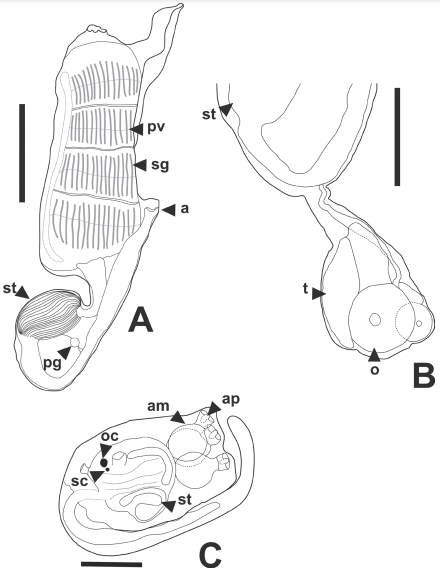
'Distaplia stylifera' (A) Zooid (thorax and abdomen). (B) Abdomen. (C) Larva. Abbreviatures: a. anus;
am. ampullae; ap. adhesive papillae; oc. ocellus; o. oocyte; pv. parastigmatic vessels; pg. pyloric gland
vesicle; sc. statocyte; sg. stigmata; st. stomach; t. testes. Scales bars: 1 cm (A); 0.5 mm (B), (C). Moreno-Dávila et al. (2023).
Within the abdomen lies an elongated and curved stomach, the wall of which has more than 20 fine longitudinal plications (folds), which can be seen on the inner and outer surfaces when the specimens are sectioned, although they are sometimes interrupted or divided. A short post-stomach connects to an enlarged mid-intestine at the bottom of the gut-loop. The distal intestine runs to the anterior, and ends in a bilobed anus at the base of the atrial aperture. A pyloric (mucus) gland between the stomach and the intestine and continues anteriorly forming
sinuous tubules over the intestine in front of the stomach.
The gonads are held within a pedunculated sac, with one or two oocytes at the bottom, above which lie a cluster of five or six elongated or wedge-shaped testes. A common sperm duct arises posteriorly from the
cluster of testes, but turns anteriorly at its very beginning, without overlapping the
oocytes.
All of the colonies examined had larvae incubating in long sacs that reach posteriorly deeper than the zooids themselves in the colonies. These sacs typically contained one or two well developed larvae, about 1.3 mm in length, plus three embryos. When fully developed the larvae reach about 1.5 mm, and possess three adhesive papillae,
two dorsal and one ventral, with a globular ampulla each in the stalks. The four rows of stigmata have developed by this stage, with an incipient abdomen folded under the branchial sac. A sensory vesicle contains two
pigmented spots, with a larger one above and a smaller one below, though these can be hard to differentiate, as they are close together and the larvae are not transparent.
Distaplia stylifera was originally described in the Red Sea, and subsequently has been recorded from several areas of the Indo-Pacific, Australia, the Philippines, and the South China Sea, as well as. under the possible synonym Distaplia mikropnoa, from Palau. There have been reports from the Mediterranean, although these are considered dubious. It has also been reported in the Western Atlantic, from the coast of North Carolina south as far as Jamaica, and at several locations in the Caribbean, and possible further south around Sao Paulo in Brazil. It has not, however, previously been reported from the Eastern Pacific.
Sites of previous records of Distaplia stylifera: (1) Red Sea, 1874 (type locality).
Indo-Pacific; (2)-(9). Mediterranean, (10). Western Atlantic Ocean, (11)-(18). Eastern Pacific Ocean, (19)
present study. The type locality in the Red Sea and the record of the present study are indicated with stars. Moreno-Dávila et al. (2023).
Despite successful amplification of DNA apparently collected from the Ascidian colonies, all of this proved, upon analysis, to be closer to that of Algae, Bacteria, or Fungi, than to any Animal, despite great care being taken to avoid any contamination. For this reason the taxonomic comparison had to be made entirely upon physical examination of the specimens, and comparison to other members of the genus Distaplia.
The taxonomy of the genus Distaplia is mainly based on characters such as colony
shape, arrangement of zooids in systems, presence or not of gonadal sac, stigmata per row, stomach shape and external surface, and muscle arrangement. Based upon these criteria, the Ensenada de La Paz specimens would appear to be entirely consistent with Distaplia stylifera. However, Moreno-Dávila et al. note that the original description of the species was made in 1874, and like a lot of descriptions from this period, was a lot less detailed than descriptions made by modern taxonomists. Furthermore, that description was made upon a specimen that was probably a juvenile, lacking larvae and having under-developed gonads.
Descriptions of populations of modern populations of 'Distaplia stylifera' show some variation, making it possible that the global population is in fact a cluster of closely related species. Notably, the specimens collected at Ensenada de La Paz all had parastigmatic vessels, something also reported in almost all specimens collected from Australia, as well as specimens collected from the Caribbean. An absence of such vessels has been noted in specimens from Madagascar, and it has been suggested that the presence or absence of these vessels might be a feature which can be used to differentiate between Distaplia stylifera and Distaplia mikropnoa. However, a number of other features can be used to differentiate Distaplia mikropnoa, which include a long double rows of zooids converging to the terminal common cloacal apertures,
a long post-pyloric part of the gut loop, and a lack of a gastric reservoir. Furthermore, in Distaplia mikropnoa the course of the gastro-intestinal ducts that does not cross from the stomach to the ascending limb of the gut loop but extends down the descending loop. Based upon this, Patricia Kott concluded that the two species are both valid, but that they have widely confused within the literature. Notably, she concluded that the Palau population belonged to Distaplia stylifera rather than Distaplia mikropnoa.
Oval follicles have been suggested as another feature which could be used to differentiate the two species, with specimens which have up to 15 oval follicles assigned to Distaplia mikropnoa, while those having only five or six, which would include the Ensenada de La Paz population, belong to Distaplia stylifera.
The sperm duct is another feature apparently variable in populations assigned to Distaplia stylifera, with some populations having a sperm duct running posteriorly and making
one or several loops over the oocytes before turning anteriorly, while in other populations, including the Ensenada de La Paz population, it is straight. Furthermore, in some populations, including Ensenada de La Paz, the gonadal sac is attached via a peduncle, while in others it is almost flush with the abdomen, separated by a wide
neck.
Moreno-Dávila et al. suggest that this wide range of variable features indicate that 'Distaplia stylifera' is probably a cluster of closely related species, often mistaken with the closely related Distaplia mikropnoa. This probably cannot be resolved without a more detailed taxonomic study, using both morphological and genetic methods to analyse populations from different regions of the world. Nevertheless, the reporting of a member of the species cluster from the Eastern Pacific represents a significant range-expansion for a group previously known from tropical regions of the Western Atlantic, Indian Ocean, and Western Pacific.
Moreno-Dávila et al. were unable to extract DNA from their specimens of 'Distaplia stylifera', and note that no records exist within the GenBank and BOLD public databases. The co-generic Distaplia bermudensis is present in these databases, and shows a 14–20% genetic variance between different populations and morphotypes, indicating either a remarkable level of genetic variation within a single species, or that Distaplia bermudensis is also a species cluster.
This taxonomic uncertainty makes it difficult to assess to what extent the different populations of 'Distaplia stylifera' represent introductions or local species, although Moreno-Dávila et al. note that the populations from North Carolina and the Caribbean appear to strongly favour lagoons and artificial structures, which is behaviour typical of invasive fouling organisms, and that this population appears to be expanding southwards to the coast of Brazil, where again it has been found only on artificial substrates.
Despite this uncertainty, Moreno-Dávila et al. believe that the Ensenada de La Paz population does represent a high-impact invasive species, and given the absence of any other known populations of 'Distaplia stylifera' in the Eastern Pacific, and the behavioural similarities of this species to the Western Atlantic populations, one which has probably arrived via the Panama Canal. probably crossing the canal on a large ship, then secondarily transferring to a smaller vessel capable of entering the harbours around La Paz.
See also...
Follow Sciency Thoughts on Facebook.
Follow Sciency Thoughts on Twitter.


.png)

.png)

.png)


.png)
.png)


%20(1)%20(1).png)


