Showing posts with label North Sea. Show all posts

Sunday, 13 August 2023

Thousands forced to flee their homes as much of southern Norway affected by flooding.

Thousands of people have been forced to flee their homes, and at least one person has died, in flooding which has affected much of southern Norway. The country received about three times as much rainfall as would usually be expected in the month of July, with no sign of a let-up in the first part of August. Many rivers have burst their banks, and a series of landslides have been triggered as sediments became waterlogged, impacting transport networks and other infrastructure. Landslides are a common problem after severe weather events, as excess pore water pressure can overcome cohesion in soil and sediments, allowing them to flow like liquids. Approximately 90% of all landslides are caused by heavy rainfall. On Wednesday 9 August the Braskereidfoss Hydroelectric Dam on the Glomma River partially collapsed under the weight of water that had built up behind it, sending floodwaters across the border into Sweden. One woman is reported to have died after falling into a flooded stream on Tuesday 8 August.

Floodwaters from the Storelv River pouring through the centre of Hønefoss, to the northwest of Oslo, on 9 August 2023. Annika Byrde/NTB/Reuters.

Summer rainfall in Norway is usually driven by evaporation over the North Sea, leading to rain when westerly winds prevail, and drier spells when the wind blows from the east. However, much of this summer's rain has been driven by the exceptionally high temperatures in the Baltic Sea this July, which have led to higher rates of precipitation, and high levels of rainfall when the wind blows from the east. The average annual rainfall in Norway has risen by 18% in the past century, with much of that increase happening in the past four decades. Should high summer temperatures in the Baltic become a regular feature of a warming climate, then it is likely that Norway, and Scandinavia in general, could shift towards a much wetter climate.

Flooding at Aurdal in southeast Norway on 11 August 2023. Ole Berg-Rusten/NTB/AFP/Getty Images.

See also...

Follow Sciency Thoughts on Facebook.

Follow Sciency Thoughts on Twitter.


Thursday, 22 June 2023

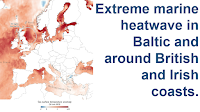
Extreme marine heatwave in Baltic and around British and Irish coasts.

One of the most extreme marine heatwaves ever recorded is currently affecting the waters of the Baltic Sea and around the coasts of Britain and Ireland, according to a press release issued by the European Space Agency on 20 June 2023. The Baltic Sea is currently 8°C above the annual average for June, based upon data from the years 1981-2016, while the North Sea is currently 5°C above average, with the northwest coast of the UK between Durham and Aberdeen particularly affected.

Sea surface temperatures on 18 June 2023, relative to average June temperatures for the period 1981-2016. European Space Agency.

Marine heatwaves tend to be closely linked to other extreme weather events, typically causing these to be longer and more intense, with the two systems potentially creating a feedback loop in which each system intensifies the other. They are also often associated with mass deaths of Fish and other marine organisms, as warmer water is capable of retaining less dissolved oxygen than cool water.

This event is part of a trend of rising ocean and atmospheric temperatures, with the global average sea surface temperature in both April and May being the highest ever recorded in those months, according to the UK's Met Office, which has temperature records going back to 1850.

These high sea temperatures are linked to other extreme weather events which have been affecting the planet this year, including the fires sweeping across the forests of Canada, the heatwaves being experienced in many parts of the world, and a sharp reduction in the levels of sea ice around Antarctica.

June 2023 looks likely to be another record-breaking month, with the Copernicus Climate Change Service reporting that the first 11 days of the month each saw the hottest global average temperatures recorded for that date, and average global temperatures exceeding pre-industrial temperatures by 1.5°C, the first time this has ever happened in June. 

While the high temperatures in the North and Baltic seas are expected to be a temporary event, further high temperature events are expected in the coming months, driven by an emerging El Niño system in the South Pacific, with predictions currently indicating that 2024 will be the hottest year ever recorded.

El Niño is the warm phase of a long-term climatic oscillation affecting the southern Pacific, which can influence the climate around the world. The onset of El Niño conditions is marked by a sharp rise in temperature and pressure over the southern Indian Ocean, which then moves eastward over the southern Pacific. This pulls rainfall with it, leading to higher rainfall over the Pacific and lower rainfall over South Asia. This reduced rainfall during the already hot and dry summer leads to soaring temperatures in southern Asia, followed by a rise in rainfall that often causes flooding in the Americas and sometimes Africa. Worryingly climatic predictions for the next century suggest that global warming could lead to more frequent and severe El Niño conditions, extreme weather conditions a common occurrence.

Movements of air masses and changes in precipitation in an El Niño weather system. Fiona Martin/NOAA.

See also...


Follow Sciency Thoughts on Facebook.

Follow Sciency Thoughts on Twitter.


Tuesday, 7 March 2023

Coastal erosion exposes part of former coprolite mine on the Yorkshire Coast.

Two walkers on the coast at Speeton in North Yorkshire, England, have discovered a series of posts eroding out of a cliff that are thought to have been part of an nineteenth century mine. Terri-Leigh Broadhead contacted local archaeologist Trevor Brigham after discovering the posts while walking on the beach with her father. Brigham at first thought they might have been associated with an eighteenth century clay mine, but upon further investigation decided the posts are more likely to have been part of a nineteenth century 'coprolite' mine, which excavated phosphorus nodules for use in the fertilizer industry. 

Wooden support posts from a nineteenth century mine exposed on the coast at Speeton in North Yorkshire. Yorkshire Post.

Phosphate 'coprolites' were mined at a number of sites around the UK in the nineteenth century, following the discoveries that phosphorus (initially obtained from Bird guano in South America) was beneficial in improving the fertility of soils, and then that this could be obtained by treating phosphate nodules with sulphuric acid. At the time all such nodules were widely believed to be coprolites (fossil dung), following publications on the subject by the geologists William Buckland and John Henslow, although, while these mines did produce coprolites and other fossils, the majority of the material would have been non-coprolitic in origin.

Phosphate nodules form when phosphorus-rich organic material, such as Animal dung or bone, is buried in shallow marine settings, where sulphur-oxidising Bacteria will tend to break down other tissues, but phosphorus becomes trapped as phosphate. In environments where these settings are subjected to repeated intervals of sedimentation and erosion, this will lead to an unconformity (part of a geological sequence where there is an erosional surface marking a period of time not recorded) topped by a gravel bed with phosphate nodules. In some settings a sequence of these phosphate nodule-rich gravel beds can build up that is thick enough to be worth mining.

These phosphate nodule accumulations are often fossil-rich, as the remains of the Animals from which the phosphates are derived become trapped in the nodules, and some extremely famous fossil deposits are formed in this way, such as the Kem Kem Beds of Morocco. Victorian palaeontologists were aware of this, and like palaeontologists today, were very interested in phosphate nodules, but the bulk of the material recovered from phosphate mines such as Speeton would have been ground up and treated with acid to recover their phosphorus, which would then have been used as fertilizer to help feed the growing populations of Britain's new industrial cities.

See also...

Follow Sciency Thoughts on Facebook.

Follow Sciency Thoughts on Twitter.


Tuesday, 3 January 2023

Walrus sighted in English coastal town.

A Walrus, Odobenus rosmarus,  spent a day resting on a harbour in the town of Scarborough in North Yorkshire, England. The Animal first appeared at about 11.30 on Friday 30 December 2022, returning to the sea at about 4.00 pm on Saturday 31 December, by which time the town had cancelled it's annual New Year Eve firework display to avoid distressing the Marine Mammal on the advice of the wildlife charity British Divers Marine Life Rescue; although as a way of attracting visitors to the town, Walruses proved to be rather more successful than fireworks, with thousands of people arriving to witness the event. The Walrus is believed to be the same Animal spotted on the coast of Hampshire earlier in December, where he was given the nickname 'Thor'. It was spotted again on a wooden pontoon at Blythe on the coast of Northumberland, about 160 km north of Scarborough, on Monday 2 January 2022.

Walrus resting on the harbour at Scarborough in North Yorkshire, England, on 31 December 2022. James Spencer/BBC.

Walruses are the third largest species of Seal, exceeded only by Northern and Southern Elephant Seals (Mirounga angustirostris and Mirounga leonina), and are armed with a large and impressive set of tusks. As such they have few natural enemies, giving them a degree of self confidence surprising compared to most wild Mammals in the UK. Both Polar Bears (Ursus maritimus) and Orca (Orcinas orca) will on occasion hunt Walrus, but they are the preferred prey of neither species, due to their large and potentially dangerous nature. Walruses are also hunted by Humans to some extent, although today this activity is tightly regulated and Walrus products are listed on Appendix 3 of the CITES convention.

Walrus resting on a pontoon dock at Blythe in Northumberland, England, on Monday 2 January 2022. The Guardian.

Walruses are, however still considered to be Vulnerable under the terms of the International Union for the Conservation of Nature's Red List of Threatened Species, due to the potential threat they face from a warming climate. The species is naturally found in the waters of the Arctic Ocean, around Greenland and Svalbard Island, and the northern coasts of Russia, Alaska, and Canada, where they feed on a wide variety of marine invertebrates, with a strong preference for Clams. These environments are considered to be particularly vulnerable to warming climates, which cause loss of the seasonal ice cover, lower the oxygen content of the water (cooler water can absorb and retain more dissolved oxygen than warmer water), and enable invasions by species from warmer climates. While occasional lone Walruses may venture southward (two Walruses where seen on the coasts of Europe in 2021, one in the Irish Sea and the other in the Baltic), it is doubtful that these environments produce enough food to feed a breeding population of these large Mammals, and doing so would almost certainly bring them into conflict with Human shellfish farmers and harvesters (notably, the Walrus seen in the Baltic in 2021 starved to death on the coast of Finland, despite efforts to rescue it).

Distribution map for Walrus, Odobenus rosmarus, populations. ICUN Red List.

See also...

Follow Sciency Thoughts on Facebook.

Follow Sciency Thoughts on Twitter.


Tuesday, 1 February 2022

Fireball meteor over the Scottish Borders region.

Witnesses across much of England and Scotland, as well as the Netherlands, and parts of Wales, Belgium, and Ireland, have reported observing a bright fireball slightly before 6.50 pm local time (GMT) on Sunday 29 January 2022. The fireball is described as having moved from northeast to southwest, first appearing over the North Sea and vanishing over northern Northumbria, England. A fireball is defined as a meteor (shooting star) brighter than the planet Venus. These are typically caused by pieces of rock burning up in the atmosphere, but can be the result of man-made space-junk burning up on re-entry.

 
The 29 January 2022 meteorite seen from Koksijde in Belgium. American Meteor Society.
 
Objects of this size probably enter the Earth's atmosphere several times a year, though unless they do so over populated areas they are unlikely to be noticed. They are officially described as fireballs if they produce a light brighter than the planet Venus. The brightness of a meteor is caused by friction with the Earth's atmosphere, which is typically far greater than that caused by simple falling, due to the initial trajectory of the object. Such objects typically eventually explode in an airburst called by the friction, causing them to vanish as an luminous object. However, this is not the end of the story as such explosions result in the production of a number of smaller objects, which fall to the ground under the influence of gravity (which does not cause the luminescence associated with friction-induced heating).
 
Heat map showing areas where sightings of the meteor were reported (warmer colours indicate more sightings), and the apparent path of the object (blue arrow). American Meteor Society.
 
These 'dark objects' do not continue along the path of the original bolide, but neither do they fall directly to the ground, but rather follow a course determined by the atmospheric currents (winds) through which the objects pass. Scientists are able to calculate potential trajectories for hypothetical dark objects derived from meteors using data from weather monitoring services.
 
See also...


Follow Sciency Thoughts on Facebook.

Follow Sciency Thoughts on Twitter


Thursday, 8 April 2021

Fireball off the east coast of Scotland.

Witnesses across the Scotland, England, Northern Ireland, and parts of Denmark and Norway, have reported observing a bright fireball slightly after 8.35 pm local time (slightly after 7.35 pm GMT) on Saturday 3 April 2021. The fireball is described as having moved from north to south, appearing off the coast of Aberdeenshire and vanishing to the east of Angus. A fireball is defined as a meteor (shooting star) brighter than the planet Venus. These are typically caused by pieces of rock burning up in the atmosphere, but can be the result of man-made space-junk burning up on re-entry. 

 
The 3 April 2021 meteorite seen from the village of Fishburn in County Durham, England. David Alderson/American Meteor Society.
 
Objects of this size probably enter the Earth's atmosphere several times a year, though unless they do so over populated areas they are unlikely to be noticed. They are officially described as fireballs if they produce a light brighter than the planet Venus. The brightness of a meteor is caused by friction with the Earth's atmosphere, which is typically far greater than that caused by simple falling, due to the initial trajectory of the object. Such objects typically eventually explode in an airburst called by the friction, causing them to vanish as an luminous object. However, this is not the end of the story as such explosions result in the production of a number of smaller objects, which fall to the ground under the influence of gravity (which does not cause the luminescence associated with friction-induced heating).
 
 
Heat map showing areas where sightings of the meteor were reported (warmer colours indicate more sightings), and the apparent path of the object (blue arrow). American Meteor Society.

These 'dark objects' do not continue along the path of the original bolide, but neither do they fall directly to the ground, but rather follow a course determined by the atmospheric currents (winds) through which the objects pass. Scientists are able to calculate potential trajectories for hypothetical dark objects derived from meteors using data from weather monitoring services.

See also...


Follow Sciency Thoughts on Facebook.

Follow Sciency Thoughts on Twitter.


Thursday, 7 January 2021

British Divers Marine Life Rescue successfully return stranded Killer Whale to water in the Orkneys.

A Killer Whale, Orcinus orca, stranded on a beach on Sanday in the Orkney Islands, Scotland, has been successfully returned to the sea by volunteers from British Divers Marine Life Rescue. The Whale was spotted by members of the public on a beach in the Bay of Newark on Monday 4 January 2020, who called the local coordinator for the group. On arrival the Animal was found to be a juvenile about 3.4 m in length, and probably a male (although the volunteers concentrated on rescuing the Animal rather than determining its sex). The Whale, which was on its side, was righted to enable it to breath better, and refloated on the incoming tide. The Whale is thought to have been about 3-4 years old, at which age it would no longer be depemdant on its mother, and a member of the North Isles 27s Pod, which is commonly seen in the area.

 
A young Killer Whale, Orcinus orca, stranded on a beach on Sanday in the Orkney Islands, on Monday 4 January 2020. British Divers Marine Life Rescue.

Killer Whales are the largest members of the Dolphin Family, Delphinidae, and have a global distribution. They are highly inteligent and adaptable Animals, able to take a wide range of prey, with different populations often specialising in hunting different prey items. It is possible that Killer Whales are a cluster of cryptic species (species which appear identical but which are genetically distinct and reproductively isolated) rather than a true biological species (single global population with all members potentially able reproduce with one-another), which makes their conservation status difficult to assess. Killer Whales are thriving in some areas, but in others are threatened by Human activities, such as heavy shipping, fishing, and offshore drilling. This means that if the species is in fact a species cluster, then the populations of each biological species might be quite small and potentially threatened.

See also...


Follow Sciency Thoughts on Facebook.

Follow Sciency Thoughts on Twitter.