Showing posts with label Cook Straight. Show all posts

Thursday, 3 October 2013

Magnitude 4.7 Earthquake under Cook Straight, New Zealand.

New Zealand's GeoNet Project, which monitors geohazards in the country, recorded a Magnitude 4.7 Earthquake at a depth of 22 km beneath the Cook Straight, which separates the nation's two main islands, slightly after 5.20 am local time on Wednesday 2 October 2013 (slightly after 4.20 pm on Tuesday 1 October, GMT). This is a moderately large quake, and was felt as far away as Christchurch to the south and Whangerei to the north, though there are no reports of any damage or injuries.

The approximate location of the 2 OCtober 2013 Cook Straight Earthquake. Google Maps.

New Zealand is located on the boundary beneath the Australian and Pacific Plates. Beneath the islands the Pacific Plate is being subducted beneath the Australian Plate. This causes a great deal of friction which causes Earthquakes where the boundary between the two plates is close to the surface; this is to the east of North Island, but onshore on South Island, where it can lead to strong Earthquakes such as the ones felt in Christchurch recently. Technically such quakes also occur where the plate margin is deeper, but these are felt less strongly as the rocks between the boundary and the surface absorb much of the energy, making strong tremors much less frequent on North Island. As the Pacific Plate sinks deeper into the Earth it is partially melted by the friction and the heat of the planet's interior. Some of the melted material then rises through the overlying Australian Plate, fueling the volcanoes of New Zealand.

Witness reports of Earthquakes can help scientists to understand these events, and the underlying geologic processes that cause them. If you felt either of these quakes then you can report it to the GeoNet here.


Follow Sciency Thoughts on Facebook.

Friday, 16 August 2013

Magnitude 6.6 Earthquake and series of aftershocks hit South Island, New Zealand.

A Magnitude 6.6 Earthquake at a depth of 8 km hit New Zealand's South Island, close to Clifford Bay on the Cook Straight, slightly after 2.30 pm local time (slightly after 2.30 am GMT) on Friday 16 August 2013, according to the GeoNet project, which monitors quakes in New Zealand. This has been followed by a number of aftershocks, with at least 10 quakes in excess of Magnitude 5 beneath northeast South Island or the Cook Straight since the initial event. There are no reports of any fatalities, but buildings have been damaged on both of New Zealand's main islands, a number of roads have been closed and several people have been treated for minor injuries.

Damage in a shop in Seddon, South Island, following the 16 August 2013 quakes. Anthony Phelps/Reuters.


New Zealand is located on the boundary beneath the Australian and Pacific Plates. Beneath the islands the Pacific Plate is being subducted beneath the Australian Plate. This causes a great deal of friction which causes Earthquakes where the boundary between the two plates is close to the surface; this is to the east of North Island, but onshore on South Island, where it can lead to strong Earthquakes such as the ones felt in Christchurch recently. Technically such quakes also occur where the plate margin is deeper, but these are felt less strongly as the rocks between the boundary and the surface absorb much of the energy, making strong tremors much less frequent on North Island. As the Pacific Plate sinks deeper into the Earth it is partially melted by the friction and the heat of the planet's interior. Some of the melted material then rises through the overlying Australian Plate, fueling the volcanoes of New Zealand.

The approximate location of the 16 August 2013 New Zealand Earthquake. Google Maps.

The Cook Straight area has been shaken by a series of quakes since a Magnitude 6.5 Earthquake took place on 21 July 2013.  

Witness reports of Earthquakes can help scientists to understand these events, and the underlying geologic processes that cause them. If you felt either of these quakes then you can report it to the GeoNet here.

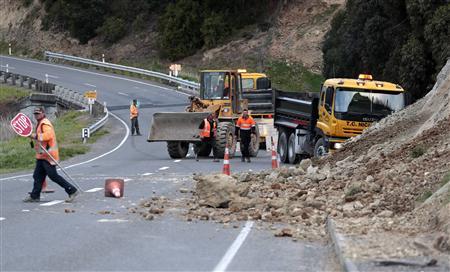
A landslip on the outskirts of  Seddon, South Island, following the 16 August 2013 quakes. Anthony Phelps/Reuters.


Follow Sciency Thoughts on Facebook.

Thursday, 1 August 2013

New Zealand rattled by Earthquakes.

Central New Zealand was rattled by a Magnitude 4.9 Earthquake at a depth of 16km beneath the Cook Strait, which separates the nation's North and South Islands, at about 11.10 am local time on Thursday 1 August 2013 (11.10 pm on Wednesday 31 July, GMT), according to the GeoNet project, which monitors quakes in New Zealand. This was followed 45 minutes later by a second quake with a Magnitude of 4.2, in roughly the same spot. These are moderately large quakes and shallow, with the potential to cause problems. In this case no damage or injuries have been reported, but the quakes were apparently felt across much of the country.

The approximate location of the 1 August 2013 Cook Strait Earthquakes. Google Maps.

New Zealand is located on the boundary beneath the Australian and Pacific Plates. Beneath the islands the Pacific Plate is being subducted beneath the Australian Plate. This causes a great deal of friction which causes Earthquakes where the boundary between the two plates is close to the surface; this is to the east of North Island, but onshore on South Island, where it can lead to strong Earthquakes such as the ones felt in Christchurch recently. Technically such quakes also occur where the plate margin is deeper, but these are felt less strongly as the rocks between the boundary and the surface absorb much of the energy, making strong tremors much less frequent on North Island. As the Pacific Plate sinks deeper into the Earth it is partially melted by the friction and the heat of the planet's interior. Some of the melted material then rises through the overlying Australian Plate, fueling the volcanoes of New Zealand.

A Magnitude 6.5 Earthquake took place beneath the Cook Strait on 21 July 2013, since when there have been a series of smaller quakes (some of them still quite large) in the area, which are thought to be aftershocks of the initial quake. 

Witness reports of Earthquakes can help scientists to understand these events, and the underlying geologic processes that cause them. If you felt either of these quakes then you can report it to the GeoNet here (for the 11.10 am quake) or here (for the 11.55 quake).


Follow Sciency Thoughts on Facebook.