Showing posts with label South Island. Show all posts

Wednesday, 20 September 2023

Mangnitude 6.0 Earthquake beneath South Island, New Zealand.

The GeoNet project, which monitors quakes in New Zealand, recorded a Magnitude 6.0 Earthquake at a depth of 11 km, about 43 km to the west of the town of Geraldine in the Canterbury Region of South Island, New Zealand, slightly before 9.15 am local time on Wednesday 20 September 2023 (slightly before 9.15 pm on Tuesday 19 September GMT). No damage or casualties have been reported following this event, but people have reported feeling it across much of New Zealand.

Ths approximate location of the 20 September 2023 South Island Earthquake. GeoNet.

New Zealand is located on the boundary beneath the Australian and Pacific Plates. Beneath the islands the Pacific Plate is being subducted beneath the Australian Plate. This causes a great deal of friction which causes Earthquakes where the boundary between the two plates is close to the surface; this is to the east of North Island, but onshore on South Island, where it can lead to strong Earthquakes. Technically such quakes also occur where the plate margin is deeper, but these are felt less strongly as the rocks between the boundary and the surface absorb much of the energy, making strong tremors much less frequent on North Island. As the Pacific Plate sinks deeper into the Earth it is partially melted by the friction and the heat of the planet's interior. Some of the melted material then rises through the overlying Australian Plate, fuelling the volcanoes of New Zealand.

The subduction zone beneath New Zealand, and how if fuels Earthquakes and volcanos. Te Ara.

Witness reports of Earthquakes can help scientists to understand these events, and the underlying geologic processes that cause them. If you this quake then you can report it to the GeoNet here.

See also...


Follow Sciency Thoughts on Facebook.

Follow Sciency Thoughts on Twitter.


Wednesday, 20 January 2021

Five workers require hospital treatment following nitric acid spill at transport yard in New Zealand.

Five workers have required hospital treatment following a nitric acid spill at a transport yard in Christchurch, New Zealand, on Wednesday 20 January 2021. The incident happened after a 1000 litre container of the acid was punctured by a forklift truck at the Owens Transport yard in Middleton, at about 12.30 pm local time. Twenty five staff working at the premises were evacuated while the spill was cleared by specialist teams from Fire and Emergency New Zealand. The site is expected to remain closed for the rest of the day.


Emergency services attend a transport yard following a chemical spill on 20 January 2021. John Kirk-Anderson/Stuff.

Nitric Acid is a colourless but extremely strong smelling liquid, it is highly corrosive and acts as an oxidising agent. Exposure to the skin can cause severe chemical burns, and inhaling the vapour can result in severe respiratory problems. Calcium Carbonate will react with Nitric Acid to produce Carbon Dioxide, Water and Calcium Nitrate (an largely inert white powder that absorbs water), so Nitric Acid spills can be tackled by adding Calcium Carbonate until the reaction stops fizzing, then clearing up the end product, a mixture of Calcium Nitrate, Calcium Carbonate and Water.

See also...


Follow Sciency Thoughts on Facebook.

Follow Sciency Thoughts on Twitter.


Thursday, 10 October 2019

Heracles inexpectatus: A Giant Parrot from the Early Miocene of South Island, New Zealand.

The phenomenon of gigantism in island Birds is well documented, with examples such as the Dodo, Raphus cucullatus, of Mauritius, and Solitaire, Pezophaps solitaria,  of Rodrigues (Giant Pigeons), the extinct Sylviornithidae of New Caledonia and Fiji, the Fiji Giant Ground Pigeon, Natunaornis gigoura, and a variety of Giant Waterfowl, Storks, Rails, Owls and Raptors from other islands. In many cases these Birds were early colonisers of small islands, where one of the first Birds to arrive typically evolved into a 'Giant Bird' niche. However the situation in New Zealand is more complex, with a large, complex ecosystem evolving in the absence of Mammals, which has produced a wide range of large Birds, including the extinct Moas, Waterfowl, Rails, and Eagles.

In a paper published in the journal Biology Letters on 7 August 2019, Trevor Worthy of the College of Science and Engineering at Flinders University, Suzanne Hand and Michael Archer of the PANGEA Research Centre at the University of New South Wales, and Paul Scofield and Vanesa De Pietri of the Canterbury Museum, describe a Giant Parrot from the Early Miocene St Bathans Fauna of South Island, New Zealand.

The St Bathans Fauna comes from a series of exposures of the lower Bannockburn Formation in the Otago Region of New Zealand. It comprises a suite of fossils laid down in a shallow lake between 19 and 16 million years ago. The lake was surrounded by a floodplain covered by subtropical vegetation including Casuarinas, Eucalypts and Palms as well as Podocarps, Araucarias and Southern Beeches. The fossiliferous layers have produced numerous disarticulated vertebrate remains, including Fish, Crocodylians, Squamates, and, most notably, Birds. These deposits are considered particularly important, as they record a time just after the Oligocene 'Great Drowning', when high sealevels left about 80% of New Zealand underwater, and is therefore thought to preserve an important stage in the assembling of the modern fauna of New Zealand.

The new species is named Heracles inexpectatus, where 'Heracles' honours the mythical Greek hero of the same name, for his slaying of Neleus, King of Pylos, after whom the largest Parrot previously known from the St Bathans Fauna to date was named, and 'inexpectatus' means 'unexpected'. The species is described from a partial left tibiotarsus and matching partial right tibiotarsus (the tibiotarsus is the lower leg bone of a Bird, the equivalent of the human shin. The describing of fossil Birds from leg bones alone is not unusual, as these are more robust than most of the Avian skeleton, and therefore more likely to be preserved.

Tibiotarsi of Heracles inexpectatus, left, holotype (a), (b), (f ) NMNZ S.51083 and right, paratype (g), compared to (d), (e) left tibiotarsus of the modern Kakapo, Strigops habroptila (Canterbury Museum Av45277), in craniolateral (a) and cranial (b)–(g) views. (c) Silhouettes of a Human and Heracles inexpectatuss for scale. Scale bars are 20 mm. Abbreviations: ccl, crista cnemialis lateralis; cl, condylus lateralis; cm, condylus medialis; dtl, distal insertion scar for transverse ligament; fc, fibular crest; lfr, lateral scar for fibular retinaculum; lic, linea intermuscularis cranialis; mfr, mediocranial scar for fibular retinaculum; pons, pons supratendineus; ptl, proximal insertion scar for transverse ligament; se, sulcus extensorius; sf, sulcus m. fibularis; trf, tuberculum retinaculi m. fibularis. Worthy et al. (2019).

Both of the preserved bones are incomplete, lacking the proximal and distal ends (top and bottom), but display a series of traits that enable them to be confidently assigned to a Parrot. These include a sulcus extensorius (deep groove) located near mid-shaft, a shaft  that widens asymmetrically and flattens craniocaudally (downwards), a horizontally aligned and reduced pons supratendineus (groove at the base), large and prominent insertion scars for the transverse ligament with the distolateral scar close to the pons supratendineus.

The bones are exceptionally large and robust, with a minimum shaft circumference of 35.8 mm. Based upon this Worthy et al. suggest that the living Heracles inexpectatus, would have had a mass of about 6.96 kg, the equivalent of a small-to-medium Dog, and almost twice the mass of the Kakapo, Strigops habroptila, the largest living Parrot, and that like the Kakapo it was probably a large, ground-dwelling Bird.

See also...

https://sciencythoughts.blogspot.com/2019/04/assessing-genetic-diversity-of.htmlhttps://sciencythoughts.blogspot.com/2018/12/tyto-alba-barn-owl-from-dinaledi.html
https://sciencythoughts.blogspot.com/2018/10/three-hunters-rescued-alive-after-their.htmlhttps://sciencythoughts.blogspot.com/2018/10/winnicavis-gorskii-new-species-of.html
https://sciencythoughts.blogspot.com/2018/08/sternula-antillarum-hundreds-of-least.htmlhttps://sciencythoughts.blogspot.com/2018/02/kumimanu-biceae-new-species-of-giant.html
Follow Sciency Thoughts on Facebook.

Sunday, 21 October 2018

Three hunters rescued alive after their campsite was hit by an avalanche in Fiordland, New Zealand.

Three men on a hunting trip were rescued alive after their campsite was hit by an avalanche early in the morning of Saturday 20 October 2018. The men were on an expedition trapping Stoats (a highly invasive European predatory species that presents a threat to New Zealand's native Birdlife) near Lake Te Anau in the Fiordland Region of South Island, New Zealand, when the avalanche hit, sweeping away the campsite, and leaving the men uninjured but very cold and wet (potentially life-threatening in a remote area without survival equipment), but were rescued after about an hour by a Southern Lakes Rescue Helicopter alerted to the event by an emergency beacon carried by the men.

Two of the hunters on a Stoat-trapping expedition that was later hit by an avalanche in Fiordland, New Zealand, on 20 October 2018. Ben Collins/Stuff.
 
Avalanches are caused by the mechanical failure of snowpacks; essentially when the weight of the snow above a certain point exceeds the carrying capacity of the snow at that point to support its weight. This can happen for two reasons, because more snow falls upslope, causing the weight to rise, or because snow begins to melt downslope, causing the carrying capacity to fall. Avalanches may also be triggered by other events, such as Earthquakes or rockfalls. Contrary to what is often seen in films and on television, avalanches are not usually triggered by loud noises. Because snow forms layers, with each layer typically occurring due to a different snowfall, and having different physical properties, multiple avalanches can occur at the same spot, with the failure of a weaker layer losing to the loss of the snow above it, but other layers below left in place - to potentially fail later. In this instance the avalanche appears to have been caused by rain falling onto snow covered slopes, weakening the structure of the snowpack.

Diagrammatic representation of an avalanche, showing how layering of snow contributes to these events. Expedition Earth.

Stoats, Mustela erminea, were introduced to New Zealand in the 1880s, in an attempt to control Rabbits, which had been introduced a decade earlier as a food animal and rapidly become an agricultural pest due to a lack of native predators, despite the warnings of scientists concerned about the effect that these alien predators would have on native Bird populations. Unfortunately these warnings proved to be accurate, and within six years dramatic population losses had been recorded in many species of New Zealand Birds. In an attempt to protect these Birds many species were established on offshore islands in the Fiordland area, though in the early 2000s Stoats were found to be reaching some of these islands, devastating the Bird populations there and leading to increased efforts to control Stoats in the Fiordland Region.

 An introduced Stoat, Mustela erminea, with a Bird chick in New Zealand. Department of Conservation Te Papa Atawhai.

See also...

https://sciencythoughts.blogspot.com/2018/09/homes-evacuated-after-chemical-spill-in.htmlhttps://sciencythoughts.blogspot.com/2018/02/cyclone-gita-reaches-new-zealand.html
https://sciencythoughts.blogspot.com/2016/11/magnitude-75-earthquake-in-canterbury.htmlhttps://sciencythoughts.blogspot.com/2016/08/passers-by-forced-to-undergo.html
https://sciencythoughts.blogspot.com/2015/01/magnitude-60-earthquake-on-south-island.htmlhttps://sciencythoughts.blogspot.com/2014/03/homes-evacuated-after-landslide.html
Follow Sciency Thoughts on Facebook.

Friday, 7 September 2018

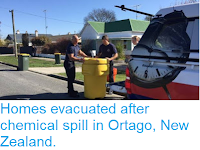
Homes evacuated after chemical spill in Ortago, New Zealand.

A number of homes in the town of Milton in the Otago Region of South Island, New Zealand, were evacuated following a chemical spill on Friday 7 September 2018. Crews from Fire and Emergency New Zealand were called to the scene after a 25 litre drum of the chemical Chloropicrin (CCl3NO2) sprang a leak. Homes within 300 m of the incident were evacuated while the chemical was cleaned up by crews wearing specialist protective clothing, and people have now been allowed to return to their homes.

Two members of Fire and EmergencyNew Zealand remove a drum containing the chemical chloropicrin from a residential street in Milton, Otago. Mary-Jo Tohill/Stuff.

Chloropicin is widely used as a broad spectrum microbial, fungicide and pesticide, particularly in agriculture where it can be used as a fumigant - injected into the soil in a liquid form, where it forms a gas that kills agricultural pests. The chemical is toxic and carcinogenic (it was used as a chemical weapon during the First World War and is still essentially used as a poison today), and due to its volatile nature should only be handled by people with specialist training wearing appropriate protective clothing.

See also...

https://sciencythoughts.blogspot.com/2018/02/cyclone-gita-reaches-new-zealand.htmlhttps://sciencythoughts.blogspot.com/2016/11/magnitude-75-earthquake-in-canterbury.html
https://sciencythoughts.blogspot.com/2016/08/passers-by-forced-to-undergo.htmlhttps://sciencythoughts.blogspot.com/2015/01/magnitude-60-earthquake-on-south-island.html
https://sciencythoughts.blogspot.com/2014/03/homes-evacuated-after-landslide.htmlhttps://sciencythoughts.blogspot.com/2013/08/magnitude-66-earthquake-and-series-of.html


Follow Sciency Thoughts on Facebook.

Tuesday, 20 February 2018

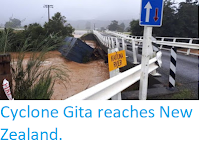
Cyclone Gita reaches New Zealand.

Cyclone Gita made landfall on South Island, New Zealand, on Tuesday 20 February 2018, bringing flooding and high winds to the area around Christchurch in the Canterbury Region. There are no reports of any casualties associated with the storm in New Zealand at this time, though it has caused flight cancellations and several people have had to be rescued from floods. 

Debris on a swollen river near Bainham in the Tasman Region of South Island. Reuters.

Cyclone Gita first formed to the southeast of the Solomon Islands in the first week of February 2018. It passed to the south of Samoa and American Samoa between 8 and 11 February, causing flooding in both groups of islands, and wind damage in parts of American Samoa. The storm passed directly over Tonga on 12 February, causing extensive damage, to the islands' infrastructure, damaging over a thousand buildings, and totally destroying over a hundred, including the nation's parliament building. One person is known to have died in Fuaʻamotu on Tongatapu (the largest island of Tonga and seat of the national government), with at least 30 more being injured, three of them seriously. After Tonga Cyclone Gita passed to the south of Fiji on 13 February, again causing flooding and wind damage, but this time no reported casualties.

Storm damage on Tonga following the passage of Cyclone Gita. John Pulu/AFP.

Tropical storms are caused by solar energy heating the air above the oceans, which causes the air to rise leading to an inrush of air. If this happens over a large enough area the inrushing air will start to circulate, as the rotation of the Earth causes the winds closer to the equator to move eastwards compared to those further away (the Coriolis Effect). This leads to tropical storms rotating clockwise in the southern hemisphere and anticlockwise in the northern hemisphere.These storms tend to grow in strength as they move across the ocean and lose it as they pass over land (this is not completely true: many tropical storms peter out without reaching land due to wider atmospheric patterns), since the land tends to absorb solar energy while the sea reflects it.
 
The passage of Cyclone Gita till 6.00 pm GMT on Monday 19 February 2018  (thick line) with its predicted future path (thin line, circles represent the margin of error on the predictions). Colours indicate the strength of the storm. Tropical Storm Risk.
 
The low pressure above tropical storms causes water to rise there by ~1 cm for every millibar drop in pressure, leading to a storm surge that can overwhelm low-lying coastal areas, while at the same time the heat leads to high levels of evaporation from the sea - and subsequently high levels of rainfall. This can cause additional flooding on land, as well as landslides, which are are a common problem after severe weather events, as excess pore water pressure can overcome cohesion in soil and sediments, allowing them to flow like liquids. Approximately 90% of all landslides are caused by heavy rainfall.
 
See also...
 
http://sciencythoughts.blogspot.co.uk/2017/11/magnitude-68-earthquake-between-tonga.htmlhttp://sciencythoughts.blogspot.co.uk/2017/01/evacuatios-after-ammonia-leak-at-plant.html
http://sciencythoughts.blogspot.co.uk/2016/11/magnitude-75-earthquake-in-canterbury.htmlhttp://sciencythoughts.blogspot.co.uk/2016/08/passers-by-forced-to-undergo.html
http://sciencythoughts.blogspot.co.uk/2016/02/twenty-one-confirmed-deaths-after.htmlhttp://sciencythoughts.blogspot.co.uk/2015/12/container-ship-detained-after-oil-leak.html
Follow Sciency Thoughts on Facebook.

Sunday, 18 February 2018

Kumimanu biceae: A new species of Giant Penguins from the Late Palaeocene of Otago, New Zealand.

Penguins, Sphenisciformes, first appeared in the Palaeocene of New Zealand, and subsequently spread around the Southern Hemisphere, reaching Antarctica, South America, Africa, and the Galapagos Islands. While typically associated with cool climates today, Penguins probably reached their most diverse during the warm greenhouse climates of the Oligocene and Eocene, when a number of giant species (species significantly larger than modern Emperor Penguins, Aptenodytes forsteri) are known from New Zealand and Antarctica.

In a paper published in the journal Nature Communications on 12 December 2017, Gerald Mayr of the Ornithological Section at the Senckenberg Research Institute and Natural History Museum Frankfurt, Paul Scofield  and Vanesa De Pietri of the Canterbury Museum, and Alan Tennyson of the Museum of New Zealand Te Papa Tongarewa, describe a new species of Giant Penguin from the Late Palaeocene of Hampden Beach in Otago, South Island.

The new species is named Kumimanu biceae, where 'Kumimanu' means 'Monster Bird' in Maori and 'biceae' honours Alan Tennyson's mother, Beatrice ('Bice') Tennyson. It is described from a partial skeleton comprising a partial left scapula, an incomplete right coracoid, part of the sternum, a partial left humerus, an incomplete left ulna, the right femur, most of the right tibiotarsus, a partial synsacrum, three vertebrae, and various bone fragments. From these it is estimated to have had a body length of about 1.77 m, and a mass of about 101 kg.

Wing and pectoral girdle bones of the new Giant Penguin, Kumimanu biceae. (a) Whole specimen, partially prepared concretion with all bones in situ. (b) Right coracoid in dorsal view (dotted lines indicate reconstructed outline of bone). (c) Left coracoid of Waimanu tuatahi from the late Paleocene of New Zealand. (d)–(f) Fragmentary proximal end of the left ulna of Kumimanu biceae in (d) dorsal, (e) ventral, and (f) proximal view. (g), (h) Left ulna of an undescribed new Sphenisciform from the Waipara Greensand in (g) ventral and (h) proximal view; the dashed line in (g) indicates the portion of the bone preserved in the  Kumimanu biceae. (i) CT image of cranial surface of partial left humerus. (j) Exposed caudal surface of the bone, surrounding bones and matrix were digitally brightened. (k), (l) CT images of caudal humerus surface with (k) minimum and (l) maximum length estimates based on the reconstructed outline of the bone (dotted lines). (m) Left humerus of Crossvallia unienwillia from the late Paleocene of Antarctica, which is one of the largest previously known Paleocene Penguin species. (n) Left humerus of Pachydyptes ponderous from the late Eocene of New Zealand, which was previously considered one of the largest fossil penguins. Abbreviations: cor, coracoid; dcp, dorsal cotylar process; fem, femur; fpt, fossa pneumotricipitalis; hum, humerus; olc, olecranon; ppc, procoracoid process; scc, scapular cotyla; sup, attachment scar for supracoracoideus muscle; tbt, tibiotarsus; vct, ventral cotyla. Scale bars equal 50 mm; same scale for (b) and (c), (f) and (h), and (i)-(l), respectively. Mayr ey al. (2017).

A phylogenetic analysis suggests that Kumimanu biceae is not closely related to the Giant Penguins of the Oligocene and Eocene, but represents a separate evolutionary lineage that arose from smaller ancestors. Mayr et al. note that the appearance of such a large Penguin so shortly after the End Cretaceous Extinction is significant, and that this may imply Penguins reached large sizes not in response to the warm climate of the Oligocene and Eocene, but rather the sudden absence of large Marine Reptiles, creating an evolutionary niche that few other groups were ready to exploit. They further observe that the disappearance of these large forms by the end of the Eocene may, therefore, not by due to the cooling climate of the time, but rather the appearance of Marine Mammals such as Toothed Whales and Seals, which would have occupied a similar ecological niche to the Giant Penguins, and in the case of Seals, competed with them directly for coastal breeding grounds.

 Further bones of Kumimanu biceae. (a) Cranial portion of left scapula; in (b) the surrounding matrix and bones were digitally removed; the dotted line demarks an overlying bone fragment. (c) Left scapula of Waimanu tuatahi from the late Paleocene of New Zealand. (d), (e) Thoracic vertebra of Kumimanu biceae in (d) caudal and (e) right lateral view. (f) Right femur of Kumimanu biceae in craniomedial view. (g) Kumimanu biceae, sternum in cranial view. (h) Right tibiotarsus in cranial view. (i) Digitally reconstructed distal end of tibiotarsus, in which the medial condyle was brought into its presumed original position and a piece of adhering bone fragment and matrix were removed. (j) Distal end of right tibiotarsus of Waimanu manneringi. Abbreviations: afh, articulation facet of humerus; cas, coracoidal articulation sulcus; cdf, caudal articulation facet; crf, cranial articulation facet; ext, extensor sulcus; fem, femur; fib, fibular crest; lcd, lateral condyle; mcd, medial condyle; stk, sternal keel; vtp, ventral process. Scale bars equal 50mm. Mayr ey al. (2017).

See also...

http://sciencythoughts.blogspot.co.uk/2014/11/hand-rearing-african-penguin-chicks-in.htmlhttp://sciencythoughts.blogspot.co.uk/2012/03/new-penguins-from-oligocene-of-new.html
http://sciencythoughts.blogspot.co.uk/2012/01/penguins-of-africa.html
Follow Sciency Thoughts on Facebook.