Showing posts with label Crocodile Newts. Show all posts

Saturday, 19 October 2024

Tylototriton soimalai: A new species of Crocodile Newt from Tak Province, northwestern Thailand.

Salamanders of the genus Tylototriton, known as Crocodile Newts for the scale-like knobbly protuberances on their skin, are found across the Himalayan Region, Southeast Asia, and South and Central China. There are currently 40 described species, most of which are highly endemic (have very limited distributions), with several known undescribed species in Southeast Asia. There are currently six described species from Thailand, Tylototriton verrucosus,   Tylototriton uyenoiTylototriton angulicepsTylototriton phukhaensisTylototriton umphangensis, and Tylototriton panhai, five of which have been described since 2013. 

In a paper published in the journal ZooKeys on 15 October 2024, Porrawee Pomchote of the Department of Biology at Chulalongkorn UniversityParada Peerachidacho of the Research Institute for Languages and Cultures of Asia at Mahidol UniversityWichase Khonsue also of the Department of Biology at Chulalongkorn University, Pitak Sapewisut of the Department of Biology at Chiang Mai UniversityAxel Hernandez of the College of Biology & the Environment at Nanjing Forestry University and the Department of Environmental Sciences at the University Pasquale Paoli of CorsicaChitchol Phalaraksh, also of the Department of Biology at Chiang Mai University, Parunchai Siriput of the Department of National Parks, Wildlife and Plant Conservation, and Kanto Nishikawa of the Graduate School of Global Environmental Studies and Graduate School of Human and Environmental Studies at Kyoto University, describe a new species of Crocodile Newt from Mae Tuen Wildlife Sanctuary in Tak Province, northwestern Thailand.

In July 2014, Axel Hernandez discovered a male Crocodile Newt in a muddy pond in the middle of a Dipterocarp and mixed deciduous forest close to the top of Doi Soi Malai (Mount Soi Malai), about 1500 m above sealevel. He initially assigned this to Tylototriton uyenoi, a species which had been described the previous year from the same area. However, subsequent examination of the specimen showed that it differed from Tylototriton uyenoi in a number of ways. In 2015 the Tourism Authority of Thailand published a video clip on the MGR Online platform showing Crocodile Newts at the same location. This led to a field study of the area in August 2022, during which three adult male Crocodile Newts and two tadpoles were discovered in a muddy puddle in a road on Doi Soi Malai, again at about 1500 m above sealevel.

Pomchote et al. carried out both genetic and morphological analysis of the Doi Soi Malai specimens, both of which led them to conclude that they were representatives of a new species. This is named Tylototriton soimalai, in reference to the location where it was discovered, Doi Soi Malai.

The male holotype of Tylototriton soimalai (CUMZ-A-8253) observed at the type locality. Pomchote et al. (2024).

The known specimens of Tylototriton soimalai are medium-sized Crocodile Newts, ranging from 90.7 mm to 109.3 mm in length, with and are black in colour (dark grey on the underside), with two orange ridges on either side of the dorsal surface of the skull, behind which are two rows of orange nodules which follow the length of the body, but not the tail, while a third, solid orange ridge follows the length of the spine, including the tail.

The two tadpoles vary in size, with one roughly double the size of the other, despite being found at the same time. In both, the head is large with visible eyes, and three pairs of reddish-brown external gills.  The tadpoles are pale brown in colour with scattered black markings, and purple-silver markings around the eyes and fin, and on the flanks.

The two larvae of Tylototriton soimalai in life. Pomchote et al. (2024).

All of the specimens were found in a muddy puddle roughly 10 m long and 5 m wide, with a maximum depth of about 35 cm. They were found at about midday on 31 August 2022, which is in the rainy season; this is presumed to be the breeding season of the Newts. The puddle is located on a road running over Doi Soi Malai, with the exact location not given to protect the species from illegal collection.

Pomchote et al. note that the road is extensively used by mountain bike and four-wheel-drive enthusiasts, particularly during the monsoon season, despite these activities being banned in national parks and wildlife sanctuaries in Thailand by the Department of National Parks, Wildlife and Plant Conservation. For this reason, Pomchote et al. recommend that the road should be closed off completely during the monsoon season, remaining open to hikers during the dry and winter seasons. They also note that the environment both within and around the Mae Tuen Wildlife Sanctuary has been degraded by deforestation and fragmentation for agricultural use, primarily cabbage farming. They therefore recommend that Tylototriton soimalai be listed as Endangered under the terms of the International Union for the Conservation of Nature's Red List of Threatened Species

See also...

Monday, 13 December 2021

Tylototriton umphangensis: A new species of Crocodile Newt from Tak Province, western Thailand.

Crocodile Newts, Tylototriton spp., range from the eastern Himalayas eastward into central and southern China, and south into Southeast Asia. These Newts are terrestrial outside their breeding season, and have a very narrow range of environmental tolerances, occupying moist subtropical forests at medium-to-high elevations, where the temperature ranges from 15−24.0°C and rainfall is high year-round. Breeding typically occurs during the Monsoon Season. 

The most southerly members of the group are found in Thailand, where there are currently considered to be five species, Tylototriton verrucosus, Tylototriton uyenoi, Tylototriton anguliceps, Tylototriton phukhaensis, and Tylototriton panhai. A number of new populations of these Newts have been discovered in recent years, in the Daen Lao, Thanon Thong Chai, and Dawna mountain ranges. All of these have been provisionally assigned to Tylototriton uyenoi, but this is thought unlikely to be correct, as they show some variation and are scattered in mountainous areas in which both lowlands and mountain ridges are likely to present barriers to distribution.

One of these new populations lies within the Umphang Wildlife Sanctuary in Tak Province, and appears to be both physically and genetically distinct from other Tylototriton species. In a paper published in the journal ZooKeys on 19 November 2021, Porrawee Pomchote and Parada Peerachidacho of the Department of Biology at Chulalongkorn University, Axel Hernandez of the Department of Environmental Sciences at the University Pasquale Paoli of Corsica and the Laboratory for Amphibian Systematic and Evolutionary Research at Nanjing Forestry University, Pitak Sapewisut of the Department of Biology at Chiang Mai University, Wichase Khonsue and Panupong Thammachoti again of the Department of Biology at Chulalongkorn University, and Kanto Nishikawa of the graduate schools of Global Environmental Studies and Human and Environmental Studies at Kyoto University, formally describe this Tak Province population as a new species.

The new species description is based upon four male specimens that were collected during a field survey by Porrawee Pomchote and Pitak Sapewisut on 19 June 2021, and subsequently determined to be a new species upon the basis of both morphological and genetic analysis. The new species is named Tylototriton umphangensis, where 'umphangensis' means 'from Umphang'. 

 
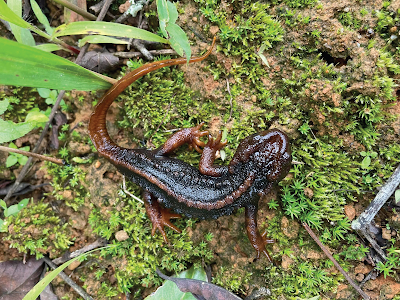
A specimen of Tylototriton umphangensis in the wild. Pomchote et al. (2021).

Like all Crocodile Newts, Tylototriton umphangensis has granular nodules on its dorsal surface, as we;; as bony ridges on its head and along its spine. It is a medium-sized member of the genus, with a length ranging from 65.6-75.3 mm excluding the tail (Newts can regrow their tails, so the length of a Newt's tail is not considered useful for assessing its size). They have short snouts, bulging quadrate regions, prominent head and spine ridges, and narrow tails. They are dark brown to blackish in colour, with the underside being lighter than the upper.

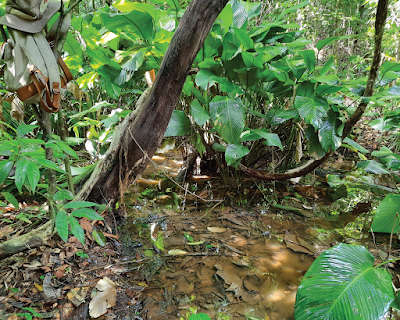
All four specimens were collected from under leaf litter and among the stems of Arrowroot Plants in a small ephemeral pond in an evergreen forest, during the local rainy season. The pond was 5.2 m long and 2.7 m wide, and 17 cm deep at its deepest. The area lies within the Dawna Mountain Range, which extends from eastern Myanmar into northwestern Thailand, and the species is thought likely to occur elsewhere within this range. 

 
Habitat at the type locality of Tylototriton umphangensis at Umphang Wildlife Sanctuary, Tak Province, western Thailand. Pomchote et al. (2021).

A second population of similar Newts has been reported from an artificial pond near the Mae Klong Khi Forest Ranger Station, but when Pomchote et al. visited this site on the evening of 18 June 2021, they found that Fish had been introduced to this pond, Cattle were roaming freely in the area, and construction work was ongoing, all of which would point to this site being lost to the Newts. Cattle and Human settlements are also encroaching on other natural environments in the area, including national parks, leading Pomchote et al. to conclude that Tylototriton umphangensis should be classified as Endangered under the terms of the International Union for the Conservation of Nature’s Red List of Threatened Species.

See also...


Follow Sciency Thoughts on Facebook.

Follow Sciency Thoughts on Twitter.