Showing posts with label Salamander. Show all posts

Saturday, 19 October 2024

Tylototriton soimalai: A new species of Crocodile Newt from Tak Province, northwestern Thailand.

Salamanders of the genus Tylototriton, known as Crocodile Newts for the scale-like knobbly protuberances on their skin, are found across the Himalayan Region, Southeast Asia, and South and Central China. There are currently 40 described species, most of which are highly endemic (have very limited distributions), with several known undescribed species in Southeast Asia. There are currently six described species from Thailand, Tylototriton verrucosus,   Tylototriton uyenoiTylototriton angulicepsTylototriton phukhaensisTylototriton umphangensis, and Tylototriton panhai, five of which have been described since 2013. 

In a paper published in the journal ZooKeys on 15 October 2024, Porrawee Pomchote of the Department of Biology at Chulalongkorn UniversityParada Peerachidacho of the Research Institute for Languages and Cultures of Asia at Mahidol UniversityWichase Khonsue also of the Department of Biology at Chulalongkorn University, Pitak Sapewisut of the Department of Biology at Chiang Mai UniversityAxel Hernandez of the College of Biology & the Environment at Nanjing Forestry University and the Department of Environmental Sciences at the University Pasquale Paoli of CorsicaChitchol Phalaraksh, also of the Department of Biology at Chiang Mai University, Parunchai Siriput of the Department of National Parks, Wildlife and Plant Conservation, and Kanto Nishikawa of the Graduate School of Global Environmental Studies and Graduate School of Human and Environmental Studies at Kyoto University, describe a new species of Crocodile Newt from Mae Tuen Wildlife Sanctuary in Tak Province, northwestern Thailand.

In July 2014, Axel Hernandez discovered a male Crocodile Newt in a muddy pond in the middle of a Dipterocarp and mixed deciduous forest close to the top of Doi Soi Malai (Mount Soi Malai), about 1500 m above sealevel. He initially assigned this to Tylototriton uyenoi, a species which had been described the previous year from the same area. However, subsequent examination of the specimen showed that it differed from Tylototriton uyenoi in a number of ways. In 2015 the Tourism Authority of Thailand published a video clip on the MGR Online platform showing Crocodile Newts at the same location. This led to a field study of the area in August 2022, during which three adult male Crocodile Newts and two tadpoles were discovered in a muddy puddle in a road on Doi Soi Malai, again at about 1500 m above sealevel.

Pomchote et al. carried out both genetic and morphological analysis of the Doi Soi Malai specimens, both of which led them to conclude that they were representatives of a new species. This is named Tylototriton soimalai, in reference to the location where it was discovered, Doi Soi Malai.

The male holotype of Tylototriton soimalai (CUMZ-A-8253) observed at the type locality. Pomchote et al. (2024).

The known specimens of Tylototriton soimalai are medium-sized Crocodile Newts, ranging from 90.7 mm to 109.3 mm in length, with and are black in colour (dark grey on the underside), with two orange ridges on either side of the dorsal surface of the skull, behind which are two rows of orange nodules which follow the length of the body, but not the tail, while a third, solid orange ridge follows the length of the spine, including the tail.

The two tadpoles vary in size, with one roughly double the size of the other, despite being found at the same time. In both, the head is large with visible eyes, and three pairs of reddish-brown external gills.  The tadpoles are pale brown in colour with scattered black markings, and purple-silver markings around the eyes and fin, and on the flanks.

The two larvae of Tylototriton soimalai in life. Pomchote et al. (2024).

All of the specimens were found in a muddy puddle roughly 10 m long and 5 m wide, with a maximum depth of about 35 cm. They were found at about midday on 31 August 2022, which is in the rainy season; this is presumed to be the breeding season of the Newts. The puddle is located on a road running over Doi Soi Malai, with the exact location not given to protect the species from illegal collection.

Pomchote et al. note that the road is extensively used by mountain bike and four-wheel-drive enthusiasts, particularly during the monsoon season, despite these activities being banned in national parks and wildlife sanctuaries in Thailand by the Department of National Parks, Wildlife and Plant Conservation. For this reason, Pomchote et al. recommend that the road should be closed off completely during the monsoon season, remaining open to hikers during the dry and winter seasons. They also note that the environment both within and around the Mae Tuen Wildlife Sanctuary has been degraded by deforestation and fragmentation for agricultural use, primarily cabbage farming. They therefore recommend that Tylototriton soimalai be listed as Endangered under the terms of the International Union for the Conservation of Nature's Red List of Threatened Species

See also...

Saturday, 30 April 2022

Hynobius owariensis: A new species of Salamander from Japan.

The Yamato Salamander, Hynobius vandenburghi, was originally described from Yamato Province (modern Nara Prefecture) in 1923, and has a modern distribution across Osaka, Nara, Kyoto, Shiga, Mie, Gifu, and Aichi prefectures. Molecular data has suggested that this distribution consists of two monophyletic populations (i.e. each population can be traced back to a separate common ancestor, with little-or-no interbreeding since that time), one comprising the population on the Atsumi Peninsula (a 50 km outcrop of land in southern Aichi Prefecture, separating Mikawa Bay, to the north, from the Philippine Sea, to the south, with Ise Bay lying to its west) and the other all other living Yamato Salamanders. However, this understanding is currently based upon only a very small number of populations, so the true picture is likely to be more complicated, potentially with more distinct lineages within the whole.

In a paper published in the Bulletin of the Kanagawa Prefectural Museum on 29 March 2022, Hirotaka Sugawara of the Faculty of Science and Technology at Kochi University, Takeshi Fujitani of the Higashiyama Zoo & Botanical Gardens, Shota Seguchi and Takuo Sawahata of the Graduate School of Agriculture at Kinki University, and Masahiro Nagano of the Faculty of Science and Technology at Oita University, evaluate the distinctiveness of the two 'Yamato Salamander' groups using morphological, phylogenetic, and evolutionary species concepts, and formally describe the Atsumi Peninsula population as a separate species.

Sugawara et al. took tissue samples from live Salamander specimens collected on private property or in fields from February 2007 to April 2021, from which DNA was extracted, another 55 specimens were anesthetized and measured for morphometric analysis (a tool used by palaeontologists, archaeologists, anthropologists and forensic pathologists to analyse and compare specimens, which involves taking numerous measurements of an object such as a bone or shell, and comparing both these measurements and ratios between measurements to those obtained from other specimens in order to establish relationships between them), with the majority then released back into the wild; three specimens from Atsumi were retained, providing a holotype and two paratypes of the new species. Samples were taken from a total of seven populations.

Two phylogenetic analyses were performed, including the collected samples and including other Hynobius species, and Salamandrella keyserlingii as the outgroup. The analysis based upon posterior probability values supported the concept that all specimens currently assigned to Hynobius vandenburghi form a monophyletic group (i.e. they share a single common ancestor from which they are all descended, with no specimens not assigned to the species being descended from that ancestor), however, an analysis based upon bootstrap values did not support this conclusion. Both the posterior probability and bootstrap analyses supported the conclusion that the two populations were themselves monophyletic groups, exclusive of one-another.

The new species is named Hynobius owariensis, where 'owariensis' means 'from Owari' (an old name for Aichi Prefecture). In this species the males tend to have a mottled pattern on their throats (generally absent or indistinct in Hynobius vandenburghi), but seldom had distinct black dots on the dorsum, distinct white dots on the venter, or distinct white dots on the lateral side of the body (generally present in Hynobius vandenburghi). Nor did they have a distinct and bright yellow line on the dorsal and ventral sides of the tail, something typically seen in Hynobius vandenburghi

 
Holotype of Hynobius owariensis (TMNHAM-78, adult male, 58.2 mm SVL): (A) dorsal and (B) ventral views. Sugawara et al. (2022).

Sugawara et al.'s study only included specimens from Aichi, Nara and Osaka prefectures, despite Hynobius vandenburghi being much more widely distributed, due to the high level of protection given to the species by Japan's strict conservation laws. This raises the distinct possibility that other, undiscovered cryptic species are hidden within this range, raising further concerns for the future of these Salamanders. As it is, the population of Hynobius owariensis comprises a number of isolated populations, each too small to be realistically viable. Attempts to address this have included at least one case of specimens of Hynobius vandenburghi being introduced to a park in the city of Nagoya-shi. Sugawara et al. therefore recommend that a conservation plan specific to the needs of this species by drawn up as a matter of urgency.

 
(A) Live holotype of Hynobius owariensis (TMNH-AM-78), and the (B) larva, (C) banana-shaped egg sacs, and (D) type locality of the new species. Sugawara et al. (2022).

See also...

See also...


Follow Sciency Thoughts on Facebook.

Follow Sciency Thoughts on Twitter.


Tuesday, 3 July 2018

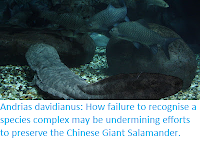
Andrias davidianus: How failure to recognise a species complex may be undermining efforts to preserve the Chinese Giant Salamander.

The Chinese Giant Salamander, Andrias davidianus, is the largest extant species of Amphibian, reaching about 1.8 m in length. It is one of only three species of Giant Salamander, Cryptobranchidae, along with the Japanese Giant Salamander, Andrias japonicus, and the Hellbender, Cryptobranchus alleganiensis, which is found in the eastern United States, which are thought to have diverged from their closest relatives during the Middle Jurassic, around 170 million years ago. The species was once widespread across China, but it's wild population is thought to have declined by about 80% since the 1950s, due to a combination of habitat loss, disease, and consumption by Humans. For this reason the species is considered to be Critically Endangered under the terms of the International Union for the Conservation of Nature’s Red List of Threatened Species. As such the species has become a focus for conservation efforts in China, which have focused on the release of large numbers of farmed Giant Salamanders back into the wild, with over 78 000 farmed Salamanders released into the wild since 2008.

In a paper published in the journal Current Biology on 21 May 2018, a group of scientists led by Fang Yan of the State Key Laboratory of Genetic Resources and Evolution at the Kunming Institute of Zoology of the Chinese Academy of Sciences present evidence that the Chinese Giant Salamander should in fact be considered to be a species cluster (group of morphologically identical but genetically distinct species, known as 'cryptic species') rather than a distinct species, and discuss the implication of this for conservation efforts.

A Chinese Giant Salamander, Andrias davidianus, in the Shanghai Aquarium. Patrick Fischer/Wikimedia Commons.

Yan et al. collected genetic samples from 70 wild caught and 1034 farmed Salamanders from across the species' range. They found that the wild Salamanders could be grouped into five distinct genetic populations, which appear to have diverged from one-another between 4.71 and 10.25 million years ago, sufficient to be considered to be separate species under most classification systems (Humans and Chimpanzees are thought to have diverged between 4 and 13 million years ago). This is not greatly surprising, as the Salamander favour upland environments, and therefore have a scattered distribution, with wide areas in between that the Salamanders cannot easily cross. 

The farmed Salamanders, in contrast, appeared to be largely hybrids, with the majority of their DNA derived from a population in the Yellow River in Shaanxi Province, the area where they were first farmed. The ability of the separate species to hybridise is not considered surprising, as the Chinese Giant Salamander is known to be able to hybridise with the (more distantly related) Japanese Giant Salamander. However the resultant hybrid Salamanders show much lower genetic diversity than wild Salamanders, and may be less well adapted to surviving in the wild. 

mtDNA haplotype clades and genetic structure of wild-caught and farm-bred Chinese Giant Salamanders. (A) A simplified Bayesian inference tree based on concatenated mtDNA haplotypes. Numbers near branches are posterior probabilities (BPP ≥ 0.90). A–E are wild caught populations and U1 and U2 are known from farms only.  (B) Sampling sites for wild-caught individuals. Lower-right insert shows the best genetic clustering (K = 5) based on genomic SNPs from localities circled in dashed line. (C) Sampling sites for farm-bred individuals where pie charts show the proportions of mitochondrial haplotypes as grouped in (A). Lower-right insert shows the second-best cluster (K = 3; optimal K = 1) based on microsatellite data for farm-bred individuals from Guizhou (farms circled in dashed line). Colours denote cryptic species lineages. Yan et al. (2018).

Yan et al. express concern that the practise of releasing farmed Salamanders (from populations originally intended form commercial exploitation as a food animal) into the wild may have a strongly adverse effect on the wild populations, potentially leading to some species becoming extinct; indeed they could find no pure indigenous Salamanders in some tributaries of the Pearl and Yangtze rivers, where all captured individuals had mtDNA (mitochondrial DNA, which is passed on only through the female line) from Yellow River Salamanders. They recommend that in future conservationists should avoid the release of captive-raised animals until a full study of the genetic structure of the subject population is carried out.

See also...

https://sciencythoughts.blogspot.com/2018/01/phosphotriton-sigei-mummified.htmlhttp://sciencythoughts.blogspot.co.uk/2014/12/a-new-species-of-salamander-from-early.html
http://sciencythoughts.blogspot.co.uk/2014/04/a-paedomorphic-salamader-from-ouachita.htmlhttp://sciencythoughts.blogspot.co.uk/2013/08/a-new-species-of-crested-newt-from.html
http://sciencythoughts.blogspot.co.uk/2013/06/stomach-contents-in-jurassic-salamanders.htmlhttp://sciencythoughts.blogspot.co.uk/2012/10/a-new-species-of-asian-warty-newt-from.html
Follow Sciency Thoughts on Facebook.

Monday, 29 January 2018

Phosphotriton sigei: A 'mummified' Salamander from the Eocene of southern France.

In 1873-7 the French naturalist Henri Filhol published a series of descriptions of 'mummified' animals from the Quercy region of southwest France, which were actually external moulds of the animals preserved in phosphatic clays within fissures on a limestone plateau. Unfortunately Filhol did not accurately record the locations from which these fossils originated, preventing accurate dating of individual specimens, though the collection as a whole are thought to range from Early Eocene to Early Miocene in age. In 2013 a a team of scientists led by Fabien Laloy of the Centre national de la recherche scientifique, the Muséum national d’histoire naturelle and the Université Pierre et Marie Curie published a paper  in the journal PLoS One, in which a Frog from the Phosphorites du Quercy was shown to have preservation of not just its external morphology, but also of some internal structures, principally the skeleton, which were revealed by computerised tomography, which enabled the formation of a three dimensional computer model of the specimen, showing its internal structure.

In a paper published in the journal PeerJ on 3 October 2017, Jérémy Tissier of the Cenozoic Research Group at the JURASSICA Museum, and the Department of Geosciences at the University of Fribourg, and Jean-Claude Rage and Michel Laurin of the Département Histoire de la Terre at the Museum national d'Histoire naturelle, describe the results of a similar study of a large Salamander from the Quercy deposits, Phosphotriton sigei.

The specimen was shown to preserve part of the skeleton, particularly the spine, plus some muscle structure, some of the nervous system, including the spinal column and lumbosacral plexus, part of the digestive tract and the urogental organ.

Exceptional preservation of nerves, digestive tract and stomachal content. (A) and (B) 3D reconstructions of the pelvic section of Phosphotriton sigei, in laterodorsal (A) and ventral (B) views. The lumbosacral plexus (in blue) is partly preserved. Nerves exit the last trunk, the sacral and the first caudosacral vertebrae through the spinal nerve foramina. (C) Preserved bones of an Anuran Frog (Ranoid?), in green, inside the digestive tract. (D) Anuran humerus found inside digestive tract of Phosphotriton sigei, in lateral and ventral views. (E) Anuran vertebrae found inside digestive tract of Phosphotriton sigei. The centrum is very thin; the holes may represent segmentation artifacts. (F) 3D reconstruction of Phosphotriton sigei in ventral view, showing the nearly complete digestive tract. The caudal end is very close to the cloaca, and is bordered near the pelvic girdle by presumed dorsal cloacal glands (see Fig. 4A). (G) Virtual section of the trunk, showing the digestive tract (in yellow) and its content (frog bones).

The digestive tract contains a bone, interpreted as the humerus of a Frog, implying that the living Phosphotriton sigei, was a carnivore capable of tackling comparatively large prey. This is unusual in Salamanders which are predominantly insectivores today.

See also...

http://sciencythoughts.blogspot.co.uk/2014/12/a-new-species-of-salamander-from-early.htmlhttp://sciencythoughts.blogspot.co.uk/2014/04/a-paedomorphic-salamader-from-ouachita.html
http://sciencythoughts.blogspot.co.uk/2013/10/the-re-examination-of-mummified-eocene.htmlhttp://sciencythoughts.blogspot.co.uk/2013/08/a-new-species-of-crested-newt-from.html
http://sciencythoughts.blogspot.co.uk/2013/06/stomach-contents-in-jurassic-salamanders.htmlhttp://sciencythoughts.blogspot.co.uk/2012/10/a-new-species-of-asian-warty-newt-from.html
Follow Sciency Thoughts on Facebook.

Tuesday, 9 December 2014

A new species of Salamander from the Early Cretaceous of Western Siberia.


Salamanders, Caudata, are one of the three extant groups of Lisamphibians, along with Frogs, Anura, and Caecilians, Gymnophiona. The earliest fossil Salamanders known date from the Middle Jurassic, and include both crown group Salamanders (all living Salamanders, their most recent common ancestor, and everything descended from that ancestor) and stem group Salamanders (Salamanders which lived before the most recent common ancestor of all living Salamanders, or which are descended from such Salamanders but not the most recent common ancestor), suggesting that more-or-less modern forms appeared very early in the history of the group. The crown group Salamanders quickly become dominant in the fossil record, with only one report of Cretaceous stem group Salamanders, based upon isolated vertebrae from the Cloverly Formation of Wyoming.

In a forthcoming paper in the journal Acta Palaeontologica Polonica available online from 28 November 2014, Pavel Skutschas of the Vertebrate Zoology Department at Saint Petersburg State University and the Laboratory of Mesozoic and Cenozoic Continental Ecosystems at Tomsk State University describes a possible stem group Salamander from the Ilek Formation of Western Siberia.

The specimen comprises a single fragmentary trunk vertebra, which Skutschas does not name, but which he feels is likely to represent a stem group Salamander as it has a notochordal centrum  (a common feature to all Lisamphibians), is longer than it is wide (seen in all Salamanders and no Frogs), lacks the extra muscle attachments seen in Caecilians, is far larger than any known Mesozoic crown group Salamander (all of which were quite small, the modern Giant Salamanders having appeared later) is heavily ossified (again not seen in Mesozoic crown group Salamanders) and has scattered pits on its ventral and lateral surfaces (a feature seen in some other stem group Salamanders but not in any known crown group Salamander).

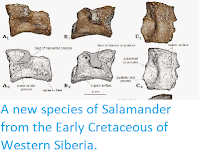
Fragmentary trunk vertebral centrum of stem salamander Caudata, from the Shestakovo locality, Lower Cretaceous (Aptian–Albian) Ilek Formation, Western Siberia, Russia; in right lateral (A), left lateral (B), ventral (C, anterior towards top), posterior (D), anterior (E), and dorsal (F, anterior towards top) views. Photographs (A1–C1, D–F) and interpretive drawings (A2–C2). All images at same scale. Skutschas (2014).

The Ilek Formation of Western Siberia has yielded a variety of other relict vertebrates with Jurassic affinities, including Choristoderes, Paramacellodid Lizards, Tritylodonts, Docodont Cynodonts and Protosuchian and Shartegosuchid Crocodyliforms. Skutschas suggests that environmental conditions in Western Siberia remained constant and stable across the Jurassic-Cretaceous boundary, and that the area therefore provided a refugia for vertebrate groups that went extinct elsewhere.

See also…

Paedomorphisis is a pattern of developmental change in which an organism evolves to retain juvenile traits into its adult, sexually mature stage. This is a recurring evolutionary pattern in some groups of animals, with different but related lineages often separately developing the same traits in this way. One such group is the Lungless Salamanders (Plethodontidae), a group...

Newts, Pleurodelinae, are small members of the...

The Daohugou Beds are a fossil Lagarstätte from Ningcheng County in Inner Mongolia, which have produced a large number of well preserved Middle Jurassic Vertebrates, Insects, Plants and other fossils...


Follow Sciency Thoughts on Facebook.

Monday, 14 April 2014

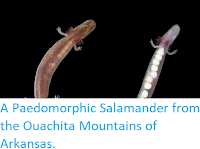
A Paedomorphic Salamander from the Ouachita Mountains of Arkansas.

Paedomorphisis is a pattern of developmental change in which an organism evolves to retain juvenile traits into its adult, sexually mature stage. This is a recurring evolutionary pattern in some groups of animals, with different but related lineages often separately developing the same traits in this way. One such group is the Lungless Salamanders (Plethodontidae), a group which has repeatedly produced species that are capable of breeding while retaining juvenile traits (such as tailfins and external gills) into adult life, some species (such as the Mexican Axolotl) having lost the adult stage altogether.

In a paper published in the journal Zootaxa on 11 April 2014, Michael Steffen of the Department of Biological Science at the University of Tulsa, Kelly Irwin of the Arkansas Game and Fish Commission and Andrea Blair and Ronald Bonett, also of the  Department of Biological Science at the University of Tulsa describe a new species of Paedomorphic Salamader from the Ouachita Mountains of Arkansas.

The new species is placed in the genus Eurycea, and given the specific name subfluvicola, meaning 'dwelling bellow a stream', a reference to the habitat where the Salamander was encountered. The species was first discovered during a study of the related Eurycea multiplicata, when an apparently juvenile female was captured, with eggs developing internally. Since Eurycea multiplicata has never been recorded to breed prior to reaching full sexual maturity, this specimen was retained, and subjected to a DNA analysis, which revealed it to be a quite separate species. 

Eurycea subfluvicola, female specimen in dorsal and ventral views. Note the developing eggs visible through the skin, particularly on the ventral surface, and retained external gills. Steffen et al. (2014).

After the first specimen was discovered, a further eight members of the species were located, all in an unnamed tributary of Slugger Creek in Lake Catherine State Park in Hot Spring County, Arkansas. Eurycea subfluvicola has a flatter profile than Eurycea multiplicata, but this could easily be missed if the existence of the species was not known, making Eurycea subfluvicola effectively a cryptic species, hidden within the juvenile population of Eurycea multiplicata.

See also...


Follow Sciency Thoughts on Facebook.

Wednesday, 14 August 2013

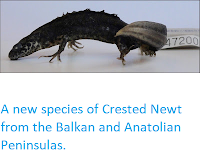
A new species of Crested Newt from the Balkan and Anatolian Peninsulas.

Newts, Pleurodelinae, are small members of the Salamander Family Salamandridae, found across Eurasia and North America. They undergo full metamorphoses, with a limbless tadpole and four-limber adults, which mat be terrestrial or aquatic in habits, though like all amphibians they cannot tolerate completely dry environments due to their semi-permeable skins. Crested Newts (Triturus) are found across much of Europe and western Asia. They are terrestrial newts, only visiting water to breed, when the males develop large crests that run the lengths of their bodies.

In a paper published in the journal Zootaxa on 28 June 2013, a team of scientists led by Ben Wielstra of the Naturalis Biodiversity Center in Leiden discuss the discovery of a new species of Crested Newt from the western Black Sea region.

The new species is named Triturus ivanbureschi, in honour of the late Ivan Buresch of the Institute of Zoology in Sofia, who was an expert on the Amphibians and Reptiles of the Balkan Peninsula. The species is described from populations already known, but formerly ascribed to the species Triturus karelinii, a name that is now restricted to those populations to the north and east of the Black Sea.

Triturus ivanbureschi is a cryptic species, distinguished from Triturus karelinii on the basis of DNA evidence, though it does have an extra pair of ribs (14 rather than 13), something that is only distinguishable if the Newts are dissected or x-rayed. Wielstra et al. suggest it is likely that Triturus ivanbureschi will be further subdivided with follow up genetic studies of populations. The systematics of Crested Newts have long been problematic, with different species often recognized in different nations, and genetic studies have the potential to resolve many of these problems.

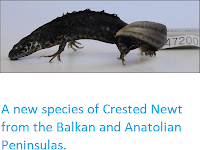
Triturus ivanbureschi, in lateral view. Adult male from Ostar Kamak, Bulgaria. Wielstra et al. (2013).

Tuesday, 11 June 2013

Stomach contents in Jurassic Salamanders.

The Daohugou Beds are a fossil Lagarstätte from Ningcheng County in Inner Mongolia, which have produced a large number of well preserved Middle Jurassic Vertebrates, Insects, Plants and other fossils. The fauna has been considered to be part of the Jehol Biota, but is now generally considered to be slightly earlier. The deposits formed in lake surrounded by a moist, warm-temperate forest, dominated by Conifers, Ginkos and Cycads.

In a paper published in the Chinese Science Bulletin in January 2012, Dong LiPing Key Laboratory of Evolutionary Systematics of Vertebrates at the Institute of Vertebrate Paleontology and Paleoanthropology and the Graduate University of Chinese Academy of Sciences, Huang DiYing of the State Key Laboratory of Palaeobiology and Stratigraphy at the Nanjing Institute of Geology and Palaeontology and Wang Yuan of the Key Laboratory of Evolutionary Systematics of Vertebrates, describe the discovery of a number of Salamanders with preserved stomach contents from the Daohugo Beds.

Two species of Salamander are very abundant in the Daohugou Beds, with over 600 individual animals having been recovered from the deposits, and specimens of both have been found with intact stomach contents. 

Jeholotriton paradoxus is a Newt-sized Salamander considered to have undergone only partial metamorphosis; the adults retained external gills as in the modern Axolotl and Tiger Salamanders. Two specimens of Jeholotriton paradoxus have been found with intact stomach contents. Both contain numerous Conchostracans (Clam Shrimps); which are an important part of the diet of many small modern Salamanders.

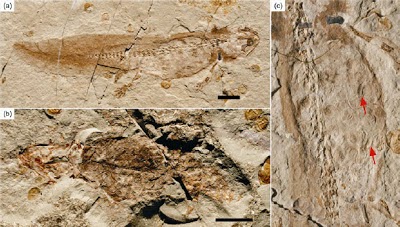
Jeholotriton paradoxus with conchostracans preserved as stomach contents. (a) First specime; (b) second specimen; (c) enlargement of conchostracans in the abdomen of first specimen. Red arrows indicate those dorsally preserved with two valves open. Scale bars: 10 mm. Dong et al. (2012).


Chunerpeton tianyiensis is a slightly larger animal, typically reaching around 180 mm in length; it is thought to be related to the modern Hellbender and Giant Salamanders, though it does not reach the large size of these modern species. Like Jeholotriton paradoxus (to which it is not thought to be closely related) Chunerpeton tianyiensis appears to have retained external gills into adult life. Nine specimens of Chunerpeton tianyiensis are preserved with intact stomach contents, though none of these are mature individuals, ranging from 30 to 62 mm in length. All of these contain the insect Yanliaocorixa chinensis, a form of Corixid (Water Boatman) which is an abundant member of the Dauhugou Biota. It is common for modern Amphibians to switch prey animals as they mature, feeding on larger animals as they grow. The presence of Yanliaocorixa chinensis in individuals of a limited size range suggests that this was the case in Chunerpeton tianyiensis. Water Boatmen have tough, waxy integuments, which may have helped their preservation in the stomachs of deceased Salamanders, which larger individuals probably fed on small vertebrates which had lower preservational potential as stomach contents.

Chunerpeton tianyiensis with corixids preserved as stomach contents. (a) Specimen with one corixid in its belly; (b) Specimen with two corixids shown by arrows; the yellow arrow indicates a corixid with a disarticulated wing on its right side; (c) enlarged view of the corixid in the belly of specimen shown in (a); the yellow arrow indicates the disarticulated head, and its original position is indicated by the white arrow; (d) specimen preserved laterally with one corixid in its belly showing its hind leg. Scale bars: 10 mm. Dong et al. (2012).


Follow Sciency Thoughts on Facebook.

Monday, 22 October 2012

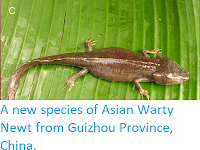
A new species of Asian Warty Newt from Guizhou Province, China.

Asian Warty Newts of the genus Paramesotriton are small Salamanders (Urodels) known from China and Southeast Asia. They tend to be dull in colour compared to other Salamanders, typically a uniform grey of brown.

In a paper published in the journal Zootaxa on 9 October 2012, a team of scientists led by Xiaoming Gu of the School of Life Sciences at Guizhou Normal University, describe a new species of Asian Warty Newt found in the Maolan National Nature Reserve in Libo County in Guizhou Province, China.

The new species is named Paramesotriton maolanensis, in reference to the reserve where it was found. It is bigger than any previously known member of the genus, with adults ranging from 177 to 208 mm in length, compared to 160 to 200 mm for the next largest species, Paramesotriton deloustali, and 94 to 186 mm for other members of the genus. The species was also found to differ in the structure of its skull and hyloid bone (in the neck), and was genetically distinct from other members of the genus. Paramesotriton maolanensis was also found to have very poorly developed eyes, apparently being at least partially blind; whereas other members of the genus have well developed eyes and good vision.

Paramesotriton maolanensis is brown in colour, with an orange stripe along its back, and mottled red markings on its belly. It has horny protuberances on the back of its skull (a feature seen in some, but not all, other members of the genus), and lacks conspicuous warts. 

Paramesotriton maolanensis, whole body. Gu et al. (2012).

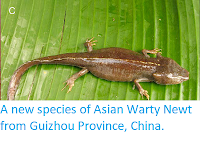
Detail of the heads of Paramesotriton maolanensis (top), Paramesotriton zhijinensis (middle) and Paramesotriton longliensis (bottom). Note the variation in eye-development and wartyness. Gu et al. (2012).

The pool where Paramesotriton maolanensis was found living. Gu et al. (2012).


Follow Sciency Thoughts on Facebook.