In the late 1960s and early 1970s a series of anthropological
excavations were carried out at Minatogawa Fissure on southern Okinawa Island,
producing a number of Late Pleistocene Human bones, as well as associated bones
of other terrestrial vertebrates. Whilst most of the bones were from animals
still found on Okinawa, or neighbouring members of the central Ryukyu Islands,
or at least extinct animals thought to have been endemic (native) to the
islands, a number of Frog species were reported which are today absent from the
Ryukyus, but found in other parts of Japan. This is puzzling, as the Ryukyu
Islands are generally thought to be biogeographically distinct from the rest of
Japan; eleven out of fourteen Amphibian species found in the Central Ryukyus
today are found nowhere else, two species are also found in southern China,
with only a single species, the wide ranging Marsh Frog, Fejervarya kawamurai, is shared with the rest of Japan, and this
species is also found in southern China and is thought likely to have reached
the Central Ryukus in a separate dispersal event from the mainland. A specimen
of Polypedates leucomystax, a
Southeast Asian Frog otherwise thought to have been introduced to the islands
in the mid twentieth century was also reported.
In addition these excavations yielded a number of Frog species still
found in the on the island, but restricted to the moister, more forested
northern part of the island. This is problematic, as the Pleistocene climate of
Okinawa is interpreted to have been cooler and drier, which would cause such
frogs to have had a more limited range, rather than an expanded one, and also because
pollen associated with the tree species now found in the woodland on the north
of the island has not been found here, implying that the south of the island
was as lacking in woodland in the Pleistocene as it is today. Furthermore, the
fissure is in an area of limestone karst (soft, absorbent and highly porous
limestone), which would make it hard for bodies of standing water to form here
under any circumstances.
Maps of the Ryukyu Archipelago (1, 2) and Okinawajima
Island (3). The map of Okinawajima shows topography, distribution of the Pleistocene
limestone, and study sites.Nakamura & Ota (2015).
The sediments in the Minatogawa Fissure have been dated to about 15
670 years ago, towards the end of the Last Glacial Maximum. It is located in
the Minatogawa Formation above the Yuhi River on the southeastern part of the
island. Nakamura and Ota were unable to access the material from the original
1960s and 1970s excavations, nor any details of how the material was analysed
(the previous publications covering the material simply listed the species).
They were, however, able to access a series of Amphibian bones obtained by
water-screening sediments from the site during a more recent excavation at the
fissure in 1998-2001. These were compared to specimens of Amphibians from the
Ryukus, other areas of Japan, and adjacent areas such as the Korean Peninsula.
The 1998-2001 Minatogawa Fissure material yielded a single humerus
assigned to a female Namiye’s Frog, Limnonectesnamiyei,
a species today found on northern, but not southern Okinawa and two humeri and
two ilia attributed to female Holst’s Frogs, Babinaholsti, another species found today on the northern part of
the island (leg bones are the most robust in Frogs, and therefore the most
commonly preserved; it is usually possible to tell the sex of a From from its
humeri).
Left female humerusfrom Minatogawa Fissure, referred to
Limnonectes namiyei, lacking the
proximal and distal parts and the crista ventralis in ventral (1), medial (2)
and dorsal (3) views. Abbreviations: cr.par, crista paraventralis; fo.div, fossula dividens; ol.sc,
olecranon scar; stm, spina tuberculi medialis. Scale bar is 5 mm. Nakamura &
Ota (2015).
Much more abundant were bones of the Okinawa Tip-nosed Frog, Odorrana narina, with 21 right and 24
left female humeri, 16 right and 16 left male humeri and 22 right and 31 left
ilia found in the material. This species is also found on the northern part of
Okinawa today.Another abundant species was the Ryukyu Brown Frog, Rana ulma, with 41 right and 48
left female humeri, one left male humerus and eight right and nine left ilia
found in the sample. This species is also found on northern Okinawa today.
Also present was a right humerus attributed to a female Ryukyu
Kajika Frog, Buergeria japonica, a
species still found on the southern part of Okinawa, and a pair of humeri of
undetermined sex assigned to the Okinawa Green Tree Frog, Rhacophorus viridis viridis, also found on the southern part of
Okinawa today.
Right femalehumerus from Minatogawa Fissure, referred
to Buergeria japonica, lacking the
proximal part in ventral (1), medial (2), and dorsal (3) views. Abbreviations: cr.lat,
crista lateralis; cr.med, crista medialis; e.cap, eminentia capitata; ep.ul,
epicondylus ulnaris; ol.sc, olecranon scar. Scale bar is 1 mm. Nakamura & Ota
(2015).
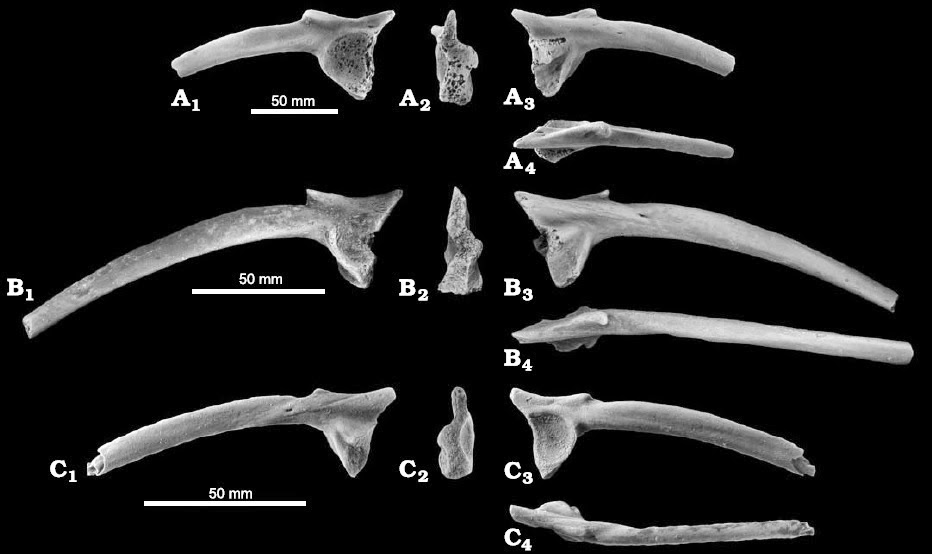
Two species of Newt were also recovered from the material. Eight
atlantes (the first vertebra after the skull), at least postatlantal precaudal
vertebrae, 20 right and 15 left humeri and 11 right and 12 left femora were
assigned to the Sword-tailed Newt, and three postatlantal precaudal vertebrae
and one right femur were attributed to Anderson’s Crocodile Newt, Echinotriton andersoni, both of with are
still present on southern Okinawa.
The Sashiki Fissure lies 6 km to the northeast of the Minatogowa Fissure
in an uplifted terrace of the Naha Formation on the Chinen Peninsula. The
fissure is a sinkhole that was exposed by limestone miners, then excavated by
archaeologists from 2004 till 2008. The fissure yielded two separate deposits,
a lower bed dated to between 28 729 and 31 745 years ago, around the beginning
of the last glacial maximum, and an upper bed dated to between 3904 and 5558
years ago, during the Middle Holocene; these beds resting in separate
depressions and not overlying one-another, though there is a thin layer at the
top of the older deposits dated to about 7445 years ago (which did not yield
any vertebrate fossils).

Photograph of the Sashiki Fissure (left) and schematic
figure showing the structure of the fissure (right). In the right figure, broken
lines represent the outline of the fissure behind rock, shaded areas represent
studied sediments, and open circles represent the locations of the dating
samples. Nakamura & Ota (2015).
The lower deposits at Sashiki yielded a single left ilium referred
to Namiye’s Frog, Limnonectes namiyei,
one right and five left female humeri, oneright and one left male humeri and
six right and three leftilia assigned to Holst’s Frog, Babina holsti, and five right and five left female humeri, two right
and one left male humeri and four right and one left ilia assigned to
Ishikawa’s Frog, Odorrana ishikawae,
all species found on the north of the island today.

Right female humerus in ventral (5), medial (6) and
dorsal (7) views; (8–10) right male humerus lacking the proximal part in ventral
(8), medial (9), and dorsal (10) views; and (11), right ilium lacking the
anterior part in lateral view. Abbreviations: acet, acetabulum; acet.m,
acetabular margin; cr.dors, crista dorsalis; cr.lat, crista lateralis; cr.med,
crista medialis; cr.par, crista paraventralis; cr.ven, crista ventralis; e.cap,
eminentia capitata; ep.rad, epicondylus radialis; ep.ul, epicondylus ulnaris;
fo.div, fossula dividens; il.sh,ilial shaft; p.asc, pars ascendens; stm, spina tuberculi medialis;
supr.fo, supracetabular fossa; tub.sup, tuber superior. Scale bars equal 5 mm.
Nakamura & Ota (2015).
The Okinawa Tip-nosed Frog, Odorrananarina,
which was one of the most abundant Frogs in the Minatogowa Fissure, but which
is only found on the north of the island today, is represented in the lower
Sashiki deposits by only four right and four left female humeri, oneright male
humerus, one pelvic girdle and one left ilium.
Pelvic girdle: fused right and left ilia (lacking
anterior parts) with the ischium and the pubis, in right lateral view. Abbreviations:
acet, acetabulum; acet.m, acetabular margin; cr.dors, crista
dorsalis; il.sh, ilial shaft; p.asc, pars ascendens; supr.fo, supracetabular
fossa; tub.sup, tuber superior. Scale bars equal 5 mm. Nakamura & Ota
(2015).
The other abundant Frog in the Minatogowa
Fissure, the Ryukyu Brown Frog, Rana ulma,
which is also absent from the south of the island today, is even more abundant
in the lower Sashiki deposits, with 108 right and 68 left female humeri, 44
right and 43 left male humeri and 46 right and 47 left ilia assigned to this
species.

Fossils referred to Rana ulma. (1–3), right female humerus in ventral (1) medial (2) and
dorsal (3) views; (4–6)right male humerus in ventral (4) medial (5) and dorsal
(6) views; (7) right iliumin lateral view. Abbreviations: acet,
acetabulum; acet.m, acetabular margin; cr.dors, crista dorsalis; cr.lat, crista lateralis;
cr.med, crista medialis; cr.par, crista paraventralis; cr.ven, cristaventralis;
e.cap, eminentia capitata; ep.ul, epicondylus ulnaris; fo.div, fossula dividens; il.sh, ilial shaft; ol.sc, olecranon
scar; p.asc, pars ascendens; stm, spina tuberculi medialis;
supr.fo, supracetabular fossa; tub.sup, tuber superior. Arrows indicate the
proximal ends of the crista paraventralis. Scale bars equal 1mm. Nakamura &
Ota (2015).
The Okinawa Green Tree Frog, Rhacophorus viridis viridis,
which was present in the Minatogowa Fissure and which is still found on south
Okinawa today, is represented in the lower Sashiki Fissure by two right and
five left female humeri, one left humeri of indeterminate sex, one right ilium
and one pelvic girdle.
Pelvic girdle of Rhacophorus viridis viridis
(fused right and left ilia lacking anterior parts withthe ischium) in left
lateral view. Abbreviations: acet, acetabulum; acet.m, acetabular margin; cr.dors,
crista dorsalis; il.sh, ilial shaft; p.asc, pars ascendens; pre.acet,
preace tabular zone; supr.fo, supracetabular fossa; tub.sup, tuber superior. Scale
bars equal 1mm. Nakamura & Ota (2015).
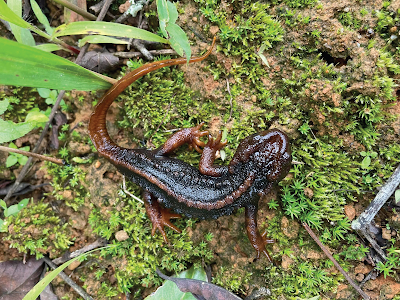
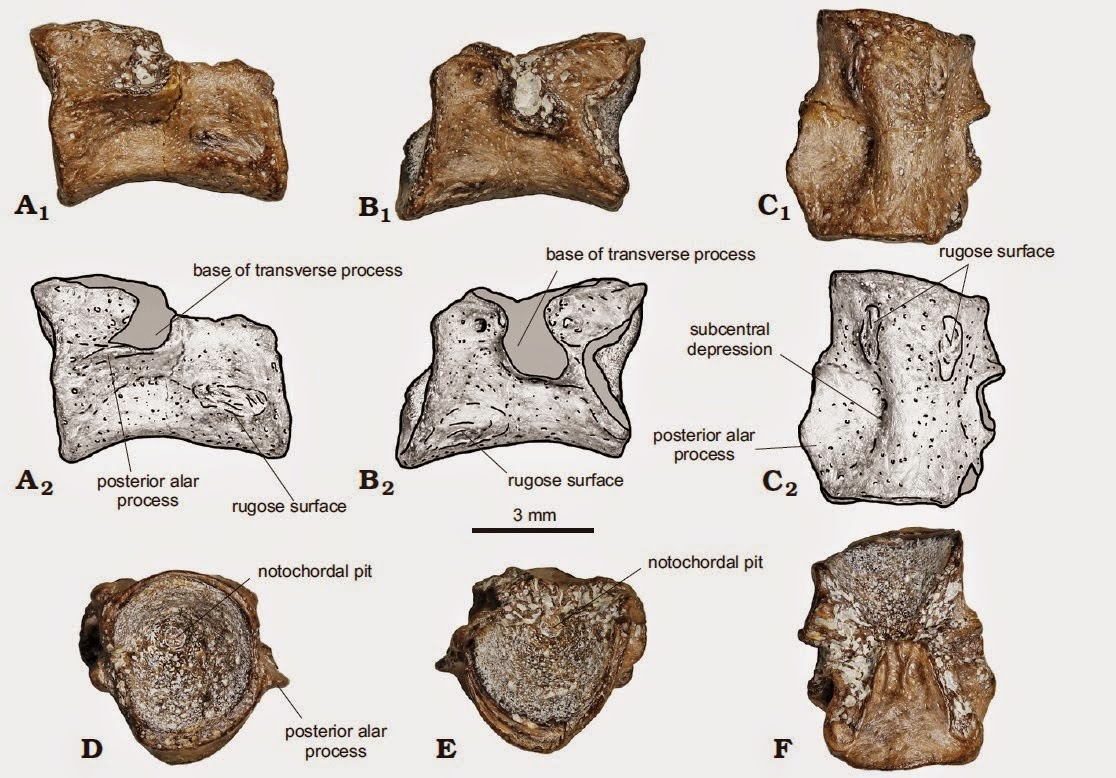
The Sword-tailed Newt, Cynops ensicauda,
is represented in the lower Sashiki Fissure by two right and one leftmaxillae,
one parietal-prootic-exoccipital, one left frontal, two right squamosals, six
right and three left dentaries, five atlantes, 108 postatlantal precaudal
vertebrae, 14 right and 11 left ribs, 41 right and 44 left humeri and 51 right
and 41 left femora.

Fossils referred to Cynops ensicauda. (1–4) Postatlantal precaudal vertebra in anterior
(1) left lateral (2) dorsal (3) and ventral (4) views; (5 and 6) atlas in
anterior (5) and left lateral (6) views; (7) parietal-prootic-exoccipital in
dorsal view; (8) right maxilla in lateral view; (9) right dentary in medial
view; (10) right rib in posterior view; (11) right humerus in lateral view; and
(12) right femur in posterior view. Abbreviations: con, condyle; diap,
diapophyses; epi.pr, epipleural processes; neu.sp, neural spine; n.prep, notch
for prearticular; parap, parapophyses; pos.pr, posterior process; subd.d,
subdental ditch; zygap, zygapophyses. The arrow in 12 indicates a concavity.
Scale bars equal 1 mm. Nakamura & Ota (2015).
Anderson’s Crocodile Newt, Echinotriton andersoni,
is represented in the lower Sashiki Fissure unit by 11 right and 19
leftmaxillae, seven right and six left frontals, one parietal-prootic-exoccipital,
nine right and nine left squamosals, three right and two left quadrates, 28 right
and 42 left dentaries, 11 atlantes, 290 postatlantal precaudal vertebrae, 89
right and 92 left ribs, 68 right and 76 left humeri and (71 right and 92 left
femora.
In the upper Sashiki Fissure unit, which is Middle Holocene in age,
none of the species currently confined to northern Okinawa is present.
One species found in southern Okinawa today, and absent from the
Pleistocene deposits is the Okinawa Narrow-mouthed Toad, Microhylao kinavensis, which is represented in the upper Sashiki
Fissure deposits by two right ilia.
Right ilium of Microhylao kinavensisin
lateral view, tub.sup, tuber superior. Scale bar equals 1mm. Nakamura & Ota
(2015).
Also present in the upper unit at the Sashiki Fissure are one left
ilium of the Ryukyu Kajika Frog, Buergeria
japonica, one male left humerus of the Okinawa Green Tree Frog, Rhacophorus viridis viridis, and one right
maxilla of the Sword-tailed Newt, Cynops ensicauda.
This study presents a very different view of the Pleistocene
Amphibian fauna of southern Okinawa, with no species not found on the island
today found in either the Late Pleistocene or Middle Holocene deposits, and the
introduced Polypedates leucomystax
absent from even the Holocene deposits. This leads Nakamura and Ota to conclude
that the previous identifications of a range of exotic Frogs in Late
Pleistocene deposits from the Minatogawa Fissure as erroneous.
The situation with Frogs found today on the north of the island is
more complex, with Nakamura and Ota able to confirm the presence and even
abundance of several north Okinawan species in Late Pleistocene deposits from
the south of the island. This is highly problematic, as all previous evidence
has suggested that the Late Pleistocene climate of the island was drier than
today, with the south of the island less able to support such moisture loving
species. Neither should pools of standing water, necessary for the survival of
many of these species, form on the karst terrain that produced the fossils in
anything short of a major flood event.
Maps showing current distributions (shaded areas) of
five forest Frogs (Limnonectes namiyeia,
Babina holstia, Odorrana ishikawaea, Odorrana narinaa,
and Rana ulmaa, and the Newt Echinotriton andersonia on Okinawajima
Island and adjacent islets. ‘?’ Denotes a population lacking a record or
observation in the past 30 years. Nakamura & Ota (2015).
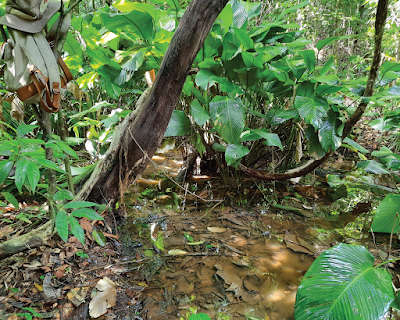
Nakamura and Ota observe that while the limestone areas of southern
Okinawa are more-or-less free from streams or bodies of standing water, due to
the drainage provided by the highly porous limestone, they are home to several
natural springs, fed by waters flowing along the top of the water impermeable Shimajiri
Group, which underlies the limestone units in places where these units are
relatively thin or the limestone becomes slightly more dense (where water
flowing through a rock body encounters a less porous area it must go somewhere,
and tends to rise to the surface). They therefore suggest that in the Late
Pleistocene the Minatogawa and Sashiki Fissures might have been home to such
springs, providing standing bodies of water, which could have supported the
moisture-loving Amphibians found preserved in the deposits there.
None of these species are present in the Middle Holocene deposits,
suggesting that any such springs did not last beyond the last Pleistocene
glaciation, and that the Amphibians of Okinawa Island had reached roughly their
modern distributions by this time.
See also…
The Cambay Shale formation from the Vastan Lignite Mine to the northeast
of Surat in Gujarat State, India, has produced a diverse and
significant Vertebrate...
The earliest known Frogs in the fossil record hail from the earliest
Triassic of Madagascar, though it is thought the group probably has its
origins deeper in the Permian. A number of Frogs have been described
from the Early Cretaceous Jehol Biota, a fossil Lagarstätte (rich fossil
deposit) from...
Follow Sciency Thoughts on Facebook.


%20(1)%20(1).png)