Showing posts with label Extreme Trans-Neptunian Objects. Show all posts

Monday, 26 May 2025

2017 OF201: A potential Dwaf Planet with an extremely wide orbit.

The majority of the known sub-planetary bodies of the Solar System are found within the Main Asteroid Belt, but the total mass of the bodies here is thought to add up to only about 0.04% of the mass of the Earth. The Kuiper Belt, located between 30 and 50 AU from the Sun (i.e. between 30 and 50 times as far from the Sun as the Earth) is thought to contain a total mass of about 2% that of the Earth, including large icy bodies such as the Dwarf Planet Pluto. Beyond this, at a distance of between about 2000 and 200 000 AU from the Sun, the Oort Cloud may contain several Earth masses of material, largely in the form of icy comets, but also including dwarf planets, and possibly unidentified planets.

Other than the Dwarf Planet Pluto, which was discovered in 1930, all of the 5000 plus known trans-Neptunian objects (Solar System bodies outside the orbit of the Planet Neptune) have been discovered in the past three decades. Most of these have been discovered by surveys concentrating on the elliptic plane of the Solar System, with higher latitudes very poorly mapped. The limitations of the instruments used also mean that few objects beyond 60 AU from the Sun have been discovered.

Cosmological surveys (i.e. surveys of the deeper cosmos, outside the Solar System) have also detected trans-Neptunian objects, most notably the Dark Energy Survey, which has already discovered about 800 such bodies.

In a paper published on the arXiv database at Cornell University on 22 May 2025, Sihao Cheng of the Institute for Advanced Study and the Perimeter Institute, and Jiaxuan Li and Eritas Yang of the Department of Astrophysical Sciences  at Princeton University, detail the discovery of  a large and exotic trans-Neptunian object from data collected by the Dark Energy Camera Legacy Survey.

Cheng et al. searched data collected by thee Dark Energy Camera Legacy Survy, which utilises the Dark Energy Camera on the 4-meter Blanco telescope at Cerro Tololoin Chile, discovering the same object had been detected at three wavelength bands on ten occasions between 2014 and 2018, and that it was possible to connect these sightings and calculate a tentative orbit for the object. This object, identified as 2017 OF201 (a name which implies it was the 5031st object discovered in the second half of July 2017) had an extremely wide and excentric orbit, was about 85 AU from the Sun was detected, and had an apparent magnitude of about 22.6, making it the second brightest object yet discovered with an orbital distance greater than 80 AU.

Armed with this data, Cheng et al. searched the data archives of the 3.6 m Canada-France-Hawaii Telescope, the Subaru Telescope, and Gemini-North Telescope, recovering images of 2017 OF201 at the predicted positions in  nine 3.6 m Canada-France-Hawaii Telescope images from 2011 and 2012, but not detecting it in data from the Subaru or Gemini-North telescopes.

Trajectory of 2017 OF201 on the sky from 2011 to 2018. Individual detections from 13 nights are shown on top of the predicted trajectory based on the best-fit orbit, which describes the detections very well with a scatter of 0.13 for the Dark Energy Camera (DECam) and 0.03 for the Canada-France-Hawaii Telescope (CFHT) arcsec in each component, consistent with the estimated astrometric error. The insets show example images from DECam (r-band on 2017-09-17) and CFHT (r-band on 2011-08-31). Cheng et al. (2025).

2017 OF201 is calculated to have an orbital period of 24 256 years, with a perihelion distance (closest approach to the Sun) of 44.9 AU, an aphelion distance (furthest distance from the Sun) of 1632 AU, and a semi-major axis (average distance from the Sun) of 838.3 AU. The last perihelion of 2017 OF201 was in 1930, the year in which Pluto was discovered, however, even at perihelion 2017 OF201 would have been about four orders of mangnitude fainter than Pluto (i.e. roughly a ten thousandth as bright), quite beyond detection by the telescopes of the day. The orbit of 2017 OF201 is tilted at 16.2° to the plane of the Solar System.

The orbits & current positions of Neptune, Pluto, and 2017 OF201. Jiaxuan Li & Sihao Cheng/Institute for Advanced Study.

2017 OF201 has a longitude of perihelion of 306° (i.e. it reaches perihelion at an angle of 306° relative to the First Point of Aries, taken as a celestial reference point). This is noteworthy, as many previously discovered trans-Neptunian objects have longitudes of perihelion clustered around 60°, something which has been postulated to imply the presence of a ninth planet (termed 'Planet X') in the Outer Solar System, the gravity of which is pushing the orbits of trans-Neptunian objects towards a similar trajectory. The orbit of 2017 OF201 not only shows no signs of such influence, it appears to be incompatible with such an object existing at all. This suggests that the similarity seen in the orbits of trans-Neptunian objects discovered to date is due to sampling bias - we have discovered more objects with longitudes of perihelion close to 60° because we have been looking at that part of the sky.

Plan view of the orbits of trens-Neptunian objects (TNOs) with extremely wide orbits, including our newly discovered 2017 OF201, which has a distinct orbit is an outlier to the apsidal clustering of the others. For reference, the most probable orbit of Planet X is shown in black. Cheng et al. (2025).

Analysis of light from 2017 OF201 suggests that it has a reddish hue, within the colour range of other trans-Neptunian objects, but possibly one of the redder objects. 2017 OF201 is calculated to be about 700 km in diameter, at which size it is presumed that it would be roughly spherical in shape. It is estimated to have a density of about 1.7 grams per cm squared, which would give it a total mass of about 300 000 000 000 000 megatons, or roughly one twenty thousandth the mass of the Earth.

2017 OF201 forms part of the Scattered Disk, an area between the Kuiper Belt considered to contain far less mass than either. However, if 2017 OF201, and other Scattered Disk objects, such as 90377 Sedna, represent an examples of a population of similar objects (which is a more likely explanation than all such objects currently being on the inner part of their orbits where we can detect them), then it is likely that the total mass contained in the Scattered Disk may be as high as 10% of that of the Earth, compared to 1-2% for the Kuiper Belt.

The orbits and positions of 2017 OF201 and 90377 Sedna. Wikimedia Commons.

2017 OF201 is unlikely to have formed on its current, highly eccentric, orbit. Rather, Cheng et al. estimate that it formed closer in to the Sun, on a more circular orbit, and has been moved onto its current orbit by encounters with other bodies. This orbit isnot consistent with the 'Planet X' hypothesis which has been used to explain the highly eccentric orbits of other trans-Neptunian objects.  Instead, Cheng et al. suggest that 2017 OF201 was initially knocked onto a less eccentric orbit by one or more encounters with the planet Neptune, and that that orbit has subsequently been further modified by the action of the Galactic Tides, and possibly close encounters with other steller systems.

See also...

Friday, 22 December 2023

Examining the possibility of undetected small terrestrial planets in the Outer Solar System.

Free floating planets (which is to say, planet-sized objects floating free in space, unbound to any star) were first observed more than two decades ago, and this population is now known to contain terrestrial mass objects as well as large Jupiter-type planets.

In a paper published in The Astrophysical Journal Letters on 18 December 2023, Amir Siraj of the Department of Astrophysical Sciences at Princeton University, discusses the possibility that one or more terrestrial sized planets might have been captured by the Sun's gravity early in the history of the Solar System, and be as yet undiscovered components of the Outer Solar System.

Siraj notes that this is a different topic to the search for Planet Nine, a hypothetical body with a mass six times that of Earth and a semi major axis (average distance from the Sun) of about 400 AU (i.e. 400 times as far from the Sun as the Earth), which has been proposed due to observed clustering extreme trans-Neptunian objects in the Outer Solar System.

Siraj instead debates the possibility of sub-Earth-mass planets in the Outer Solar System, motivated by the fact that such bodies have been observed free floating in space, and could potentially be captured by the Sun's gravity.

An artist's impression of a free floating planet. NASA/JPL/CalTech/Wikimedia Commons.

In theory, any stellar system is most likely to capture drifting planets when it is still very young, and within its birth cluster, that is to say a cluster of stars forming within a single molecular cloud, which acts as a stellar nursery. This is the stage at which young stellar systems are most likely to eject planets, and the time when they are close to the largest number of other systems, making it most likely that such planets will be captured.

Stellar nurseries are variable in nature, with planets more likely to be captured in clusters where the molecular cloud is expanding rapidly. To give a conservative estimate of the probability of planet-capture, Siraj assumed a gently collapsing cluster, which is thought to be the environment in which planetary capture is least likely.

Surprisingly, despite applying the most conservative conditions, Suraj's simulation predicts that there wit be approximately 1.2 captured planets with a mass at least equivalent to that of Mars in the Outer Solar System, and 2.4 planets with a mass equivalent to Mercury or larger. If less conservative assumptions are made, this increases to roughly 2.7 planets with a mass equal to that of Mars or larger, and about 5.2 Mercury sized or larger planets. The average distance from the Sun of these planets would be 1400 AU, with half of all such bodies orbiting at between 600 AU and 3500 AU.

Detecting such planets would be another problem, as they would be very faint objects, and we do not actually know where to look for them. The Legacy Survey of Space and Time project at the Vera C. Rubin Observatory is due to Survey the entire Southern Hemisphere sky every three nights in six optical bands ranging from 320 to 1050 nm for a ten year period. 

The largest high-performance optical lens ever fabricated (1.55 m feet in diameter) in a clean room at the SLAC National Accelerator Laboratory, where the lab assembles the 3,200-megapixel digital camera of the Legacy Survey of Space and Time instrument. Farrin Abbott/SLAC.

This survey should be capable of detecting such planets in the Outer Solar System, if they are present and visible from the Southern Hemisphere (bodies in the Outer Solar System will orbit extremely slowly, taking hundreds or even thousands of years to complete a single orbit of the Sun, and are also likely to have more eccentric orbits than the planets of the Inner Solar System, making it possible that bodies could spend an entire ten year period in the northern sky). Suraj estimates that this survey could detect between about 1.0 and 1.4 Mercury sized planets, and 0.7-0.9 Mars sized planets, although only planets in the innermost part of the Outer Solar System, between about 400 AU and about 700 AU from the Sun. 

See also...

Follow Sciency Thoughts on Facebook.

Follow Sciency Thoughts on Twitter


Monday, 18 April 2022

Dwarf Planet 136108 Haumea reaches oposition.

The Dwarf Planet 136108 Haumea will reach opposition (i.e. be directly opposite the Sun seen from Earth) on Tuesday 19 April 2022 at 8.18 pm GMT. This means that it will both be at its closest to the Earth this year, about 49.28 AU (19.28 times the average distance between the Earth and the Sun, or about 7 327 183 000 km), and completely illuminated by the Sun. While it is not visible to the naked eye observer, the planets have phases just like those of the Moon; being further from the Sun than the Earth, 136108 Haumea is 'full' when directly opposite the Sun. The Dwarf Planet will be in the constellation of Bootes and at its highest point in the sky at about 1.40 am local time from anywhere on Earth (this is because the rising and setting of objects in the sky is caused by the Earth's rotation, not the movement of the object). (Even at it's very brightest 136108 Haumea will only have a Magnitude of 17.3, making it almost impossible to see with any but the largest of Earth-based telescopes, and where resolvable it will only be possible to see it as a point of light indistinguishable from a faint star.

 
The orbit and position of 136108 Haumea (2003 EL61) at 8.00 pm on Tuesday 19 April 2022. JPL Small Body Database Browser.

136108 Haumea orbits the Sun on an eccentric orbit tilted at an angle of 28.2° to the plane of the Solar System, which takes it from 34.4 AU from the Sun (34.4 times the average distance at which the Earth orbits the Sun) to 51.5 AU from the Sun (51.5 times the average distance at which the Earth orbits the Sun). With an average distance of 43.0 AU, 136108 Haumea completes one orbit around the Sun every 282 years. This means that the planet is almost stationary compared to the faster moving Earth, so that it reaches Opposition only one day later each year than the year before, and reaches Solar Conjunction (when it is directly on the opposite side of the Sun to the Earth), roughly six months later.

 
The Dwarf Planet Haumea is believed to rotate in just under 4 hours. This rapid rotation causes the Dwarf Planet to be elongated in appearance. Stephanie Hoover/Wikimedia Commons.

136108 Haumea was discovered on 28 December 2004 by a team led by Mike Brown of the Palomar Observatory in California, in images taken by them on 28 May 2004; on 27 July 2005 a team led by José Luis Ortiz Moreno and his team at the Instituto de Astrofísica de Andalucía reported that they had also discovered the Dwarf Planet, in images taken between 7 and 10 March 2003. With a diameter of 2100 km it is considered to be the third largest dwarf planet in the Solar System (after 134340 Pluto and 136199 Eris) as well as the eighteenth largest body in the Solar System, excluding the Sun (several moons, including our own, are larger).

Haumea has been calculated to be rotating once every 3.9 hours, far more rapidly than any other large body in the Solar System. Curiously for such a fast rotating body, it has not adopted a oblate spheroid (flattened sphere) shape, but is instead a triaxial ellipsoid (elongate flattened sphere, or flattened egg-shape). This implies that, although its surface is comprised of ice, it has a core of fairly dense rocky material. The Dwarf Planet also appears to be surrounded by a ring of icy material, and at least two moons, which have been named Hiʻiaka and Namaka.

 
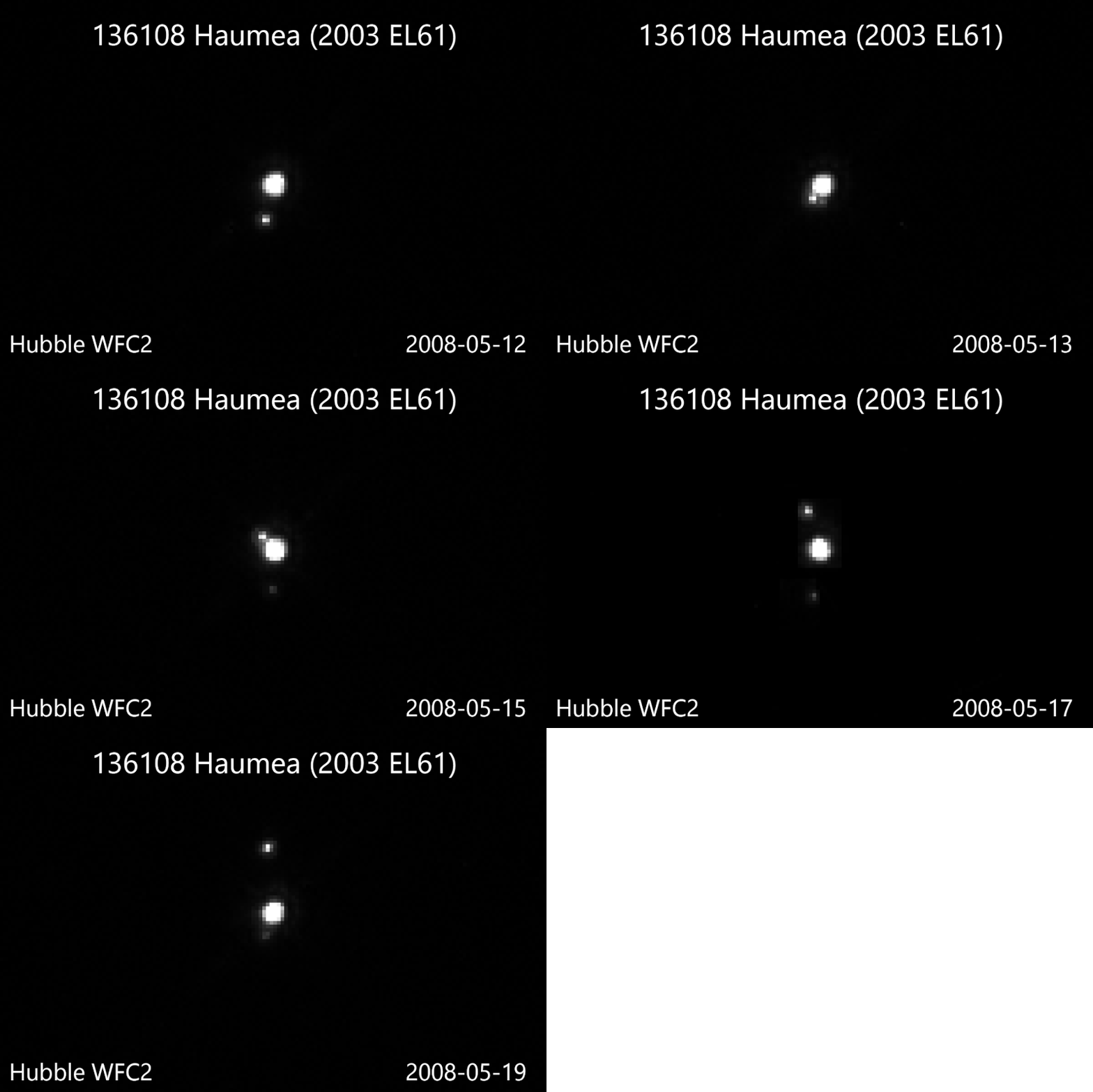
Dwarf Planet Haumea and its satellites, imaged by the Hubble Space Telescope's WFC2 camera from 12 May 2008 and 19 May 2008. The brighter dot orbiting Haumea is the larger outer moon Hi'iaka while the fainter dot is the smaller inner moon Namaka. This animation of the moons' orbits spans 7 days and the orbital plane of Namaka is oriented vertically. Hubble Space Telescope/Michael Brown/Wikimedia Commons.

See also...


Follow Sciency Thoughts on Facebook.

Follow Sciency Thoughts on Twitter


Monday, 23 January 2017

Investigating the nature of Extreme Trans-Neptunian Objects (474640) 2004 VN112 and 2013 RF98.

Extreme Trans-Neptunian Objects are Outer Solar System bodies with orbits that never bring them closer to the Sun than 30 AU (i.e. 30 times as far from the Sun as the Earth), and an average distance from the Sun of greater than 150 AU. The first of these objects, (148209) 2000 CR105, was discovered in 2000, since when a total of 21 have been found. Curiously these bodies not appear to orbit in the plane of the Solar System, but rather follow highly eccentric orbits that are consistent with having been thrown from this plane by encounters with a large, undiscovered body, a body that has been referred to as Planet 9 or Planet X.

In a paper published on the online arXiv database at Cornell University Library on 10 January 2017, and submitted for publication in the Monthly Notes of the Royal Astronomical Society, Julia de León of the Instituto de Astrofísica de Canarias and the Departamento de Astrofísica at the Universidad de La Laguna, and Carlos and Raul de la Fuente Marcos of the Universidad Complutense de Madrid describe the results of a study of the visible spectra of two Extreme Trans-Neptunian Objects, (474640) 2004 VN112 and 2013 RF98, made with the OSIRIS camera-spectrograph at the 10.4 m Gran Telescopio Canarias.

(474640) 2004 VN112 was discovered on 6 November 2004 by the ESSENCE Supernova Survey using the 4 m Blanco Telescope at Cerro Tololo International Observatory. The  name 2004 VN112 implies that 2813th asteroid (asteroid N112) discovered in the first half of November 2004 (period 2004 V), while the longer designation 474640 implies that it was the 474 640th asteroid ever discovered. It is estimated to be between 130 and 300 km in diameter, and has an orbit calculated from 31 observations made over a period of fourteen years. This orbit is calculated to take 5629 years and is tilted at an angle of 26°, taking the asteroid from 47.3 AU from the Sun at its closest out to 586 AU from the Sun at its furthest. It is calculated that an object of this size in an orbit of this nature would be visible to the ESSENCE survey for only 2% of its orbit, which suggests that a significant number of similar asteroids could be awaiting discovery.

2013 RF98 was discovered on 12 September 2013 by the Dark Energy Camera on the Blanco 4-meter Telescope at the Cerro Tololo Inter-American Observatory in La Serena, Chile. The designation 2013 RF98 implies that it was the 2456th asteroid (asteroid F98) discovered in the first half of September 2013 (period 2013 R). It is estimated to be between 50 and 120 km in diameter, and has had an orbit described from 38 observations made over a period of 56 days. This orbit is calculated to take 6527 years and be tilted at an angle of 30°, taking the asteroid from 36.1 AU from the Sun at its closest out to 662 AU at its farthest.

2013 RF98, at center of circle, as seen on 11 October 2013 by the Dark Energy Camera. Dark Energy Survey.

These objects are considered to be part of the Scattered Disk, objects sufficiently distant from the Sun that they are not influenced by tidal forces exerted by the eight known planets. Nevertheless both objects are tilted strongly from the Plane of the Solar System, which implies that they have had their orbits perturbed by the influence of some large body, one of the pieces of evidence that led astronomers to propose that an undiscovered ninth planet may be present in the Outer Solar System. These orbits are not only inclined to the Plane of the Solar System, they are very similar, leading de León et al. to speculate that these bodies might share a common origin.

To this end they examined the visual spectra of the two objects with the OSIRIS Spectograph in March and August 2016. Since all materials reflect light at certain wavelengths (spectra), the visual spectra of an object will reflect the materials present on its surface. Thus if two objects have similar visual spectra, then they are likely to have similar compositions.

De León et al. calculated that the spectral slope for 474640 is 12±2 %/0.1 μm and that of 2013 RF98 is 15±2 %/0.1 μm. As with the orbital parameters, these are not identical, but are very similar (to give some comparison the Trans-Neptunian Dwarf Planets Eris, Pluto, Makemake and Haumea have spectral slopes in the range 0–10 %/0.1 μm, while Sedna has a spectral slope of 26-42 %/0.1 μm). This suggests these objects have surfaces with variety of pure ices (water, methane, carbon dioxide etc.) as well as carbon and possibly amorphous silicates, but not complex organic molecules.

 Comparison between the spectra of (474640) 2004 VN112 and 2013 RF98 smoothed by a Savitzky-Golay filter and scaled to match at 0.60 μm. The most prominent absorption band of pure methane ice at 0.73 μm is not seen on either spectra. De León et al. (2017).

Given the similarities between the orbits and spectra of the two objects, de León et al.conclude that the two bodies are likely to share a common origin. They therefore consider two possibilities; that the two bodies are the result of a single object breaking up close to perihelion (when bodies are at their closest to the Sun, and receiving their most heat and tidal stress from it), or that they were a single object or binary asteroid (i.e. two asteroids orbiting one-another) torn apart by repeated tidal stresses from an encounter with a larger body.

Of these hypotheses, de León et al. reject the idea that the two objects reject the idea that the two bodies might represent the remains of a single body torn apart by tidal forces close to perihelion, as two fragments of such a bodies which fragment at perihelion are should not return to perihelion at the same time on every passage (if they did there would be no tidal forces pulling them apart) so happening to see the two together close to perihelion within a year would be a remarkable coincidence.

In order to test the second hypothesis, de León et al.used a computer model, which was run several thousand times with varying parameters, in order to work out the most likely scenarios for such an encounter. They conclude that the most likely scenario would be one where the parent body of the two objects repeatedly encountered a planet with a mass 10-20 times that of the Earth on an orbit with an eccentricity of up to 40% (an orbit in which it is 40% closer to the Sun at its closest than at its furthest), inclined to the Plain of the Solar System by 20-40°. Such a planet could cause a binary asteroid pair of weekly consolidated asteroid to break apart and nudge the parts onto the observed orbits due to repeated encounters over a period of 5-10 million years.

See also...

http://sciencythoughts.blogspot.co.uk/2016/07/using-hypothetical-ninth-planet-to.htmlhttp://sciencythoughts.blogspot.co.uk/2016/05/hubble-space-telescope-discovers-moon.html
http://sciencythoughts.blogspot.co.uk/2016/03/sputnik-planum-apparently-young-feature.htmlhttp://sciencythoughts.blogspot.co.uk/2016/02/deciphering-rings-of-10199-chariklo.html
http://sciencythoughts.blogspot.co.uk/2015/04/assessing-composition-of-ices-on.htmlhttp://sciencythoughts.blogspot.co.uk/2015/01/searching-for-bright-objects-in-outer.html


Follow Sciency Thoughts on Facebook.