Showing posts with label Kuiper Belt Objects. Show all posts

Wednesday, 22 April 2026

Dwarf Planet 136108 Haumea approaches opposition.

The Dwarf Planet 136108 Haumea will reach opposition (i.e. be directly opposite the Sun seen from Earth) at 8.47 am GMT on Thursday 23 April 2026. This means that it will both be at its closest to the Earth this year, about 42.1 AU (42.1 times the average distance between the Earth and the Sun, or about 6 298 255 000 km), and completely illuminated by the Sun. While it is not visible to the naked eye observer, the planets have phases just like those of the Moon; being further from the Sun than the Earth, 136108 Haumea is 'full' when directly opposite the Sun. 

The orbit and position of 136108 Haumea and the planets of the Solar System at 9.00 am on Thursday 23 April 2026. JPL Small Body Database Browser.

At opposition, the Dwarf Planet will be in the constellation of Bootes and at its highest point in the sky at about midnight local time from anywhere on Earth (this is because the rising and setting of objects in the sky is caused by the Earth's rotation, not the movement of the object). (Even at it's very brightest 136108 Haumea will only have a Magnitude of 17.3, making it almost impossible to see with any but the largest of Earth-based telescopes, and where resolvable it will only be possible to see it as a point of light indistinguishable from a faint star.

136108 Haumea orbits the Sun on an eccentric orbit tilted at an angle of 28.2° to the plane of the Solar System, which takes it from 34.4 AU from the Sun (34.4 times the average distance at which the Earth orbits the Sun) to 51.5 AU from the Sun (51.5 times the average distance at which the Earth orbits the Sun). With an average distance of 43.0 AU, 136108 Haumea completes one orbit around the Sun every 282 years. This means that the planet is almost stationary compared to the faster moving Earth, so that it reaches Opposition only one day later each year than the year before, and reaches Solar Conjunction (when it is directly on the opposite side of the Sun to the Earth), roughly six months later.

136108 Haumea was discovered on 28 December 2004 by a team led by Mike Brown of the Palomar Observatory in California, in images taken by them on 28 May 2004; on 27 July 2005 a team led by José Luis Ortiz Moreno and his team at the Instituto de Astrofísica de Andalucía reported that they had also discovered the Dwarf Planet, in images taken between 7 and 10 March 2003. With a diameter of 2100 km it is considered to be the third largest dwarf planet in the Solar System (after 134340 Pluto and 136199 Eris) as well as the eighteenth largest body in the Solar System, excluding the Sun (several moons, including our own, are larger).

Haumea has been calculated to be rotating once every 3.9 hours, far more rapidly than any other large body in the Solar System. Curiously for such a fast rotating body, it has not adopted a oblate spheroid (flattened sphere) shape, but is instead a triaxial ellipsoid (elongate flattened sphere, or flattened egg-shape). This implies that, although its surface is comprised of ice, it has a core of fairly dense rocky material. 

The Dwarf Planet Haumea is believed to rotate in just under 4 hours. This rapid rotation causes the Dwarf Planet to be elongated in appearance. Stephanie Hoover/Wikimedia Commons.

Although Haumea is only about a quarter the size of Pluto, it is thought to be large enough that it should have reached hydrostatic equilibrium (i.e. become approximately spherical due to its own gravity). The elongate shape of Haumea is at odds with this, something which, in combination with its high rotational rate, has been suggested as evidence of a major collision in Haumea's past. This has been supported by the discovery in 2017 of a ring surrounding the dwarf planet with a radius of about 2285 km. This is well within the Roche limit for Haumea (the distance below which a ring or other orbiting body should be disrupted by the parent body's gravity and either fall onto it or be ejected), suggesting that this is a temporary structure caused by a relatively recent event (although still potentially billions of years ago, given the weak gravitational forces involved).

136108 Haumea rotating within its ring system. Tom Ruen/Wikimedia Commons.

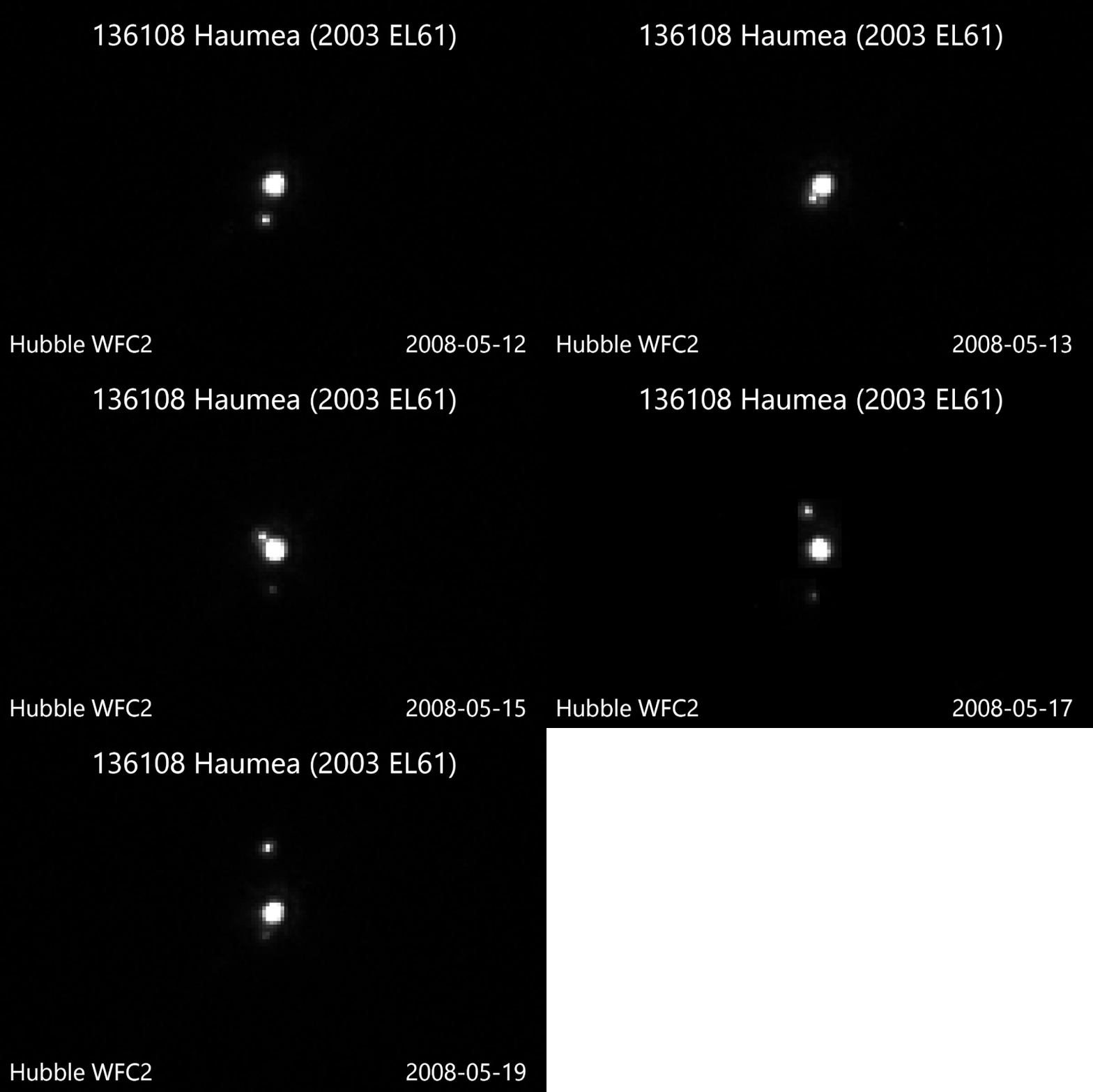
136108 has two small moons, both of which were discovered in 2005 by Darin Ragozzine and Michael Brown, at that time working at the W. M. Keck Observatory in Hawai'i. The larger of these, Hi'iaka, is roughly 370 km in diameter (although, like its parent body, it has been calculated to have an elongate, non-spherical shape) and orbits at a distance of 49 400 km, completing one orbit every 49.5 days. The smaller, Namaka, has been calculated to be about 150 km in diameter with an irregular shape, and to orbit at a distance of approximately 25 500 km.

Both the rings of 136108 Haumea and the larger moon, Hi'iaka, follow orbital paths 1-3° offset from the equator of the dwarf planet, and are thought to be products of the same collision. The smaller moon, Namaka, has an orbit offset by 69° from the equator of Haumea. This moon is thought to have been formed in the same collision, but to have had it's orbit perturbed significantly by tidal interactions with the larger moon.

Dwarf Planet Haumea and its satellites, imaged by the Hubble Space Telescope's WFC2 camera from 12 May 2008 and 19 May 2008. The brighter dot orbiting Haumea is the larger outer moon Hi'iaka while the fainter dot is the smaller inner moon Namaka. This animation of the moons' orbits spans 7 days and the orbital plane of Namaka is oriented vertically. Hubble Space Telescope/Michael Brown/Wikimedia Commons.

136108 Haumea is thought to be a member of a collisional family of Kuiper Belt objects; the only collisional family identified from this part of the Solar System. This family has been named the Haumea, or Haumean, Family in reference to its largest known member. Collisional families are groups of bodies which appear to have been created in a single collision event, and whose orbital trajectories can in theory all be traced back to a single point of origin, although this is not the case for the Haumea Family, which are thought to have had their orbital paths modified over time by interactions with the gravitational field of Neptune. 

As well as 136108 Haumea and its ring and moons, this family is thought to include the Kuiper Belt Objects (19308) 1996 TO66, (24835) 1995 SM55, (55636) 2002 TX300, (86047) 1999 OY3, (120178) 2003 OP32, (145453) 2005 RR43, (202421) 2005 UQ513, (308193) 2005 CB79, (315530) 2008 AP129, (386723) 2009 YE7, (416400) 2003 UZ117, (523645) 2010 VK201, (543454) 2014 HZ199, (612620) 2003 SQ317, (653589) 2014 QW441, (671467) 2014 LO28, and (673087) 2015 AJ281, as well, presumably, as other as yet undiscovered bodies.

The orbits of the bodies of the Haumea Collisional Family (not all are shown). Tom Ruen/Wikimedia Commons.

As well as having similar orbital properties, the bodies of the Haumea Family all share a similar high albedo (with the exception of (202421) 2005 UQ513), which suggests a surface largely covered by reflective water ice, rather than the darker, reddish, tholins (frozen organic compounds) which cover the surface of most Kuiper Belt objects. (202421) 2005 UQ513 has a lower albedo and a reddish spectrum, suggesting that it has an outer surface covered with tholins, but is included within the Haumea Family due to the similarity of its orbit.

See also...

Thursday, 24 July 2025

Pluto approaches opposition.

The Dwarf Planet Pluto will reach opposition (be directly on the opposite side of the Earth as the Sun) at 6.24 am GMT on Friday 25 July 2025. This means that it will be at its closest to the Earth this year, about 34.3AU (34.3 times the average distance between the Earth and the Sun, or about 3 639 716 200 km), and completely illuminated by the Sun. While it is not obvious to the naked eye observer, the planets have phases just like those of the Moon; being further from the Sun than the Earth, Pluto is 'full' when directly opposite the Sun, although with an apparent magnitude of only 15.0 it will take a reasonably good telescope to see Pluto at all, and it will only be visible as a star-like point to those that can see it. 

The relative positions of Earth and Pluto at 6.00 am on 25 July 2025. JPL Small Body Database.

Pluto was discovered in 1930 by Clyde Tombaugh, a young astronomer working at the Lowell Observatory in Arizona; its existence had been predicted as early as 1909, due to anomalies in the orbit of Neptune. At the time it was assumed that Pluto was a planet of some size, capable of disturbing the orbit of Neptune. Pluto spends part of its 248 earth year orbit inside the orbit of Neptune; this is not the same on every orbit, but alternates between a 20 and a 14 year stay.

The Dwarf Planet Pluto imaged by the New Horizons space probe in July 2015. NASA/JPL/Southwest Research Institute.

Pluto was downgraded from a planet to a dwarf planet by the International Astronomical Union in 2006, following the discovery of several similar small bodies in the Kuiper Belt beyond the orbit of Neptune. The term 'Dwarf Planet' is now used to designate objects large enough to form a roughly spherical shape under their own gravity, but no so massive as to have cleared the area around their orbit of all other objects. Pluto, Haumea, Makemake, and Eris were placed in this category, as was Ceres in the asteroid belt. Ceres had also been classified as a planet at the time of its discovery in 1801, as were a number of other asteroids until the mid-nineteenth century, when it became clear that asteroids were too abundant to be classed as planets.

The comparative sizes of Pluto, its largest moon, Charon, and the continental United States of America. Calvin Hamilton/Cornell University.

Pluto has an 247.7 year orbital period and an eccentric orbit tilted at an angle of 17.1° to the plane of the Solar System, which takes it from 29.6 AU from the Sun (i.e. 2960% of the average distance at which the Earth orbits the Sun) to 49.4 AU from the Sun (i.e. 4940% of the average distance at which the Earth orbits the Sun). As a body which spends most of its time outside the orbit of the planet Neptune it is classed as a Trans-Neptunian Object, even though it does come inside the orbit of Neptune for part of its orbital period.

See also...

Friday, 21 July 2023

Pluto approaches opposition.

The Dwarf Planet Pluto will reach opposition (be directly on the opposite side of the Earth as the Sun) at 12.23 pm GMT on Saturday 22 July 2023. This means that it will be at its closest to the Earth this year, about 33.8 AU (33.8 times the average distance between the Earth and the Sun, or about 5 056 000 000 km), and completely illuminated by the Sun. While it is not obvious to the naked eye observer, the planets have phases just like those of the Moon; being further from the Sun than the Earth, Pluto is 'full' when directly opposite the Sun, although with an apparent magnitude of only 14.9 it will take a reasonably good telescope to see Pluto at all, and it will only be visible as a star-like point to those that can see it. 

The relative positions of Earth and Pluto at 12.00 noon on 22 July 2023. JPL Small Body Database.

Pluto was discovered in 1930 by Clyde Tombaugh, a young astronomer working at the Lowell Observatory in Arizona; its existence had been predicted as early as 1909, due to anomalies in the orbit of Neptune. At the time it was assumed that Pluto was a planet of some size, capable of disturbing the orbit of Neptune. Pluto spends part of its 248 earth year orbit inside the orbit of Neptune; this is not the same on every orbit, but alternates between a 20 and a 14 year stay.

The Dwarf Planet Pluto imaged by the New Horizons space probe in July 2015. NASA/JPL/Southwest Research Institute.

Pluto was downgraded from a planet to a dwarf planet by the International Astronomical Union in 2006, following the discovery of several similar small bodies in the Kuiper Belt beyond the orbit of Neptune. The term 'Dwarf Planet' is now used to designate objects large enough to form a roughly spherical shape under their own gravity, but no so massive as to have cleared the area around their orbit of all other objects. Pluto, Haumea, Makemake, and Eris were placed in this category, as was Ceres in the asteroid belt. Ceres had also been classified as a planet at the time of its discovery in 1801, as were a number of other asteroids until the mid-nineteenth century, when it became clear that asteroids were too abundant to be classed as planets.

The comparative sizes of Pluto, its largest moon, Charon, and the continental United States of America. Calvin Hamilton/Cornell University.

Pluto has an 247.7 year orbital period and an eccentric orbit tilted at an angle of 17.1° to the plane of the Solar System, which takes it from 29.6 AU from the Sun (i.e. 2960% of the average distance at which the Earth orbits the Sun) to 49.4 AU from the Sun (i.e. 4940% of the average distance at which the Earth orbits the Sun). As a body which spends most of its time outside the orbit of the planet Neptune it is classed as a Trans-Neptunian Object, even though it does come inside the orbit of Neptune for part of its orbital period.

See also...

Follow Sciency Thoughts on Facebook.

Follow Sciency Thoughts on Twitter


Tuesday, 11 July 2023

A colour enhanced image of Charon.

NASA has released a colour image of Pluto's largest moon, Charon, taken by the New Horizons space probe on 14 July 2015. The image is a composite built up from images taken in the blue, red, and infrared parts of the spectrum by the Ralph Multispectral Visual Imaging Camera, processed to accentuate the surface features of the moon.

Composite image of Pluto's moon Charon, built up from images taken by the Ralph Multispectral Visual Imaging Camera on the New Horizons space probe on 14 July 2015. NASA.

Discovered in 1978, Charon is the largest moon of Pluto, with a diameter of 1212 km, and 12% of the mass of Pluto itself. This makes it the sixth largest known trans-Neptunian object, after Pluto itself, Eris, Haumea, Makemake and Gonggong, as well as the twelfth largest moon in the Solar System, after Ganymede and Titan (which are both larger than the planet Mercury), Calisto, Io, the Earth's Moon, Europa, Triton, Titania, Rhea, Oberon, and Iapetus.

Pluto and Charon are gravitationally locked, always keeping the same face towards one-another, and orbiting their mutual barycentre every 6.387 days. The two bodies are, on average, 19 591 km apart, although this orbit does vary slightly. 

The orbit of Pluto and Charon about their mutual barycentre. Tom Ruen/Wikimedia Commons.

Unlike Pluto, which has a surface largely covered by methane and nitrogen ices, the surface of Charon appears to be covered largely by water ice, with patches of tholins and other hydrocarbons around its north pole. Patches of ammonia and water ice crystals on the surface are thought to indicators of cryovolcanism. The surface of the moon also has a number of large canyons following a southwest-northeast direction.

See also...


Follow Sciency Thoughts on Facebook.

Follow Sciency Thoughts on Twitter.


Monday, 18 April 2022

Dwarf Planet 136108 Haumea reaches oposition.

The Dwarf Planet 136108 Haumea will reach opposition (i.e. be directly opposite the Sun seen from Earth) on Tuesday 19 April 2022 at 8.18 pm GMT. This means that it will both be at its closest to the Earth this year, about 49.28 AU (19.28 times the average distance between the Earth and the Sun, or about 7 327 183 000 km), and completely illuminated by the Sun. While it is not visible to the naked eye observer, the planets have phases just like those of the Moon; being further from the Sun than the Earth, 136108 Haumea is 'full' when directly opposite the Sun. The Dwarf Planet will be in the constellation of Bootes and at its highest point in the sky at about 1.40 am local time from anywhere on Earth (this is because the rising and setting of objects in the sky is caused by the Earth's rotation, not the movement of the object). (Even at it's very brightest 136108 Haumea will only have a Magnitude of 17.3, making it almost impossible to see with any but the largest of Earth-based telescopes, and where resolvable it will only be possible to see it as a point of light indistinguishable from a faint star.

 
The orbit and position of 136108 Haumea (2003 EL61) at 8.00 pm on Tuesday 19 April 2022. JPL Small Body Database Browser.

136108 Haumea orbits the Sun on an eccentric orbit tilted at an angle of 28.2° to the plane of the Solar System, which takes it from 34.4 AU from the Sun (34.4 times the average distance at which the Earth orbits the Sun) to 51.5 AU from the Sun (51.5 times the average distance at which the Earth orbits the Sun). With an average distance of 43.0 AU, 136108 Haumea completes one orbit around the Sun every 282 years. This means that the planet is almost stationary compared to the faster moving Earth, so that it reaches Opposition only one day later each year than the year before, and reaches Solar Conjunction (when it is directly on the opposite side of the Sun to the Earth), roughly six months later.

 
The Dwarf Planet Haumea is believed to rotate in just under 4 hours. This rapid rotation causes the Dwarf Planet to be elongated in appearance. Stephanie Hoover/Wikimedia Commons.

136108 Haumea was discovered on 28 December 2004 by a team led by Mike Brown of the Palomar Observatory in California, in images taken by them on 28 May 2004; on 27 July 2005 a team led by José Luis Ortiz Moreno and his team at the Instituto de Astrofísica de Andalucía reported that they had also discovered the Dwarf Planet, in images taken between 7 and 10 March 2003. With a diameter of 2100 km it is considered to be the third largest dwarf planet in the Solar System (after 134340 Pluto and 136199 Eris) as well as the eighteenth largest body in the Solar System, excluding the Sun (several moons, including our own, are larger).

Haumea has been calculated to be rotating once every 3.9 hours, far more rapidly than any other large body in the Solar System. Curiously for such a fast rotating body, it has not adopted a oblate spheroid (flattened sphere) shape, but is instead a triaxial ellipsoid (elongate flattened sphere, or flattened egg-shape). This implies that, although its surface is comprised of ice, it has a core of fairly dense rocky material. The Dwarf Planet also appears to be surrounded by a ring of icy material, and at least two moons, which have been named Hiʻiaka and Namaka.

 
Dwarf Planet Haumea and its satellites, imaged by the Hubble Space Telescope's WFC2 camera from 12 May 2008 and 19 May 2008. The brighter dot orbiting Haumea is the larger outer moon Hi'iaka while the fainter dot is the smaller inner moon Namaka. This animation of the moons' orbits spans 7 days and the orbital plane of Namaka is oriented vertically. Hubble Space Telescope/Michael Brown/Wikimedia Commons.

See also...


Follow Sciency Thoughts on Facebook.

Follow Sciency Thoughts on Twitter