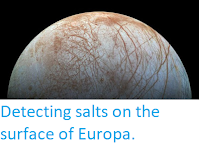
Images of Europa from the Voyager and Galileo spacecraft show striking color variations across the surface that exhibit marked hemispherical di�erences and correlations with surface geology. These visible patterns likely reflect the combined influences of endogenous and exogenous sources on the underlying surface composition. A unique association of colour with geologic features, such as lineae and heavily disrupted 'chaos' terrain, pervades the entire surface and hints at the possibility that compositional fingerprints of the internal ocean may persist within recent geology. However, a distinct colour contrast between the leading and trailing hemispheres, in which the geologic features of the trailing hemisphere are signi�cantly darker and redder than their leading-hemisphere counterparts, appears to reflect the constant exogenous alteration of the trailing-hemisphere surface chemistry via sulphur radiolysis. Sulphur plasma ions from the volcanos of Io co-rotate with Jupiter's magnetic fi�eld and continuously deposit onto the trailing hemisphere, where bombardment by energetic magnetospheric electrons, protons, and ions drives a chemically active radiolytic sulfur cycle that aff�ects the underlying composition. Indeed, continuous lineae that traverse from the trailing to the leading hemisphere appear to change color, becoming less red as they become sheltered from the impinging sulphur plasma. Such exogenic processing complicates the interpretation of surface components as oceanic signatures, even within geologically young terrain. Disentangling potential endogenous species from radiolytic products is thus critical to understanding the surface composition of Europa and thereby constraining the chemistry of the ocean below.
The imagery implies that visible wavelengths contain compositional information, which may help distinguish endogenic from exogenic influences. Indeed, multiple studies have utilized broadband photometry and spectral ratios from these images to reveal patterns in visible reflectance associated with plasma bombardment and geologic units.
Until recently, visible spectroscopy of the surface has been limited to disk-integrated observations obtained from the ground These spectra echo the leading/trailing albedo and color contrasts seen in imagery and reveal some notable spectral features, including possible absorptions near 360 and 530 nm on the trailing hemisphere and a broad, global downturn toward the near near ultraviolet (with a band edge at �500 nm) that is stronger on the trailing hemisphere. However, despite the fact that Europa's surface colour shows a clear association with geology, suggesting endogenous influences at visible wavelengths, the features visible in the ground-based spectra have most often been attributed entirely to sulphur allotropes and sulphur dioxide. Though it was suggested that some sulphur could be endogenic, these species are also anticipated products of the exogenic sulphur implantation, which is indiscriminate
of underlying geology.
More recent thinking, however, has considered the possible visible-wavelength contributions of salts related to the internal ocean, which would more plausibly follow disrupted terrain and can become visibly coloured due to the formation of radiation-induced defects known as 'colour centers'. Distinguishing between the potential spectral signatures of salts and sulphur products may be possible with spatially resolved spectroscopy, which can isolate large-scale geologic regions. Indeed, spatially resolved visible-wavelength spectra taken with the Hubble Space Telescope have already revealed what appears to be a colour-center absorption of irradiated sodium chloride at 450 nm on the leading hemisphere, challenging the idea that Europa's surface color and visible spectrum solely reflect sulphur species. The sodium chloride feature appears exclusively on the leading hemisphere, separate from the trailing-hemisphere sulphur radiolysis, and correlates with surface geology and colour, corresponding particularly to Tara Regio, a large, visibly yellow region of chaos terrain. Sodium chloride may explain some of the visible patterns on the leading hemisphere, but the species responsible for those on the trailing hemisphere remain uncertain.
In a paper published on the arXiv database at Cornell University on 21 December 2020, Samantha Trumbo and Michael Brown of the Division of Geological and Planetary Sciences at the California Institute of Technology, and Kevin Hand of the Jet Propulsion Laboratory, also at the California Institute of Technology, use the same Hubble Space Telescope visible-wavelength dataset to investigate the composition of the trailing hemisphere.

Galileo Solid-State Imaging colour images of approximately the leading (A) and approximately the trailing (B) hemispheres (PIA01295 and PIA00502 in the NASA JPL Photojournal). The actual central longitudes of the images are closer to 45�W and 295�W, respectively. These approximate true-colour images were created using the Galileo violet, green, and near-infrared (986 nm) fi�lters. Both images show a clear association of colour with geologic features, though the geology of the trailing hemisphere appears significantly redder than its more yellow leading-hemisphere counterparts. Individual lineae that traverse from the trailing to the leading hemisphere change color from red to yellow as they leave the sulphur-implantation experienced on the trailing hemisphere. The surface colour's simultaneous correlation with geology and dichotomy between the hemispheres suggest that the colour may indicate endogenous material on the leading hemisphere and endogenous material altered by sulphur radiolysis on the trailing hemisphere. The large yellow patch in the lower left of the leading-hemisphere image is the large-scale chaos region Tara Regio, where Hubble Space Telescope spectra detect irradiated Sodium Chloride. Trumbo et al. (2020). Trumbo et al. mapped visible spectral features across the surface and compared their geographic distributions with surface geology, surface colour, and particle bombardment patterns in an attempt to distinguish between endogenic and exogenic origins.
Trumbo et al. observed Europa with the Space Telescope Imaging Spectrograph across four Hubble Space Telescope visits in 2017. During each visit, Trumbo et al. repeatedly stepped the 52" x 0.1" slit in 0.06" increments across the full disk of Europa, resulting in overlapping aperture positions. We executed this slit-scan pattern twice per visit; once each in the G430L and G750L �first-order spectroscopy modes (R �500) to achieve full 300-1000 nm wavelength coverage. At each slit position, Trumbo et al. integrated for either 9 (G750L) or 10 seconds (G430L). Flux and wavelength-calibrated data were then provided by Hubble Space Telescope after standard reduction with the Space Telescope Imaging Spectrograph calibration pipeline (calstis). Using the same pipeline, but including the calstis defringing procedures, Trumbo et al. reprocessed the G750L data to remove substantial fringes from the longest wavelengths. Trumbo et al. extracted single spectra by taking individual rows from the two-dimensional spectral images, corresponding to the 0.05" pixel-scale (�150-km di�raction-limited resolution at 450 nm). Trumbo et al. then divided each spectrum by the ASTM E-490 solar reference spectrum to convert to reflectance.
The G750L data (�roughly 550-1000 nm) seemed to contain multiple artifacts, some of which may have been residuals of the defringing process similar to those seen in Space Telescope Imaging Spectrograph spectra of Mars. In addition, significant slit losses and the broad point spread function of Space Telescope Imaging Spectrograph distorted the continuum spectral shape in the G750L setting. To correct for these e�ffects, Trumbo et al. �fitted a spline curve to a high-quality ground-based spectrum of the leading hemisphere and extended the fi�t as a constant beyond the extent of the groundbased spectrum (roughly �775 nm), which is approximately consistent with spectrophotometric measurements at these wavelengths. Trumbo et al. then multiplied our spectra by the ratio of this curve to a corresponding disk-integrated spectrum constructed from our G750L data. This approach simultaneously divided out global artifacts from the G750L spectra and corrected the continuum shape for slit losses, while preserving relative differences between individual spectra. Finally, to produce continuous 300-1000 nm spectra of the entire surface, Trumbo et al. combined the G430L and G750L settings, scaling as appropriate to correct minor flux o�sets and smoothing the G430L data to match the G750L signal-to-noise. Trumbo et al. calculated the corresponding latitude/longitude coordinates of each extracted pixel using the known phase and angular size of Europa (as obtained from JPL Horizons) and the aperture geometry information included in the Hubble Space Telescope FITS headers.
Trumbo et al.'s spectra of the trailing hemisphere show the same strong downturn toward the near ultraviolet (with a band edge around 500 nm) that was seen in prior ground-based spectrophotometry, and better spectrally resolve the discrete features near 360 and 530 nm that were more tentatively detected. Previously, it was suggested that an assortment of sulphur allotropes could explain all three features, with the 360 and 530 nm absorptions tentatively identi�ed as polymeric sulphur and tetrasulfur, respectively, and the broad near-ultraviolet downturn most often associated with �orthorhombic cyclooctal sulphur. In one respect, invoking sulphur allotropes to explain the visible spectrum of the trailing hemisphere makes sense due to the sulphur implantation and radiolysis known to be occurring there. However, the imagery clearly implies that some aspects of the visible spectrum must be related to geology, which one would not necessarily expect of radiolysis products composed of pure sulphur. In order to investigate which aspects of their spectra may be endogenous in origin and which can be attributed to exogenous sulphur chemistry, Trumbo et al. mapped the strength of the aforementioned features across the surface and look for correlations with surface colour, geology, and radiation bombardment patterns.

Representative spectrum from Trumbo et al.'s Hubble Space Telescope data of the trailing hemisphere of Europa compared to the Voyager and Galileo imaging fi�lters. The spectrum is an average from Eastern Annwn Regio and features a strong near-ultraviolet downturn with a band edge near 500 nm, as well as two discrete features near 360 and 530 nm. Black dashed lines indicate representative continuum �ts akin to those used to map the strength of each feature in our individual spectra. Trumbo et al. include the Voyager ultraviolet and violet fi�lter responses underneath the spectrum, as well as the Galileo fi�lters. The Galileo near-infrared (986 nm) fi�lter response is multiplied by 10 for clarity. Trumbo et al. (2020).
To independently measure the strength of the discrete 360 nm absorption and of the larger-scale near-ultraviolet downturn on which it is superimposed, Trumbo et al. normalised each spectrum to the median reflectance of the 415-425 nm region and �fit a linear continuum from 307.5 to 425 nm, excluding the portion corresponding to the discrete absorption (�315-415 nm). Trumbo et al. assessed each �fit by eye and, if necessary, made small changes to these bounds. Trumbo et al. took the slope of the �fitted continuum as a measure of the magnitude of the near-ultraviolet downturn. Trumbo et al. then divided out the calculated continuum from each spectrum and integrated the residual absorption to obtain the band area of the 360 nm feature. Trumbo et al. took a similar approach to measure the band area of the 530 nm feature, instead using a second-order polynomial continuum between 480 and 770 nm, excluding the wavelengths of the apparent absorption (�500-700 nm) and making adjustments when necessary to achieve a satisfactory continuum fi�t. Finally, Trumbo et al. mapped their measures of all three absorptions across the surface. Trumbo et al. excluded data near the limb of Europa, as the spectra are of poorer quality, making accurate quanti�cation of spectral features di�fficult.
The results of this mapping were compared to the Voyager ultraviolet/violet ratio map, which was constructed from images taken in the Voyager ultraviolet and violet fi�lters. The Voyager ultraviolet/violet map has long been interpreted to primarily reflect the effects of exogenous sulphur implantation on the trailing hemisphere, as the large-scale pattern of ultraviolet dark material forms an elliptic pattern centered around the trailing point (0°� North, 270°� �West) that largely coincides with the expected patterns of both Iogenic sulphur and electron bombardment. Indeed, like the expected sulphur flux, the Voyager ultraviolet/violet ratio varies roughly as the cosine of the angle from the trailing point, though the relationship is not perfectly linear. However, as Alfred McEwen noted, the ultraviolet/violet map also features smaller-scale patterns that appear to be endogenic in origin and that precisely associate with geology. In particular, the large-scale chaos regions Dyfed Regio (�approximately 250°�� West) and Eastern Annwn Regio (approximately �294°�� West) and the intervening smaller-scale chaos regions appear especially dark in the ultraviolet/violet map, but discrete features south of Pwyll Crater (25°� �South, 271°�� West) also appear distinct from the background elliptic pattern. In fact, in comparing the Voyager ultraviolet and violet filter responses to a representative trailing-hemisphere spectrum, Trumbo et al. see that the ultraviolet/violet ratio simultaneously measures two diff�erent things|the large near-ultraviolet downturn and the discrete 360 nm feature. Trumbo et al.'s analysis attempts to separate the two.

(A) Voyager ultraviolet/violet ratio map. The large-scale elliptic pattern of ultraviolet-dark material on the trailing hemisphere likely reflects the exogenous sulphur chemistry occurring there. However, the ultraviolet/violet ratio also displays smaller-scale patterns associated with the large-scale chaos regions Dyfed Regio and Eastern Annwn Regio, the smaller-scale chaos terrain between them, and some apparent geology south of Pwyll Crater. (B) Map of the slope from 307.5 to 425 nm (Trumbo et al.'s proxy for the near-ultraviolet downturn) in the Hubble Space Telescope spectra, which reproduces the large-scale, exogenic pattern of the ultraviolet/violet map. This distribution suggests that the near-ultraviolet downturn reflects exogenous influences. (C) Map of the 360 nm band strength in the Hubble Space Telescope spectra, which resembles the smaller scale, apparently endogenic portions of the Voyager ultraviolet/violet map. This geography is suggestive of a combination of endogenic and exogenic influences. (D) Map of the 530 nm band strength in the Hubble Space Telescope spectra, which may be consistent with either an association with geology near the trailing point or with a simple dependence on the highest sulphur fluxes. Trumbo et al. (2020).
Trumbo et al. found that mapping the slope across the 315-415 nm region (their proxy for the near-ultraviolet downturn) reproduces the large-scale, apparently exogenic pattern of the ultraviolet/violet map. With the exception of a few spuriously strong slopes near the northern limbs of each observation, which Trumbo et al. believe are pixel-dependent artifacts, the slopes on the trailing hemisphere follow a largely uniform and symmetric elliptic distribution centered on the trailing point and tapering toward the sub- and anti-Jovian points. Again, this pattern is largely consistent with the expected geographies of sulphur implantation and electron bombardment on the trailing hemisphere, suggesting an exogenic origin for the near-ultraviolet downturn. It is worth noting, however, that this slope is not a perfect measure of the near-ultraviolet downturn everywhere across the surface, as it is disrupted by the 450 nm sodium chloride absorption on the leading hemisphere. Indeed, the sodium chloride feature, which falls partly within the Voyager violet �filter and is strongest in the large-scale chaos region Tara Regio (10°�� South, 75°�� West), explains much of the red 'ultraviolet-bright' material in the Voyager ultraviolet/violet map and results in a depressed slope by Trumbo et al.'s measure. In reality, this region also exhibits an overall drop in reflectance toward the near-ultraviolet that is comparable to that of the immediately surrounding terrain. In fact, though the near-ultraviolet downturn is strongest on the trailing hemisphere, all of Trumbo et al.'s spectra exhibit a downturn toward the near-ultraviolet, and the presence of an absorption edge at �500 nm appears to be a truly global characteristic that is independent of terrain type. Thus, while the strong near-ultraviolet downturn on the trailing hemisphere certainly appears to result from the exogenous sulphur chemistry, potentially reflecting the previously suggested orthorhombic cyclooctal sulphur or some combination of sulphur allotropes that absorb strongly in the ultraviolet, alternative explanations may be worth considering for the weaker near-ultraviolet downturn observed elsewhere. Indeed, the near ubiquitous presence of an absorption edge near 500 nm on the other icy Galilean satellites as well as on the icy Saturnian satellites supports this idea. Radiation-processed organics are invoked to explain the near-ultraviolet downturn on the Saturnian satellites. However, limited laboratory data have suggested that radiation-damaged water ice could exhibit a similar near-ultraviolet downturn, which perhaps presents an alternative explanation for the leading hemisphere and icy regions of Europa, as there is currently no evidence for widespread organics at other wavelengths.
Trumbo et al.'s map of the discrete 360 nm band reveals a more irregular and spatially localized pattern that is strongest near the trailing point, but that does not fi�ll the entire elliptic pattern of exogenous alteration. Instead, the geographic distribution of the 360 nm feature appears to correspond to the same geology as the endogenic patterns visible in the Voyager ultraviolet/violet map, but simply mapped at the coarser spatial resolution of Trumbo et al.'s Hubble Space Telescope data. Like the lowest Voyager ultraviolet/violet ratios, the strongest 360 nm absorptions appear associated with Dyfed Regio, Eastern Annwn Regio, and the intervening smaller-scale chaos terrain, with more moderate strengths south of Pwyll Crater. In fact, as the ultraviolet/violet ratio is necessarily decreased by the presence of the 360 nm feature, Trumbo et al.'s can say with some certainty that their map of the 360 nm band strength reflects the same geologic regions. Indeed, applying the Hubble Space Telescope point spread function and pixel scale to a starting distribution corresponding to the lowest ratios in the Voyager map produces a pattern very similar to the geography of the 360 nm feature that Trumbo et al. observe.
The association with geologically young chaos terrain implies that the 360 nm feature reflects endogenous influences on the surface composition. However, its connement to the sulphur-bombarded trailing hemisphere simultaneously suggests that it is related to the exogenous sulphur radiolysis occurring there. Indeed, the fact that the 360 nm absorption is not equally strong within all trailing-hemisphere chaos terrain, but is instead concentrated within that closest to the trailing point, suggests that it may depend heavily on the impinging sulphur flux. All together, this geography is suggestive of an endogenous material that has been compositionally altered by sulphur radiolysis. Previously, the 360 nm absorption was tentatively attributed to polymeric sulphur. However, as polymeric sulphur� can likely result solely from the radiolysis of implanted Iogenic sulphur, requiring no endogenous input, there is no obvious reason to expect a correlation with chaos terrain. Thus, while it is conceivable that there may be unknown e�ects acting to concentrate or enhance the stability of polymeric sulphur� within chaos regions, it is worth re-evaluating the cause of the 360 nm feature and considering species that are not pure sulphur, but that instead form radiolytically from a mixture of Iogenic sulphur and endogenic materials.
The 530 nm absorption proved more di�cult to quantify, as it falls at the junction between the G430L and G750L settings and very near the �500 nm band edge of the near-ultraviolet downturn. Thus, the measurement of this feature was somewhat sensitive to slight slope and flux mismatches between settings, particularly at the limbs, as well as to changes in the near-ultraviolet absorption edge. As a result, our map of the 530 nm absorption is less certain, though mapping with di�erent polynomial continua and �tting parameters consistently produces qualitatively similar geographies. Trumbo et al. estimate the pixel-bypixel uncertainty to be less than 1.5 nm of band area on average.
The distribution Trumbo et al. obtain is similar to that of the 360 nm feature in that it also displays the strongest absorptions near the trailing point and does not fi�ll the entire exogenic alteration pattern. However, without a corresponding high-spatial-resolution imaging map sensitive to the 530 nm absorption, it is di�cult to evaluate any potential correlation with the chaos terrain containing the 360 nm feature. Indeed, while such a correlation seems plausible from our map, the observed distribution of the 530 nm feature is also largely consistent with a simple concentration nearest the trailing point, which receives the highest sulphur flux. Thus, though it is possible that the 530 nm absorption also results from radiolytically altered endogenous material, it's previous identi�cation as tetrasulphur is equally consistent with Trumbo et al.'s data.
Though the strong near-ultraviolet downturn is widespread on the trailing hemisphere and at least the 360 nm feature correlates with some trailing hemisphere chaos terrain, none of the spectral features Trumbo et al. have investigated thus far consistently correspond to the red colour that appears common to all geology across the trailing hemisphere. The near-ultraviolet elliptic pattern overprints much of the underlying geologic features, but is signi�cantly more uniform and more symmetric about the trailing point than is the visibly red large-scale geology, which is asymmetric and o�ffset west from the apex. In contrast, the 360 nm feature does associate speci�cally with some of this geology, particularly Dyfed Regio and the eastern portion of Annwn Regio nearest the trailing point, but it is much weaker within the western portions of Annwn Regio, which are similarly red in colour to their eastern counterparts. The 530 nm absorption is equally constrained to the most central portions of the trailing hemisphere. Thus, while all three features necessarily influence the colours visible in the Voyager and Galileo imagery, none appear to be an underlying commonality speci�cally associated with the widespread red material.
Instead, the aspect of Trumbo et al.'s spectra that they fi�nd corresponds best geographically to the red material in the imagery is the slope in the 700 nm region. This slope appears to result from a broad absorption that extends through the red wavelengths before interfering with the 530 nm feature. As a proxy for its strength, Trumbo et al. normalise our spectra to the median reflectance between 745 and 750 nm, linearly �fit the data between 650 and 750 nm, and then map the resulting slopes across the surface. Trumbo et al.'s map of this absorption seems uniquely correlated with all of the visibly red large-scale chaos terrain on the trailing hemisphere, highlighting not just Dyfed Regio and the eastern portions of Annwn Regio, but also the western portions of Annwn Regio, which extend across the sub-Jovian point. In fact, the absorption even appears weakly within the less-red large-scale chaos terrain near the anti-Jovian point. However, like the red colour visible in imagery, this feature is absent from the chaos terrain on the leading hemisphere, which is sheltered from the trailing-hemisphere sulphur implantation and the resultant sulphur radiolytic chemistry.

Map of the spectral slope from 650 to 750 nm compared to an approximate true-color mosaic of Europa's surface. This slope acts as a measure of the broad absorption feature visible across the red wavelengths and corresponds well to the reddish material visible in the imagery. Trumbo et al.'s map of this slope highlights all of the large-scale trailing-hemisphere chaos terrain and even the less-red chaos regions near the sub- and anti-Jovian points to a lesser extent. As the broad absorption across the red wavelengths appears common to all of the large-scale geology experiencing sulphur radiolysis, it likely reflects species formed via the radiolysis of a mixture of endogenic material and implanted Iogenic sulphur. Trumbo et al. (2020).
Trumbo et al.'s map may reflect the same absorber as does the incomplete Galileo NIMS 0.7/1.2 �m ratio map published previously, which highlighted some of the same regions. Like the ground-based spectra, the NIMS map was interpreted to most likely reflect sulphur chains or polymers, potentially produced as part of the radiolytic sulphur cycle on the trailing hemisphere. However, as the absorber and the reddish colour with which it correlates appear so speci�cally associated with geologic features, we suggest that a radiolytically altered endogenous material better explains the observed geography.
The Hubble Space Telescope spectra of Europa's trailing hemisphere appear to reflect both endogenous and exogenous influences on the surface composition. The implantation and subsequent radiolysis of sulfur from Io almost certainly results in the formation of sulphur allotropes, such as orthorhombic cyclooctal sulphur and tetrasulphur, which will a�ect the visible spectrum and may explain the strong near-ultraviolet downturn and 530 nm feature Trumbo et al. observe on the trailing hemisphere. Indeed, these two species have been invoked to explain similar absorption features on Io. However, Europa's simultaneous global association of colour with geology and dichotomy of colour between the leading and trailing hemispheres seems to suggest the presence of endogenous material that has been chemically altered by the exogenous sulphur radiolysis. The geographies of the 360 nm feature and of the 700 nm slope in our spectra appear most consistent with species that are radiolytically produced from a mixture of Iogenic sulphur and endogenic material. Salts from the internal ocean, which have long been considered as likely components of Europa's surface, are perhaps the most obvious candidates for the endogenic starting material. Though the nature of such salts is still debated, recent work utilising spatially resolved ground-based near-infrared spectra has suggested that chlorides may dominate Europa's endogenic surface salts. Speci�cally, Michael Brown and Kevin Hand previously proposed a conceptual model in which these hypothesised chlorides participate in the radiolytic sulphur cycle on the trailing hemisphere and convert to sulphates when irradiated in the presence of Iogenic sulphur. In this picture, endogenic chloride-rich material would persist within geologic terrain on the leading hemisphere, where it is sheltered from the incoming sulphur plasma, but become progressively altered to a more sulphate-rich composition within those terrains subjected to the sulphur radiolysis on the trailing hemisphere. It should be noted that this hypothesis diff�ers from that of Nicolas Ligier, François Poulet, John Carter, Rosario Brunetto, and Florian Gourgeot, who also hypothesised the presence of chlorinated salts using a similar near-infrared dataset to that of Michael Brown and Kevin Hand, but instead interpreted their data to reflect magnesium-bearing chlorinated salts within the chaos terrain of the trailing hemisphere. However, the compositions suggested by Ligier et al. result from the linear mixture modeling of largely featureless continua, rather than from the detection of distinct, compositionally diagnostic absorption features, which is necessary to unambiguously identify surface species. Indeed, the recent Hubble Space Telescope detection of a 450 nm absorption indicative of irradiated sodium chloride within large-scale chaos regions on the leading hemisphere represents the only unambiguous detection of chlorinated salts on Europa to date and is consistent with the conceptual view laid out by Brown and Hand. Thus, sulphate salts may represent a likely candidate for the altered endogenous material implied by the visible-wavelength data of the trailing hemisphere.
Though many candidate sulphate salts are typically white at visible wavelengths, like sodium chloride, they can become signi�cantly discoloured when subjected to radiation conditions like those at the surface of Europa. In fact, Charles Hibbitts, Karen Stockstill-Cahill, Boswell Wing, and Christopher Paranicas, recently proposed that irradiated sulphate salts may explain the ground-based disk-integrated spectrophotometry of the trailing hemisphere. Speci�cally, Hibbet et al. noted that irradiated magnesium sulphate, a species already suggested from the infrared spectra of Michael Brown and Kevin Hand, provides a decent �fit to the overall shape of the trailing-hemisphere spectrum in the visible, while salts that form broad colour-center absorptions near 600 nm could contribute to the apparent broad absorption beyond 500 nm, which Trumbo et al. have shown to be a convolution of the 530 nm feature and a wider absorption spanning the red wavelengths.
Like the spectrum of Eastern Annwn Regio, that of irradiated magnesium sulphate also exhibits a pronounced near-ultraviolet downturn. Thus, it is possible that magnesium sulphate may contribute to the strong near-ultraviolet downturn Trumbo et al. fi�nd on the trailing hemisphere, though sulphur allotropes almost certainly contribute as well and are likely required to explain the elliptic distribution they observe. Both irradiated potasium chloride and tetrasulpher exhibit absorptions nearby in wavelength to the 530 nm feature Trumbo et al. observe on Europa. However, tetrasulpher provides a more satisfactory explanation, both in terms of the wavelength of the band minimum and in terms of the geographic distribution, as one would expect potassium chloride to be spatially associated with the previously observed sodium chloride on the leading hemisphere. Though sulphur allotropes may be implicated for the near-ultraviolet downturn and perhaps the 530 nm absorption, colour center absorptions by irradiated sulphate salts similar to the shown sodium sulphate or hydrated sodium magnesium sulphate (bloedite) may better explain the broad absorption causing the observed spectral slope at 700 nm, which maps to the reddish material visible in imagery. However, these laboratory spectra bear little resemblance to the Europa spectrum beyond both exhibiting broad features across the red wavelengths. Thus, a conclusive correspondence between sulphate colour centers and the Europa spectra is by no means implied from the available data. In fact, it is impossible to either identify or rule out any of the sulphates shown, due to the broad nature of their absorption features, the interference of multiple features within the Europa spectra, and the limitations of the laboratory data, which were obtained at room temperature using unrealistically high radiation fluxes. Furthermore, though our observed geography of the 360 nm feature on Europa suggests that it too results from altered endogenous material, none of the examined laboratory spectra provide a satisfactory explanation for this absorption. Thus, while Trumbo et al., in part, agree with Hibbitt et al. and suggest that irradiated sulphate salts may explain those aspects of the visible Europa spectra that correlate with geologic features on the trailing hemisphere, a better understanding of the surface composition and sulphur radiolysis chemistry and additional laboratory spectra are needed to fully address this hypothesis.

Average spectrum of Eastern Annwn Regio compared to the spectra of multiple sulphur allotropes, select irradiated sulphate and chloride salts, and the trailing hemisphere of Io. Vertical dashed lines indicate the approximate wavelengths of the band minima for the 360 and 530 nm absorptions on Europa. With the exception of the S�μ (polymeric sulfur) and S₄ (tetrasulpher) spectra, which are scaled arbitrarily for clarity, all of the spectra are scaled to unity at their longest wavelengths and o�ffset vertically from each other. With the exception of the S�μ spectrum, all of the spectra shown represent irradiated samples. The Na₂Mg(SO₄)₂·�4H2O (bloedite) spectrum shows a proton-irradiated sample, the remaining salt spectra show electron-irradiated samples, and the S₄ and S₈ (orthorhombic cyclooctal sulphur) spectra are of ultraviolet-irradiated samples. With the exception of the NaCl brine spectrum, which was taken at 100 K, and the S₈ and S₄ spectra, which were obtained at 77 K, all of the shown laboratory spectra were obtained at room temperature. Trumbo et al. (2020).
Utilising spatially resolved visible-wavelength spectra of Europa from the Hubble Space Telescope, Trumbo et al. have examined several absorption features unique to the trailing hemisphere in an attempt to disentangle potential endogenous influences from those of the exogenous radiolytic sulphur chemistry. By comparing the distribution of each absorption with surface colour, geology, and radiation bombardment patterns, Trumbo et al. diff�erentiate between features that they interpret to reflect pure-sulphur radiolytic products and those that they interpret to reflect species radiolytically produced from a combination of endogenic material and Iogenic sulphur. Two of the features Trumbo et al. observe, a widespread near-ultraviolet downturn and a distinct feature at 530 nm appear consistent with sulphur allotropes, as has been suggested based on previous ground-based data. However, the geographies of the remaining features, a discrete absorption at 360 nm and the spectral slope at red wavelengths, appear to indicate endogenous material altered by sulphur radiolysis. Though Trumbo et al. cannot uniquely identify the responsible species with currently available data, they suggest irradiated sulfates produced by the radiolysis of endogenous salts as potential candidates. Trumbo et al. suggest that future laboratory experiments examining the sulphur radiolysis of potentially endogenous salts and investigating the spectroscopy of irradiated sulphates at Europa-like temperatures and energy fluxes may provide further insight in to the interpretation of the Hubble Space Telescope spectra.
See also...