Showing posts with label Jupiter. Show all posts

Thursday, 8 January 2026

Jupiter approaches opposition.

The planet Jupiter will come to opposition (be directly opposite the Sun) at 8.34  am GMT on Saturday 10 January 2026. This means that it will be at its closest to the Earth this year, about 4.23 AU (4.23 times the average distance between the Earth and the Sun, or about 632 800 000 km), and completely illuminated by the Sun. While it is not obvious to the naked eye observer, the planets have phases just like those of the Moon; being further from the Sun than the Earth, Jupiter is 'full' when directly opposite the Sun. 

The relative positions of Earth, Jupiter, and the planets of the Inner Solar System at 8.00 am on Saturday 10 January 2026. JPL Small Body Database.

While the relative positions of the planets have no direct influence on life on Earth, the opposition of Jupiter does present the best opportunity for observations of the planet by Earth-based observers. On Saturday 10 January, Jupiter will appear as a bright object in the constellation of Gemini. Seen through a moderate sized telescope both the planet and its larger moons should be visible, although the Moon will be quite bright, being just before its third quarter, which may hamper viewing somewhat.

See also...

Friday, 6 December 2024

Jupiter approaches opposition.

The planet Jupiter will come to opposition (be directly opposite the Sun) at 8.50  pm GMT on Saturday 7 December 2024. This means that it will be at its closest to the Earth this year, about 4.09 AU (4.09 times the average distance between the Earth and the Sun, or about 611 855 000 km), and completely illuminated by the Sun. While it is not obvious to the naked eye observer, the planets have phases just like those of the Moon; being further from the Sun than the Earth, Jupiter is 'full' when directly opposite the Sun.  

The relative positions of Jupiter, the Earth, and the planets of the Inner Solar System at 9.00 pm GMT on 7 December 2024. JPL Small Body Database.

While the relative positions of the planets have no direct influence on life on Earth, the opposition of Jupiter does present the best opportunity for observations of the planet by Earth-based observers. On Saturday 7 December, Jupiter will appear as a bright object in the constellation of Taurus. Seen through a moderate sized telescope both the planet and its larger moons should be visible, and a waxing Moon should present little light interference.

See also...

Monday, 20 May 2024

New images of Jupiter's moon Amalthea.

NASA has released a pair of images of Jupiter's moon Amalthea, taken by the Juno Spacecraft during a close flyby on 7 March 2024. At the time of the flyby the spacecraft was only 265 000 km from the Jovian moon (about 69% of the distance between the Earth and its Moon), though Amalthea still appears as a tiny speck, since it is only about 84 km in diameter.

Images of the Jovian moon Amalthea taken by the Juno Spacecraft on 7 March 2024. NASA/JPL/Caltech/Southwest Research Institute/Main Space Science Systems/Gerald Eichstädt.

Amalthea was discovered on 9 September 1892 by American astronomer Edward Emerson Barnard, then working at the Lick Observatory on Mount Hamilton in California. Other than the four moons discovered by Galileo Galilei in 1610, Amalthea is the only Jovian moon to have been discovered by direct observation. The remaining 90 know moons of Jupiter have been discovered either by photographic surveys or spacecraft flybys.

Amalthea is irregularly shaped, being roughly 250 km long, 146 km wide, and 128 km deep, and tidally locked to Jupiter, so that it always has the same side facing towards the planet and the same end forward, with its long axis aligned with its orbit.

Images of Amalthea captured by the Galileo Spacecraft; (left) from a distance of 446 000 km on 12 August 1999, (right) from a distance of 374 000 km on 26 November 1999. NASA/JPL/Wikimedia Commons.

Amalthea orbits Jupiter at a distance of 181 000 km, making it the third closest known moon to the planet; since the Roche Limit of Jupiter (distance below which a satellite will be torn apart by tidal forces) is about 80 000 km, it is unlikely that there are many undiscovered moons closer to the planet than Amalthea. The current orbit of the moon is extremely circular and has a very low inclination, but it has been calculated that it goes through periodic episodes of resonance with Io, the innermost of the Galilean Moons, during which its orbit becomes more eccentric and tilted.

The surface of Amalthea is extremely red, and brighter than the other inner satellites of Jupiter, with a leading hemisphere 1.3 times as bright as the trailing hemisphere. This has been theorized to be because of an accumulation of sulphur ejected from Io onto the surface of Amalthea, although without visiting the moon it is unlikely that this can ever be established.  

Amalthea as imaged by the Voyager 1 Spacecraft on 5 March 1979. Calvin Hamilton/NASA/Wikimedia Commons.

A number of large craters have been observed on the surface of Amalthea. The largest of these has been named Pan, and is 100 km wide and at least 8 km deep. Another crater, Gaea, is only about 80 km wide, but thought to be at least twice as deep as Pan.

Largely inside the orbit of Amalthea lies the Amalthea Gossamer Ring, a faint dust ring which extends from about 129 000 km above Jupiter to about 182 000 km, which reaches its maximum thickness, about 2300, close to the orbit of Amalthea. The Galileo Spacecraft passed through this ring in 2002-2003, finding that it is made of particles between 0.2 μm and 5.0 μm in diameter, with some larger bodies close to the moon. It is thought that the ring is made up of material ejected from the surface of Amalthea, and that the larger objects may represent debris from a collision.

See also...

Thursday, 4 January 2024

New images of Io.

NASA has released a new series of images of Jupiter's moon Io, following a close pass of the moon by its Juno Spacecraft on 30 December 2023. Juno passes within 1500 km of the moon, the closest any spacecraft has come to Io since the Galileo Spacecraft- made a pass at 181 km in 2001 (for comparison, the International Space Station orbits the Earth at 408 km). The flyby is the closest the spacecraft has come to the moon in a series of passes that began in July 2022, with the intention of studying Io and its volcanoes.

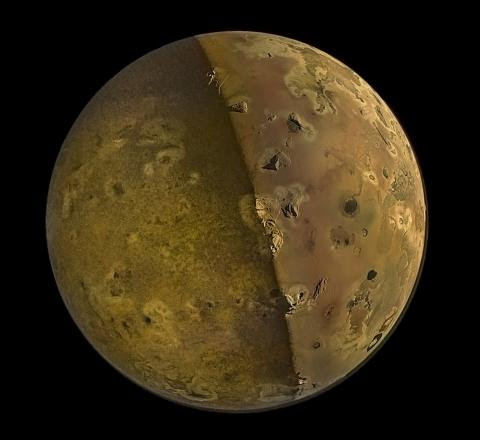
An image showing the day and night sides of Io. Emma Walimaki/NASA.

Io is the innermost of the four Galilean Moons of Jupiter (the four large moons discovered by Galileo Galilei in January 1610), and is one of the most distinctive bodies in the Solar System, with a surface dominated by a series of extensive volcanic fields. The volcanism is thought to be caused by tidal forces, as Io is pulled by the gravitational forces of both Jupiter and the other large Galilean Moons, deforming and heating the moon's interior. This has led to a body unlike any other in the Outer Solar System, with no significant ice or hydrocarbon deposits (presumably lost due to the heat of the volcanic activity) and a silicate rock surface surrounding an iron or iron-sulphur core.

A high colour image of Io. NASA.

See also...

Follow Sciency Thoughts on Facebook.

Follow Sciency Thoughts on Twitter.


Thursday, 2 November 2023

Jupiter approaches opposition.

The planet Jupiter will come to opposition (be directly opposite the Sun) at 4.55 am GMT on Friday 3 November 2023. This means that it will be at its closest to the Earth this year, about 3.95 AU (3.9 times the average distance between the Earth and the Sun, or about 591 295 000 km), and completely illuminated by the Sun. While it is not obvious to the naked eye observer, the planets have phases just like those of the Moon; being further from the Sun than the Earth, Jupiter is 'full' when directly opposite the Sun.  

The orbit and position of Jupiter and the planets of the Inner Solar System on 3 November 2023. In the Sky.

While the relative positions of the planets have no direct influence on life on Earth, the opposition of Jupiter does present the best opportunity for observations of the planet by Earth-based observers. On Friday 3 November, Jupiter will appear as a bright object in the constellation of Ares. Seen through a moderate sized telescope both the planet and its larger moons should be visible, Although the event coming between the Full Moon and Third Quarter Moon may hamper viewing somewhat.

See also...

Follow Sciency Thoughts on Facebook.

Follow Sciency Thoughts on Twitter.


Friday, 16 December 2022

NASA releases dramatic image of Io as Juno Spacecraft begins extended study of the Jovian moon.

NASA has released a dramatic image of Jupiter's moon Io, showing a surface covered by hundreds of active volcanoes, which was taken by the Jovian Infrared Auroral Mapper imager on the Juno Spacecraft on 5 July 2022. The image was taken during a close flyby of the moon, when the spacecraft was about 80 000 km from its surface (for comparison, the International Space Station is 408 km above the Earth's surface, while the Earth's Moon orbit's at an average of 384 300 km).

The volcano-laced surface of Jupiter’s moon Io was captured in infrared by the Juno spacecraft’s Jovian Infrared Auroral Mapper imager as it flew by at a distance of was about 80 000 km on 5 July 2022. Brighter spots indicate higher temperatures in this image. NASA/JPL/Caltech/Southwest Research Institute/Agenzia Spaziale Italiana/Instituto Nazionale di AstroFisica.

Io is the innermost of the four Galilean Moons of Jupiter (the four large moons discovered by Galileo Galilei in January 1610), and is one of the most distinctive bodies in the Solar System, with a surface dominated by a series of extensive volcanic fields. The volcanism is thought to be caused by tidal forces, as Io is pulled by the gravitational forces of both Jupiter and the other large Galilean Moons, deforming and heating the moon's interior. This has led to a body unlike any other in the Outer Solar System, with no significant ice or hydrocarbon deposits (presumably lost due to the heat of the volcanic activity) and a silicate rock surface surrounding an iron or iron-sulphur core.

The release coincides with another flyby of the Jovian Moon, on 15 December 2022, the first of a series of nine close passes, two of them coming within 1500 km of the moon's surface, over the next eighteen months, during which Io will become a focus of research by the Juno Spacecraft. Previous research has shown that the small moon's numerous volcanoes are a significant contributing factor to Jupiter's spectacular polar aurora's, constantly raining charged particles down upon the atmosphere of the planet, which are then swept toward's the poles by Jupiter's powerful magnetic field.

See also...

Follow Sciency Thoughts on Facebook.

Follow Sciency Thoughts on Twitter.