Gall Crabs, Cryptochiridae, are
small Crabs which live in burrows within living Corals, causing the Coral to
grow around the living Crab. Most species live in tropical reef Corals, where
some can reach very high population densities, though some are known from deep
water Corals. Gall Crabs are known to have a global distribution, probably
occurring wherever there are Corals, but have only been extensively studied in
a few areas where specialists on the group have worked, with additional records
from other parts of the world collected as parts of more general biological
surveys.
In a paper published in the
journal Zootaxa on 16 March 2015, Sancia van der Meij of the Department of Marine Zoology at the Naturalis Biodiversity Center, Michael Berumen of the Red Sea Research Center of the King Abdullah University of Science and Technology
and Gustav Paulay of the Florida Museum of Natural History at the University of Florida, describe a new species of Gall Crab from the Saudi Arabian Red Sea and
reefs in the Gulf of Oman.
The new species is placed in the
genus Fizesereneia, and given the
specific name panda in reference to
its colouration; whitish with two black blotches on its back which resemble the
eye patches of a Giant Panda. The species is described from twelve female and
one male specimens collected from the Farasan Banks and Islands and the reefs
off Thuwal on the Saudi Arabian Red Sea coast and one male and one female from
off Bandar Al-Khayran in the Gulf of Oman.

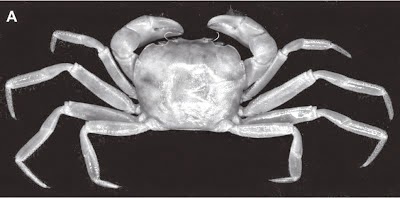
Fizesereneia panda,
colouration in life. (A, B) female in dorsal (A) and ventral (B) view. (C, D)
male in dorsal (A) and ventral (B) view. Arthur Anker & Patrick Norby in
van der Meij et al. (2015).
These showed very little
variation in size with females being 4.2-4.3 mm in length and 3.4-3.6 mm in
width, and the males 4.2 mm in length and 3.2 mm in width. The colouration was
more variable, with the white areas of some specimens being more bluish than in
others, while the red areas were more reddish in some specimens. The male from
the Arabian coast was reddish in colour, the male from the Gulf of Oman had
blue and green spots.

Fizesereneia panda, female
(left) and male (right) specimens in dorsal view. Erik-Jan Bosch in van der
Meij et al. (2015).
This is the first record of the
genus Fizesereneia from the Red Sea
or Gulf of Oman, the genus has previously been recorded from Vietnam,
Indonesia, Japan, Australia, and Micronesia. Like all previous members of the
genus it was found on Corals belonging to the Family Lobophylliidae, and also
like most other members of the genus it seems to be slightly flexible about
host, being found on two species of Lobophyllia
in the Red Sea and on the closely related Symphyllia recta in the Gulf of Oman
(a species which has not been found in the Red Sea to date); most other genera
of Gall Crabs produce species specific to a single Coral host.

Fizesereneia panda (circled)
in Lobophyllia corymbosa at Shi'b
Ammar on the Farasan Banks on the Red Sea Coast of Saudi Arabia. Sancia van der
Meij in van der Meij et al. (2015).
See also…

Gall Crabs, Cryptochiridae, are colony-forming Crabs inhabiting Coral reefs. They dwell in tunnels within the Coral surface, often at very high population densities, the females causing the Corals to form galls (tumour-like growths) which they use for protection.
Follow Sciency Thoughts on
Facebook.