Showing posts with label Grasshoppers. Show all posts

Monday, 13 April 2020

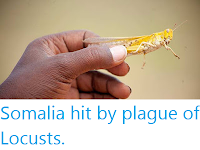
Emerging Locust swarms threaten further food insecurity in East Africa and the Arabian Peninsula.

The Food and Agriulture Organisation's Locust Watch Program has issued a warning that several new Desert Locust, Schistocerca gregaria, swarms are emerging in northern Kenya, southern Ethiopia, Somalia and Yemen, threatening further food insecurity in the region. The area has already been suffering the worst Locust outbreak in 70 years, leading to the destruction of crops across Ethiopia, Somalia, Kenya, Djibouti, Eritrea, Tanzania, Sudan, South Sudan, Uganda, Yemen, Oman and Saudi Arabia, but the agency has warned that the Insects are breeding rapidly in remote areas where there is little oportunity for aerial spraying, the most effective way of controlling them, and that populations emerging now would be likely to swarm in June, which is peak crop growing time in the region. 

A swarm of Desert Locusts, Schistocerca gregaria, in Isiolo county, Kenya. Sven Torfinn/AP.

Desert Locusts typically have two or three generations in a year, but when conditions are favourable then five or more generations can occur. The females lay eggs in an ootheca (egg sack) in soft sand, where they can remain dormant until conditions are favourable or hatch within a few days. Hatchlings can reach maturity in about five weeks, eating as much as one-and-a-half times their body weight each day, when they are potentially able to breed again.

 A swarm of Locusts in the Somali Region of Ethiopia. Giulia Paravicini/Reuters.

The adult form of the Desert Locust has two forms, the more usual solitary form, which does not usually move far from the area where they emerge, and a gregarious form, which forms large swarms and can roam long distances. The change from solitary to gregarious Locusts can happen in individuals, which change from one to the other in response to a rise in population density, but the reverse, a change from gregarious to solitary Locusts, can only happen when a new generation reaches maturity.

Solitary (top) and gregarious (bottom) Desert Locust nymphs. Compton Tucker/NASA/Goddard Space Flight Center/Wikimedia Commons.

See also...

https://sciencythoughts.blogspot.com/2019/12/locust-swarms-begin-moving-from.htmlhttps://sciencythoughts.blogspot.com/2019/12/somalia-hit-by-plague-of-locusts.html
https://sciencythoughts.blogspot.com/2019/10/danatettix-hoffeinsorum-new-species-of.htmlhttps://sciencythoughts.blogspot.com/2019/02/plagues-of-locusts-from-sudan-and.html
https://sciencythoughts.blogspot.com/2018/11/poecilocloeus-coffeaphilus-new-species.htmlhttps://sciencythoughts.blogspot.com/2017/12/acutogordius-taiwanensis-new-species-of.html
Follow Sciency Thoughts on Facebook.

Saturday, 23 February 2019

Plagues of Locusts from Sudan and Eritrea threatens Egypt and Saudi Arabia.

Nations around the Red Sea are being threatened by a series of Desert Locusts, Schistocerca gregaria, that have been breeding in Sudan and Eritrea over the winter. The Insects often build up in numbers towards the end of summer in the region, but typically the end of the rainy season in October results in a fall-off of these numbers, but this year exceptionally wet weather in the region has enabled them to keep breeding through the dry season. A further two generations of Locusts have been born in East Africa since October, with one swarm crossing the Red Sea to Saudi Arabia, where they have also been reported to be breeding in the country's Empty Quarter, with Locusts reaching the borders of the United Arab Emirates, and potentially threatening Yemen, a country already devastated by war and famine, and potentially crossing the Persian Gulf to reach southern Iran, Pakistan or even India. Another swarm has been moving up the west coast of the Red Sea, and is thought likely to reach Egypt in the near future.

Desert Locusts in Abu Dhabi, United Arab Emirates, this month. Getty Images.

Desert Locusts typically have two or three generations in a year, but when conditions are favourable then five or more generations can occur. The females lay eggs in an ootheca (egg sack) in soft sand, where they can remain dormant until conditions are favourable or hatch within a few days. Hatchlings can reach maturity in about five weeks, eating as much as one-and-a-half times their body weight each day, when they are potentially able to breed again.

The adult form of the Desert Locust has two forms, the more usual solitary form, which does not usually move far from the area where they emerge, and a gregarious form, which forms large swarms and can roam long distances. The change from solitary to gregarious Locusts can happen in individuals, which change from one to the other in response to a rise in population density, but the reverse, a change from gregarious to solitary Locusts, can only happen when a new generation reaches maturity.

Solitary (top) and gregarious (bottom) Desert Locust nymphs. Compton Tucker/NASA/Goddard Space Flight Center/Wikimedia Commons.

See also...
https://sciencythoughts.blogspot.com/2018/11/poecilocloeus-coffeaphilus-new-species.htmlhttps://sciencythoughts.blogspot.com/2017/12/acutogordius-taiwanensis-new-species-of.html
https://sciencythoughts.blogspot.com/2017/06/sphodromerus-carapezzanus-new-species.htmlhttps://sciencythoughts.blogspot.com/2016/01/arulenus-miae-new-species-of-pygmy.html
https://sciencythoughts.blogspot.com/2015/08/eneopterine-crickets-from-leyte-island.htmlhttps://sciencythoughts.blogspot.com/2015/05/three-new-species-of-mud-crickets-from.html
Follow Sciency Thoughts on Facebook.

Saturday, 17 November 2018

Poecilocloeus coffeaphilus: A new species of Masked Grasshopper from Coffee farms in Colombia.

Masked Grasshoppers of the genus Poecilocloeus are brightly coloured medium-sized Grasshoppers found in the tropical forests of the Americas, where they are found at all levels within the forest, from low shrubs to the canopy of large trees, though in areas disturbed by Human activity several species formerly found in the canopy have managed to adapt to new environments closer to the ground. To date 64 species have been described, 63 of them from the Amazon Basin and one from Costa Rica.

In a paper published in the journal Insecta Mundi on 27 April 2018, Luis Miguel Constantino of the Disciplina de Entomología at the Centro Nacional de Investigaciones de Café, Oscar Cadena-Castañeda of the Grupo de Investigación en Artrópodos ‘Kumangui’ at the Universidad Distrital Francisco José de Caldas, Juan Manuel Cardona Granda of Carbon Decisions International, and Pablo Benavides Machado and Carmenza Góngora Botero, also of the Disciplina de Entomología at the Centro Nacional de Investigaciones de Café, describe a new species of Poecilocloeus from two Coffee farms in Antioquia Department, Colombia.

The new species is named Poecilocloeus coffeaphilus, meaning ‘Coffee lover’, in reference to its apparent fondness for Coffee Plants. These are medium-sized Grasshoppers, with the males reaching about 22 mm in length, and the slightly more robust females 28-30 mm. They are predominantly dark and lime green in colour, with some pink and yellow markings. The antennae are pink or brown, and the eyes grey. The species is found on the eastern slope of the Western Cordillera of Colombia in the Cauca River canyon at altitudes of between 1600 and 1800 m above sealevel.

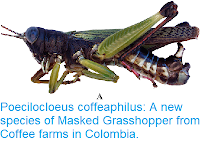
Poecilocloeus coffeaphilus (male). (A) Adult male, lateral view. (B) Dorsal view with right wing spread. Constantino et al. (2018).

The species has apparently been known to Coffee farmers in the region since the 1960s, but has not previously been the subject of any published scientific publication. Infestations typically starts on Coffee plots close to remnant fragments of forest and are typically noticed at the beginning of the rainy season (in March) when nymphs begin to emerge from the ground. Since each female is capable of laying 6-8 ootheca (egg masses), each containing 15-30 eggs, the number of Grasshoppers tends to climb rapidly. The nymphs of the species feed on leaves, avoiding the veins, so that the leaves become hollowed out, eventually turning brown and falling. Adults are capable of completely consuming leaves, leaving only the central vein, and will also attack and consume the fruit of the plant (i.e. the Coffee beans). Damage caused by the Grasshoppers can also serve as an entrance for Fungal pathogens, which cause further damage to the plants.

Damage caused by adults of Poecilocloeus coffeaphilus on coffee plants. (A) Close-up of leaf damage. (B) Scrapings on the bark of stems and branches. (C) Damage of ripe fruit. (D)-(E) Damage of unripe and near ripe fruits. (F) Fruits with the pulp consumed. (G) Coffee fruits with the exocarp and pulp completely eaten off and the grains exposed. Constantino et al. (2018).

Away from the Coffee farms Poecilocloeus coffeaphilus was also found in the canopy of the tree Ladenbergia oblongifolia, like the Coffee plant a member of the Rubiaceae, a group of Plants not usually attacked by Grasshoppers, which suggests that this species might have been suitably pre-adapted for the arrival of Coffee, and East Africa plant grown in large monocultural plantations, which clearly provides an excellent new opportunity. As such the species is a serious economic threat, though as Coffee is a rainforest plant growing in ecologically sensitive environments, Constantino et al. caution against trying to control the Grasshoppers with chemical pesticides, instead suggesting that the Grasshoppers could be managed using a biological control such as Nematodes or Fungi.

Natural enemies of Poecilocloeus coffeaphilus. (A) Leaf Mantis Acanthops centralis. (B) Leaf Mantis Acontista cordillerae. (C) Nematode Mermis sp., parasite of Poecilocloeus coffeaphilus adults. (D) Assassin Bug Zelus vespiformis. (E) Entomopathogenic Fungi Beauveria bassiana on adult of Poecilocloeus coffeaphilus. (F) Beauveria bassiana on Poecilocloeus coffeaphilus nymph. Constantino et al. (2018).

See also...

https://sciencythoughts.blogspot.com/2017/12/acutogordius-taiwanensis-new-species-of.htmlhttps://sciencythoughts.blogspot.com/2017/06/sphodromerus-carapezzanus-new-species.html
https://sciencythoughts.blogspot.com/2016/01/arulenus-miae-new-species-of-pygmy.htmlhttps://sciencythoughts.blogspot.com/2015/08/eneopterine-crickets-from-leyte-island.html
https://sciencythoughts.blogspot.com/2015/05/three-new-species-of-mud-crickets-from.htmlhttps://sciencythoughts.blogspot.com/2015/01/two-new-species-of-katydids-from.html
Follow Sciency Thoughts on Facebook.

Wednesday, 21 June 2017

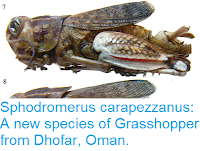
Sphodromerus carapezzanus: A new species of Grasshopper from Dhofar, Oman.

The Arabian Peninsula lies between the continents of Africa and Asia, providing a bridge between the two, and the area hosts a mixture of African and Asian wildlife. The area also contains a wide range of micro-habitats, particularly where large expanses of arid desert separate isolated areas with moister climates. These isolated micro-habitats are often home to endemic species, not found anywhere else.

In a paper published in the journal ZooKeys on 8 June 2017, Bruno Massa of the Department of Agriculture at the University of Palermo describes a new species of Grasshopper from Wadi Ayun in the Dhofar Governate of Oman.

The new species is placed in the genus Sphodromerus, and given the specific name carapezzanus, in honour of Attilio Carapezza, the Italian heteropterologist (scientist that studies True Bugs, Heteroptera), who collected the specimens from which the species is described, during an expedition to the area by the Museum of Cardiff in 2016. The species is described from two specimens, one male and one female. Both are dark brown in colour with a rough surface and some lighter spots, the female being slightly larger than the male. 

Sphodromerus carapezzanus. Male (top) and female (bottom). Massa (2017).

See also...

http://sciencythoughts.blogspot.co.uk/2016/01/arulenus-miae-new-species-of-pygmy.htmlhttp://sciencythoughts.blogspot.co.uk/2015/08/eneopterine-crickets-from-leyte-island.html
http://sciencythoughts.blogspot.co.uk/2015/05/three-new-species-of-mud-crickets-from.htmlhttp://sciencythoughts.blogspot.co.uk/2015/01/two-new-species-of-katydids-from.html
http://sciencythoughts.blogspot.co.uk/2014/10/three-new-species-of-katydid-from-china.htmlhttp://sciencythoughts.blogspot.co.uk/2014/08/a-new-species-of-pygmy-grasshopper-from.html
Follow Sciency Thoughts on Facebook.

Saturday, 31 May 2014

A new species of Grasshopper from Oaxaca State, Mexico.

Grasshoppers (Acrididae) are large Insects related to Crickets and Katydids. They undergo incomplete metamorphosis, with juveniles essentially similar to adults, lacking only wings and sexual characteristics. Grasshopper eggs are laid in ootheca (egg cases) which hold a number of eggs arranged like peas in a pod. The oldest known fossil Grasshoppers date from the Early Jurassic.

In a paper published in the journal Zootaxa on 1 May 2014, Derek Woller of the Department of Biology at the University of Central Florida, Paolo Fontana of Protezione delle piante e biodiversità agroforestale at the Centro Trasferimento Tecnologico at the Fondazione Edmund Mach and Ricardo Mariño-Pérez and Hojun Song, also of the Department of Biology at the University of Central Florida, describe a new species of Grasshopper from the pine-oak forests of the Sierra Madre del Sur Mountain Range in Oaxaca State, Mexico.

The new species is named Liladownsia fraile, where ‘Liladownsia’ honours the Grammy Award-winning Mexican singer-songwriter Ana Lila Downs Sánchez, who performs under the name ‘Lila Downs’, and ‘fraile’ is a Spanish word for monk or friar, a reference to the swollen prozona (front part of the abdomen) which resembles the hood of a monk, and which gets the Grasshopper its local name, ‘Chapulín de Capucho’, the Hooded Grasshopper.

Field photographs of both sexes of Liladownsia fraile from the type locality in Oaxaca, Mexico: (A) Female. (B) Male. Woller et al. (2014).

Liladownsia fraile is a large, robust Grasshopper, with adult males reaching 29.49 mm in length and adult females reaching 41.46 mm. It is slow moving for a Grasshopper, and brightly coloured, with at least two male and one female colour forms.

Two different colour variations in adult male Liladownsia fraile. Woller et al. (2014).

Female Liladownsia fraile. Woller et al. (2014).

Liladownsia fraile was found living around the boundaries of Pine-Oak forests between 1900 and 3000 m above sea level, in a shrubby layer at the edge of the woodland, with acid soils and a temperature range of 10-26°C, and annual precipitation from 350-2000 mm per year. Its preferred host plant is the Pineapple Sage, Salvia elegans. This is a habitat that ranges from Mexico to Guatemala, so the Grasshopper may have a similarly extensive range.

See also…


The modern Insect Order Orthoptera (Grasshoppers, Crickets and Katydids etc.) appeared in the fossil record in the Late Carboniferous. It is placed by Palaeoentomologists in the Superorder Archaeorthoptera, which comprises both the Orthopterans and related groups known from the late Palaeozoic and Mesozoic, but which...


The Rancho La Brea Tar Pits of Los Angeles County are renowned worldwide for their well preserved late-Pleistocene fossils, notably...


Mole Crickets, Gryllotalpidae, are burrowing insects related to...


Follow Sciency Thoughts on Facebook.