Showing posts with label Orthoptera. Show all posts

Friday, 4 July 2025

Eupholidoptera stelae: A new species of Bush Cricket from Cyprus.

Bush Crickets of the genus Eupholidoptera are found around the Mediterranean Basin from southern France to Turkey and the Levant. There are currently 55 known species, mostly with very limited distributions. The maximum diversity in the genus has been recorded from Greece (26 species) and Turkey (21 species). The cryptic habits of these Crickets, which are almost entirely nocturnal and mostly live in dense thorn-scrub, means that new species are still being discovered fairly regularly. The standard method of sampling Orthopterans, capture by hand, is difficult with cryptic groups such as Eupholidoptera, but members of the genus have been captured in baited pit traps set for Spiders and Beetles, which offers an alternative way to study the group.

In a paper published in the journal Zootaxa on 26 June 2025, Luc Willemse of the Naturalis Biodiversity Center, Christodoulos Makris of Lemesós on Cyprus, and Baudewijn Odé of Plasmolen in the Netherlands, describe a new species of Eupholidoptera from the Troodos Massif.of Cyprus.

The new species is named Eupholidoptera stelae in honour of Stela Makris, the daughter of Christodoulos Makris. It is described from a series of specimens obtained from baited traps and 'wine ropes' (ropes made from absorbent material which has been soaked in a mixture of vinagar and sugar and draped over shrubs and bushes - a method used primarily to capture Moths) in the Cedar and maquis forests of the Troodos Massif of Cyprus.

Eupholidoptera stelae field images. (1) Female Cedar Valley 07/09/2021 on a ‘wine rope’; (2) female Kannoures 23/08/2019; (3) male Kannoures 21/09/2019; (4) male Kannoures 21/09/2019. Christodoulos Makris in Willemse et al. (2025).

Female specimens are, on average, slightly larger than males, measuring between 17.4 and 21.4 mm, compared to between 16.2 and 19.5 mm in males. They are maroon in colour, alternated with some yellowish and blackish parts, a shade of green is visible on the legs. In females the proximal edge of the last abdominal tergite is black.

Eupholidoptera stelae is found at altitudes of 525 m–1515 m in the central and south-western part of the Troodos Massif of Cyprus, a landscape dominated by open Pine and Oak forests. The area of available habitat appears to be over 1000 km², and while it has only been detected in an area of about 24 km², it is difficult to detect and could be more widespread. This area receives a high number of tourist visits, but falls mostly within a series of national reserves, and is largely protected from development. For this reason, Willemse et al. do not believe that Eupholidoptera stelae needs to be included on the International Union for the Conservation of Nature's Red List of Threatened Species.

Habitats of Eupholidoptera stelae. (250 The central and south-western part of Troodos Massif. (26) Open Black Pine, Pinus nigra, forest with an undergrowth of Golden Oak, Quercus alnifolia, Grecian Whitebeam, Sorbus graeca and Holy Bramble, Rubus sanctus, in the Kannoures area of the Troodos Mountains,  (27)  Cedar  forest  with  the  endemics Cyprus Cedar, Cedrus  brevifolia,  and Golden Oak, Quercus  alnifolia,  in the Tripilos  area  of  Pafos  Forest,  (28) Shrubs including the endemic Golden Oak,  Quercus alnifolia, in Turkish Pine, Pinus brutia, forest. Christodoulos Makris in Willemse et al. (2025).


See also...
Monday, 13 April 2020

Emerging Locust swarms threaten further food insecurity in East Africa and the Arabian Peninsula.

The Food and Agriulture Organisation's Locust Watch Program has issued a warning that several new Desert Locust, Schistocerca gregaria, swarms are emerging in northern Kenya, southern Ethiopia, Somalia and Yemen, threatening further food insecurity in the region. The area has already been suffering the worst Locust outbreak in 70 years, leading to the destruction of crops across Ethiopia, Somalia, Kenya, Djibouti, Eritrea, Tanzania, Sudan, South Sudan, Uganda, Yemen, Oman and Saudi Arabia, but the agency has warned that the Insects are breeding rapidly in remote areas where there is little oportunity for aerial spraying, the most effective way of controlling them, and that populations emerging now would be likely to swarm in June, which is peak crop growing time in the region. 

A swarm of Desert Locusts, Schistocerca gregaria, in Isiolo county, Kenya. Sven Torfinn/AP.

Desert Locusts typically have two or three generations in a year, but when conditions are favourable then five or more generations can occur. The females lay eggs in an ootheca (egg sack) in soft sand, where they can remain dormant until conditions are favourable or hatch within a few days. Hatchlings can reach maturity in about five weeks, eating as much as one-and-a-half times their body weight each day, when they are potentially able to breed again.

 A swarm of Locusts in the Somali Region of Ethiopia. Giulia Paravicini/Reuters.

The adult form of the Desert Locust has two forms, the more usual solitary form, which does not usually move far from the area where they emerge, and a gregarious form, which forms large swarms and can roam long distances. The change from solitary to gregarious Locusts can happen in individuals, which change from one to the other in response to a rise in population density, but the reverse, a change from gregarious to solitary Locusts, can only happen when a new generation reaches maturity.

Solitary (top) and gregarious (bottom) Desert Locust nymphs. Compton Tucker/NASA/Goddard Space Flight Center/Wikimedia Commons.

See also...

https://sciencythoughts.blogspot.com/2019/12/locust-swarms-begin-moving-from.htmlhttps://sciencythoughts.blogspot.com/2019/12/somalia-hit-by-plague-of-locusts.html
https://sciencythoughts.blogspot.com/2019/10/danatettix-hoffeinsorum-new-species-of.htmlhttps://sciencythoughts.blogspot.com/2019/02/plagues-of-locusts-from-sudan-and.html
https://sciencythoughts.blogspot.com/2018/11/poecilocloeus-coffeaphilus-new-species.htmlhttps://sciencythoughts.blogspot.com/2017/12/acutogordius-taiwanensis-new-species-of.html
Follow Sciency Thoughts on Facebook.

Thursday, 26 December 2019

Locust swarms begin moving from Pakistan into northwest India.

Swarms of Desert Locusts, Schistocerca gregaria, that have been troubling Pakistan since November have began to move across the border into neighbouring areas of Gujarat and Rajastan states, India, this week, threatening crops in the region. Farmers in the area are reported to be battling the Insects on their own, by burning tyres and banging pots and drums, while complaining that little support is being received from central government, despite ample warnings having been given by Pakistan.

Locusts attacking crops in Gujarat State, India, this week. Go News India.

Desert Locusts typically have two or three generations in a year, but when conditions are favourable then five or more generations can occur. The females lay eggs in an ootheca (egg sack) in soft sand, where they can remain dormant until conditions are favourable or hatch within a few days. Hatchlings can reach maturity in about five weeks, eating as much as one-and-a-half times their body weight each day, when they are potentially able to breed again.

The adult form of the Desert Locust has two forms, the more usual solitary form, which does not usually move far from the area where they emerge, and a gregarious form, which forms large swarms and can roam long distances. The change from solitary to gregarious Locusts can happen in individuals, which change from one to the other in response to a rise in population density, but the reverse, a change from gregarious to solitary Locusts, can only happen when a new generation reaches maturity.

 Solitary (top) and gregarious (bottom) Desert Locust nymphs. Compton Tucker/NASA/Goddard Space Flight Center/Wikimedia Commons.

See also...

https://sciencythoughts.blogspot.com/2019/12/somalia-hit-by-plague-of-locusts.htmlhttps://sciencythoughts.blogspot.com/2019/10/danatettix-hoffeinsorum-new-species-of.html
https://sciencythoughts.blogspot.com/2019/02/plagues-of-locusts-from-sudan-and.htmlhttps://sciencythoughts.blogspot.com/2018/11/poecilocloeus-coffeaphilus-new-species.html
https://sciencythoughts.blogspot.com/2017/12/acutogordius-taiwanensis-new-species-of.htmlhttps://sciencythoughts.blogspot.com/2017/06/sphodromerus-carapezzanus-new-species.html
Follow Sciency Thoughts on Facebook.

Thursday, 19 December 2019

Somalia hit by plague of Locusts.

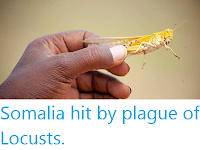
Somalia and neighbouring parts of Ethiopia are suffering the worst Desert Locust, Schistocerca gregaria, outbreak in 25 years according to the Food and Agriculture Organization. The Insects have already destroyed around 700 km² of crops, and are likely to do considerable further damage, as well as potentially spreading to neighbouring countries such as Kenya, Djibouti, Eritrea, South Sudan and Sudan. The large numbers of Locusts this year are thought to have been triggered by the exceptionally heavy rains across the region, which have brought moist conditions in which the Insects thrive. The outbreak is likely to prove difficult to control as the preferred method of dealing with such events, the spraying the Locusts with insecticide from aircraft, is effectively impossible in politically unstable Somalia.

A Desert Locust, Schistocerca gregaria. Food and Agriculture Organization. 

Desert Locusts typically have two or three generations in a year, but when conditions are favourable then five or more generations can occur. The females lay eggs in an ootheca (egg sack) in soft sand, where they can remain dormant until conditions are favourable or hatch within a few days. Hatchlings can reach maturity in about five weeks, eating as much as one-and-a-half times their body weight each day, when they are potentially able to breed again. 

The adult form of the Desert Locust has two forms, the more usual solitary form, which does not usually move far from the area where they emerge, and a gregarious form, which forms large swarms and can roam long distances. The change from solitary to gregarious Locusts can happen in individuals, which change from one to the other in response to a rise in population density, but the reverse, a change from gregarious to solitary Locusts, can only happen when a new generation reaches maturity.

 Solitary (top) and gregarious (bottom) Desert Locust nymphs. Compton Tucker/NASA/Goddard Space Flight Center/Wikimedia Commons.

The rains this year in East Africa are thought to have been made worse by the development of a meteorological phenomenon called a Negative Indian Ocean Dipole. Indian Ocean Dipole Phases are similar to the El Niño/La Niña climatic oscillation that affect the Pacific Ocean. Under normal circumstances equatorial waters off the east coast of Africa and west coast of Indonesia are roughly similar in temperature, however during a Negative Indian Ocean Dipole Phase the waters off the coast of Indonesia become significantly warmer. As the prevailing currents in the area flow west to east, this warm water is then pushed onto the shallower continental shelf of north Australia, where it warms the air over the sea more rapidly, leading to increased evaporation (which fuels rain) and a drop in air pressure over the east Indian Ocean and west Pacific. This in turn drives air currents over the Indian Ocean to flow more strongly west to east, leading to higher rates of  cooling off the coast of Africa (where more water is drawn up from the cool sea depths) and more warming off the coast of Indonesia, fuelling a feedback cycle that tends to remain through the winter season in any year when it forms. This leads to a particularly wet winter across much of Australia, as well as a potentially damaging heatwave in the north, while much of East Africa is at risk of drought (during a Positive Indian Ocean Dipole Phase the reverse happens, with drought in Australia and flooding in East Africa). 

 Areas of warming and cooling and air flow during a Negative Indian Ocean Dipole Phase. Australian Bureau of Meteorology.

See also...

https://sciencythoughts.blogspot.com/2019/10/danatettix-hoffeinsorum-new-species-of.htmlhttps://sciencythoughts.blogspot.com/2019/02/plagues-of-locusts-from-sudan-and.html
https://sciencythoughts.blogspot.com/2018/11/poecilocloeus-coffeaphilus-new-species.htmlhttps://sciencythoughts.blogspot.com/2017/12/acutogordius-taiwanensis-new-species-of.html
https://sciencythoughts.blogspot.com/2017/06/sphodromerus-carapezzanus-new-species.htmlhttps://sciencythoughts.blogspot.com/2016/01/arulenus-miae-new-species-of-pygmy.html
Follow Sciency Thoughts on Facebook.

Wednesday, 16 October 2019

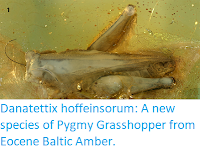
Danatettix hoffeinsorum: A new species of Pygmy Grasshopper from Eocene Baltic Amber.

Pygmy Grasshoppers (Tetrigidae) are small Orthopteran Insects related to True Grasshoppers, Crickets and Katydids, found across much of the globe but most numerous and diverse in the tropics. The name ‘Pygmy Grasshoppes’ is somewhat misleading, as they seldom feed on Grass, instead mainly consuming Bryophytes (Mosses), Algae, Lichens and only the occasional small vascular plant; the group are also known as Grouse Locusts or Ground Hoppers. Surprisingly for Orthopterans, many species are capable swimmers, and live semi-aquatic lifestyles. They are a large group today, with over 1700 described species, however their fossil record is rather limited, with only eleven fossil species described to date.

In a new paper published in the journal Zootaxa on 16 August 2019, Jared Thomas of the Center for Paleontology at the University of Illinois at Urbana-Champaign, Josip Skejo of the Evolution Lab at the University of Zagreb, and the Institute for Molecular Evolution at Heinrich-Heine University Düsseldorf, and Sam Heads, also of the Center for Paleontology at the University of Illinois at Urbana-Champaign, describe a new species of Pygmy Grasshopper from Eocene Baltic Amber.

Baltic amber is the preserved resin of Eocene Coniferous Trees that formed huge forests covering much of Scandinavia and Northern Europe between about 56 and 34 million years ago. Since this amber floats, it is often found on beaches around the Baltic Sea, and sometimes further afield, making the precise dating of individual pieces difficult, though most Baltic Amber is thought to be about 46 million years old.

The new species is named Danatettix hoffeinsorum, where 'Danatettix' means 'Dana's Grasshopper' in honour of Katie Dana, the wife of Jared Thomas, for stimulating his interest in Insects, and 'hoffeinsorum' honours Christel and Hans Hoffeins for their efforts in collecting Baltic Amber; the specimens from which the species is described come from the Hoffeins' collection, but will be donated to the Senckenberg Deutsches Entomologisches Institut in Müncheberg. The new species is described from three specimens, an adult female and two nymphal (immature) males.

Dorsal oblique view adult female Danatettix hoffeinsorum. (1) Photograph. (2) Line drawing. Scale bars are 1 mm. Thomas et al. (2019).

The anterior (front) margin of the pronotum (plate that covers the back of the thorax) is truncated in Danatettix hoffeinsorum, a trait seen in members of the living genera Paurotarsus and Eutettigidea, which are found in Central and South America. This is interesting because like them Danatettix hoffeinsorum appears to be a member of the subfamily Batrachideinae, which today is found in the Americas, Africa, Australia, and parts of tropical Asia, but not Europe. This suggests that the subfamily was more widely distributed in the past.

Left lateral image of early instar male nymph of Danatettix hoffeinsorum. (9) Photograph. (10) Line drawing. Scale bars are 1 mm. Thomas et al. (2019).

See also...

https://sciencythoughts.blogspot.com/2019/02/plagues-of-locusts-from-sudan-and.htmlhttps://sciencythoughts.blogspot.com/2018/11/poecilocloeus-coffeaphilus-new-species.html
https://sciencythoughts.blogspot.com/2017/12/acutogordius-taiwanensis-new-species-of.htmlhttps://sciencythoughts.blogspot.com/2017/06/sphodromerus-carapezzanus-new-species.html
https://sciencythoughts.blogspot.com/2016/01/arulenus-miae-new-species-of-pygmy.htmlhttps://sciencythoughts.blogspot.com/2015/08/eneopterine-crickets-from-leyte-island.html
Follow Sciency Thoughts on Facebook.

Saturday, 23 February 2019

Plagues of Locusts from Sudan and Eritrea threatens Egypt and Saudi Arabia.

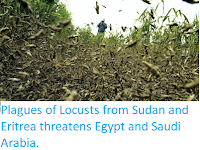
Nations around the Red Sea are being threatened by a series of Desert Locusts, Schistocerca gregaria, that have been breeding in Sudan and Eritrea over the winter. The Insects often build up in numbers towards the end of summer in the region, but typically the end of the rainy season in October results in a fall-off of these numbers, but this year exceptionally wet weather in the region has enabled them to keep breeding through the dry season. A further two generations of Locusts have been born in East Africa since October, with one swarm crossing the Red Sea to Saudi Arabia, where they have also been reported to be breeding in the country's Empty Quarter, with Locusts reaching the borders of the United Arab Emirates, and potentially threatening Yemen, a country already devastated by war and famine, and potentially crossing the Persian Gulf to reach southern Iran, Pakistan or even India. Another swarm has been moving up the west coast of the Red Sea, and is thought likely to reach Egypt in the near future.

Desert Locusts in Abu Dhabi, United Arab Emirates, this month. Getty Images.

Desert Locusts typically have two or three generations in a year, but when conditions are favourable then five or more generations can occur. The females lay eggs in an ootheca (egg sack) in soft sand, where they can remain dormant until conditions are favourable or hatch within a few days. Hatchlings can reach maturity in about five weeks, eating as much as one-and-a-half times their body weight each day, when they are potentially able to breed again.

The adult form of the Desert Locust has two forms, the more usual solitary form, which does not usually move far from the area where they emerge, and a gregarious form, which forms large swarms and can roam long distances. The change from solitary to gregarious Locusts can happen in individuals, which change from one to the other in response to a rise in population density, but the reverse, a change from gregarious to solitary Locusts, can only happen when a new generation reaches maturity.

Solitary (top) and gregarious (bottom) Desert Locust nymphs. Compton Tucker/NASA/Goddard Space Flight Center/Wikimedia Commons.

See also...

https://sciencythoughts.blogspot.com/2018/11/poecilocloeus-coffeaphilus-new-species.htmlhttps://sciencythoughts.blogspot.com/2017/12/acutogordius-taiwanensis-new-species-of.html
https://sciencythoughts.blogspot.com/2017/06/sphodromerus-carapezzanus-new-species.htmlhttps://sciencythoughts.blogspot.com/2016/01/arulenus-miae-new-species-of-pygmy.html
https://sciencythoughts.blogspot.com/2015/08/eneopterine-crickets-from-leyte-island.htmlhttps://sciencythoughts.blogspot.com/2015/05/three-new-species-of-mud-crickets-from.html
Follow Sciency Thoughts on Facebook.