Showing posts with label Ichthyosaurs. Show all posts

Wednesday, 18 December 2019

Ichthyosaur fossil found by dog walker on Somerset Beach.

An Ichthyosaur fossil has been found on a beach in Somerset, England, by a man waling his Dogs. Jon Gopsill of Stolford in Somerset was walking his Dogs, Poppy and Sam, on a beach near his home when he made the find. The specimen appears to comprise a spinal column about 1.65 m in length, plus a number of ribs, although more material may be buried at the site. Mr Gopsill has informed Somerset Heritage and the Natural History Museum of his find. 

 The Stalford Ichthyosaur. Jon Gopsill/BBC.

The beaches at Stalford comprise a wide foreshore platform mad up of Early Jurassic Lias limestones, noted for their production of extensive shallow marine fossils, including large Marine Reptiles. England is noted for having produced a large range of Early Jurassic Ichthyosaur specimens, though the majority of these have come from the Jurassic Coast area of Dorset, with specimens also described from Somerset, Leicestershire and Warwickshire.

Ichthyosaurs were Marine Reptiles known from the Triassic to the Cretaceous. They were fully-aquatic with a Dolphin-like form, and known to have given birth to live young, rather than emerging from the water to lay eggs, as is the case in Turtles and Crocodiles. However the known diversity of the group is probably somewhat skewed by the fact that overwhelming majority of known Ichthyosaurs come England, with the majority of the remaining specimens coming from Europe, North America and Russia.

See also...

https://sciencythoughts.blogspot.com/2017/12/an-ophthalmosaurid-ichthyosaur-from.htmlhttp://sciencythoughts.blogspot.co.uk/2017/09/ichthyosaurus-somersetensis-pregnant.html
http://sciencythoughts.blogspot.co.uk/2016/06/wahlisaurus-massarae-new-species-of.htmlhttps://sciencythoughts.blogspot.com/2016/06/sclerocormus-parviceps-new-species-of.html
http://sciencythoughts.blogspot.co.uk/2014/12/a-new-species-of-hupehsuchian-from.htmlhttp://sciencythoughts.blogspot.co.uk/2012/03/fresh-look-at-albian-ichthyosaur.html

Follow Sciency Thoughts on Facebook.

Thursday, 14 December 2017

An Ophthalmosaurid Ichthyosaur from the Late Jurassic of Gujarat State, India.

Ichthyosaurs were Marine Reptiles known from the Triassic to the Cretaceous. They were fully-aquatic with a Dolphin-like form, and known to have given birth to live young, rather than emerging from the water to lay eggs, as is the case in Turtles and Crocodiles. The group suffered heavily in the End Triassic Extinction, but subsequently recovered their numbers, though not their diversity, with all Middle-Lat Jurassic and Cretaceous Ichthyosaurs known having belonged to a single family, the Ophthalmosauridae, with the exception of a single specimen from the Early Cretaceous of Iraq. However the known diversity of the group is prbably somewhat skewed by the fact that overwhelming majority of known Ichthyosaurs come England, with the majority of the remaining specimens coming from Europe, North America and Russia. Very few Icthyosaurs are known from Gondwana, with only three Jurassic specimens described to date, all from Argentina.

In a paper published in the journal PLoS One on 25 October 2017, Guntupalli Prasad of the Department of Geology at the University of Delhi, Dhirendra Pandey of the Earth and Planetary Sciences Group at Manipal University, Matthias Alberti of the Institut für Geowissenschaften at Christian-Albrechts-Universität zu Kiel, Franz Fürsich of the GeoZentrum Nordbayern at Friedrich-Alexander-Universität Erlangen-Nürnberg, and Mahesh Thakkar and Gaurav Chauhan of the Department of Earth and Environmental Science at KSKV Kachchh University, describe an  Ophthalmosaurid Ichthyosaur from the Late Jurassic Katrol Formation of Kachchh District in Gujarat State, India.

The specimen described comprises a premaxilla, some articulated vertebrae, a left forefin, three isolated phalanges, two mandibular fragments, some ribs, and an associated right forefin, which is probably but not certainly, from the same animal. Because of this partial and fragmentary nature it is not assigned to a specific species or genus.

Field photograph (A) accompanied with a sketch (B) of the excavated ichthyosaur skeleton in the Katrol Formation near Lodai village, Kachchh, India. Prasad et al. (2017).

See also...

http://sciencythoughts.blogspot.co.uk/2017/09/ichthyosaurus-somersetensis-pregnant.htmlhttp://sciencythoughts.blogspot.co.uk/2016/06/wahlisaurus-massarae-new-species-of.html
http://sciencythoughts.blogspot.co.uk/2016/06/sclerocormus-parviceps-new-species-of.htmlhttp://sciencythoughts.blogspot.co.uk/2014/12/a-new-species-of-hupehsuchian-from.html
http://sciencythoughts.blogspot.co.uk/2012/03/fresh-look-at-albian-ichthyosaur.html
Follow Sciency Thoughts on Facebook.

Saturday, 16 September 2017

Ichthyosaurus somersetensis: A pregnant Ichthyosaur from the Early Jurassic of Somerset, England.

Ichthyosaurs were Marine Reptiles known from the Triassic to the Cretaceous. They were fully-aquatic with a Dolphin-like form, and known to have given birth to live young, rather than emerging from the water to lay eggs, as is the case in Turtles and Crocodiles. England is noted for having produced a large range of Early Jurassic Ichthyosaur specimens, with the majority of these have come from the Jurassic Coast area of Dorset, and the area around the village of Street in Somerset, where a number of limestone quarries have produced Ichthyosaur specimens since the middle nineteenth century.

In a paper published in the journal Acta Paleaontologica Polonica on 28 August 2017, Dean Lomax of the School of Earth and Environmental Sciences at The University of Manchester, and Sven Sachs of the Naturkundemuseum Bielefeld, describe a new pregnant Ichthyosaur specimen from Doniford Bay in Somerset, England.

The new specimen is assigned to the species Ichthyosaurus somersetensis, the largest species in the genus, reaching about 1.5 meters, though this is not the largest specimen of the species (it is, however, the first pregnant Ichthyosaurus specimen assigned to a species). The specimen was excavated in the 1990s by commercial fossil hunter Peter Langham, who prepared it by using a tail from another specimen (it lacked one) and adding several Ammonites to the slab on which it was preserved. It was then sold to Swiss fossil and mineral dealers Siber + Siber, who in turn sold it on to the Hanoverian art collector Ernst Schwitters (1940-1998). After his death the specimen, along with other items from his collection, was left to the Kurt & Ernst Schwitters Foundation, who first loaned and then sold specimen to the Niedersächsisches Landesmuseum in Hannover.

(A) Skeleton of Ichthyosaurus somersetensis from the Lower Jurassic (lower Hettangian) of Doniford Bay, Watchet, Somerset, UK. (B) Explantory photograph with the composite/reconstructed sections shown in black; the question marks indicate that the element may have been added to the specimen; arrow points to a large crack that runs across the specimen; star indicates the position of the embryo. Lomax & Sachs (2017).

The embryo in the specimen is located between the ribs, near the mid-posterior dorsal vertebrae. It is identified from a series of 23 vertebral centra, 16 of which are articulated and one of which appears damaged and possibly restored, forming a section of vertebral column 6.37 cm in length. This is associated with a number of delicate ribs and a number of other bones, including a partial fin.

Embryo of Ichthyosaurus somersetensis from the Lower Jurassic (lower Hettangian) of Doniford Bay, Watchet, Somerset, UK, showing articulated vertebral column, isolated forefin, probable scapula (white arrow), ribs, and isolated centra. Lomax & Sachs (2017).

See also...

http://sciencythoughts.blogspot.co.uk/2016/06/wahlisaurus-massarae-new-species-of.htmlhttp://sciencythoughts.blogspot.co.uk/2016/06/sclerocormus-parviceps-new-species-of.html
http://sciencythoughts.blogspot.co.uk/2014/12/a-new-species-of-hupehsuchian-from.htmlhttp://sciencythoughts.blogspot.co.uk/2012/03/fresh-look-at-albian-ichthyosaur.html
Follow Sciency Thoughts on Facebook.

Monday, 27 June 2016

Wahlisaurus massarae: A new species of Ichthyosaur from the Early Jurassic of Nottinghamshire, England.

England is noted for having produced a large range of Early Jurassic Ichthyosaur specimens, though the majority of these have come from the Jurassic Coast area of Dorset, with specimend also described from Somerset, Leicestershire and Warwickshire. A number of specimens are also known from the Early Jurassic of Nottinghamshire, though to date these have been the subject of little organized study.

In a paper published in the Journal of Systematic Palaeontology on 13 June 2016, Dean Lomax of the School of Earth, Atmospheric and Environmental Sciences at The University of Manchester describes a new species of Ichthyosaur from the Early Jurassic Scunthorpe Mudstone Formation of the Normanton Hills, near Normanton on Soar in the district of Rushcliffe, Nottinghamshire.

The species is described from a single specimen, obtained from the collection of Percy Faulks by the Leicester Arts and Museums Service. The specimen has been prepared mechanically and by acid disolution some time between 1952 and 1981, and is currently in several pieces, with the majority on three large blocks. It is named Wahlisaurus massarae, in honour of William Wahl and Judy Massare for their contributions to the study of Mesozoic Marine Reptiles.

Basioccipital, rostrum and dentition of Wahlisaurus massarae. (A) Basioccipital in posterior view; note the extensive extracondylar area, fragment of the left stapes and portion of basisphenoid. (B) Ventral view of mandible and snout with anterior portion of dentary rotated (in dorsal view) and positioned adjacent (dashed line indicates point of fit); note the slenderness of the rostrum and the presence of an overbite. (C) Close-up of the large, long and robust teeth and some of the needle-like teeth positioned under the maxilla. (D) Close-up of three dentary teeth; note the ‘waisted’ morphology, recurved crown and infolded root. Abbreviations: bas, basisphenoid; den, dentary; mx, maxilla (right maxilla); pmx, premaxilla; sta, stapes. Scale bars: (A) 5 cm; (B) 10 cm; (C) 3 cm. Lomax (2016).

The specimen has variable preservation, with some portions articulated and well preserved, and others completely disarticulated and worn The skull is partially crushed with some portions missing completely. It is thought to be a sub-adult, with only partial fusion of the skull and patches of roughness on the articulating surfaces of the humerus, which would be expected to be smooth in a fully mature specimen.

See also...

http://sciencythoughts.blogspot.co.uk/2016/06/sclerocormus-parviceps-new-species-of.htmlSclerocormus parviceps: A new species of Ichthyosaur from the Early Triassic of Anhui Province, China.                                 Ichthyosaurs were Marine Reptiles known from the Triassic to the Cretaceous. They were fully-aquatic with a Dolphin-like form, and known to have given birth to live young, rather than emerging from the water to lay eggs, as is the case in Turtles and Crocodiles...
http://sciencythoughts.blogspot.co.uk/2014/12/a-new-species-of-hupehsuchian-from.htmlA new species of Hupehsuchian from the Early Triassic of Hubei Province, China.      The Hupehsuchians are a group of Marine Reptiles known only from the Early Triassic of Hubei Province, China. Their origins and relationships are obscure, though it has been suggested that they might be...

http://sciencythoughts.blogspot.co.uk/2012/03/fresh-look-at-albian-ichthyosaur.htmlA fresh look at the Albian Ichthyosaur Platypterygius hercynicus.                           The Ichthyosaurs were a group of marine tetrapods that resembled dolphins. They appear in the fossil record in the mid-Triassic about 245 million years ago, and survive till the mid-Cretaceous, about 90 million years ago. During the Jurassic they appear to have been the top marine predators, but in the Cretaceous they were...


Follow Sciency Thoughts on Facebook.

Thursday, 16 June 2016

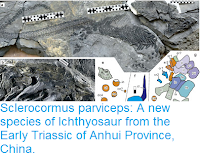
Sclerocormus parviceps: A new species of Ichthyosaur from the Early Triassic of Anhui Province, China.

Ichthyosaurs were Marine Reptiles known from the Triassic to the Cretaceous. They were fully-aquatic with a Dolphin-like form, and known to have given birth to live young, rather than emerging from the water to lay eggs, as is the case in Turtles and Crocodiles. The origin of the group has for a long time been obscure, with large fully aquatic forms known from the Middle Triassic onwards. However several recent discoveries have suggested that they may have been related to the Hupehsuchians, an enigmatic group of Marine Reptiles known from the Early Triassic of China.

In a paper published in the journal Scientific Reports on 23 May 2016, a group of scientists led by Da-Yong Jiang of the Laboratory of Orogenic Belt and Crustal Evolution at Peking University, describe a new species of Ichthyosaur from the Early Triassic Nanlinghu Formation of Anhui Province, China.

The new species is named Sclerocormus parviceps, where 'Sclerocormus' means 'stiff trunk' and 'parviceps' means 'small skull'. The species is described from a single skeleton, 159.9 cm in length and partially compressed. The skull is notably small for an Ichthysaur, even for an early Ichthyosaur (which were generally shorter snouted), having a short snout and comprising only 6.25% of the total bodylength, compared to 12% in the earliest previously known Ichthyosaur, Chaohusaurus.

Sclerocormus parviceps. (a) Whole specimen. (b) Skull. (c) Close-up of gastral basket. (d) Close-up of U-shaped haemal arches. (e) Right forelimb. (f) Shoulder elements. (g) Pelvic girdle and hind limb. (h) Skull elements. Abbreviations: a, angular; ar, articular; as, astragalus; ca, calcaneum; car, caudal rib; ca.v, caudal vertebra; ce, centralia; cl, clavicle; d, dentary; dc, distal carpal; f, frontal; fe, femur; fi, fibula; he, hemal arch; il, ilium; in, intermedium; is, ischium; j, jugal, l, lacrimal; m, maxilla; mc, metacarpal; mt, metatarsal; n, nasal; p, parietal; pm, premaxilla; po, postorbital; pof, postfrontal; prf, prefrontal; pu, pubis; q, quadrate; sa, surangular; sc, scapula; scl, scleral ossicles; sq, squamosal; sr, sacral rib; st, supratemporal; ti, tibia; u, ulna; ul, ulnare. Scale unit in (a) is 1 cm, other scale bars are 2 cm. Jiang et al. (2016).

Sclerocormus parviceps has a short trunk with broad, flattened ribs and an extensive gastric basket covering its underside, similar to the condition seen in Hupehsuchians, strongly supporting a connection between the two groups. The fossil also dates from surprisingly close to the beginning of the Triassic; dating from the Olenekian (251.2-247.2 million years ago, with the beginning of the Triassic dated to 252.2 millions of years ago) which implies Marine Reptiles were colonising the oceans far sooner after the End Permian Extinction than had previously been supposed.

See also...

http://sciencythoughts.blogspot.co.uk/2014/12/a-new-species-of-hupehsuchian-from.htmlA new species of Hupehsuchian from the Early Triassic of Hubei Province, China.      The Hupehsuchians are a group of Marine...
http://sciencythoughts.blogspot.co.uk/2012/03/fresh-look-at-albian-ichthyosaur.htmlA fresh look at the Albian Ichthyosaur Platypterygius hercynicus.                           The Ichthyosaurs were a group of marine tetrapods that resembled dolphins. They appear in the fossil record in the mid-Triassic about 245 million years ago, and survive till the mid-Cretaceous, about 90 million years ago. During the Jurassic they appear to have been the top marine predators, but in the Cretaceous they were overshadowed by other groups...
Follow Sciency Thoughts on Facebook.