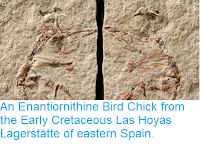
Specimen MPCM-LH-26189 is a hatchling Enantiornithine Bird described from the Early Cretaceous Las Hoyas Deposits of Spain, first described in 2018. Like other Enantiornithine Birds preserved in the Las Hoyas Deposits, specimen MPCM-LH-26189 is preserved in an articulated state, with some soft tissue preservation. However the specimen has no apparent plumage (feathers), which led the scientists describing it to conclude that, like many modern Birds, MPCM-LH-26189 was featherless when it hatched, implying that it was also likely to be altricial (completely dependent on its parents for food and shelter), rather than precocious (able to fend for itself with minimal parental supervision) in nature.
In a paper published in the journal Scientific Reports on 21 March 2019, Thomas Kaye of the Foundation for Scientific Advancement, Michael Pittman of the Vertebrate Palaeontology Laboratory at the University of Hong Kong, and Jesús Marugán-Lobón, Hugo Martín-Abad, José Luis Sanz, and Angela Buscalioni of the Facultad de Ciencias at the Universidad Autónoma de Madrid, re-examine specimen MPCM-LH-26189 using Laser-Stimulated Fluorescence imaging.
Kaye et al. used a 405 nm laser diode to cause the specimen to fluoresce, then imaged it with a Nikon D810 DSLR camera and a 425 nm laser blocking filter, then processed the pictures in Photoshop CS6, using a technique in which the equalisation, saturation and colour balance was adjusted across the entirety of the image, in order to prevent inadvertently manufacturing features.
Specimen MPCM-LH-26189 is surrounded by yellowish stains in several places, which when subjected to Laser-Stimulated Fluorescence imaging revealed filamentous structures, which Kaye et al. interpret as feathers. They further reason that if the hatchling Bird did in fact have feathers, then it is less likely to have been completely altricial at the time of hatching, as in modern Birds species which hatch with feathers are far more likely to be precocious.

Feathers are present in patches across the body, with the best preservation seen on the left side of the neck and on the left wing. The feathers of the left side of the neck are elongate, with bands of darker and lighter colour, with a generally bushy appearance. On the right wing feathers can be seen associated with the radius and ulna, with those on the ulna seeming obliquely in multiple thin filaments. The best preserved feather is associated with the left wing, and is about 3 cm in length, with barbs deriving from the rachis at an angle of about 30°.

Kaye et al. used a 405 nm laser diode to cause the specimen to fluoresce, then imaged it with a Nikon D810 DSLR camera and a 425 nm laser blocking filter, then processed the pictures in Photoshop CS6, using a technique in which the equalisation, saturation and colour balance was adjusted across the entirety of the image, in order to prevent inadvertently manufacturing features.
Specimen MPCM-LH-26189 is surrounded by yellowish stains in several places, which when subjected to Laser-Stimulated Fluorescence imaging revealed filamentous structures, which Kaye et al. interpret as feathers. They further reason that if the hatchling Bird did in fact have feathers, then it is less likely to have been completely altricial at the time of hatching, as in modern Birds species which hatch with feathers are far more likely to be precocious.

Spanish Enantiornithine hatchling MPCM-LH-26189. (A) White light image of the counterslab. (B) Laser-Stimulated Fluorescence image of the slab and counterslab combined (composite image) reveals brown patches around the specimen. These comprise of clumps of elongate feathers associated with the neck and wings (upper arrows) as well as a single long pennaceous feather associated with the left wing (lower arrow). (C) White light image of the slab. Scale bar is 5 mm. Kaye et al. (2019).
Feathers are present in patches across the body, with the best preservation seen on the left side of the neck and on the left wing. The feathers of the left side of the neck are elongate, with bands of darker and lighter colour, with a generally bushy appearance. On the right wing feathers can be seen associated with the radius and ulna, with those on the ulna seeming obliquely in multiple thin filaments. The best preserved feather is associated with the left wing, and is about 3 cm in length, with barbs deriving from the rachis at an angle of about 30°.

Preserved feathering of Spanish Enantiornithine hatchling MPCM-LH-26189 under LSF and white light. Elongate feathers preserving bushy dorsal tips are found near the neck and appear to be cover feathers: (A) under Laser-Stimulated Fluorescence, (B) under white light. Scale bar is 1 mm. Suspected feather clumps are associated with the right wing (C) under Laser-Stimulated Fluorescence, (D) under white light. Scale bar is 3 mm. A long pennaceous feather associated with the left wing is very similar to an Enantiornithine embryo specimen from China (E) under Laser-Stimulated Fluorescence, (F) under white light. Scale bar is 4 mm. Kaye et al. (2019).
The presence of feathers in very young Birds has been seen in other Enantiornithines, and the newly discovered plumage of MPCM-LH-26189 shows that the specimen conforms to this wider pattern. Interestingly the presence of bushy feathers on the neck of the hatchling shows that it possessed cover, as well as flight, feathers, something which has not previously been demonstrated in an Enantiornithine Bird, and the discovery of which adds to our understanding of the biology of the group.
The presence of feathers in very young Birds has been seen in other Enantiornithines, and the newly discovered plumage of MPCM-LH-26189 shows that the specimen conforms to this wider pattern. Interestingly the presence of bushy feathers on the neck of the hatchling shows that it possessed cover, as well as flight, feathers, something which has not previously been demonstrated in an Enantiornithine Bird, and the discovery of which adds to our understanding of the biology of the group.