Showing posts with label Isle of Sheppey. Show all posts

Monday, 1 June 2020

Residents evacuated from their homes after landslide on the Isle of Sheppey.

Around 20 households have been evacuated following a landslide on the north coast of the Isle of Sheppey, on the north coast of Kent in southeast England, on Monday 1 June 2020. The event, a slump on an exposure of London Clay in the cliffs, is about fifteen metres wide and about two metres deep, and partially undermined one house, with the clear potential to extend further, leading the Kent Fire and Rescue Service to order the evacuation of twenty homes, with a further thirteen warned that they could be asked to leave if the slip spread further.

Aerial view of a landslide that partially undermined a house on the north coast of the Isle of Sheppey on Monday 1 June 2020. Kent Fire and Rescue Service.

Photographs of the landslide show excessive water pooled within the slumped material, this is fairly typical of landslides, as excess pore water pressure can overcome cohesion in soil and sediments, allowing them to flow like liquids. Approximately 90% of all landslides are caused by heavy rainfall. However, the north Kent coastal area has been suffering a prolonged bout of dry weather, making such an explanation for the event unlikely. Reports in the local press state that cracks were first seen on the cliffs on Friday 29 May, probably a result of dry cracking of the clay, and that locals had responded by pouring water onto the affected area in the hope of improving the cliffs cohesion, something which had reportedly worked in the past, but which seems highly likely to have triggered the landslip.

Wider angle view of the 1 June 2020 Sheppey landslip. SWNS.

The north coast of the Isle of Sheppey is popular with fossil collectors due to the large number of Eocene fossils it produces. The London Clay outcrops directly on the coast here, and as this is a poorly consolidated, soft sediment, it is easily eroded by the action of the sea, revealing large numbers of highly fossiliferous phosphate nodules, noted for the high quality plant macrofossils (particularly Mangrove Plants) and marine invertebrates (particularly articulated Decapod Crustaceans) that they produce. Unfortunately the same sediment makes conditions at the site extremely treacherous, as the clay readily absorbs large volumes of water, turning into a highly sticky mud that can cause cliff failures in the area, exposing new fossil material, but which can also  trap the unwary, as the weight of a human footfall is sufficient to squeeze the water out of the mud beneath the foot, creating a vacuum that prevents the foot from being lifted again.

A fossil Shark's tooth from the London Clay on the north coast of the Isle of Sheppey. UK Fossils.

See also...

http://sciencythoughts.blogspot.com/2019/10/second-dead-whale-found-in-thames.htmlhttp://sciencythoughts.blogspot.com/2018/09/delphinapterus-leucas-beluga-whale.html
http://sciencythoughts.blogspot.com/2018/03/hundreds-of-artefacts-stolen-from.htmlhttp://sciencythoughts.blogspot.com/2018/03/thousands-of-starfish-wash-up-on.html
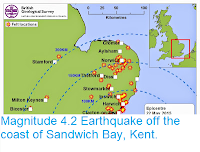
http://sciencythoughts.blogspot.com/2018/02/thousands-of-artifacts-stolen-after.htmlhttp://sciencythoughts.blogspot.com/2015/05/magnitude-42-earthquake-off-coast-of.html

Follow Sciency Thoughts on Facebook.

Tuesday, 16 December 2014

Two teenaged girls rescued from soft mud at popular English fossil hunting site.


Two teenaged girls were rescues by teams from Kent Fire and Rescue and the Whitstable RNLI after becoming trapped in soft mud at Warden Point on the Isle of Sheppey (off the north coast of Kent in the Thames Estuary) on Saturday 2014. Initial attempts to by the Fire Service to reach the girls from land were hampered by the incoming tide, leading to a crew from the Lifeboat Institution to be called. The girls were reported to be suffering from mild hypothermia when rescued, but otherwise unhurt.

The two girls trapped in soft mud at warden point on 13 December 2014. Whitstable RNLI.

Warden Point is popular with fossil collectors due to the large number of Eocene fossils it produces. The London Clay outcrops directly on the coast here, and as this is a poorly consolidated, soft sediment, it is easily eroded by the action of the sea, revealing large numbers of highly fossiliferous phosphate nodules, noted for the high quality plant macrofossils (particularly Mangrove Plants) and marine invertebrates (particularly articulated Decapod Crustaceans) that they produce. Unfortunately the same sediment makes conditions at the site extremely treacherous, as the clay readily absorbs large volumes of water, turning into a highly sticky mud that an trap the unwary, as the weight of a human footfall is sufficient to squeeze the water out of the mud beneath the foot, creating a vacuum that prevents the foot from being lifted again.

An articulated Eocene Lobster, Hoploparia sp., from a phosphate nodule collected at Warden Point on the Isle of Sheppey. Discovering Fossils.

Weather conditions across much of the UK have been extremely wet for the past few days, driven by a storm system the popular press have dubbed the ‘Weather Bomb’, driven by warm weather over the Atlantic Ocean, which has brought with it an area of very low pressure, leading to a storm surge that has brought high tides to coastal areas, and very high rainfall levels. The low pressure above oceanic storms causes water to rise there by ~1 cm for every millibar drop in pressure, leading to a storm surge that can overwhelm low-lying coastal areas, while at the same time the heat leads to high levels of evaporation from the sea - and subsequently high levels of rainfall.

The two girls trapped in soft mud at warden point on 13 December 2014. Whitstable RNLI.

his can cause additional flooding on land, as well as landslides, which are are a common problem after severe weather events, as excess pore water pressure can overcome cohesion in soil and sediments, allowing them to flow like liquids. Approximately 90% of all landslides are caused by heavy rainfall. The extent to which this has happened at Warden Point this weekend is unclear, but photographs from the Whitstable RNLI appear to show signs of recent slumping, and the mud produced by recent slumps is particularly dangerous.


Satellite image showing the typical extent of slumping on the foreshore at Warden Point. Google Maps.


See also…

A large section of cliff at Penarth in the Vale of Glamorgan, roughly 8.4 km southwest of Cardiff, has collapsed onto the foreshore. The incident happened at about 12.40 pm British Summertime (about 11.40 am...

A 67-year-old German Man is being treated for third degree burns after a pebble he picked up while collecting amber on a beach on the country's Baltic...

On Friday 9 March 2012 a large part of the White Cliffs of Dover, in the Crab Bay area, between Langdon Cliffs and the South Foreland Lighthouse fell into the sea. This is thought to be a result of water soaking into the porous chalk, then freezing, cracking the rock of the...


Follow Sciency Thoughts on Facebook.