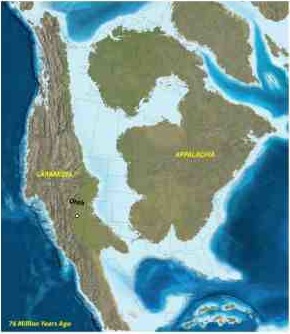
The
Prince Creek Formation of Northern Alaska is noted for the production
of numerous End Cretaceous Dinosaurs, with at least thirteen
different species thought to have been present. One of the most
numerous of these is a Hadrosuarid Dinosaur, known from thousands of dis-articulated bones known from a single horizon, the Liscomb
Bonebed. These bones appear to have come from an animal similar to
the widespread and numerous Late Cretaceous genus Edmontosaurus,
and have often been referred to as Edmontosaurus
sp.
or even Edmontosaurus
regalis (one
of two described species in the genus), although recent studies have
cast doubts upon this designation. The Liscomb Bonebed material has
proved difficult to analyse taxonomically, as it appears to come
almost entirely from juvenile animals, and most Dinosaur species are
identified using characteristics seen in adult animals.
In
a paper published in the journal Acta Palaeontologica Polonica on 22
September 2015, Hirotsugu Mori of the Department of Geosciences at
the University of Alaska Fairbanks, the University of Alaska Museum
and the Saikai City Board of Education, Patrick Druckenmiller of the
University of Alaska Museum and the Department of Geosciences at the
University of Alaska Fairbanks and Gregory Erickson of the Departmentof Biological Science at Florida State University re-examine the
Liscomb Bonebed material and formally describe it as a new species.
As
noted before, almost all the Liscomb Bonebed material is attributed
to juvenile animals, whereas almost all Dinosaur species are
described from adult specimens, making direct comparisons difficult.
However the Liscomb Bonebed clearly shows closer affinities to the
Late Cretaceous Hadrosaur Edmontosaurus
than
to any other Dinosaur, and Edmontosaurus
is one of the most common known Cretaceous Dinosaurs, with a large
number of specimens described from across western Canada and the
western United States. This enabled Mori et
al.
to study the ontogeny of Edmontosaurus,
and document the way in which its bones grew and changed as it got
older, from which they conclude that the Liscomb Bonebed material
represents a new species of Hadrosaur, less closely related to the
two species of Edmontosaurus
than
they are to one-another, but more closely related to these two
species than to their three closest known relatives to date,
Shantungosaurus,
Kerberosaurus
and Kundurosaurus,
all of which are known from northeastern Asia. This new species is
named Ugrunaaluk
kuukpikensis,
where 'Ugrunaaluk'
means 'ancient grazing animal' in the Alaskan Iñupiaq language,
spoken in the area where the material was found, and 'kuukpikensis'
means 'from Kuukpik', the Iñupiaq name for the River Colville,
besides which the Liscomb Bonebed outcrops.
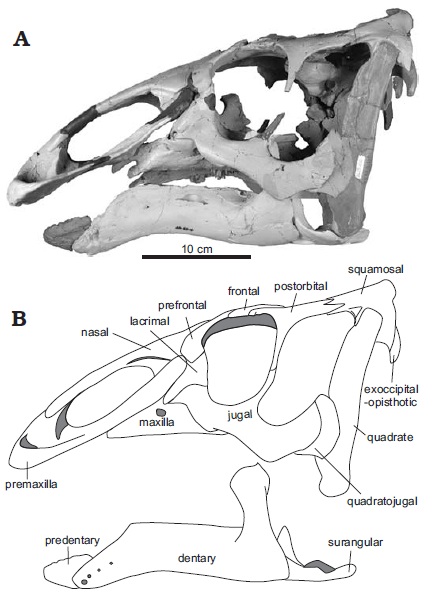
Cranial
reconstruction of Ugrunaaluk
kuukpikensis
from the early Maastrichtian Prince Creek Formation in left lateral
view. Photograph (A) and bone interpretation (B). Mori et
al. (2015).
The
fauna of the Prince Creek Formation is of particular interest to
palaeontologists studying the Late Cretaceous of North America, as it
produces the most northerly known material from the island of
Laramidia, which comprises much of the western United States and
Canada, and which was cut off from the rest of North America by the
Western Interior Seaway, an intracontinental sea created by the high
sea levels associate with the warm Cretaceous climate. The climate in
which the Prince Creek Formation was laid down is interpreted as
having been very cool by Late Cretaceous standards, with a mean
annual temperature of 5–6 °C, and a distinct cold season, which
probably did not produce permanent winter-long freezing, but
certainly would have had cold periods with sub-zero temperatures.
These deposits have produced a wide variety of Dinosaur species
(including at least one Bird) as well as a range of Mammals, but have
produced no members of unequivocally cold-blooded groups such as
Crocodilians, Champsosaurs (an extinct group of Crocodile-like Diapsid Reptiles), Choristodires (also Crocodile-like Diapsid Reptiles),
Squamates (Snakes and Lizards) or Turtles.

Study
area in northern Alaska, USA (A) and location of the Liscomb bonebed
(B). (C) Paleogeographic reconstruction of North America at 70 Ma;
the box indicates the approximate position of Alaska at that time.
Mori et
al. (2015).
See
also...

The preserved tracks of ancient animals such as Dinosaurs can
provide insights into their lifestyles and biology that could not be determined
by examination of bones alone, although such data needs to be interpreted
carefully. Such studies can potentially provide data on herding or other social...

Hadrosaurs, or Duck-Billed Dinosaurs, were large herbivorous...
 A new Lambeosaurine Dinosaur from the French Pyrenees. The Lambeosaurs were a group of hollow crested Hadrosaurs (Duck-billed
Dinosaurs) known from the Late Cretaceous of Asia, North America and
Europe, with all previously described European species...
A new Lambeosaurine Dinosaur from the French Pyrenees. The Lambeosaurs were a group of hollow crested Hadrosaurs (Duck-billed
Dinosaurs) known from the Late Cretaceous of Asia, North America and
Europe, with all previously described European species...
Follow
Sciency Thoughts on Facebook.