Showing posts with label Octahedrites. Show all posts

Saturday, 27 July 2019

Possible meteorite lands in field in Bihar State, India.

A probable meteorite has been handed to the Bihar Museum in Patna after falling in a paddy field in the village of Mahadeva in Madhubani District, Bihar, on Wednesday 24 July 2019. The object is described as weighing about 15 kg, light in colour, and magnetic, which suggests that it may be an iron or nickel-iron meteorites, or octahedrites, which are the most common class of meteorite, and left a hole over a metre deep where it landed. The object is currently on display in the Bihar Museum, though it is planned to send it on the the Srikrishna Science Center to be studied properly.

Villagers in Madhubani District, Bihar, with a possible meteorite that fell nearby on Wednesday 24 July 2019. NDTV.

A meteorite falling from the sky without previously being seen seems unlikely, but a small object entering the Earth's atmosphere in daytime over India would not necessarily produce a bright enough meteor to be seen (a 'meteor' is a bright light in the sky caused by an extra-terrestrial object entering the atmosphere, a meteorite is a piece of rock that is derived from such an object). The brightness of a meteor is caused by friction with the Earth's atmosphere, which is usually far greater than that caused by simple falling, due to the initial trajectory of the object. Such objects typically eventually explode in an airburst called by the friction, causing them to vanish as an luminous object. However this is not the end of the story as such explosions result in the production of a number of smaller objects, which fall to the ground under the influence of gravity (which does not cause the luminescence associated with friction-induced heating).

 Impact crater left by the 24 July 2019 Bihar meteorite. CNN.

These 'dark objects' do not continue along the path of the original bolide, but neither do they fall directly to the ground, but rather follow a course determined by the atmospheric currents (winds) through which the objects pass. Scientists that have witnessed meteors are sometimes able to calculate potential trajectories for hypothetical dark objects derived from meteors using data from weather monitoring services.

See also...

https://sciencythoughts.blogspot.com/2019/03/looking-for-asteroids-in-2018-la-like.htmlhttps://sciencythoughts.blogspot.com/2019/03/fireball-over-united-arab-emirates.html
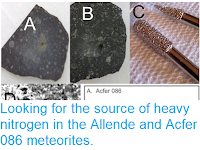
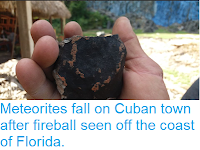
https://sciencythoughts.blogspot.com/2019/03/looking-for-source-of-heavy-nitrogen-in.htmlhttps://sciencythoughts.blogspot.com/2019/02/meteorites-fall-on-cuban-town-after.html
https://sciencythoughts.blogspot.com/2018/11/preserved-magnetic-field-in-mineral.htmlhttps://sciencythoughts.blogspot.com/2018/10/unusual-inickel-iron-meteorite.html
Follow Sciency Thoughts on Facebook.

Saturday, 17 March 2018

Meteorite stolen from Virginia museum.

A meteorite has been stolen from the Science Museum of Virginia in Richmond. The rock, which was contained in a metal stand in an exhibit on the museum's first floor was removed some time between 9.30 am and 2.30 pm on Thursday 15 March 2018, by a thief who apparently used some sort of tool to partially dismantle the stand. Virginia Capitol Police are seeking the perpetrator of the crime, however the item, a nickel-iron meteorite about the size of a tennis ball, may be hard to dispose of, as it is not particularly uncommon, giving it a low value (about US$1500) and a limited number of potential buyers. The museum expects to be able to replace the meteorite cheaply and within a few days.

A meteorite that was stolen from the Science Museum of Virginia on 15 March 2018. Virginia Capitol Police.

Nickel-iron meteorites, or octahedrites, are the most common class of meteorite, being comprised largely of iron with a substantial amount of nickel, leading to the formation of the mineral kamacite, which has an octahedral form, giving these meteorites their name. Strictly speaking iron meteorites are less common than stony meteorites, but they are much more commonly found as they are resilient both to atmospheric entry and terrestrial weathering, and relatively easy to recognise. Only about 5.7% of objects entering the atmosphere are thought to be iron meteorites, but they comprise about 90% of objects in collections. Nickel-iron meteorites are the most common form of iron meteorite, though low-nickel meteorites hexahedrites, are also found. Both are thought to have formed within the interior of large planetesimals in the early Solar System. These bodies were large enough to develop differentiated iron cores (as is seen in the Earth today), but which were subsequently torn apart by tidal forces generated by the larger planets.

Anyone with information on the crime can contact the Virginia Capitol Police on (804) 786-2120. 

See also...

http://sciencythoughts.blogspot.co.uk/2018/02/thousands-of-artifacts-stolen-after.htmlhttp://sciencythoughts.blogspot.co.uk/2018/01/micrometerites-from-late-cretaceous.html
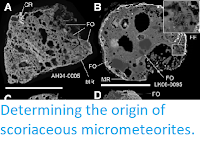
http://sciencythoughts.blogspot.co.uk/2017/12/determining-origin-of-scoriaceous.htmlhttp://sciencythoughts.blogspot.co.uk/2017/12/possible-metoerite-impact-near-thunder.html
http://sciencythoughts.blogspot.co.uk/2017/11/fragments-of-metorite-found-in-british.htmlhttp://sciencythoughts.blogspot.co.uk/2017/10/meteorite-hits-shop-in-paarl-western.html
Follow Sciency Thoughts on Facebook.