Showing posts with label Ophichthidae. Show all posts

Tuesday, 3 May 2016

Muraenichthys velinasalis: A new species of Worm Eel from the Indo-Pacific Region.

Worm Eels, Ophichthidae, are specialized burrowing Eels found in tropical and temperate marine environments from depths of about 750 m to the tidal shallows, with some species being found in rivers and other freshwater habitats. Worm Eels generally lack fins, having lost them as an adaptation to a burrowing lifestyle, though some species have secondarily returned to a pelagic (free-swiming) mode of life.

In a paper published in the journal Zootaxa on 24 December 2015, Yusuke Hibino and Seishi Kimura of the Fisheries Research Laboratory at Mie University describe a new species of Worm Eel from museum specimens collected at a number of sites cross the Indo-Pacific Region.

The new species is placed in the genus Muraenichthys and given the specific name velinasalis, meaning 'veiled nostril'; members of the genus Muraenichthys have two pairs of nostrils, the second of which is covered by a pair of large flaps in Muraenichthys velinasalis. The species is described from five specimens, originally collected from Taiwan, Vanuatu, Queensland, Sri Lanka and the Philippines. All were found in tidal pools or around coral reefs at depths of less than 30 m.

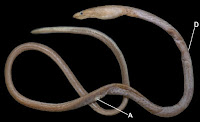
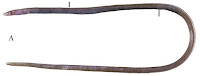
Preserved specimen of Muraenichthys velinasalis, 281 mm TL. A, position of anus; D, origin of dorsal fin. Hibino & Kimura (2015).

See also...
http://sciencythoughts.blogspot.co.uk/2016/03/neenchelys-andamanensis-new-species-of.htmlNeenchelys andamanensis: A new species of Worm Eel from the Andaman Sea.            Worm Eels of the genus Neenchelys are small burrowing Eels found in the Indian ans Pacific Oceans. There are currently about ten...
http://sciencythoughts.blogspot.co.uk/2016/01/neenchelys-gracilis-new-species-of-worm.htmlNeenchelys gracilis: A new species of Worm Eel from Taiwan.                                         Worm Eels, Ophichthidae, are burrowing Eels found...
http://sciencythoughts.blogspot.co.uk/2014/06/japanese-eel-classified-as-endangered.htmlJapanese Eel classified as Endangered.        The International Union for the Conservation of Nature published its annual update of its Red List of Threatened Species on Thursday 12 June 2014, marking the 50th year of the list's existence, and revising the status of a number of Plant and Animal species from around...
Follow Sciency Thoughts on Facebook.

Saturday, 5 March 2016

Neenchelys andamanensis: A new species of Worm Eel from the Andaman Sea.

Worm Eels of the genus Neenchelys are small burrowing Eels found in the Indian ans Pacific Oceans. There are currently about ten described species, with other undescribed species known in museum and university collections.

In a paper published in the journal Zootaxa on 24 December 2015, Yusuke Hibino of the Fisheries Research Laboratory at Mie University, Ukkrit Satapoomin of the Phuket Marine Biological Center and Seishi Kimura, also of the Fisheries Research Laboratory describe a new species of Worm Eel from the Andaman Sea.

The new species is named Neenchelys andamanensis, meaning 'from the Andaman'. It is described from a single specimen collected from a depth of between 520 and 531 m off the coast of Phucket in 1999, and held in the collection of the Phuket Marine Biological Center. The specimen is 336 mm in length, and is of uncertain sex. It can be differentiated from other species in the same genus by the number of ribs and tail vertebrae.

Neenchelys andamanensis, 336 mm TL, Andaman Sea. (A) position of anus, (D) origin of dorsal fin. Hibino et al. (2015).

See also...

http://sciencythoughts.blogspot.co.uk/2016/01/neenchelys-gracilis-new-species-of-worm.htmlNeenchelys gracilis: A new species of Worm Eel from Taiwan.                                         Worm Eels, Ophichthidae, are burrowing Eels found...
http://sciencythoughts.blogspot.co.uk/2014/06/japanese-eel-classified-as-endangered.htmlJapanese Eel classified as Endangered.        The International Union for the Conservation of Nature published its annual update of its Red List of Threatened Species on Thursday 12 June 2014, marking the 50th year of the list's existence, and revising the status of a number of Plant and Animal species from around...
The effect of parasitic Nematodes on European Eels.                                       European Eels, Anguilla anguilla, have a complex life-cycle; they hatch from eggs in the Sargasso Sea...The effect of parasitic Nematodes on European Eels.                                       European Eels, Anguilla anguilla, have a complex life-cycle; they hatch from eggs in the Sargasso Sea...

Follow Sciency Thoughts on Facebook.

Monday, 18 January 2016

Neenchelys gracilis: A new species of Worm Eel from Taiwan.

Worm Eels, Ophichthidae, are burrowing Eels found in tropical and temperate waters from the coastal shallows to depths of about 750 m, with some species found in freshwater ecosystems. They range from about 10 cm to about 3 m in length, and are highly adapted to their burrowing lifestyle, with many species having lost their fins completely, with larger species occasionally mistaken for Sea Snakes.

In a paper published in the journal Zootaxa on 24 December 2015 Hsuan-Ching Ho of the National Museum of Marine Biology & Aquarium and Institute of Marine Biology at the National Dong Hwa University and Kar-Hoe Loh of the Institute of Ocean and Earth Sciences at the University of Malaya describe a new species of Worm Eel from off the coast of Dong-gang on the southeast coast of Taiwan.

The new species is placed in the genus Neenchelys and given the specific name gracilis, meaning slender. The species is described from a single specimen caught in a otter trawl at a depth of about 400 m. The specimen is 429 mm in length, with a fringe of cirri around its nostrils; it has small gill openings and has almost completely lost its pectoral fins (paired fins behind the gills). It is a brownish grey colour.

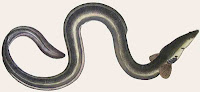
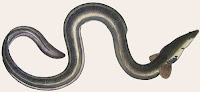
 Neenchelys gracilis. Lateral view of whole fish. Bars indicate the locality of the dorsal-fin origin (left) and the anus (right). Ho & Loh (2015).

See also...

http://sciencythoughts.blogspot.co.uk/2014/06/japanese-eel-classified-as-endangered.htmlJapanese Eel classified as Endangered.        The International Union for the Conservation of Nature published its annual update of its Red List of Threatened Species on Thursday 12 June 2014, marking the 50th year of the list's existence, and revising the status of a number of Plant and Animal species from around...
http://sciencythoughts.blogspot.co.uk/2013/05/the-effect-of-parasitic-nematodes-on.htmlThe effect of parasitic Nematodes on European Eels.                                       European Eels, Anguilla anguilla, have a complex life-cycle; they hatch from eggs in the Sargasso Sea...
http://sciencythoughts.blogspot.co.uk/2012/01/living-fossil-eel-discovered-in-palau.htmlA living fossil eel discovered in Palau.            Eels first appear in the fossil record about 100 million years ago, in the Mid Cretaceous. These Cretaceous forms are primitive compared to modern forms, with incomplete fusion of the dorsal, caudal and anal fins, scales on their bodies and many of the bones lost or fused still present. However they are still clearly eels, with elongate bodies and the loss and fusion of...
Follow Sciency Thoughts on Facebook.