Showing posts with label Pantherines. Show all posts

Monday, 20 November 2017

Panthera leo: A gigantic Lion from the Middle Pleistocene Natodomeri deposits of the Ilemi Triangle, East Africa.

Lions, Panthera leo, first appeared in the Late Pliocene of Africa and spread across Eurasia and North America during the Pleistocene, an expansion matched only bu one other African Mammal, Homo sapiens. During this expansion some very large Lions appeared in the northern part of this range, which are sometimes considered to be separate species, Panthera spelaea, the European Cave Lion, and Panthera atrox, the American Cave Lion. However, since modern Lions are, on average, smallest at the equator and largest at the northernmost and southernmost extent of their ranges, it is possible that these large European and American Lions are simply more extreme examples of this trend from a time when the species occupied a far larger range. This is made more complicated by the fact that very few fossil Lions are known from the Pleistocene of Africa, making comparisons difficult.

In a paper published in the Journal of Paleontology on 9 November 2017, Fredrick Manthi of the Department of Earth Sciences at the National Museums of Kenya, the late Francis Brown of the Department of Geology and Geophysics at the University of Utah, Michael Plavcan of the Department of Anthropology at the University of Arkansas, and Lars Werdelin of the Department of Palaeobiology at the Swedish Museum of Natural History, describe a new and exceptionally large Lion skull from the Middle Pleistocene Natodomeri Deposits of the Ilemi Triangle.

The Ilemi Triangle is a disputed territory located between Ethiopia, South Sudan and Kenya. It is claimed by both South Sudan and Kenya, but is currently controlled and administered by Kenya. The territory has no permanent residents, but is used seasonally by a variety of pastorialist groups (nomadic Cattle herders), whose ranges also include parts of Ethiopia, South Sudan and Kenya. The Natodomeri Deposits have been worked by archaeologists and palaeontologists since the 1960s. They comprise a former northward extension of Lake Natodomeri, producing material dating from about  205 000 to about 35 000 years ago.

The new specimen is a poorly preserved partial skull, but clearly that of a Lion. In the absence of any evidence to the contrary it is assigned to the modern Lion species, Panthera leo. It is estimated to have come from a fully grown young adult, based upon analysis of dental wear. Due to its worn and damaged state it is not possible to accurately state the size of the full skull, but the teeth, generally a good proxy for this size in Leonids, are comparable in size to those of the largest Cave Lions, suggesting that this Animal, which lived close to the equator, was as large as those northern Lions.

Partial skull of Panthera leo from Natodomeri in (top) right lateral and (bottom) occlusal views. Manthi et al. (2017).

See also...

http://sciencythoughts.blogspot.co.uk/2016/12/machairodus-horribilis-new-excepionally.htmlhttp://sciencythoughts.blogspot.co.uk/2014/11/a-pantherine-big-cat-from-late-miocene.html
http://sciencythoughts.blogspot.co.uk/2014/10/a-new-species-of-leopard-cat-from-brazil.htmlhttp://sciencythoughts.blogspot.co.uk/2014/09/the-newton-abbott-lynx.html
http://sciencythoughts.blogspot.co.uk/2014/04/the-origin-and-diversification-of.html
Follow Sciency Thoughts on Facebook.

Monday, 3 November 2014

A Pantherine ‘Big Cat’ from the Late Miocene to Early Pliocene of Tibet.


The Pantherine Felids, or Big Cats, are one of the most conspicuous and charismatic Mammal groups alive today, comprising the Leopards, Lions, Tigers, and Jagaurs. The group are top predators in many ecosystems today, but have a relatively short fossil record, with the earliest known fossils from the group dating from the Pliocene of Africa, about 3.8 million years ago. While the earliest known Pantherines to date have come from Africa, phylogenetic analysis of the group suggests that it originated in Asia, with the African members of the group being closely related and of fairly recent origin.

In a paper published in the Proceedings of the Royal Society: SeriesB Biological Sciences on 13 November 2013, a group of scientists led by Jack Tseng of the Department of Biological Sciences at the University of SouthernCalifornia, the Department of Vertebrate Paleontology at the Natural HistoryMuseum of Los Angeles County and the Division of Paleontology at the American Museumof Natural History, describe a new species of Pantherine Felid from the Zanda Basin of Tibet.

The new species is named Panthera blytheae, in honour of the daughter of Paul and Heather Haaga (presumably Blythe Haaga, though this is not actually stated), for their ‘avid support’ of the Natural History Museum of Los Angeles County. The species is described from a diagenetically compressed skull, which has been reconstructed using high-resolution X-ray computer tomography.

Cranium of Pantherablytheae (a) Three-dimensional reconstruction of cranium, dorsal view. (b) Cranium dorsal view. (c) Three-dimensional reconstruction of cranium, left lateral view. (d ) Cranium left lateral view. (e) Three-dimensional reconstruction of cranium, ventral view. (f ) Cranium ventral view. f.s.,frontal sinus; mx., maxilla; pmx., premaxilla; n., nasal; i.f., infraorbital foramen; j., jugal; sq., squamosal; C, upper canine; P3, upper third premolar; P4, upper fourthpremolar (carnassial), P2.a, alveolus of upper second premolar. Tseng et al. (2013).

The specimen from which the species is described is thought to be approximately 4.42 million years old (Pliocene), but a number of other fragmentary fossils (mostly teeth and fragments of jaw) are referred to the species, which date from between 5.95 and 4.10 million years ago (Late Miocene to Early Pliocene), extending the chronologic range of Panthera blytheae back about 2 million years earlier than any previously described Pantherine species.

Stratigraphicranges of previously known fossil record of Pantherinae (Panthera & Neofelis), compared with the age of Panthera blytheae and previous divergence time estimatebased on molecular data and nodal calibration points. Tseng et al. (2013).

Phylogentically Panthera blytheae is calculated to be nested within a group of Asian Pantherines, closely related to the modern Snow Leopard, Panther auncia. Tseng et al. suggest that taken along with other fossils from the Zanda Basin, such as Horses, Foxes and Sheep, Panthera blytheae serves to support a model in which an ecosystem similar to that found in parts of the Himalayas today was starting to form in what was then a rapidly uplifting area in a young mountain range. They further suggest that the subsequent spread and success of the Big Cats was connected to the cooling climate of the Plio-Pleistocene, which served to spread similar conditions across much of the Northern Hemisphere, facilitating the spread of species pre-adapted to such environments.

See also…

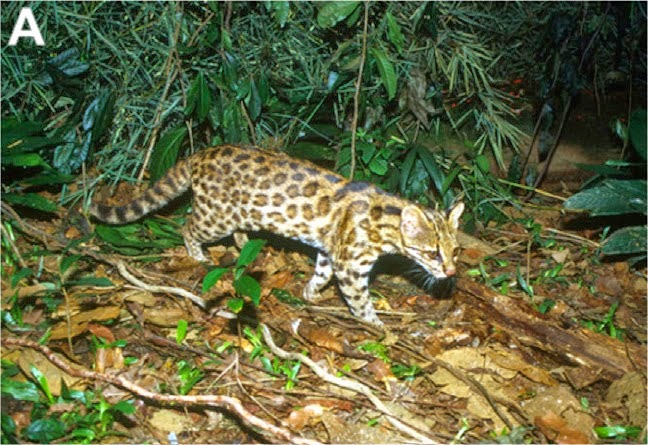
Leopard Cats of the genus Leopardusare small Felids found in Central and South America. There are at least seven species, all thought to be descended from a single population that migrated from North America during the Great American Biotic Interchange that...


Stories of Big Cats sighted, or sometimes killed or captured in the British countryside have been popular in the national press for a long time, and modern folklore often postulates the existence of a permanent population of such animals within the UK. Since the implementation of the 1976 Dangerous Wild Animals Act a number of large Felids have been captured...

Lions (Panthera leo) are large, charismatic predators currently found in Africa and India, with a fossil record that includes areas of northern Eurasia and North America. Lions outside their current range persisted in North Africa (Barbary Lions) and the Middle East...

Follow Sciency Thoughts on Facebook.